

Menu

Uber Clone vs inDrive Clone: Which Ride-Hailing App Should You Launch?

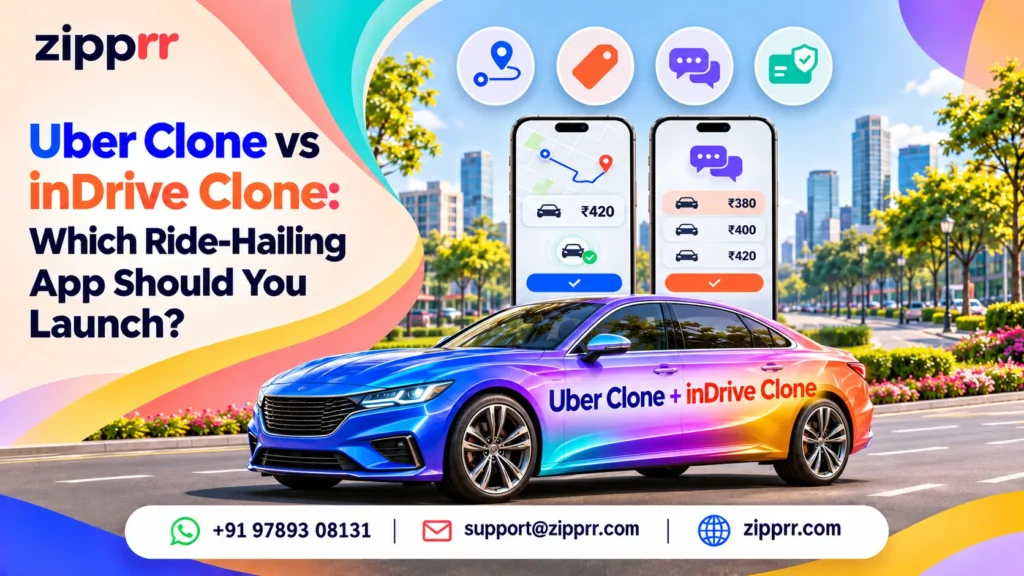
Uber clone vs inDrive clone: fixed fare and fare bidding ride-hailing apps compared

Table of Contents

The Uber clone vs inDrive clone choice comes down to one thing: who sets the price. An Uber clone gives riders a fixed, upfront fare and assigns drivers automatically. An inDrive clone lets riders name a fare, and drivers accept, decline or counter it. Both Zipprr scripts start at $490, so the real decision is your market, not your budget.

Choose an Uber clone ifPrice certaintyYour riders expect a price before they book, and you want fast automatic dispatch for volume.
VS
Choose an inDrive clone ifPrice controlYour riders and drivers want control over price, and you need to win driver supply with fair pay.
$490 / $890Standard (web only) or Pro (adds Android and iOS apps and app store submission), for both products
100% source codeIncluded in both, with 90 days of free support
7-day refundIncluded in both

What Is the Real Difference Between an Uber Clone and an inDrive Clone?

An Uber clone script is a ride-hailing app built around platform-set pricing. The app calculates the fare, shows it before the ride, and matches the nearest driver. Riders get certainty. Drivers get steady requests.

An inDrive clone script is a ride-hailing app built around fare bidding. The rider proposes a price. Nearby drivers then accept, decline or counter it, and the rider picks an offer. In one 2023 report on inDrive's US launch, drivers were not penalized for declining orders.

Both are independently developed solutions. Zipprr is not affiliated with Uber, inDrive or any other brand named here. Therefore, you build your own brand, your own rules and your own driver community on top of the code.
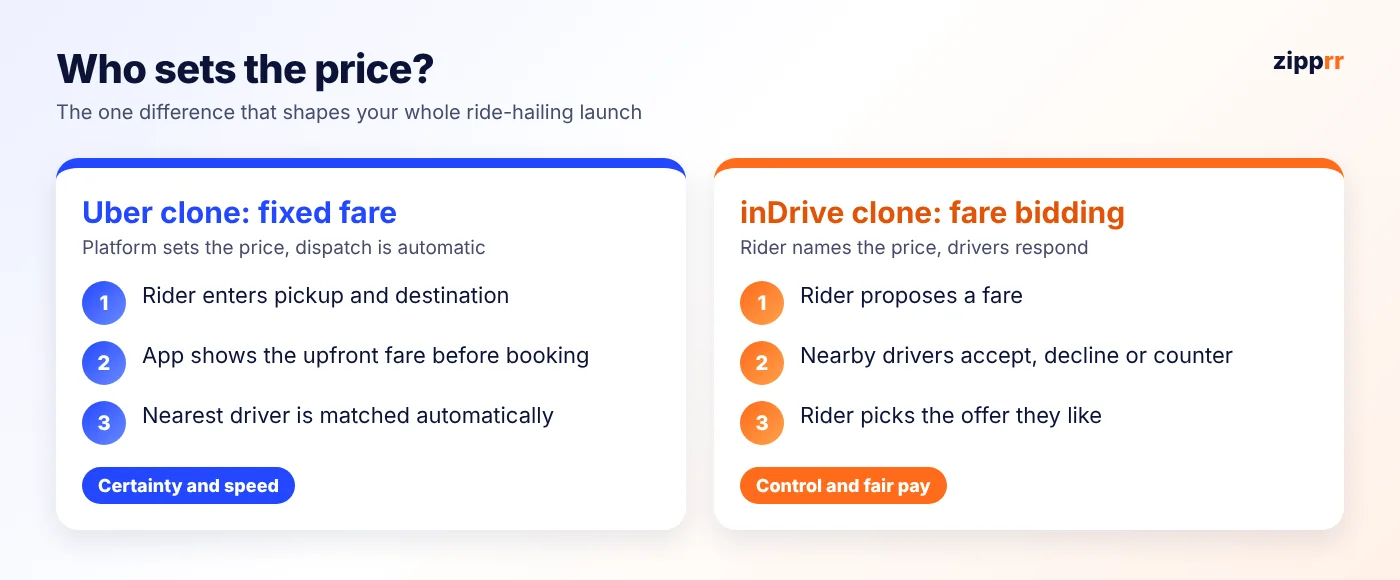
Uber clone vs inDrive clone: fixed fare with automatic dispatch compared with rider fare bidding

Uber Clone vs inDrive Clone: How Do They Compare Side by Side?

The table below uses only what each live Zipprr product page lists on November 17, 2026.

RoundZipprr Uber CloneZipprr inDrive Clone
Fare modelPlatform-calculated fare, shown upfrontRider proposes a fare, drivers accept, counter or skip. Fixed-fare mode also listed
Price controlPricing management and promotions in the admin panelBidding on or off per city, with commission set per city
Features listedPassenger app 20, driver app 18, admin 20Vehicle types, scheduled rides, intercity routes, SOS, trip code, trip sharing, fleet owner panel
PaymentsPayments and walletsWallet, card and cash, with 15+ gateways
PlansStandard $490, Pro $890Standard $490, Pro $890
Mobile appsPro onlyPro only
Go-live7 business days from branding and requirements7 business days from branding and requirements

Note that the Zipprr inDrive Clone page lists bidding and fixed-fare modes under Pro. Ask us to confirm exactly what the web-only Standard plan ships before you buy. Meanwhile, the Zipprr Uber Clone page lists a React Native, Node.js, Socket.io and Next.js stack.

Uber Clone vs inDrive Clone: How Does Fare Bidding Change Rider and Driver Behaviour?

Bidding moves the price conversation into the app. In 2026, Oxford Economics analysed surveys of about 5,000 drivers and 3,000 riders in seven emerging markets, in partnership with inDrive. Because inDrive is a partner, treat the study as company-linked.

Even so, the findings show what bidding can do. About 75% of inDrive trips in those countries involved negotiated fares. In Latin America, 64% of riders and drivers said they completed more trips because they could negotiate. You can read the coverage in the Zag Daily report on the Oxford Economics study.

Bidding also has a cost. Fares can drift down, and drivers may decline low offers, so some requests wait longer. In contrast, a fixed fare removes the wait and the haggling. However, it gives riders and drivers no say when the price feels wrong.

Not sure which model your city needs?

Send us your city on WhatsApp and we will point you to the better fit, with both demos side by side.

Uber Clone vs inDrive Clone Revenue: A Worked Example

Please note these numbers are examples to show the method, not forecasts. Replace them with your own.

Example city, one monthFixed fare (Uber clone style)Bidding (inDrive clone style)
Completed rides1,0001,200 (assumes 20% more rides)
Average fare$20$20
Gross fares$20,000$24,000
Commission you set20%10%
Your monthly revenue$4,000$2,400
Fixed fare$4,000
Bidding$2,400

The lesson of this Uber clone vs inDrive clone example is simple. At half the commission, bidding needs about twice the rides to match the same revenue. Therefore, a bidding app is a volume and supply bet. It can win drivers with fair pay, but it pays you less per ride on day one.

In reporting on its Miami launch, TechCrunch noted that inDrive's usual commission is about 10% of each ride, compared with 25% at Uber and Lyft. Zipprr's inDrive Clone lets you set commission per city, so you choose your own rate.

The Zipprr Fare Model Fit Test: Uber Clone or inDrive Clone?

We use a five-question Uber clone vs inDrive clone test with founders. Answer each row for your own city, then count which column fits more.

1. How do riders pick a ride?

2. How do drivers feel about commissions?

3. What does your target segment value?

4. How are fares treated by local rules?

5. How big is your driver pool?

Answer each row for your own city. Your result appears here.

Mostly left means start with an Uber clone. Mostly right means start with an inDrive clone. A mixed result means you can start with the inDrive Clone and use its fixed-fare mode in cities that prefer upfront pricing, then switch bidding on where it helps.

Uber Clone vs inDrive Clone in the United States: Which Fits Better?

Both sides of the Uber clone vs inDrive clone choice exist in the US today. For example, inDrive launched its bid-based app in Miami in July 2023, according to TechCrunch. So bidding is not blocked by default.

However, rules differ by state and city. For instance, New Hampshire's ride-app statute (RSA 359-U:5) says the company must disclose the fare or the fare calculation method to the rider. A clear bid screen and a fare estimate help in that kind of rule. Always speak to a local transport attorney about insurance, permits and driver checks before launch.

If you want a simpler start, the Zipprr taxi booking script and the Lyft clone use fixed fares. Founders who like the low-commission story can also look at the Bolt clone. For build costs, read our Uber clone cost, revenue and AI features guide.

How Do Driver Supply and Rider Trust Differ Between an Uber Clone and an inDrive Clone?

Every ride-hailing launch is a two-sided problem. Without drivers, riders wait. Without riders, drivers leave. In the Uber clone vs inDrive clone decision, the fare model changes how you solve each side.

With a fixed fare, you solve driver supply through incentives, bonuses and a commission drivers accept. Riders trust the app because the price is known before they book. The weak spot is the driver who feels the fare is too low and has no way to say so.

With bidding, drivers get a voice in the price, which can make your platform attractive to experienced drivers who feel squeezed elsewhere. Riders may feel they are getting a better deal. The weak spot is consistency: a rider who gets three low-quality offers may lose patience. Therefore, plan clear rules for cancellations, ratings and offer limits, whichever model you pick.

What Should You Configure on Day One in Either App?
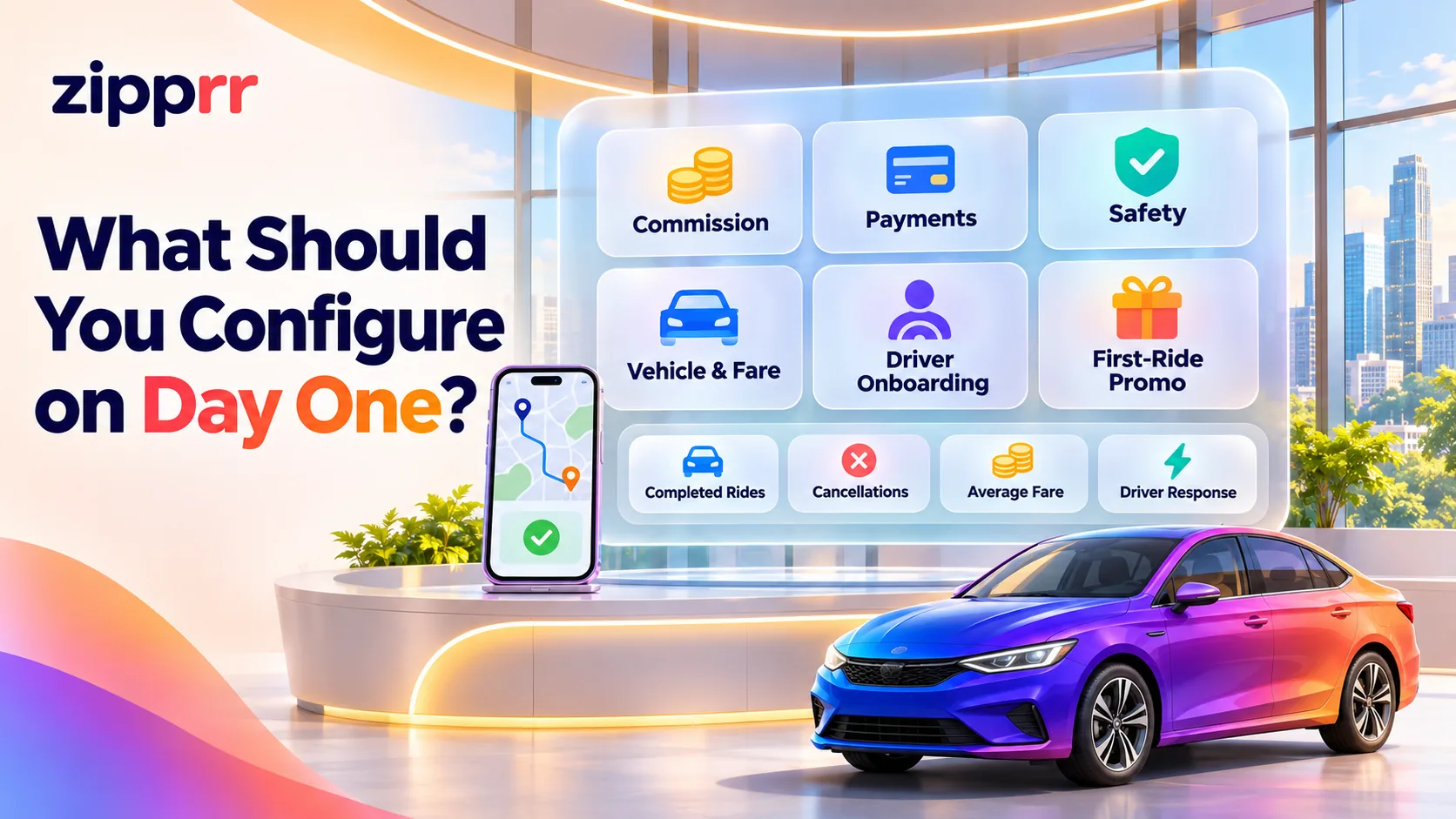
What to configure on day one in an Uber clone or inDrive clone: commission, payments, safety, vehicle and fare, driver onboarding and first-ride promo

The same launch checklist works for both sides of the Uber clone vs inDrive clone choice. It keeps your first month focused on proof, not polish.
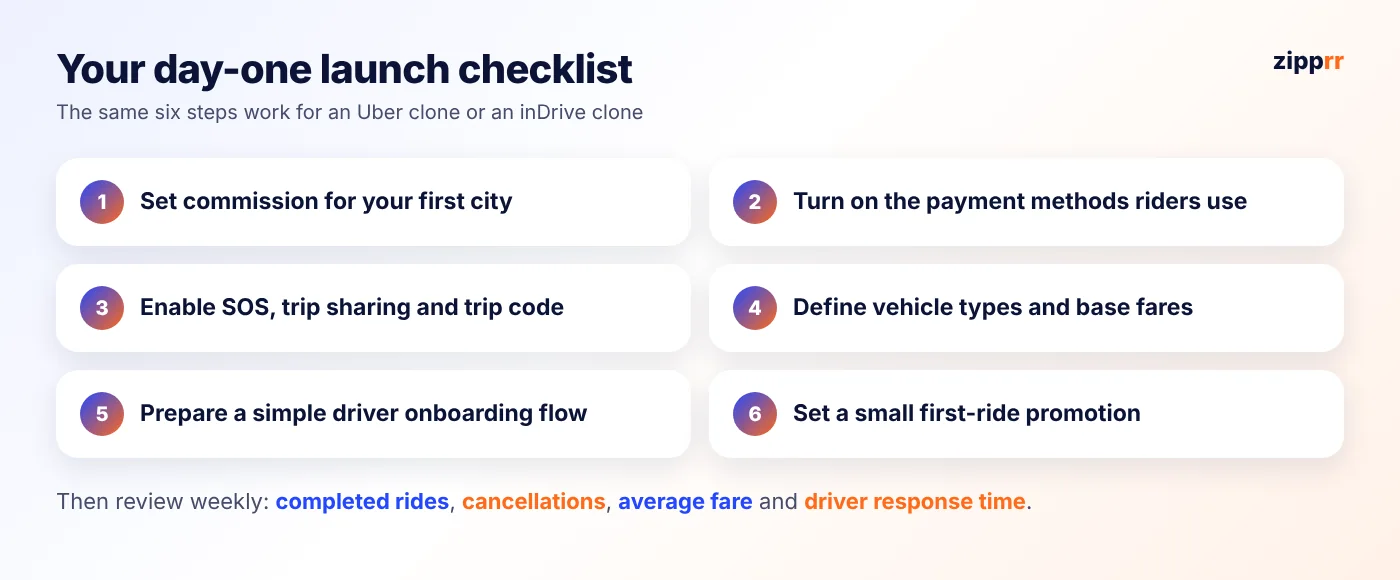
Day-one launch checklist for a ride-hailing app: commission, payments, safety tools, vehicle types, driver onboarding and a first-ride promotion
  • Set your commission for your first city and write it down for drivers in plain words.
  • Turn on the payment methods your riders actually use, such as cash, card or wallet.
  • Enable safety tools, including SOS, trip sharing and the trip code where your plan lists them.
  • Define vehicle types and base fare rules, even if bidding is on.
  • Prepare a simple driver onboarding flow with document checks that match your local rules.
  • Set a small promotion for first-time riders so you can measure real demand.

Afterwards, review the admin dashboard weekly. Look at completed rides, cancellations, average fare and driver response time. Those four numbers tell you whether your fare model is working.

What Mistakes Do New Ride-Hailing Founders Make with Fare Models?

Most early mistakes in the Uber clone vs inDrive clone decision are not technical. They are decisions made before talking to drivers.

First, founders copy a famous app's commission without checking local driver costs such as fuel, insurance and vehicle payments. Second, they launch in a whole country instead of one city, so supply and demand never meet in the same place. Third, they skip the legal check and discover permit or insurance rules after launch. Finally, they treat the script as the whole business. The code gets you live in days. The driver community, the brand and the local rules take longer, so give them more of your time.

How Should You Test an Uber Clone and an inDrive Clone Before You Spend More?

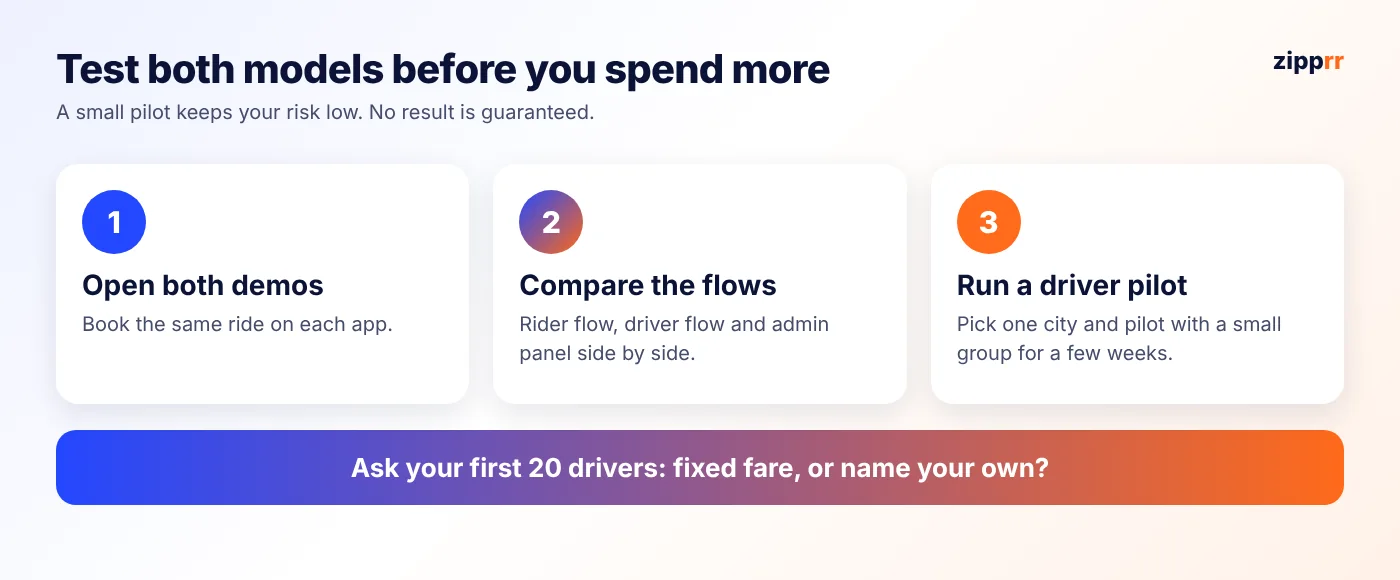
First, open both demos and book the same ride on each. Second, compare the rider flow, the driver flow and the admin panel. Third, pick one city and run a small driver pilot for a few weeks.

Also, ask your first twenty drivers one question: would you rather take a fixed fare or name your own? Their answers beat any guess. No result is guaranteed, but a small pilot keeps your risk low.
Three-step pilot to test an Uber clone and an inDrive clone: open both demos, compare the flows, run a driver pilot

Compare both demos side by side

Book a free demo and we will walk through the rider flow, driver flow and admin panel of both scripts in this Uber clone vs inDrive clone comparison, or message us on WhatsApp or email.

Frequently Asked Questions About Uber Clone vs inDrive Clone

What is the difference between an Uber clone and an inDrive clone?

An Uber clone uses a fixed, upfront fare calculated by the platform, with automatic driver matching. An inDrive clone uses fare bidding: the rider proposes a price, and drivers accept, decline or counter it. Zipprr offers both, and each starts at $490 with 100 percent source code.

Which is better for a taxi startup, an Uber clone or an inDrive clone?

It depends on your city. Choose an Uber clone for predictable pricing and fast dispatch. Choose an inDrive clone where riders like to negotiate and drivers want fairer pay. Run the five-question fit test in this guide, then pilot one city before you scale.

How does an inDrive clone make money?

The operator earns a commission on each completed ride. With Zipprr's inDrive Clone, you set commission per city. TechCrunch reported in 2023 that inDrive's usual commission was about 10 percent. Your own rate is your choice, so test it against driver supply and rider demand.

How does fare bidding work in a ride-hailing app?

The rider enters a pickup, a destination and a proposed fare. Nearby drivers can accept it, decline it or counter with another price. The rider then chooses an offer. Zipprr's inDrive Clone lets you switch bidding on or off per city, with a fixed-fare mode available too.

Can I run fixed fares and bidding in one app?

Zipprr's inDrive Clone page lists both bidding and fixed-fare modes, with bidding switchable per city. That lets you offer upfront pricing in one city and bidding in another. Because plans differ, confirm which mode ships in Standard and which in Pro before you buy.

Is an inDrive clone legal in the USA?

Building a bid-based ride app is legal when it uses your own brand and follows local rules. inDrive itself launched in Miami in 2023. However, states regulate ride apps differently, including fare disclosure, insurance and driver checks. Speak to a local transport attorney before you launch.

Which costs more, an Uber clone or an inDrive clone?

On Zipprr, they cost the same: Standard is $490 for the web script and admin dashboard, and Pro is $890 and adds Android and iOS apps with app store submission. Hosting, maps, payments, permits and driver incentives cost the same on either model.

Do I need the Pro plan for mobile apps?

Yes. Android and iOS apps and app store submission are exclusive to the $890 Pro plan on both products. Standard at $490 is web only. Apple and Google also charge their own developer fees if you publish apps, and store review time is set by them.

How long does it take to launch a ride-hailing app with Zipprr?

Both product pages list a go-live time of seven business days. The clock starts when Zipprr receives your branding and requirements. App store review by Apple and Google is separate and can add time. Permits and insurance may also set your real launch date.

Do I get the source code and ongoing support?

Yes. Both plans include 100 percent source code, 90 days of free support and regular updates. Zipprr sells the script as a one-time purchase with no per-ride fees to Zipprr. You still pay for hosting, maps, payment services and any developer you hire for custom changes.

Book Your Meeting

Let’s Talk! Book Your Meeting