

An Uber Clone lets a founder or fleet owner launch a fully branded ride-hailing business without having to build the underlying technology from scratch. Ride-hailing itself rebuilt urban transportation around one core idea: replace an uncertain wait for a taxi with a visible, priced, trackable transaction. Live location data, an upfront fare, cashless checkout, and a two-way rating system became baseline expectations everywhere, not just on the platforms that pioneered them. That baseline created an opening far bigger than any single company. Airports need dedicated pickup coordination. Regional taxi fleets need to compete on the same technical footing without handing their customer base to a global app. Businesses need transportation for staff that’s both accountable and easy to track. Every one of these needs the same underlying machinery: live GPS matching, digital payments, and dispatch logic, without any of them needing to build that machinery from zero.
That’s the opportunity Uber Clone software addresses directly. Instead of committing a year and a six-figure budget to rebuild dispatch technology that already exists and works, a founder, fleet owner, or transportation operator can license a proven version of it, brand it, and be operating a real ride-hailing business within days. This guide breaks down how the technology functions, what a realistic budget actually looks like, which business models it supports, and how to evaluate a vendor before committing capital.
The Evolution of Ride-Hailing
Traditional taxi dispatch relied on radio calls and manual guesswork, a dispatcher matching a caller to the nearest available driver with no way to confirm the car’s actual position or give a reliable arrival estimate. The only trip record was whatever a driver logged on paper, if anything.
Between 2010 and 2016, GPS-based dispatch and two-sided marketplace apps replaced that model entirely. The shift proved two things at scale: riders would pay for visibility into their ride, upfront pricing, and cashless checkout, and a commission-based business built on that technology could scale profitably across dozens of cities and countries.
Today we’re a step further, in a stage best described as platformization. The engineering that once demanded years of work and massive capital to solve- instant matching, secure payments, mutual accountability- is no longer sealed away inside one company’s infrastructure. It’s a known pattern, built and refined by many teams since, which is exactly why licensed Uber Clone platforms work: the hard engineering is already solved elsewhere. What separates one operator from another isn’t the underlying tech; it’s which city, which vehicle types, and which brand.
This also explains why ride-hailing today looks like a patchwork rather than one company owning everything. Wherever a global platform hasn’t built real density, or local rules favor homegrown ownership, or a niche like airport transfers or women-only rides goes unaddressed, locally branded operators on licensed technology step into that space.
What Is an Uber Clone?
Strip away the marketing language and an Uber Clone is simply this: pre-built ride-hailing software, one app for passengers, one for drivers, and a dashboard for whoever’s running the business, engineered to do what platforms like Uber do, that gets handed to an operator to brand and launch under their own name. Nobody’s copying Uber’s actual codebase here. It’s separately built software solving the same problem: connect a nearby driver to a waiting passenger fast, calculate what the ride should cost, move the payment securely, and let both people see what’s happening throughout the trip.
The real difference between licensing this kind of platform and building your own from nothing comes down to your starting line. Build from scratch, and day one looks like an empty code editor and a stack of requirements documents. License an Uber Clone, and day one looks like a working system that’s already handled real trips somewhere else, waiting to be reshaped around your city, your branding, your pricing rules. The parts most likely to break under pressure- matching drivers correctly when demand spikes, keeping payments reliable, making sure the driver app doesn’t crash mid-shift- have already been tested and fixed before you ever touch the product. Zipprr’s Uber Clone is a working example of exactly this: a complete, already-built platform sold as a single purchase rather than months of custom engineering.
How Uber Clone Works
Underneath the simple experience of “tap a button, get a ride,” three parties constantly exchange information: the passenger, the driver, and the dispatch logic between them. The moment someone requests a ride, the app pulls their GPS location and hunts for the closest free driver in the right vehicle type, landing a match within seconds. That driver accepts or passes, and once accepted, both phones show the same live map, each side watching the other move.
Pricing works one of two ways: a locked-in estimate shown before the ride starts, built from a base rate, distance, time, and any active surge, or a meter tracking the actual trip. Once the passenger arrives, payment fires automatically through whatever method’s stored: card, wallet, or cash where supported, and the transaction lands in the operator’s dashboard for bookkeeping.
None of that visible simplicity happens by accident. Behind it sits a location-tracking service watching every driver continuously, a matching system balancing wait times against fair driver workloads, a pricing engine that can shift on the fly, a notification layer keeping everyone updated, and a payments system handling not just successful charges but failures, refunds, and payouts. A licensed platform means all of that arrives finished and proven, leaving you to configure it rather than build it.
The Ride-Hailing Ecosystem
A platform worth calling production-ready isn’t one app; it’s a cluster of connected tools built for different people in the chain. Passengers get an app for booking, following the ride live, paying, and rating afterward. Drivers get their own for going online, accepting requests, navigating, and tracking earnings. A dispatcher’s panel lets staff step in when needed, reassigning a stuck trip or sorting a complaint. The admin dashboard is where the business runs: onboarding drivers, setting fares, watching the fleet on a live map, pulling reports. A fleet-management layer handles vehicle assignments and upkeep, and underneath it all, GPS and payment engines keep everything synchronized.
Each piece could technically stand alone, but the value is in how tightly they’re wired together: a fare estimate only works with live location data, a driver only gets paid correctly with accurate trip records, a pricing decision only makes sense with live dispatch numbers. That interdependence is exactly the part that’s brutal to get right from a blank slate
Essential Features
| Category | Rider-Facing | Driver-Facing | Admin-Facing |
|---|---|---|---|
| Booking | Ride requests, scheduled pickups, upfront fare quote | Accept or decline trips, turn-by-turn routing | Dispatch controls, manual reassignment |
| Safety | Live location sharing, emergency button, trip sharing with contacts | Live location sharing, emergency button | Real-time map of the whole fleet |
| Pricing | Discount codes, referral credit | Earnings breakdown per trip | Surge and zone-based pricing controls |
| Payments | In-app wallet, multiple payment options | Payout tracking | Commission reports, revenue analytics |
| Fleet | Choosing a vehicle category | Vehicle assignment | Managing categories and fleet-wide settings |
Industry Examples
The same core platform bends into very different businesses depending purely on how it’s set up. One operator might start with plain city rides plus airport pickups, since airports come with designated zones and flat rates both travelers and authorities tend to prefer over a meter. Once driver coverage is reliable, adding corporate accounts, centralized invoicing for companies wanting accountable staff transport, often comes next, and that revenue tends to stick around far better than one-off bookings. In a crowded downtown core, bike-based rides solve trips a car can’t finish quickly. And where a region already has scattered taxi operators, folding them under one branded platform builds supply faster than recruiting drivers one at a time.
Business Models You Can Launch
| Business Model | Best For | Margin Profile |
|---|---|---|
| Standard Taxi | General urban markets | Moderate |
| Bike Taxi | Dense, congested cities | Moderate-high |
| Airport Taxi | Cities with major airports | High |
| Corporate Transportation | B2B, business districts | High, contract-based |
| Luxury Chauffeur | Affluent urban markets | Very high per trip |
| Electric Taxi | EV-incentivized markets | Moderate |
| Women-Only Taxi | Safety-conscious markets | Moderate-high |
| Fleet Aggregation | Fragmented existing taxi supply | Moderate |
How Uber Clone Makes Money
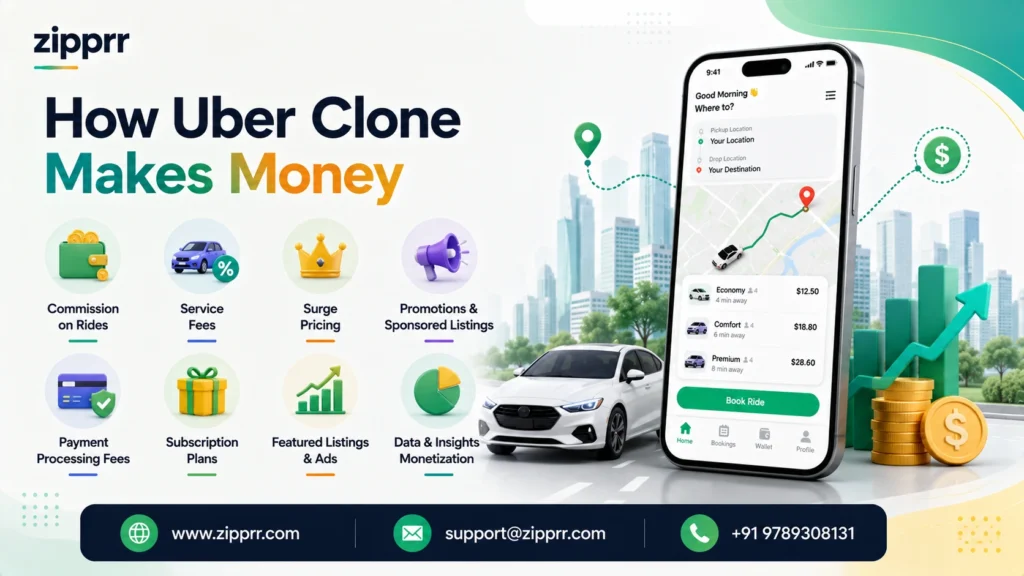
Most revenue here comes from commission, a cut of every completed fare, usually 15 to 30 percent depending on the market, and since it scales directly with trip volume, it’s the easiest number to forecast. Some platforms layer in subscriptions instead, a flat weekly driver rate rather than skimming each fare. Corporate accounts bring negotiated, recurring revenue that’s often the healthiest money on the books because it’s predictable. Convenience charges and cancellation fees round things out, covering premium bookings and protecting drivers from passengers who cancel after a car’s already en route.
The operators building the most durable businesses rarely lean on commission alone; they stack corporate revenue, convenience charges, and a fair cancellation policy on top of that base layer.
Technology Behind the Platform
Peel back the interface and a modern Uber Clone is built from several distinct technical layers. Mapping and location services turn an address into coordinates, calculate routes, and render the map both sides look at, directly shaping how accurate fare estimates and arrival times feel. Cloud infrastructure lets the same platform handle a handful of daily trips in a pilot city and, later, thousands at once across markets without a rebuild. Payment gateway connections plug into the financial rails needed to move money securely, often several at once for operators crossing borders. Identity checks protect everyone involved, particularly driver-side document verification and background checks. And the analytics built into the admin panel turn raw activity into decisions an operator can act on, where driver supply is thin, whether a pricing change is working.
Each layer represents real months of specialized engineering when built from nothing, with failure points that usually only surface once real traffic hits them. A licensed platform arrives having already absorbed those lessons elsewhere, before you ever go live.
Development Timeline
| Approach | Typical Timeline |
|---|---|
| Zipprr Uber Clone | As fast as 3 days |
| White-Label Uber Clone (market average) | 4–6 weeks |
| Basic Custom MVP | 2–3 months |
| Mid-Level Custom Build | 3–6 months |
| Enterprise Custom Build | 9–12+ months |
Cost of Building an Uber Clone
| Tier | Cost | Timeline |
|---|---|---|
| Zipprr Uber Clone | $490, one-time payment | As fast as 3 days |
| White-Label Uber Clone (market average) | $3,000–$15,000 | 4–6 weeks |
| Basic Custom MVP | $40,000–$60,000 | 2–3 months |
| Mid-Level Custom Build | $60,000–$120,000 | 3–6 months |
| Enterprise Custom Build | $120,000–$250,000+ | 9–12+ months |
The reason Zipprr’s price sits so far under what most white-label vendors charge comes down to the delivery model itself: the operator receives the actual source files at purchase and handles configuration with their own team, rather than paying for a drawn-out custom implementation project. That’s the setup that makes a 3-day turnaround realistic in the first place: no recurring license charges, no cut taken from every ride booked, and 90 days of support included from the start. It fits operators who want to own the whole platform outright without signing up for a lengthy, expensive build process.
Whichever tier you go with, ongoing costs sit outside the license price: cloud hosting typically runs somewhere between $100 and $500 a month, third-party API and service fees can land anywhere from $5,000 to $30,000 a year, and general upkeep tends to cost roughly 15 to 20 percent of whatever the original build cost annually.
Comparison Table
| Dimension | Zipprr Uber Clone | Market-Average White-Label | Building from Scratch |
|---|---|---|---|
| Time to launch | 3 days | 4–6 weeks | 6–12+ months |
| Upfront cost | $490, one-time | $3,000–$15,000 | $40,000–$250,000+ |
| Source code | Full, delivered as-is | Varies by vendor | Full, by default |
| Post-launch support | 90 days free | Varies | Depends on in-house team |
| Payment model | One-time purchase | One-time or subscription | N/A |
Benefits of White-Label Uber Clone Software
Common Mistakes to Avoid
Picking the wrong vendor tends to be the costliest error, and the damage usually doesn’t surface until well after launch, once customization promises turn out overstated, or support isn’t there when something breaks. Ignoring how well a platform scales creates a painful rebuild exactly when the business is finally gaining momentum. Treating driver onboarding like a checkbox leads directly to higher turnover, since the platform is only as reliable as the drivers running on it. Weak marketing leaves a solid platform with no riders, since a working app alone never generates demand by itself. And skipping a growth plan,-no path for adding zones, vehicle types, or business accounts- means growth stalls wherever the launch happened to land.
Buyer's Checklist
Before signing with any vendor, get clear answers on these:
- Does the platform hold up under a real, hands-on demo, not just a scripted walkthrough?
- What exactly is bundled into the base price, and what gets billed separately later?
- Is the source code actually handed over, and is it documented, usable, and open to being modified by a developer you choose?
- How many operators are genuinely running this platform in production right now, and can you talk to one of them?
- Which payment gateways and languages come ready out of the box versus needing custom work?
- How long does free support last before it converts into a paid add-on?
- Can vehicle categories, pricing, and branding all be adjusted without needing a full rebuild?
- Has the vendor kept pace with Apple and Google’s constantly shifting app store rules?
Why Businesses Choose Zipprr's Uber Clone
By the time most operators have compared enough vendors, they’ve narrowed the field down to the ones with a real, checkable track record, and Zipprr’s Uber Clone tends to survive that filtering because it’s built around what actually matters at that stage.
The price is a flat $490, paid once, with nothing recurring afterward and no cut taken out of every ride, a fraction of what most white-label vendors charge. Setup can wrap in as little as three days. The source files hand over as-is at the point of purchase, so either the operator’s own team or an independent developer they bring in can inspect, adjust, or extend the platform without staying dependent on Zipprr indefinitely. And 90 days of support come included from day one, covering exactly the stretch of time when unexpected issues tend to surface once real trips start happening.
What’s included: native apps for iOS and Android on both the rider and driver side, a browser-based admin panel, and a separate panel for fleet owners, plus a live map of the fleet, pricing controls by city and zone, and revenue reporting built in from the start. None of this removes the actual work of running the business, finding drivers, getting the word out to riders, but it takes the technology risk off the table entirely.
Conclusion
Ride-hailing reset the baseline for what “acceptable” transportation technology looks like, and that shift produced a business pattern that’s now well understood, not something a new entrant needs to reinvent. An Uber Clone gives an operator that same technological foundation, configurable and ready to brand, capable of going live in days instead of the better part of a year.
For founders and operators evaluating a branded ride-hailing launch, the most useful next step is reviewing the platform directly rather than continuing to compare specs on paper. Explore Zipprr’s Uber Clone to see what a $490, three-day-delivery, fully-owned platform includes before committing to a custom build.
Ready to Launch Your Ride-Hailing Business?
Frequently Asked Questions
What is an Uber Clone?
How much does an Uber Clone cost?
Most white-label platforms fall between $3,000 and $15,000, while fully custom builds run anywhere from $40,000 to $250,000. Zipprr’s Uber Clone breaks from that pattern entirely: a single $490 payment, source files included, no recurring charges, and setup possible within three days.
What ongoing costs should I still budget for?
Regardless of which vendor you pick, plan for cloud hosting (roughly $100 to $500 monthly), third-party API and service costs ($5,000 to $30,000 a year), and general maintenance (about 15 to 20 percent of the original build cost annually). These apply whether you went custom or licensed.
Do I own the source code?
That depends entirely on who you buy from. Zipprr hands over the actual source files at purchase, meaning full ownership and the freedom to bring in whichever developer you want for future changes, rather than staying locked to one vendor indefinitely.
How long does it take to launch?
Typical white-label platforms take 4 to 6 weeks to get live. Zipprr’s platform can be ready in as little as three days, noticeably faster than what’s standard elsewhere in the category.
Can I customize the branding and features?
Yes. You should expect full control over icons, colors, and in-app messaging, along with adjustable vehicle categories, pricing structures, service areas, and language support. Platforms that hand over real source code give you the most room to customize beyond what a settings panel alone allows.
Can I launch in multiple cities?
Yes, most platforms today support adding service zones without limit, so you can prove the model works in one city first and expand from there, rather than needing entirely separate software for each new market.
What ongoing support is included?
Zipprr bundles in 90 days of free support after launch, covering the window when most real-world issues tend to show up, before any further help becomes a paid service.
Can I support multiple vehicle types?
Yes, running sedans, SUVs, premium vehicles, and bike taxis on one platform is standard, not a premium add-on, which lets an operator serve different customer segments and grow their offering over time.
How do drivers get paid?
Usually through per-trip earnings, the fare minus commission, paid out either right after the trip or on a set schedule, with the admin dashboard giving the operator full control over timing and commission rates.
Is Zipprr's Uber Clone scalable?
Yes. It supports unlimited service zones, multiple languages, and more than a dozen payment gateways, letting operators grow into new markets without running into a hard limit built into the license.