

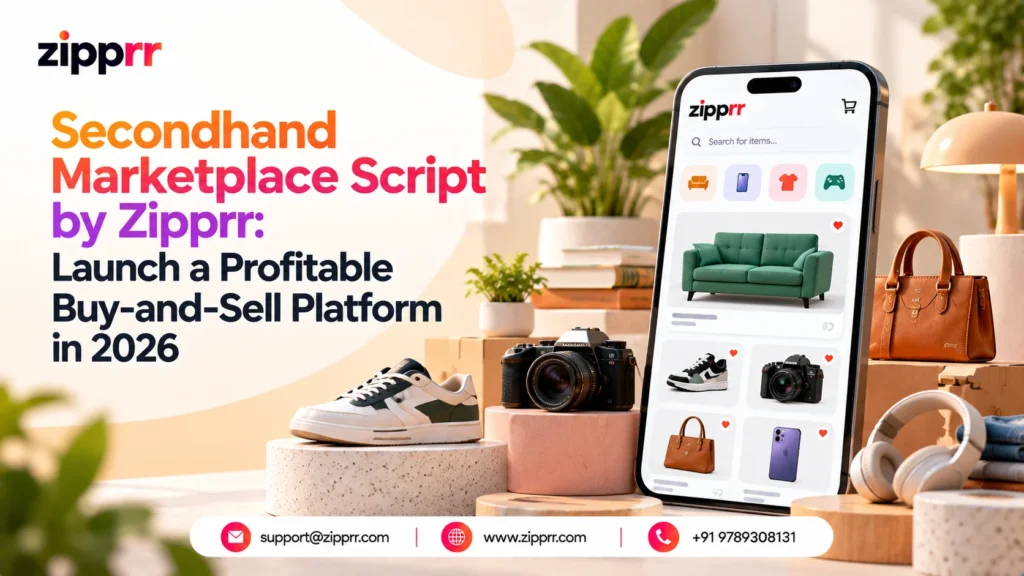
Resale is no longer a side hustle. Buyers now treat used goods as a first choice, not a fallback, and the global secondhand and resale market is projected to reach $350 billion by 2028, according to ThredUp’s Resale Report. That kind of shift creates real room for a new secondhand marketplace script to carve out its own niche, whether the focus is fashion, electronics, furniture, or a general buy-and-sell community.
Zipprr built its Secondhand Marketplace Script as a ready-made, white-label answer to that demand. It pairs classifieds-style listing flexibility with the ecommerce mechanics a real transaction actually needs: payments, seller verification, and in-app chat are all built in, so a buyer and seller can close the entire deal without ever bouncing off the app. If your business model leans purely toward simple listings with no in-app transactions, it’s worth comparing this product against Zipprr’s Letgo Clone classifieds script, which is built for that lighter use case instead.
This guide is written for founders evaluating a ready-made platform instead of custom development, and for anyone comparing Zipprr against building an app from scratch. Whether the plan is a niche fashion resale app or a general buy-and-sell platform for a whole city, the same core decision points apply: total cost, feature depth, and how quickly the platform can start generating revenue.
This article walks through why the resale business model works right now, what actually ships inside Zipprr’s script, and exactly what it costs alongside the revenue streams a buyer can turn on from day one. Every figure below was checked directly against Zipprr’s live product page before writing.
Why a Secondhand Marketplace Is One of the Smartest Online Businesses to Start Right Now
Three consumer trends are converging at once, and each one pushes people toward buying and selling used goods. Household budgets are tighter, sustainability concerns are mainstream rather than niche, and younger shoppers increasingly see thrifted and resold items as a style choice rather than a compromise.
A secondhand marketplace also tends to be cheaper to launch than a new-goods ecommerce store. There’s no inventory to purchase upfront, no warehousing cost, and supply grows organically as sellers list their own items. That lowers the founder’s financial risk considerably compared to a traditional retail model.
Customer acquisition also tends to work differently, and more favorably, for resale platforms. Every listing a seller shares with friends or posts on social media acts as free distribution for the marketplace itself, something a store selling new inventory rarely gets without paying for ads. That built-in word-of-mouth effect is one reason resale marketplaces can grow a local user base faster than their marketing budgets alone would suggest.
This business model fits a wide range of niches, including:
- Fashion and apparel resale, covering pre-loved clothing, shoes, and accessories
- Electronics and gadget resale, where buyers want verified, tested used devices
- Furniture and home-goods resale, a category with high shipping friction that rewards strong local search
- Campus or hyperlocal resale communities built around a university, city, or neighborhood
- General buy-and-sell marketplaces that blend classifieds with real e-commerce checkout
Every one of those niches runs on the same underlying platform. Founders who want to see exactly how it’s built, rather than take a features list on faith, can review the Secondhand Marketplace Script product page directly and map it against their own category before deciding.
Local competition also matters less than most founders assume going in. A resale marketplace can start hyperlocal, prove the model in a single city or category, and expand only once trust and supply are established. That staged approach removes the pressure to compete nationally from day one, which is exactly the kind of risk a smaller, focused launch is meant to avoid.
Borders are less of a barrier than they used to be, too. Multi-language and multi-currency support ships with the platform from day one, so a founder can push into a second city or an entirely different country without rebuilding anything, which pushes the business’s long-term ceiling well past what a single-market classifieds board could ever reach.
What separates a true marketplace platform from a basic classifieds board is trust infrastructure. A classifieds app hands buyers a phone number and hopes for the best. A proper resale marketplace software platform adds seller verification, in-app messaging, and built-in payment processing, which keeps transactions on-platform and gives the operator visibility into what’s actually selling. Founders who want a rental-first spin on the same reuse economy, rather than outright resale, might instead look at Zipprr’s P2P Rental Script, which applies similar trust and discovery mechanics to renting instead of selling.
Every new marketplace also faces a handful of predictable early risks worth planning for before launch rather than after:
- Thin initial supply, since a brand-new marketplace has no listings until sellers join
- Trust gaps between strangers transacting with each other for the first time
- Category sprawl, where too many product types dilute search relevance for buyers
- Underpriced monetization, where fees are set too low to cover payment processing costs
Zipprr’s built-in seller verification, trust badges, and ratings system exist specifically to close the trust gap during that early phase, while flexible category management lets an operator start narrow and expand deliberately instead of launching too broad on day one.
See the Secondhand Marketplace Script in Action
Reading a feature list only tells part of the story. Watching the seller flow, the admin dashboard, and the payment system work together live makes the decision much easier. Book a free walkthrough at zipprr.com/schedule-free-demo, message the team directly on WhatsApp at wa.me/919789308131, or email [email protected] with your business idea for a straight answer on fit and timeline.
What's Inside Zipprr's Secondhand Marketplace Script
Zipprr’s platform runs on a modern, verified technology stack rather than a dated template. The mobile apps are built on Flutter for both Android and iOS, the backend runs on Laravel, the admin dashboard is built in React, and data is stored in MySQL. Real-time features like chat run through Firebase, location discovery uses Google Maps, and hosting is designed for AWS infrastructure.
Both the mobile apps and the website run against the same backend and admin panel, so sellers who prefer listing from a laptop and buyers who browse mainly on mobile are served from one consistent catalog inside the same Secondhand Marketplace Script package, rather than two systems that can drift out of sync with each other.
The product ships with twelve core features that cover the full buyer and seller journey:
- Multi-category listing management for organizing inventory across unlimited categories
- In-app chat powered by WebSocket connections for real-time buyer-seller conversations
- GPS-based product discovery through Google Maps, so buyers find listings near them
- Multi-payment gateway support, including Stripe, PayPal, Razorpay, and cash on delivery
- Seller verification and trust badges to build buyer confidence before a sale
- Advanced admin analytics dashboard for tracking listings, sales, and platform activity
- Multi-language and multi-currency support for launching beyond a single region
- Listing boost and featured ad placements that sellers can purchase for extra visibility
- Saved searches and watchlist functionality so buyers get notified about relevant new listings
- Price negotiation built directly into the chat flow, matching how resale actually works
- Push notifications for messages, price drops, and saved-search matches
- Ratings and review system to reinforce accountability on both sides of a transaction
For a broader look at how different secondhand and classifieds clone options stack up feature-for-feature, Zipprr’s own guide to building a successful secondhand marketplace compares five clone-based approaches side by side.
In practice, GPS-based discovery and in-app chat work together to shorten the path from browsing to a completed sale. A buyer searching for a used couch nearby can message the seller instantly, negotiate a price through the built-in negotiation tool, and arrange pickup without ever leaving the app, which keeps the transaction visible to the platform instead of drifting into a phone call or an outside messaging app.
The admin analytics dashboard also matters more than most founders expect in the early months. Knowing which categories get the most searches, which listings actually convert into sales, and whether boosted listings are paying off lets an operator adjust pricing and promotion decisions using real data instead of guesswork.
Because payment data flows through established processors like Stripe, PayPal, and Razorpay rather than a custom-built payment system, the platform inherits their compliance and fraud-monitoring infrastructure instead of requiring the operator to build that trust layer from the ground up.
Beyond that core set, the script also includes a digital wallet, a built-in currency converter, RTL language support for right-to-left markets, an optional bidding system for auction-style listings, an image watermark system to protect seller photos, and AWS S3 integration with smart caching for fast image loading at scale.
Every purchase includes 100% source code ownership, and the platform is fully white-label, meaning no Zipprr branding appears anywhere in the buyer-facing app. There’s no ongoing revenue share owed back to Zipprr on anything the marketplace earns after launch. As the platform grows past a single resale category, some founders eventually migrate toward a broader storefront model like Zipprr’s Amazon Clone ecommerce marketplace script, which supports full multi-vendor retail alongside resale.
Secondhand Marketplace Script Pricing and How You'll Actually Make Money
Zipprr offers two one-time pricing tiers for the Secondhand Marketplace Script, with no recurring license fee and no per-transaction royalty owed to Zipprr itself. Both tiers include the website source code, the admin panel source code, website installation, Android and iOS apps, free app store submission, 90 days of expert technical support, and lifetime updates. Zipprr also backs the purchase with a 100% refund within 7 days if the buyer isn’t satisfied.
Choosing between the two plans usually comes down to timeline and scale rather than missing features, since both tiers ship with the same core platform. Founders who already have a multi-city rollout planned, or who simply want the configuration Zipprr’s own team most frequently deploys, tend to pick Pro. A first-time operator testing a single city or category is often better served starting with Standard and reinvesting the savings into early marketing and seller acquisition.
The 7-day refund window matters because it gives a buyer real time to explore the admin panel and mobile apps hands-on before committing, rather than relying only on a sales page. The 90-day support window is also worth planning around directly: it’s meant to cover launch and stabilization, not to function as permanent free maintenance, so budgeting for ongoing support or an in-house developer once that window closes is a reasonable expectation to set early.
Launch itself is designed to move fast, on a 7-business-day timeline:
- Day 1: Source code delivery to the buyer
- Days 1 to 2: Server provisioning and environment setup
- Days 2 to 3: Backend installation and configuration
- Days 3 to 5: Mobile app store submission for iOS and Android
- Days 5 to 7: Final configuration, testing, and go-live
The table below combines both pricing tiers and the four monetization paths built into the script, so you can see cost and revenue potential side by side.
| Category | Name | Price / Range | What It Includes or How It Works | Best For |
|---|---|---|---|---|
| Pricing Plan | Standard Plan | $490 one-time | Website and admin source code, website installation, Android and iOS apps, free app store submission, 90 days support, lifetime updates | Founders launching a single-region resale marketplace |
| Pricing Plan | Pro Plan | $890 one-time | Zipprr's most-selected package, built on the same full feature set and support terms as Standard | Founders who want the recommended, most-deployed configuration |
| Revenue Stream | Transaction Commission | 3% to 10% per sale | A percentage fee automatically deducted when a buyer pays through Stripe, PayPal, or Razorpay | Ongoing, recurring revenue tied to platform activity |
| Revenue Stream | Featured Listing / Boost Fees | $2 to $20 per listing | Sellers pay a one-time fee to push their listing higher in search results and category pages | High-frequency micro-revenue from active sellers |
| Revenue Stream | Seller Subscription Plans | $9 to $49 per month | Recurring plans that unlock unlimited listings, reduced commission rates, or priority placement | Predictable monthly recurring revenue from power sellers |
| Revenue Stream | Banner and Display Advertising | $100 to $500 per month | Ad space sold to brands, local businesses, or affiliate partners across the app and website | Passive revenue that costs sellers nothing directly |
Most operators don’t rely on a single revenue stream, and most don’t turn every stream on at once either. A common sequencing pattern starts with a modest transaction commission as the default source from day one, since it needs no extra seller adoption to work. Listing boosts tend to get added once sellers start asking how to get more views on their own. A seller subscription tier usually follows once a segment of repeat sellers is listing often enough to want unlimited posting, and banner advertising is typically held back until traffic is consistent enough to interest outside advertisers.
If your audience is more interested in monetizing skills or services than physical goods, Zipprr’s Freelancer Script applies a similar built-in monetization approach to a gig-based marketplace instead.
Final Thoughts: Is Zipprr's Secondhand Marketplace Script Right for You?
A ready-made secondhand marketplace script makes the most sense for founders who want to validate a resale business quickly without spending months on custom development. Because the admin panel supports unlimited customization of categories, attributes, and settings, the platform can be reshaped around a specific niche after launch without touching the underlying code.
This script is less likely to be the right fit for a founder who needs a highly bespoke workflow unlike anything in the existing feature set, or whose entire business model depends on a proprietary matching algorithm found nowhere else. Those cases usually call for custom development from the ground up rather than a pre-built platform, and it’s worth saying so plainly rather than pretending one product fits every scenario.
Before committing to any resale platform vendor, it’s worth confirming a few specifics directly with their team:
- Whether source code ownership is full and unrestricted, or limited in some way
- What happens after the included support window ends, and what ongoing maintenance costs
- Which payment gateways are supported in your target launch country
- Whether the refund policy is time-boxed and clearly stated in writing
Zipprr answers all four of those plainly: full ownership, lifetime updates with 90 days of active support included, multi-gateway payment support out of the box, and a 7-day refund window. Founders exploring adjacent local-service opportunities alongside a resale marketplace sometimes pair it with a services layer like Zipprr’s TaskRabbit Clone on-demand services script, since resale buyers often also need delivery, repair, or installation help for what they’ve just bought.
The resale economy isn’t slowing down, and a platform that combines classifieds-style flexibility with real ecommerce trust features is well positioned to capture that demand for years to come.
Get a Custom Quote Before You Buy
Every secondhand marketplace business has different volume expectations, category mixes, and monetization priorities, so pricing questions rarely have a single right answer. Schedule a free walkthrough at zipprr.com/schedule-free-demo, send a message on WhatsApp at wa.me/919789308131, or write to [email protected] to confirm which plan and revenue setup fits your launch budget.