

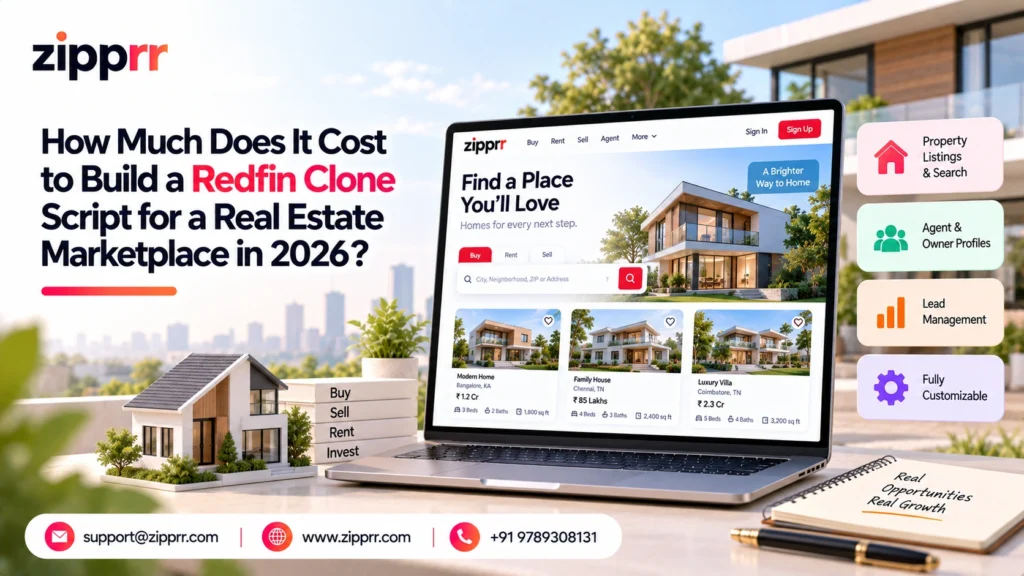
Building a Redfin clone script costs between $490 and $890 if you use a ready-made white-label solution, or anywhere from $25,000 to $150,000 if you commission custom development from an agency. A Redfin clone is a real estate listing marketplace that lets buyers search homes, agents manage listings, and admins run the platform, modeled on the workflow Redfin popularized but built as an independent product with no affiliation to Redfin itself. Zipprr’s own Redfin Clone is built around exactly this workflow, with the source code included from day one.
This question matters most to entrepreneurs, brokers, and startup founders who want to launch a property portal quickly without spending a year and six figures on software from the ground up. The right answer for you depends on your budget, your timeline, and how much control you want over the source code.
What Is a Redfin Clone Script and Who Actually Needs One?
A Redfin clone script is pre-built software that replicates the core functions of a real estate listing marketplace: property search, agent profiles, listing management, and lead capture. It is not affiliated with Redfin, Zillow, or any other real-world real estate brand. Think of it as a foundation you customize with your own branding, city coverage, and business rules.
We see three types of buyers for this kind of script:
- Brokers and agency owners who want their own branded portal instead of paying referral fees to third-party listing sites.
- Startup founders who have spotted a gap in a specific city, region, or property niche and want to move fast.
- Investors and agencies that build and resell real estate platforms to clients.
If you fall into any of these groups, a clone script saves you the months of backend engineering that a listing marketplace needs before it can even take its first search query.
The Real Estate Marketplace Market Is Still Growing Fast
Grand View Research puts the global PropTech market at $45.1 billion for 2025, with a climb to $115.0 billion forecast by 2033 on a 12.6 percent annual growth rate. Numbers like that tell us buyers, sellers, and agents keep pushing more of the property search and deal-closing process onto digital tools rather than pen-and-paper paperwork.
Brokerages are riding the same wave. Mordor Intelligence pegs the U.S. real estate brokerage market at $206.45 billion for 2025, climbing to $281.80 billion by 2031 at a 5.32 percent annual pace. Helping new, tech-forward brokerages grab a share of that segment is exactly what our own Realtor Clone was designed for.
Think about what makes Redfin worth studying here. It built a national presence on a discounted listing fee, roughly 2 percent standard and closer to 1 percent when certain conditions apply, and paired that pricing with everyday conveniences like a live seller dashboard, professional photos, and walk-through style property tours baked into the standard package instead of sold as extras.
A founder does not need Redfin’s budget to borrow that playbook. Pair a lower-friction fee model with a genuinely useful piece of software, and you have replicated the core idea for your own city or niche without the years of engineering it originally took to build.
Consumer habits back this shift up too. Most buyers now start hunting for a home from their phone or laptop long before they ever dial an agent, and they expect to filter, compare, and shortlist properties on their own terms first. Whichever platform makes that early research effortless usually wins the phone call once the buyer is finally ready to talk to someone.
Why Entrepreneurs Are Investing in Real Estate Listing Platforms Right Now
Real estate remains one of the largest purchase decisions most people make, which means the businesses that sit in the middle of that decision tend to be durable and profitable once they reach scale. A handful of reasons keep pulling founders toward this model in 2026.
- Low customer acquisition cost per transaction value. A single closed home sale can generate thousands of dollars in commission or lead-fee revenue, so even a modest number of monthly transactions can support a healthy business.
- Recurring agent relationships. Once an agent lists consistently on your platform, they tend to keep using it, creating a stickier revenue base than one-off consumer apps.
- Local market defensibility. National players like Zillow and Redfin cannot serve every regional or niche market with the same depth as a locally focused platform.
- Multiple monetization paths. Listing fees, featured placements, lead sales, and advertising can all run on the same platform at the same time.
How a Redfin-Style Real Estate Marketplace Actually Works
At a basic level, a real estate listing marketplace connects three groups of users on one platform:
- Buyers or renters search using filters like location, price range, property type, and number of bedrooms, then browse results on a map or list view. When something matches, they can save it, message the listing agent, or request a tour directly through the platform.
- Agents and property owners get their own dashboard to upload listings with photos, pricing, and property details, then track views, inquiries, and saved-listing counts for each property they manage. Ratings and reviews from past clients build their credibility on the platform over time.
- Admin teams approve or moderate new listings, manage agent accounts, configure commission or subscription rules, and pull analytics on traffic, lead volume, and top-performing markets.
Essential Features Every Real Estate Clone Script Should Include
Before you evaluate any script or development quote, it helps to know what the baseline feature set looks like. These are the features that make a listing platform functional on day one, and they show up in agent-focused scripts too, such as our own Realtor Clone.
| Feature | Why It Matters |
|---|---|
| Property listing management | Lets agents and owners add, edit, and remove listings with photos, videos, floor plans, and pricing in one place |
| Advanced search and filters | Covers location, price range, property type, and bedroom/bathroom count so buyers narrow results quickly |
| Interactive map-based search | Shows listings pinned to their exact location, now a default buyer expectation rather than a bonus |
| Agent profiles with ratings | Lets buyers see an agent's track record, reviews, and active listings before reaching out |
| Favorites and saved searches | Bookmarks listings and notifies users of new matches, keeping them coming back |
| Secure in-app messaging | Connects buyers and agents without exposing personal contact details too early |
| Push notifications | Alerts users to price drops, new matching listings, or replies to their inquiries |
| Admin analytics dashboard | Shows traffic sources, top-performing listings, and lead conversion for data-driven decisions |
Advanced Features That Help You Compete With Bigger Platforms
Once the essential feature set is in place, a set of advanced features can help a new platform stand out against larger, more established competitors. A similar advanced feature set already powers our Trulia Clone, so you can see these working together before you decide what to prioritize.
- AI-based property recommendations suggest listings based on a buyer’s search history and saved properties.
- Virtual and 3D property tours let buyers walk through a home online before requesting an in-person visit, shortening the sales cycle for serious buyers.
- Mortgage and affordability calculators help buyers understand what they can afford directly on the listing page, keeping them on your platform longer.
- Neighborhood insights and price trend data give buyers context on schools, walkability, and historical price movement.
- WhatsApp and live chat integration meets buyers where they already communicate, which tends to convert better than a contact form alone.
- Multi-language and multi-currency support opens the platform to international buyers and investors, the same approach we use in our own PropertyGuru Clone for cross-border markets.
- Agent verification badges add a layer of trust for buyers wary of fake or outdated listings.
Revenue Models: How a Real Estate Marketplace Actually Makes Money
A listing platform is not just a directory, it is a business with several realistic ways to generate revenue. Most successful platforms combine two or three of these rather than relying on just one.
- Agent subscription plans charge agents or agencies a recurring fee for platform access, listing slots, and lead tools.
- Featured listing fees let agents pay extra for top placement in search results or on the homepage.
- Lead generation fees charge agents per qualified buyer inquiry the platform sends their way.
- Display advertising sells banner and sponsored placements to mortgage lenders, movers, and insurance providers.
- Premium agent profiles offer enhanced visibility and verified badges for agents willing to pay more to stand out.
- Data and market report subscriptions package aggregated, anonymized trend data for agencies and investors.
Technology Requirements Behind a Real Estate Listing Platform
A production-ready real estate marketplace needs more than a nice-looking front end. Here is what typically has to be in place before launch.
- A scalable backend that handles image-heavy listings, search queries, and simultaneous users without slowing down during peak evening browsing hours.
- Map and geolocation integration, usually through a mapping API, to power location-based search and pin placement.
- Secure payment processing for subscription billing, featured listing purchases, or transaction fees.
- Cloud storage for photos, videos, and virtual tour files, since listings are among the most media-heavy content on the internet.
- Native or hybrid mobile apps for Android and iOS, since a large share of home searches now start and continue on a phone.
- An admin panel with role-based access, so staff can moderate listings or view analytics without full system access.
Build vs Buy: Comparing Your Three Real Options
This is the decision most founders actually get stuck on. Here is a straight comparison of the three realistic paths to launching a real estate marketplace in 2026.
| Option | Typical Cost | Time to Launch | Source Code Ownership |
|---|---|---|---|
| Custom development (agency) | $25,000 - $150,000+ | 6-12 months | Depends on contract, often yes but at a high price |
| SaaS real estate platform subscription | $99 - $999+ per month, ongoing | Days to a few weeks | No, you rent access and risk vendor lock-in |
| Zipprr Redfin Clone (one-time script) Most Popular | $490 - $890 one-time | Days | Yes, full source code included |
Custom development gives you the most flexibility, but it also carries the most risk. Most agencies quote a wide range because scope tends to grow once real requirements surface, and a six to twelve month build means competitors have more time to establish themselves in your target market first.
A SaaS real estate platform subscription gets you live faster than custom development, but you are renting the software. Monthly fees add up over time, you rarely get full source code access, and switching providers later usually means rebuilding significant parts of your platform from scratch, unlike a one-time purchase such as our Zillow Clone script.
A one-time clone script, like the Redfin Clone from Zipprr, sits in the middle. You get the source code, you avoid recurring platform fees, and you can typically launch within days instead of months, which matters most when you are trying to validate a real estate business idea without over-committing capital upfront.
Business Benefits of Launching With a Ready-Made Script
A ready-made script brings a handful of concrete advantages over building a platform from scratch or renting one through a monthly subscription, especially for a founder who has not run a software launch before.
- Speed to market. While a competitor is still interviewing development agencies, you can already be collecting your first agent sign-ups and listings.
- Lower upfront risk. Testing a real estate business model with a $490 to $890 investment is a fundamentally different risk profile than committing tens of thousands of dollars before you know if agents in your target market will actually list on your platform.
- Full source code ownership. You are not locked into a vendor’s roadmap or pricing changes down the line, unlike a SaaS subscription model where the platform itself can raise prices or shut down.
- Room to customize. A clone script is a starting point, not a rigid template, so you can adjust branding, add region-specific features, or integrate local payment and mapping providers as your business grows.
What to Check Before You Buy a Redfin Clone Script
Not every script provider offers the same code quality or support, so a short checklist protects you before you commit to a purchase. A few minutes of due diligence here can save weeks of frustration after you have already paid.
- Full source code ownership. Confirm you receive the complete website, admin, and app source code, not just hosted access you lose the moment you stop paying a subscription.
- Installation support included. Check whether the provider installs the platform on your server or leaves that step entirely to you.
- A defined update and support window. Look for a specific support period, commonly 90 days, plus lifetime version updates, not vague “support available” language.
- Live demo access. Test the actual buyer search flow, agent dashboard, and admin panel yourself before paying, rather than relying on screenshots alone.
- Mobile app clarity. Ask directly which plan includes Android, iOS, and app store submission, since this detail can differ between providers and even between plan tiers on the same pricing page.
- A real refund policy. Even a short money-back window, such as seven days, signals a provider confident in their own code.
- Clear ownership terms in writing. A short line item in the order confirmation or invoice stating that source code ownership transfers to you on payment avoids any ambiguity later if you decide to resell or white-label the platform yourself.
Common Challenges (and How to Solve Them)
Every real estate marketplace faces a version of the same early hurdles. Knowing them in advance makes them much easier to plan around.
- The chicken-and-egg listing problem. Buyers will not visit a platform with no listings, and agents will not list on a platform with no buyers. Solve it by manually onboarding a small set of local agents and their existing listings before public launch, so the platform never looks empty on day one.
- Slow agent trust and adoption. Agents who do not see immediate value tend to wait and see. Offering free premium placement or waived fees for your first cohort of agents is a common way to build initial momentum and testimonials.
- Data accuracy and duplicate listings. These become a problem as volume grows. A clear listing moderation workflow in the admin panel, combined with agent verification, keeps the platform credible as it scales.
- Local competition against national platforms. A locally focused platform can win by publishing genuinely useful neighborhood content and by being the go-to source for a specific city or property type, similar to how our Point2Homes Clone is positioned for regional operators rather than trying to out-rank Zillow or Redfin nationally.
- Seasonal demand swings. Buyer inquiries and listing volume both tend to slow down in certain months depending on your region’s climate and school calendar. Build a content and outreach plan around your market’s slow season instead of assuming demand stays flat year round, which keeps agent engagement steady even when transaction volume dips.
Future Growth Opportunities for Real Estate Marketplace Founders
Once your core platform is live and generating leads, several expansion paths open up naturally.
- Short-term rental or vacation listings can run alongside traditional buy and sell listings on the same platform infrastructure.
- Mortgage and financial services partnerships let you add a referral revenue stream by connecting buyers with lenders directly from the listing page.
- Commercial real estate expansion, covering office, retail, or industrial listings, taps an entirely separate buyer and agent base using the same underlying platform, similar to how our Loopnet Clone is purpose-built for commercial property.
- Data licensing to local investors, appraisers, or researchers can become a meaningful secondary revenue line once your platform has enough transaction and listing history to be genuinely useful.
- International or multi-region expansion becomes realistic once your platform supports multi-language and multi-currency features, letting you replicate your playbook in a new market without rebuilding the underlying technology.
How to Launch Your Real Estate Marketplace Successfully
A handful of practical steps separate a marketplace that gains traction from one that stalls out.
- Start narrow before you go broad. Launching in one city or region with genuine agent and listing density beats launching nationally with thin coverage everywhere.
- Recruit your first agents personally. Cold outreach, local real estate meetups, and direct calls to independent agents tend to outperform generic ads in the earliest days of a marketplace.
- Seed the platform with real listings before opening it publicly, even if that means manually uploading a few dozen properties yourself to start.
- Set a clear, simple monetization model from day one, even if it is just a modest agent subscription fee, so you are validating a real business rather than only vanity traffic metrics.
- Plan your technology stack and mobile apps around your budget and timeline honestly. If you need to be live in weeks rather than months, a ready-made script with the source code included is usually the more realistic starting point than a custom build. You can always schedule a free demo first to see it firsthand before deciding.
- Treat your first ninety days as a learning period, not a finished product. Track which search filters agents and buyers actually use, which listing types get the most inquiries, and which markets respond best, then adjust your feature priorities and marketing spend based on that real usage data instead of guesswork.
Ready to see it for yourself?
Schedule a free demo of the Redfin Clone, message us directly on WhatsApp, or email our team and we will walk you through pricing and features for your market.
Key Takeaways
- A ready-made Redfin clone script costs $490 to $890 one-time, versus $25,000 to $150,000 and six to twelve months for custom development.
- The real estate technology market is growing fast: the global PropTech market is projected to reach $115.0 billion by 2033, per Grand View Research.
- Essential features (search, map view, agent profiles, messaging) get you live; advanced features (AI recommendations, virtual tours, mortgage calculators) help you compete with larger platforms.
- Revenue comes from agent subscriptions, featured listings, lead fees, and advertising, usually combined rather than relied on alone.
- Starting narrow in one city or region and recruiting your first agents personally beats a wide, thin national launch.
- The full People Also Ask and FAQ questions for this article are combined into one 10-question block in Section 8, FAQ Schema Content, below.
Ready to launch your own real estate marketplace instead of just reading about one?
Zipprr’s Redfin Clone gives you the full source code, a working web platform, and Android and iOS apps, so you can go from idea to live product in days, not months. Book a free, no-pressure walkthrough and see the actual admin panel and buyer experience before you decide anything. If you would rather talk it through first, message us on WhatsApp or email and we will walk you through pricing, features, and what a realistic launch timeline looks like for your target market.