
An OLX clone is ready-made classifieds marketplace software that copies how the OLX app works. It bundles a buyer-and-seller app, category listings, in-app chat, secure payments, and an admin panel, so you can open your own branded buy-and-sell platform in days rather than months. Zipprr supplies one for $490 (standard) or $890 (premium), delivered in 3 days, instead of the $50,000 or more that a custom marketplace usually demands.
Classified ads moved from newspaper columns to phone screens, and OLX became one of the names that defined that shift. Today a founder no longer needs a large development team to enter this market. A well-built OLX clone hands you a tested marketplace, and your real job becomes choosing a region, filling it with categories, and bringing in the first sellers. This guide walks through exactly what you get, the top 10 features that actually matter, how much it costs, whether it is legal, how it earns money, and how to launch it without a technical background.
What Is Olx Clone Software?
An OLX clone is pre-built software that reproduces the buy-and-sell experience of the OLX app and lets you run it under your own brand. Instead of writing a classifieds platform line by line, you start from a tested foundation that already handles listings, categories, search, buyer-seller messaging, and payments, then add your name, region, and rules on top.
OLX itself launched in 2006, founded by Alec Oxenford and Fabrice Grinda, and grew into one of the world’s largest classifieds groups, now owned by the OLX Group under Prosus and operating across markets including India, Brazil, Pakistan, Poland, and Portugal. A clone does not touch any of OLX’s data, listings, or company assets. It borrows the concept of connecting local buyers and sellers through a simple category-based app, and hands you a version you fully own and control.
A useful way to picture it: building from scratch is like constructing a shopping arcade brick by brick, while a clone is a finished arcade waiting for you to open the shops. The structure already stands, so your effort goes into branding, categories, and community, not into laying the foundation. If you want to see a working example, Zipprr’s OLX clone script demonstrates all three parts, the app, the web marketplace, and the admin panel, running together.
What is included in an OLX clone?
A complete OLX clone is made of connected parts that work together in real time. Each one serves a different audience, and the platform only feels alive when all of them talk to each other.
- Buyer and seller app: One app where users browse categories, search and filter listings, post their own ads with photos, chat with the other party, save favourites, and complete a deal. On classifieds platforms, the same person is often both buyer and seller, so this is a single unified app.
- Web marketplace: A responsive website that mirrors the app, so people can browse and post from a desktop and so search engines can index your listings for free organic traffic.
- Admin panel: Your control room. From here you manage users and listings, approve or reject ads, set categories and pricing packages, run featured-ad promotions, handle disputes and reports, and read revenue analytics.
Reliable clones run on both Android and iOS and pair the mobile apps with a web-based admin and an SEO-friendly public site. Broad coverage matters, because classifieds traffic comes from a mix of app users hunting locally and web searchers looking for a specific item or city.
What are the top 10 features of an OLX clone in 2026?
The best classifieds platforms all share the same core toolkit. If you are comparing providers, these are the top 10 features to insist on, because together they decide whether users trust your marketplace enough to post, message, and pay.
- Category-based listings: Clear parent and sub-categories such as cars, property, electronics, jobs, furniture, and services, so users post and find items quickly.
- Powerful search and filters: Keyword search plus filters for price, condition, brand, and distance, since most classifieds visits start with a specific search.
- In-app buyer-seller chat: Private real-time messaging so people negotiate inside your platform instead of leaking to WhatsApp, which keeps your data and trust.
- Location-based results: GPS and city filters that surface nearby listings first, the heart of local classifieds.
- User verification: Phone, email, and optional ID checks that cut down on fake accounts and scams.
- Featured and promoted ads: Paid boosts that push a listing to the top or highlight it, usually your biggest revenue stream.
- Ratings and reviews: Buyer and seller feedback that builds a reputation layer and rewards honest users.
- Multiple payment gateways: Support for cards, wallets, and local methods so you can charge for listings and promotions anywhere.
- Moderation-ready admin panel: Report handling, banned-word filters, and one-click removal to keep listings safe and legal.
- Multi-language and multi-currency: Localisation so the same platform can serve different regions without a rebuild.
A strong classifieds marketplace script should ship with all ten out of the box. If a provider is missing several of these, you will end up paying for custom work later, which erases the savings that made a clone attractive in the first place.
How does an OLX clone work behind the scenes?
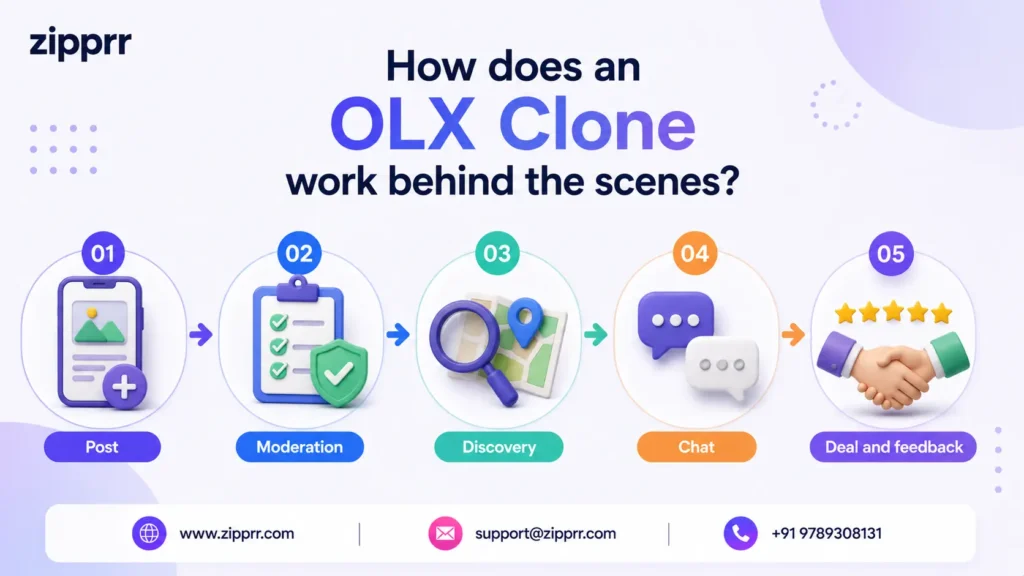
An OLX clone runs as a live marketplace that connects a person with something to sell to a person nearby who wants to buy it. Every listing follows the same short cycle, and understanding it makes the whole business easier to manage.
- Post: A seller creates a listing with photos, a title, a price, and a category, then submits it for review.
- Moderation: The listing is auto-checked or manually approved so banned or duplicate items never reach the public feed.
- Discovery: Buyers browse categories or search, with location and filters surfacing the most relevant nearby items first.
- Chat: A buyer messages the seller in-app to ask questions, agree a price, and arrange a meeting or delivery.
- Deal and feedback: The item changes hands, any optional payment or promotion fee is settled, and both parties leave a rating.
Throughout this loop, the admin panel logs every listing, promotion, and report, works out your revenue, and feeds the analytics that show how the marketplace is performing. This cycle is the real engine, turning single ads into a community you can measure and grow.
How much does an OLX clone cost in 2026?
An OLX clone costs far less than a custom build. With Zipprr, the price is fixed at $490 for the standard package and $890 for the premium package, and both are delivered in 3 days. By contrast, commissioning a classifieds marketplace from a development agency typically runs from $50,000 to $120,000 and takes six to nine months before you have anything to test.
The gap is easy to explain. A clone spreads the cost of a tested codebase across many buyers, so you pay for branding and setup rather than for inventing the marketplace. Where you should still spend money is on the things a clone cannot do for you: category research, moderation staff once you scale, and marketing to bring in your first sellers. You can compare packages and features directly with Zipprr’s OLX clone app, but the headline is that the software is the small line item, and your growth budget matters more.
Is it legal to launch an app like OLX?
Yes, launching an OLX-style classifieds app is legal, as long as you build your own brand and do not copy OLX’s protected assets. The concept of a classifieds marketplace and the general way such an app works cannot be owned by any single company. What is protected is OLX’s name, logo, trademark, and actual source code, none of which a legitimate clone touches.
To stay on the right side of the line, run the platform under your own name, logo, and colours; never use OLX branding or claim any affiliation; and make sure your provider gives you clean, independently written software rather than stolen code. On the operations side, you must also follow local consumer-protection and privacy laws such as GDPR in Europe, publish clear terms and a privacy policy, and moderate listings so that illegal or prohibited items are removed quickly. Handled this way, a classifieds clone is a completely legitimate business, which is why hundreds of regional marketplaces already operate on this model.
How does an OLX clone make money?
An OLX clone earns money mainly by charging for visibility rather than by taking a cut of every sale, because most classifieds deals happen offline between two local people. The revenue comes from several streams that you switch on inside the admin panel.
- Featured and promoted listings: Sellers pay to push an ad to the top of a category or highlight it, usually the single largest income source.
- Paid listing packages: Free basic ads, with charges for extra photos, longer runtimes, or posting beyond a monthly limit.
- Category or per-ad fees: Higher-value categories such as cars, property, and jobs often carry a listing fee where casual items stay free.
- Subscription plans: Monthly plans for dealers, agents, and power sellers who post in volume.
- Advertising: Banner and native ads sold to local businesses, plus sponsored placements in search results.
- Optional transaction commission: If you add in-app payments or delivery, you can take a small percentage of completed transactions.
Most successful operators combine two or three of these rather than relying on one. A common pattern is free basic listings to build volume, paid promotions for sellers who want speed, and premium subscriptions for professional users. To explore how these models are priced in practice, the team behind Zipprr’s classifieds marketplace software can walk you through real configurations before you commit.
What separates a great OLX clone from a cheap one?
The difference between a clone that grows and one that stalls comes down to code ownership, security, support, and proof of real launches. A low sticker price means little if you cannot own or extend the software, or if it collapses under a few thousand listings.
Before buying, work through a short checklist. Ask whether the package includes a full source-code license or only hosted access. Confirm that the platform is built for scale, with fast search and image handling that hold up as listings grow. Check the security basics: verification, spam and fraud filters, and encrypted data. Ask what support and updates you get after launch, including bug fixes and operating-system updates. Finally, ask to see real, verifiable marketplaces the provider has delivered, not just a polished demo. A dependable provider answers all of these in writing.
A practical seven-step plan to launch your OLX clone
You can bring an OLX clone to market in seven manageable steps, even with no coding background.
- Pick a niche or region: A whole country is hard to win on day one, so start with a city, a country, or a vertical such as cars or property.
- Choose a provider: Compare options against the checklist above and confirm your source-code and licensing rights.
- Brand the platform: Add your name, logo, colours, and welcome content so the marketplace has a distinct identity.
- Set up categories and rules: Configure categories, listing packages, promotion pricing, payment gateways, and moderation filters.
- Test thoroughly: Post real practice listings on Android, iOS, and web, and run through chat and payment flows before opening.
- Handle compliance: Publish terms, a privacy policy, and prohibited-item rules, and set up your moderation process.
- Launch and seed supply: Fill the platform with genuine listings first, then market to buyers so no one arrives to an empty marketplace.
One rule sits above the rest: a classifieds platform is only useful when it already has listings. Seed real inventory, whether your own, partner dealers, or migrated ads, before you spend on buyer marketing, because an empty marketplace loses visitors on their first visit.
How should you adapt an OLX clone to local markets?
An OLX clone should be tuned to the market it serves, because buying habits, popular categories, payment methods, and languages differ sharply from place to place. The core engine stays the same, but the settings around it decide whether the platform feels local or foreign.
In South Asian markets such as India and Pakistan, cars, mobiles, and property dominate, cash-on-meetup is normal, and light data usage matters. Across Latin America and Africa, mobile-first browsing, local wallet payments, and visible anti-scam features carry the most weight. In Europe, privacy compliance, card and wallet payments, and clear pricing are expected. In the Middle East, Arabic right-to-left layouts and strong verification are common requirements. The practical takeaway is to treat the clone as a flexible base, not a fixed product: set your currency, languages, categories, and payment gateways to match the first market you target before you launch.
What mistakes quietly sink new classifieds apps?
The most common reason a new classifieds app fails is launching with an empty marketplace and marketing to buyers before there is anything to buy. Beyond that supply problem, a handful of avoidable mistakes undo otherwise promising launches.
- Going too broad: trying to cover every category and city at once instead of owning one niche or region first.
- Weak moderation: letting spam, scams, and duplicate ads pile up destroys trust faster than anything else.
- No seller incentive: sellers are your inventory, so make posting free and effortless at the start rather than charging early.
- Ignoring SEO: classifieds live on organic search, so a web marketplace with indexable listings is not optional.
- Picking the cheapest script blindly: a low price with no code rights, weak security, or poor support becomes costly as the platform grows.
- Underfunding marketing: the app is half the business, so budget for seller recruitment and buyer acquisition from day one.
Avoiding these problems comes down to discipline: launch narrow, seed listings first, moderate hard, invest in search visibility, and choose a provider you can grow with rather than the cheapest one available today.
Written by the Zipprr Product Team. Zipprr builds ready-made marketplace and on-demand apps used by founders in more than 30 countries. Our team has shipped classifieds, rental, and service-marketplace platforms since 2016, and this guide reflects patterns we see across real launches. Facts on pricing and delivery reflect Zipprr’s current OLX clone packages as of July 2026.
Ready to launch your own classifieds marketplace?
Frequently Asked Questions
What is an OLX clone in simple terms?
How much does an OLX clone cost?
How quickly can an OLX clone go live?
Is it legal to make an app like OLX?
How does an OLX clone make money?
What are the top features I should look for?
Is an OLX clone better than building from scratch?
Do I receive the source code with an OLX clone?
Can I add rentals, services, or delivery to an OLX clone?
Final thoughts: should you launch an OLX clone?
If you want to enter the classifieds market quickly and affordably, an OLX clone is the most practical route in 2026. It gives you a tested buyer-and-seller app, web marketplace, and admin panel for a small fraction of the cost and time of custom development, while still letting you own your brand, choose your categories, and expand into new verticals later.
The smartest approach is simple. Start with well-built software, launch narrow in one niche or region, seed real listings before you market to buyers, moderate firmly to keep trust high, and reinvest early revenue into the features your community actually asks for. Do that, and a ready-made script can become a real, scalable marketplace business.
Ready to launch your own classifieds marketplace?
Get Zipprr’s OLX clone, a fully brandable buyer/seller app, web marketplace, and admin panel, from $490 standard or $890 premium, delivered in 3 days.