

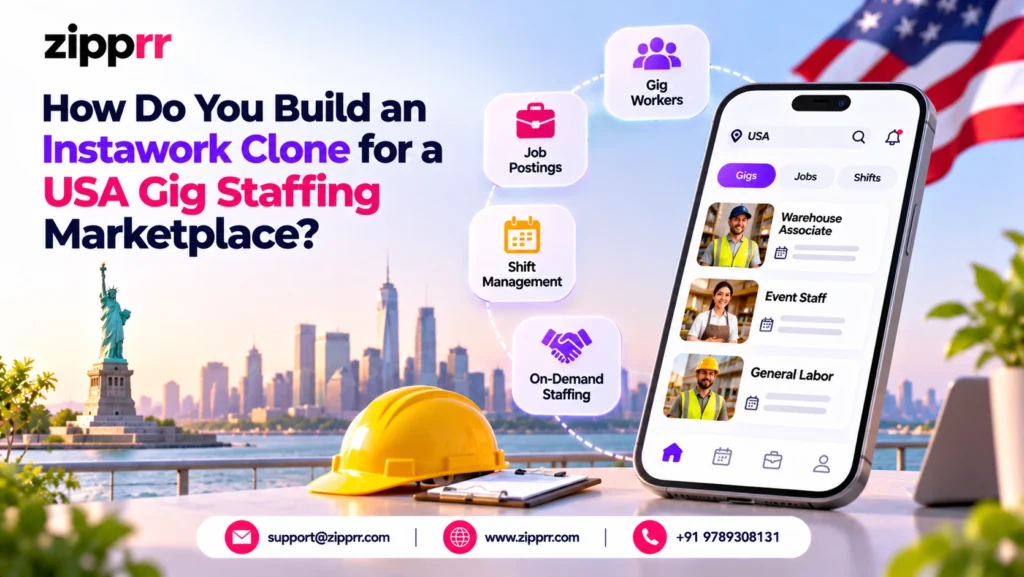
You build an Instawork clone by choosing one US metro and one shift category, launching a ready-made staffing marketplace script under your own brand, signing a handful of local businesses, vetting your first wave of workers, and filling shifts manually while the app handles matching, check-ins and payments. A focused launch reaches real shifts in weeks, because the software foundation already exists.
This playbook walks you from idea to your first filled shifts and through the first 90 days. It is written for entrepreneurs in the United States who want to run an on-demand staffing business of their own.
Along the way you will meet the Zipprr Launch Ladder, a five-rung framework built for staffing founders, plus a sample 90-day plan with clearly labelled hypothetical numbers you can adapt.
What Is an Instawork Clone?
An Instawork clone is a ready-made, white-label on-demand staffing marketplace that you launch under your own name. Businesses post shifts, vetted workers accept them, and the platform handles matching, check-in, ratings and payment.
Zipprr’s solution is an independently developed script with no affiliation to any existing staffing brand. You own the brand, the client relationships and the worker community you build on top of it.
The appeal for a US founder is speed. Instead of funding months of custom development before meeting a single customer, you start from working software and spend your energy on the part that decides success: supply, demand and trust.
The Zipprr Launch Ladder: Five Rungs From Idea to Filled Shifts
Most staffing marketplaces grow when both sides arrive in the right order and in the right ratio. The Launch Ladder gives you that order, so every week of effort lands on the rung that matters most.
Each section below maps to one or more rungs. Climb them in order and you give your marketplace a reliable base before you widen it.
Step 1: Pick One US Metro and One Shift Category
Local marketplaces win through density. A hundred workers spread across ten cities create few matches, while forty workers in one city create many.
Choose a metro where you already have a connection, such as your hometown, a former employer’s industry or a community you belong to. Familiar ground makes your first conversations with business owners much warmer.
Choose a shift category with steady, repeatable demand
Pick a category where shifts recur weekly and where the skills are easy to describe. Strong starting points in many US metros include:
- Event staffing such as servers, bartenders, setup crews and ushers.
- Restaurant and catering support such as line cooks, dishwashers and prep staff.
- Warehouse and fulfillment help such as pickers, packers and loaders.
- Retail and merchandising support during seasonal peaks.
- Cleaning and janitorial crews for offices and venues.
Start with one or two of these. A tight niche lets you write a precise promise, for example “vetted event staff in Phoenix, booked in hours.”
Write your one-sentence promise
A good promise names the customer, the speed and the quality. Draft it now, because it will shape your app store text, your website headline and your first outreach messages.
Try this pattern: “[Business type] in [metro] fill [shift type] with screened workers in [time window].” Reuse it everywhere until it feels natural.
Step 2: Decide Your Business Model and Worker Classification Approach
Before you recruit anyone, decide how workers relate to your platform and to the businesses that book them. This choice affects your contracts, your payout flow and your tax paperwork.
In the United States, two common approaches exist. In the first, workers act as independent contractors who choose shifts and set their availability. In the second, a licensed staffing company or an employer-of-record partner employs the workers and handles payroll.
Check the rules that apply in your state
Classification rules differ by state, and some states, California among them, apply stricter tests to decide whether a worker is a contractor or an employee. Federal agencies such as the IRS and the Department of Labor also publish guidance on the topic.
Book a short session with an employment attorney or a staffing compliance advisor in your launch state. Bring your planned shift categories and your payout flow, and leave with a written approach you can follow with confidence.
Match the model to your platform settings
Your chosen model shapes the worker onboarding screens, the agreement workers accept, and the tax forms you collect, such as a W-9 for contractors. Settle these details early so your onboarding flow reads clearly from day one.
Step 3: Stand Up the Platform With a Ready-Made Script
With your niche and model settled, you can launch the software. A ready-made script puts the heavy lifting of shift posting, matching and payments in place before your first customer meeting.
The Instawork clone from Zipprr is built for this stage. It brings together shift scheduling, worker matching, GPS-based tracking and automated invoicing in one white-label platform that you brand as your own. Review the product page for current plan details and confirm which plan includes the iOS and Android apps and app store submission.
The core features your launch needs
- Business shift posting: role, date, time, location, pay rate and requirements in a few taps.
- Worker profiles: skills, certifications, work history, photos and availability.
- Matching and notifications: alerts that reach qualified nearby workers quickly.
- GPS check-in and check-out: proof that the worker arrived and completed the shift.
- Ratings in both directions: businesses rate workers, and workers rate businesses.
- Invoicing and payouts: clear records for every shift and every payment.
- Admin dashboard: approvals, dispute handling, pricing control and reporting.
Configure before you invite anyone
Spend a few days setting your brand colors, service area, shift categories, fee structure and notification wording. Run a full test shift with your own team: post it, accept it, check in, check out, approve hours and trigger a payout.
That rehearsal shows you exactly what your first customers will experience, and it gives you screenshots and a short demo video for outreach.
Mid-Article Shortcut: See the Platform in Action
Want to see how shift posting, worker matching and invoicing look before you commit? Book a free demo and walk through the full flow with the Zipprr team.
Step 4: Recruit Your First Wave of Workers
Workers arrive first, because a business that posts a shift and sees no response rarely returns. Aim for a small, reliable pool rather than a large, uneven one.
Your goal for the first two weeks is simple: a few dozen screened workers in your chosen category who are ready to say yes to short-notice shifts.
Where to find them
- Local community colleges, trade schools and hospitality programs.
- Neighborhood social groups and community boards for your metro.
- Referrals from workers you recruit first, rewarded after their friend completes a first shift.
- Short-form video that shows what a shift looks like and how quickly pay arrives.
- Partnerships with local community organizations that support job seekers.
The same early-traction thinking applies to any two-sided marketplace. Zipprr’s guide on getting your first providers and clients when a marketplace launches offers a complementary view you can adapt to shift work.
Write a worker pitch that shows the benefit
Workers care about three things: pay, flexibility and speed of payment. Lead with them.
For example: “Pick shifts that fit your week, get paid on a clear schedule, and build a rating that unlocks better shifts.” Keep the message short, concrete and honest about what each shift pays.
Step 5: Sign Your First Business Clients
With a worker pool forming, turn to demand. Your first clients should be businesses with recurring needs, quick decisions and a manager who can say yes in one conversation.
Independent restaurants, catering companies, event planners, small warehouses and venue operators often fit well. Their schedules change weekly, and a reliable flexible workforce solves a daily headache for them.
The pilot offer
Offer a low-risk pilot: your first few shifts at an introductory rate, with you personally checking that each shift is staffed. A pilot lets a busy manager try your service without reworking their routine.
Bring your demo video and a one-page summary of how workers are vetted. Business owners respond to clear answers about who will show up and what happens if a worker cancels.
Outreach that works for busy managers
- Visit venues in person during quiet hours and leave a short, friendly card.
- Send a three-sentence email that names a specific shift type and a specific benefit.
- Ask each happy client for an introduction to one neighboring business.
- Join local business associations and chambers of commerce in your metro.
Step 6: Vet Workers So Businesses Can Book With Confidence
Trust is the product you sell. Businesses hand you their customers’ experience, so a clear vetting process becomes your strongest sales tool.
Design a vetting path with levels, so every worker starts at a baseline and can earn access to higher-trust shifts over time.
A simple three-level vetting path
Background checks in the United States
When you use a third-party screening provider, US federal law (the Fair Credit Reporting Act) sets rules for disclosure and consent. Choose an established screening partner, share the process openly with workers, and keep your wording consistent.
Your attorney can confirm the exact steps for your state and your worker model. Document the process once and apply it the same way to every worker.
Reliability signals inside the app
Use the built-in tools to reinforce reliability: GPS check-ins, reminder notifications before each shift, ratings after each shift, and a backup list of workers who are ready to step in. These small habits lift fill rates and make each client’s experience predictable.
Step 7: Set Up Payments, Payouts and Invoicing
Fast, clear payment keeps workers active and gives businesses a record they can trust. Map the money flow before your first shift so every party knows what to expect.
A simple money flow
Publish your payout schedule where workers can see it, for example “paid within two business days of approved hours.” Consistency here builds loyalty faster than almost any bonus.
Keep your records tidy
Automated invoicing gives each business a clean summary of shifts and charges. Store worker agreements, tax forms and payout records in an organized way, and ask your accountant which year-end forms, such as the 1099-NEC where it applies, your model will need.
Add smart matching as you grow
Once you have a few hundred shifts of history, data-driven matching becomes powerful. Reliability scores, skill tags and distance can all feed smarter suggestions. Zipprr’s overview of AI-enabled gig apps shows where intelligent matching can fit into a growing marketplace.
Step 8: Fill Your First Shifts, Hands-On
In the first weeks, treat every shift as a small experiment. You are learning what businesses ask for, what workers accept quickly, and which details cause friction.
Stay close to the first twenty shifts. Message the worker the evening before, check in with the manager during the shift, and follow up afterward with a quick thank-you and a request for ratings.
A daily rhythm for the first month
- Morning: review open shifts and nudge qualified workers who have not responded.
- Midday: confirm tomorrow’s shifts with workers and managers.
- Evening: collect ratings, resolve questions and approve hours.
- Weekly: review fill rate, no-shows, ratings and worker feedback.
Turn each shift into a case study
Ask satisfied managers for a short quote, with permission to use their business name. Real feedback from local businesses outperforms any marketing copy you could write yourself.
Your First 90 Days: A Sample Plan
The table below shows a sample 90-day path for a hypothetical launch in one US metro. All figures are illustrative planning targets, not industry benchmarks, so adjust them to your market, your category and your capacity.
| Period | Main focus | Sample target (hypothetical) |
|---|---|---|
| Days 1 to 14 | Legal setup, platform configuration, test shifts, brand assets | Platform live, 1 full test shift complete, 3 business conversations booked |
| Days 15 to 30 | Recruit and vet the first worker pool, sign pilot clients | 40 screened workers, 4 pilot businesses, 20 shifts posted |
| Days 31 to 60 | Hands-on filling, process tuning, collecting ratings and quotes | 120 shifts posted, 85% filled, 10 rated businesses |
| Days 61 to 90 | Pricing review, referral programs, second category preview | 250 shifts posted, 90% filled, 15 recurring clients |
Why the ratio matters more than the totals
Watch the balance between open shifts and active workers. A healthy early marketplace keeps a comfortable cushion of available workers for every shift posted, so businesses see quick responses.
If shifts wait too long, recruit more workers in that category. If workers wait too long, spend the next week on business outreach. This simple seesaw guides your weekly priorities.
The Numbers to Track From Week One
A short dashboard keeps your decisions grounded. Review these figures every week:
- Fill rate: the share of posted shifts that get a confirmed worker.
- Time to fill: how long a shift waits before a worker accepts.
- On-time arrival rate: the share of shifts where the worker checks in as scheduled.
- Repeat booking rate: the share of businesses that book again within 30 days.
- Worker activity: the number of workers who accepted at least one shift this month.
- Average rating on both sides: a quality signal for workers and businesses alike.
Share the positive trends with your workers and clients. A note such as “your Friday shifts filled in under two hours” reinforces the habit of booking and working through your platform.
How a Staffing Marketplace Earns Revenue
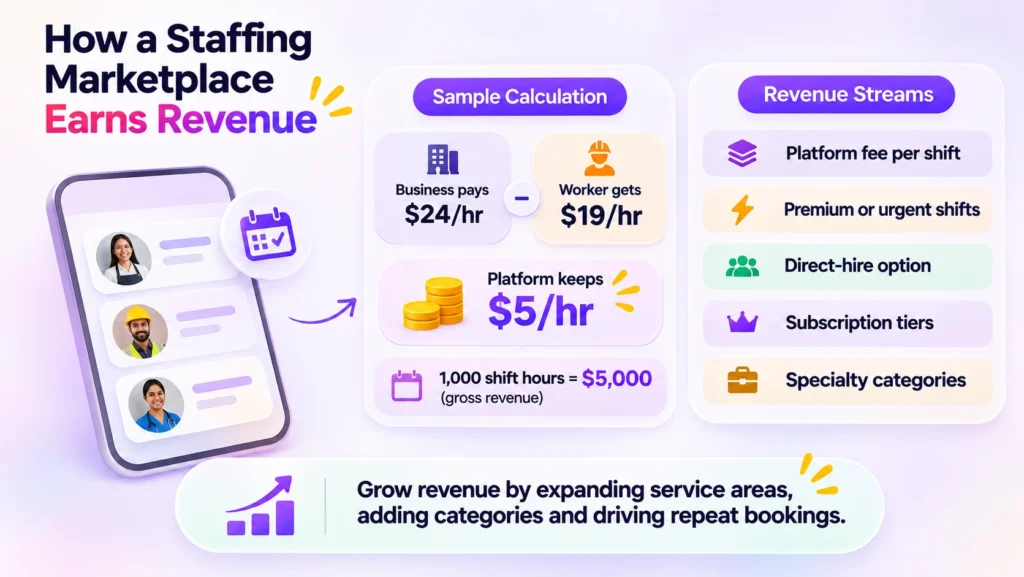
Your revenue model can stay simple at launch. Most on-demand staffing platforms build their income from the gap between the rate a business pays and the amount the worker receives.
- Platform fee per shift: a percentage or hourly markup built into the business rate.
- Premium or urgent shifts: a higher rate for same-day or last-minute bookings.
- Direct-hire option: a fee or hour threshold when a business wants to bring a favorite worker on staff.
- Subscription tiers: optional plans for larger clients that want priority access or dedicated support.
- Specialty categories: higher-skill roles that carry higher rates and fees.
Here is a sample calculation, with hypothetical numbers for illustration only. If a business pays $24 per hour and the worker receives $19 per hour, the platform keeps $5 per hour before payment processing and operating costs. Across 1,000 shift hours in a month, that sample margin equals $5,000 of gross platform revenue.
Grow that figure by widening your service area, adding categories and encouraging repeat bookings. For broader context on where on-demand work is heading, the Zipprr article on apps transforming the gig economy is a helpful companion read.
Ready-Made Script or Custom Build?
Both paths can work. A custom build gives you full control over every detail but asks for a larger budget and a longer wait before your first customer. A ready-made script gives you a working marketplace quickly and leaves room for tailored changes.
For most first-time founders, the faster path creates more learning per dollar. You test your niche, your pricing and your supply and demand pattern with real shifts, then invest in extra customization once the data points the way.
Questions to ask any provider
- Which plan includes the iOS and Android apps and app store submission?
- Do I receive the full source code and keep ownership of my platform?
- What support period and update access come with my plan?
- Can the fee structure, shift categories and branding be changed to match my model?
- Which payment gateways work for my US launch?
The Zipprr product page answers these points in one place, and the team is glad to walk through them live. If you are weighing different marketplace formats first, this look at a service marketplace business model strategy shows how another on-demand model organizes its revenue and supply.
Frequently Asked Questions
1. What is an Instawork clone?
An Instawork clone is a ready-made, white-label on-demand staffing marketplace you launch under your own brand. Businesses post shifts, vetted workers accept them, and the platform manages matching, GPS check-in, ratings, invoicing and payouts. It lets entrepreneurs start a staffing business without building software from scratch.
2. How do you build an app like Instawork?
Choose one US metro and shift category, pick your worker model with an attorney, launch a ready-made staffing script under your brand, recruit and vet a small worker pool, sign pilot businesses, and fill your first shifts hands-on. Then track fill rate and repeat bookings, and expand gradually.
3. What are the essential features of a gig marketplace app?
Essential features include shift posting, worker profiles, matching and notifications, GPS check-in and check-out, two-way ratings, secure payments with invoicing, and an admin dashboard for approvals, disputes and reporting. Messaging and scheduling tools help workers and businesses coordinate quickly, and reporting shows fill rate and repeat bookings.
4. How much does it cost to develop a gig marketplace app?
Cost depends on scope. A custom build is typically the larger investment, while a ready-made script lowers the upfront spend because core features already exist. Budget also for legal advice, screening, marketing and launch operations. Zipprr lists current plan pricing on its product page.
5. How long does it take to build a gig marketplace app?
A custom build can take many months, while a ready-made script can be configured and tested in a matter of weeks. Most of your launch time then goes to recruiting workers, signing businesses and completing test shifts, so plan roughly a month before your first live shifts.
6. How do payments work in a gig marketplace?
The business pays an hourly rate that covers the worker’s pay and the platform fee. The platform collects the payment through a connected gateway, generates an invoice after hours are approved, and sends the worker’s payout on a published schedule, such as within two business days.
7. How do you build trust between businesses and gig workers?
Combine layered vetting with visible reliability signals. Verify identity, skills and references, use GPS check-ins and shift reminders, collect two-way ratings, and respond quickly to questions. Sharing your vetting process with business owners helps them book with confidence from the very first shift.
8. How do you monetize a gig staffing marketplace?
Most platforms earn a fee on each shift, built into the hourly rate the business pays. Additional income can come from urgent-shift premiums, direct-hire fees, optional subscription tiers for larger clients, and higher-margin specialty categories. Start with one simple fee and refine it with real data.
9. How do you launch and grow a gig marketplace?
Launch in one metro with one or two shift categories, recruit workers first, then sign pilot businesses with recurring needs. Fill early shifts hands-on, gather ratings and quotes, and review fill rate weekly. Expand into new categories or neighborhoods once your fill rate stays strong.
10. How does an on-demand staffing app like Instawork work for businesses?
A business posts a shift with role, time, location and pay rate. Qualified workers receive alerts and accept the shift, then check in by GPS on arrival. The business approves hours, receives an invoice, and rates the worker, which improves future matching.
Launch Your Staffing Marketplace With Zipprr
You now have the full path: a focused niche, a clear worker model, a ready platform, a vetted worker pool, pilot clients and a 90-day plan. The next move is seeing the platform in action and mapping it to your metro. Book your free demo to tour the Instawork clone with the Zipprr team, chat with us on WhatsApp for quick answers about plans, features and your launch timeline, or email your questions to [email protected] and we will reply with next steps.