
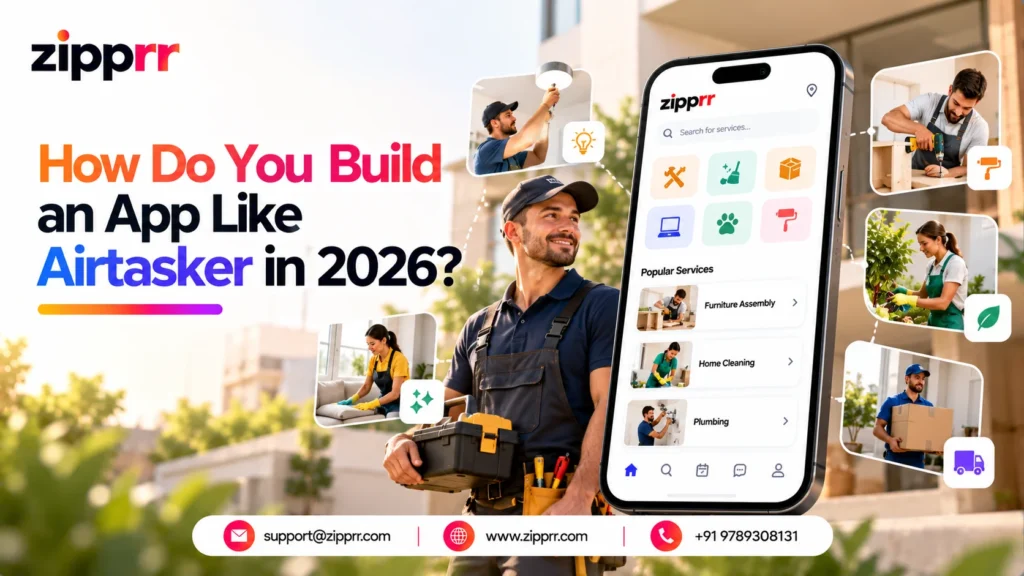
An app like Airtasker connects people who need small jobs done, cleaning, handyman work, moving help, assembly, errands, with local service providers who bid or apply for the task. The fastest and least expensive way to launch one in 2026 is a ready-made task marketplace script that already has task posting, bidding, in-app messaging, and escrow payments built in, rather than commissioning a custom build or locking into a monthly SaaS subscription.
This guide walks through what an Airtasker clone script actually is, how the business model makes money, what the current market data says about demand, a side-by-side comparison of the three ways to launch, the task categories that tend to work best for a new marketplace, the features a task marketplace needs on day one, and what to check before paying for any script or platform.
It is worth pausing on why founders are drawn to this model specifically. Unlike a general classifieds site, a task marketplace app has a built-in trust and payment layer: bidding, ratings, and escrow all live inside one product, so both sides have a reason to keep transacting through it instead of taking the deal offline after the first job. That retention mechanic is a large part of why investors and founders keep treating the category as a durable one rather than a short-lived trend, and it is also why the build decision, whether to code it from scratch, rent it, or buy an owned script such as Zipprr’s, matters more than it might for a simpler app.
What Is an Airtasker Clone Script?
An Airtasker clone script is pre-built software that replicates the core mechanics of a task marketplace: a customer posts a task with a budget and deadline, nearby taskers view it and submit offers or bids, the customer picks a tasker, the job gets done, and payment is released through the platform. It is not a copy of Airtasker’s trademarked brand or code. It is an independently built marketplace engine that follows the same functional pattern, sold as source code the buyer owns outright.
Zipprr’s version of this script is built specifically around that task-and-bid workflow, covering everything from task categorization to dispute handling, and is aimed at founders who want to launch a local or niche task marketplace, such as home services, moving help, or business errands, under their own brand rather than listing as a provider on someone else’s platform.
To be clear about positioning: Zipprr’s Airtasker Clone script is an independently developed marketplace solution, not affiliated with, endorsed by, or connected to Airtasker Pty Ltd in any way. Any reference to Airtasker in this article is made only to describe the category of task marketplace app being built.
How Does a Task Marketplace App Make Money?
Most task marketplace apps, including the Airtasker model this article is describing, generate revenue through a small number of well-tested mechanisms rather than one single fee:
- Commission on completed tasks: a percentage fee deducted when a tasker gets paid through the platform, usually the primary revenue source.
- Service or booking fees: a smaller flat or percentage fee charged to the customer at checkout, separate from the tasker’s commission.
- Featured or promoted task listings: taskers pay to have their profile or bid highlighted in search results.
- Subscription tiers for taskers: optional paid plans that reduce commission or unlock more bids per month for high-volume providers.
- Verification and background-check add-ons: optional paid trust badges for taskers who complete identity or background verification.
With Zipprr’s script, the commission percentage, service fee amount, and any subscription tiers are all configurable from the admin panel, so the business model can be adjusted after launch without touching code, based on what the local market will support.
Is There Real Demand for a Task Marketplace App in 2026?
Grand View Research puts the global freelance platforms market at USD 6.4 billion in 2025, projecting growth to USD 7.3 billion in 2026 and USD 24.2 billion by 2033, a compound annual growth rate of 18.6 percent from 2026 to 2033. That figure covers the broader freelance and task-platform category that an Airtasker-style marketplace sits inside.
On the home services side specifically, Mordor Intelligence sizes the US home service market at USD 842.04 billion in 2026, projected to reach USD 989.22 billion by 2031. Traditional, offline booking still accounted for roughly 65 percent of 2025 revenue by their estimate, but Mordor Intelligence’s report notes that digital marketplaces and booking apps are forecast to grow faster than the offline channel through 2031, with named platforms in that category, including TaskRabbit, cited as having expanded booking features and embedded checkout options during that period.
Read together, these two sources point in the same direction: the underlying task and home-services market is already enormous, and the share of it moving through app-based, on-demand booking is the part still growing fastest. That is the segment a new task marketplace script is built to capture, not the market as a whole.
Build, Rent, or Buy: Comparing the Three Ways to Launch a Task Marketplace App
Founders comparing options for a task marketplace app usually narrow it down to three paths: custom development from scratch, a subscription-based SaaS clone platform, or a one-time-purchase script such as Zipprr’s. Cost matters, but it should not be the only lens, since ownership, customization depth, and long-term scalability affect the business just as much once the app is live.
| Factor | Custom Development | SaaS Subscription Clone Platform | Zipprr Airtasker Clone Script |
|---|---|---|---|
| Source code ownership | Full ownership, but only after paying the full development invoice | No ownership; access is revoked if the subscription lapses | Full ownership from day one, one-time purchase |
| Launch timeline | 4 to 9 months typically, depending on scope | Days to weeks, but locked to the vendor's release cycle | Days to a few weeks, including customization and store submission |
| Ongoing cost structure | Large upfront cost plus maintenance retainer | Recurring monthly or annual fee for as long as the app runs | One-time cost, plus optional support renewal after the included period |
| Customization depth | Unlimited, but every change is billed separately | Limited to what the vendor's dashboard exposes | Full source-level customization since the code is owned outright |
| Scalability | Depends entirely on the development team's architecture choices | Constrained by the vendor's shared infrastructure and plan tier | Built on Laravel and a standard LAMP-style stack that scales on the buyer's own hosting |
| Support and maintenance | Negotiated separately, often expensive after the initial build | Included in the subscription, but stops the moment payment stops | 90 days included, lifetime updates, renewable support after that window |
The table above is not meant to say one option is universally correct. A founder who needs a highly unusual workflow that no existing script supports may still need custom development. A founder who wants to test an idea for a single month with zero commitment might start with a subscription platform. But for a founder who has already validated that a task marketplace is the right model and wants to own the asset outright, a one-time script like Zipprr’s Airtasker Clone removes the recurring-fee dependency that subscription platforms carry indefinitely.
Which Task Categories Work Best for a New Marketplace?
Founders launching an Airtasker-style app rarely try to cover every task type on day one. Most successful launches pick two or three categories where local demand is already proven, then expand once the tasker supply side is healthy.
- Home services: cleaning, handyman repairs, furniture assembly, and small electrical or plumbing jobs. This is the largest category by volume and the one Mordor Intelligence’s home service figures speak to most directly.
- Moving and delivery help: single-item moves, packing assistance, and short-distance delivery, which tend to have high urgency and lower price sensitivity.
- Business and office errands: mailing, document runs, and small business support tasks, a category with less competition from consumer-focused platforms.
- Event and seasonal help: setup and teardown for events, yard work, and holiday-season tasks, useful for driving periodic demand spikes.
Because Zipprr’s script ships with configurable task categories rather than a fixed list, a founder can start narrow, for example handyman services only in a single metro area, and add categories later from the admin panel without a new development cycle. That flexibility is one of the practical advantages of owning the source code outright instead of operating inside a vendor’s fixed category structure.
What Features Does a Task Marketplace App Need on Day One?
Based on both the competitor pages reviewed and the feature set on Zipprr’s own product page, a launch-ready task marketplace app needs to cover four areas well, not just look impressive in a feature list.
Customer-Facing Features
- Task posting with category, budget range, deadline, and photo or video attachments
- Tasker profiles showing ratings, completed task count, and verification status
- In-app messaging to discuss task details before accepting a bid
- Secure, escrow-based payment so funds are only released after task completion
Tasker-Facing Features
- A competitive bidding system where taskers submit price offers on open tasks
- Availability and schedule management
- Earnings and payout tracking
- Push notifications for new tasks matching their category and location
Admin-Facing Features
- User and task management with approval workflows
- Transaction monitoring, commission tracking, and tax management
- Dispute resolution tools for when a task goes wrong
- Business analytics covering completed tasks, active taskers, and revenue by category
Zipprr’s script ships with all three layers built in, which is why the comparison table above treats “customization depth” as a meaningful factor rather than a marketing line: the buyer is adjusting an existing, working system instead of specifying one from zero.
How Zipprr's Airtasker Clone Script Is Actually Built
It is worth being specific here instead of making a vague engineering claim. Zipprr publishes a public repository on GitHub for its TaskRabbit-style marketplace codebase, built on PHP with the Laravel framework, a MySQL database, a Bootstrap-based frontend, and AWS hosting, and it includes a live demo installation for buyers to test before purchase. That same core architecture, task and bid data models, escrow payment handling, and admin dispute tools, is what this task marketplace script is built on, adapted for open task bidding rather than fixed-price service booking.
This matters for a practical reason: Laravel and MySQL are widely supported by hosting providers and developers, so a founder is not locked into a proprietary framework that only the original vendor can maintain. If a business later wants to hire an independent developer to extend the platform, that developer can work with a standard, well-documented stack rather than reverse-engineering closed, proprietary code.
For a closer look at how Zipprr approaches marketplace architecture more broadly, including booking logic, commission handling, and preventing conflicting bookings across multiple vendors, see this technical case study on building a peer-to-peer marketplace platform, which covers the same underlying engineering patterns that support the platform’s task and bidding engine.
Step-by-Step: Launching a Task Marketplace App With Zipprr
- Review the live demo. Test the task posting flow, bidding system, and admin dashboard before paying anything.
- Choose a plan. Standard at $490 or Pro at $890, both one-time payments, verified live on Zipprr’s Airtasker Clone product page as of this article’s publish date.
- Share branding and category requirements. Logo, service categories (handyman, cleaning, moving, errands, or a custom niche), supported regions, and commission percentage.
- Installation and customization. The Zipprr team installs the platform on the buyer’s hosting and applies branding and workflow adjustments.
- App store submission. Android and iOS apps are prepared and submitted under the buyer’s own developer accounts.
- Launch and onboard early taskers. Most founders start with a small, invite-only group of taskers in one city or category before opening broadly.
Because Zipprr’s script is a one-time purchase rather than a subscription, the 90-day support window and lifetime update policy apply from the day the platform goes live, without a recurring bill arriving every month regardless of whether new features were needed that month.
What to Check Before You Buy Any Airtasker Clone Script
Whether the final choice is Zipprr or a different vendor, a few checks apply to any task marketplace script purchase:
- Confirm source code ownership in writing. Some vendors market a script as “yours” but retain licensing restrictions that limit resale or migration to different hosting.
- Ask exactly what is included in each plan. Mobile app inclusion, support duration, and update policy vary by vendor and sometimes by plan tier, so get this in writing rather than assuming.
- Request a working demo, not just screenshots. A live demo reveals whether the bidding flow, messaging, and escrow payments actually function end to end.
- Check the technology stack. A widely supported stack like Laravel and MySQL means it will be easier to find developers later if the original vendor’s support window ends.
- Clarify commission and payment gateway setup. Confirm which payment processors are supported in the buyer’s target country before assuming a specific gateway is included.
- Compare total cost over three years, not just the sticker price. A $249 monthly subscription costs roughly $8,964 over three years, while a one-time script purchase plus an occasional support renewal is typically far lower over the same period.
- Ask how disputes and refunds are actually handled. A feature list that simply says “dispute resolution” should be backed up by a real admin workflow you can see in the demo, not just a support ticket form.
- Check multi-language and multi-region support if you plan to expand. A task marketplace that only works in one language limits how far the business can grow without a second development project later.
None of these checks are unique to Zipprr. They apply to any vendor selling a task marketplace script, and a founder who runs through this list before paying is far less likely to end up locked into software that cannot grow with the business.
Key Takeaways
- An Airtasker clone script replicates the task-posting-and-bidding marketplace model, not Airtasker’s brand or proprietary code, and Zipprr’s version is independently developed with no affiliation to Airtasker.
- The three real paths to launch are custom development, a recurring SaaS subscription platform, or a one-time-purchase script, and each trades off cost, ownership, timeline, and customization differently.
- Grand View Research values the freelance platforms market at USD 6.4 billion in 2025, growing to USD 24.2 billion by 2033, while Mordor Intelligence sizes the broader US home service market at USD 842.04 billion in 2026, with digital booking channels growing faster than offline demand.
- Zipprr’s Airtasker Clone is priced at $490 (Standard) or $890 (Pro), one-time payment, verified live on the product page, with source code ownership, a documented Laravel-based stack, and a public GitHub reference implementation.
- Before buying any script, confirm ownership terms, plan inclusions, a working demo, the technology stack, and the true three-year cost, not just the launch price.
Get a Custom Quote Before You Buy
Every task marketplace business has different category mixes, tasker supply, and commission expectations, so pricing questions rarely have a single right answer. Schedule a free walkthrough, send a message on WhatsApp, or write to [email protected] to confirm which Airtasker Clone plan and commission setup fits your launch budget.