
The food delivery industry is worth $1.51 trillion globally in 2026, and the most important shift happening right now is not at the top of the market. It is happening at the edges, where regional entrepreneurs, restaurant owners, and niche delivery operators are building locally branded platforms that compete with national giants on their own turf.
The tool making that possible is the Uber Eats clone script, a ready-made, white-label food delivery platform that replicates everything Uber Eats does, delivered to you as owned, customizable source code that you deploy under your own brand.
This is the complete guide to what an Uber Eats clone script is, what it includes, how much it costs, who it is built for, and how to go from zero to a live, revenue-generating food delivery platform.
What Is an Uber Eats Clone Script?
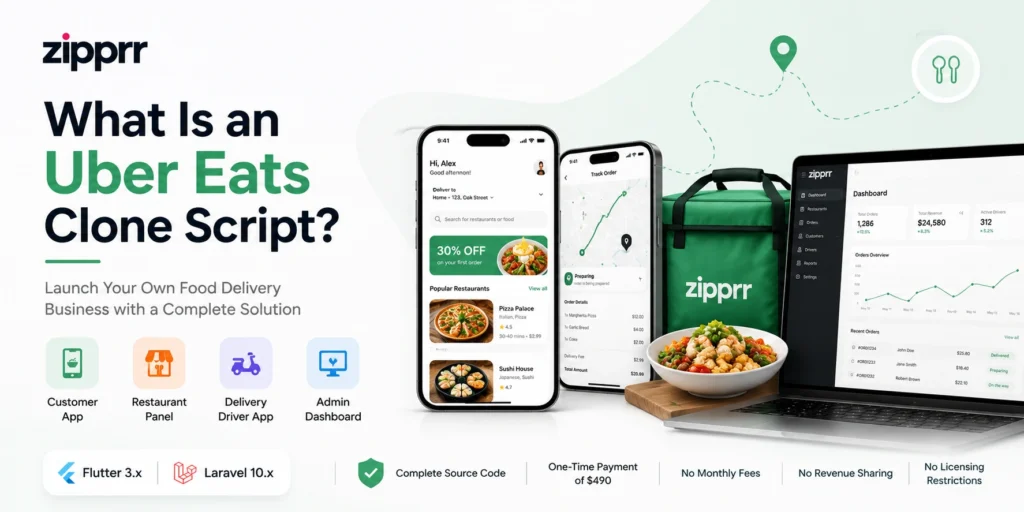
An Uber Eats clone script is a pre-built software package that replicates the full functionality of the Uber Eats food delivery platform, including the customer ordering app, the restaurant management panel, the delivery driver app, and the centralized admin dashboard.
The term “clone” does not mean a copy of Uber Eats’ brand or code. It means a proven software architecture, built from scratch using original code, that solves the same problem Uber Eats solves. The business model of connecting customers, restaurants, and drivers on a commission-based marketplace is not proprietary. Any entrepreneur can operate it legally under their own brand.
Zipprr’s Uber Eats Clone Script is built on Flutter 3.x and Laravel 10.x, two of the most production-trusted frameworks available in 2026. The complete source code (mobile apps, backend API, and admin dashboard) is included in a single one-time payment of $490. No monthly fees. No revenue sharing. No licensing restrictions.
Who Should Use an Uber Eats Clone Script?
Not everyone who builds a food delivery app is trying to compete nationally with DoorDash. The strongest use cases for an Uber Eats clone in 2026 are the ones that national platforms cannot serve well.
Entrepreneurs launching a regional food delivery startup. If you operate in a city or region where Uber Eats is absent, underperforming, or charging restaurants rates the local market resents, you have a structural opening. A locally branded platform with competitive commission rates and personal restaurant relationships wins market share that algorithms cannot defend.
Restaurant chains are eliminating third-party commissions. Uber Eats, DoorDash, and Swiggy charge restaurants 15 to 30 percent commission per order. A restaurant processing $10,000 in monthly delivery orders pays $1,500 to $3,000 every month to a platform it does not own. A one-time $490 investment in your own ordering app eliminates that dependency permanently.
Cloud kitchen and ghost kitchen operators. Cloud kitchens need a direct ordering channel to customers, not a third-party aggregator that controls visibility, pricing, and the customer relationship. An Uber Eats clone gives cloud kitchen operators a branded ordering platform that they fully control, across multiple kitchen brands, from a single admin dashboard.
Investors targeting emerging food delivery markets. Asia Pacific, Latin America, the Middle East, and Sub-Saharan Africa are adding millions of new food delivery users annually as smartphone adoption accelerates. A production-ready, white-label platform built for $490, with multi-language, multi-currency, and multi-zone support built in, is a compelling entry point for investors who want to move fast in high-growth markets.
What Features Does a Quality Uber Eats Clone Include?
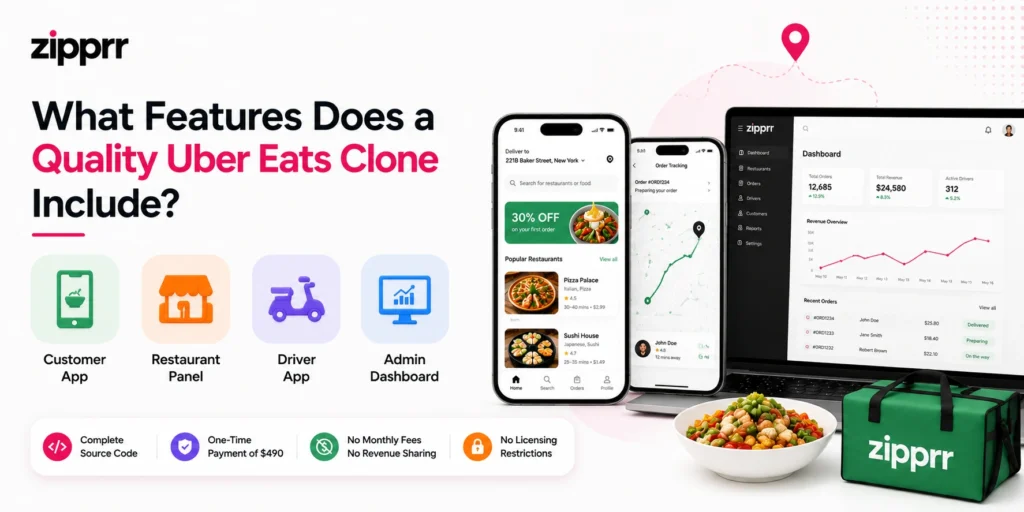
The feature set is what separates a production-ready platform from a stripped-down demo. Zipprr’s Uber Eats clone ships with 12 core features across all four user types, included in the base $490 price with no additional modules to purchase.
Customer App Features
Real-time GPS order tracking
Customers watch their driver move on a live map that updates every 10 seconds via Google Maps. The estimated arrival time recalculates dynamically as the driver moves. Restaurants and admins can also monitor all active deliveries simultaneously.
Multi-restaurant marketplace
The platform supports unlimited restaurant partners operating simultaneously on one instance. Each restaurant manages its own menu, pricing, and operating hours from a dedicated panel, while your admin controls commission rates and visibility from the central dashboard.
Multiple payment gateways
Stripe, PayPal, Razorpay, and cash on delivery are pre-integrated and ready to activate from the admin panel without any code changes. Refunds, partial payments, and delivery fee splits are handled automatically within the platform.
Push notifications at every order stage
Automated push notifications fire at confirmation, preparation, pickup, and delivery. Every notification is configurable from the admin panel. Delivery requests notify available drivers and auto-expire after 30 seconds before moving to the next driver
Scheduled order delivery
Customers place orders up to 48 hours in advance and select a specific time slot. Scheduled orders surface in the restaurant panel at the correct preparation window and auto-assign drivers before the requested delivery time, ideal for office lunches, event catering, and corporate meal planning.
In-app customer-to-driver chat
After order assignment, customers and drivers communicate through the app without sharing personal numbers. This resolves address confusion, gate access issues, and unclear delivery instructions before they become failed deliveries. All chat history is stored in the admin panel for dispute resolution.
Loyalty rewards and promo codes
Customers earn loyalty points on every order, redeemable as discounts on future purchases. The admin panel includes a full promo code manager for percentage discounts, flat-rate offers, free delivery codes, and first-order promotions. Each code can be time-limited, usage-limited, or user-specific.
Ratings and reviews
Customers rate restaurants and drivers separately after each delivery. Restaurant ratings display on listing pages and influence in-app search ranking. Driver ratings affect assignment priority and bonus eligibility, with admin moderation tools for all reviews.
Restaurant Panel Features
Full menu management with pricing, availability, and modifier control. Live incoming order management with accept, reject, and prep time adjustments. A restaurant analytics dashboard showing total orders, revenue by day and week, average order value, popular menu items, and peak ordering hours.
Driver App Features
Route-optimized navigation via Google Maps for every pickup and delivery. Per-delivery earnings breakdown showing base pay, distance bonus, tips, and surge earnings. Online/offline availability toggle and in-app chat with customers.
Admin Dashboard Features
The admin controls everything: restaurant onboarding, commission rates, driver approvals, delivery zones, surge pricing, and promotional campaigns, all from a single dashboard that requires zero developer involvement for configuration. Platform-wide analytics covering daily active users, average order value, and total revenue are updated in real time.
How Much Does It Cost to Build a Food Delivery App in 2026?
This is the question every founder asks first, and the answer depends entirely on the approach.
| Build Approach | Estimated Cost | Time to Launch |
|---|---|---|
| Custom development (agency) | $40,000 to $80,000 | 6 to 12 months |
| Freelance team build | $15,000 to $40,000 | 3 to 6 months |
| Zipprr Uber Eats Clone Script | $490 one-time | 7 days |
The clone script delivers the same production-ready feature set at 98.8% lower cost than the custom development average. What you save on engineering you reinvest in restaurant partnerships, driver acquisition, and marketing. These are the levers that actually determine market share.
Zipprr offers two plans:
- Standard Plan ($490): Website source code, admin source code, website installation, 90 days support, lifetime updates, one-time payment, Android app, iOS app.
- Pro Plan ($890): Everything in Standard, plus app store submission handled for you.
Both plans include full source code ownership with no monthly fees, no revenue sharing, and no restrictions on how you use, modify, or scale the platform. A 7-day money-back guarantee applies to both plans.
How Does the Uber Eats Clone Generate Revenue?
Your platform earns through four configurable income streams, all managed from the admin dashboard without developer involvement.
Restaurant commission (primary revenue)
Charge restaurants 15 to 30 percent on every order processed. At 100 daily orders, a $25 average order value, and a 20 percent commission, the platform generates $500 per day, which is $15,000 per month and $182,500 per year from commission alone.
Customer delivery fees
Charge customers $1.99 to $4.99 per order, calculated based on distance, order value, and current surge status. Fees can be waived above a minimum order threshold to increase the average basket size. At 100 daily orders averaging $3 per delivery fee, this stream generates $109,500 annually.
Premium restaurant placement
Charge restaurants $50 to $200 per month for featured listing positions at the top of search results inside your app. Ten restaurants paying $100 per month generate $1,000 monthly, which is $12,000 in predictable recurring annual revenue that is independent of order volume.
Surge pricing during peak demand
The built-in surge pricing engine automatically increases delivery fees by 1.2x to 2x during lunch hours, dinner rush, weekends, and adverse weather. Surge pricing adds 20 to 40 percent to delivery fee revenue during high-demand windows without manual adjustment.
These four streams together create a compounding revenue model where the platform earns on every order while building a parallel recurring revenue base through premium placements.
How to Launch in 7 Days: The Real Timeline
Day 1
Purchase confirmed. Full source code delivered within 24 hours, including Flutter customer app, Flutter driver app, Laravel backend API, React admin dashboard, technical documentation, and installation guide.
Days 1-2
Server setup on AWS EC2 (Ubuntu 22.04, PHP 8.2, MySQL 8.0, Nginx, Redis). Domain DNS configured. Zipprr technical support assists with server configuration, included in purchase.
Days 2-3
Automated Laravel installation script deploys the database, environment variables, Firebase keys, Google Maps API key, and payment gateway credentials. Admin dashboard goes live at your domain.
Days 3-5
Flutter apps built with your brand name, logo, and color scheme. Submitted to Apple App Store and Google Play simultaneously. Google Play review: 24-48 hours. Apple App Store review: 1-3 business days.
Days 5-7
Admin panel configured with delivery zones, commission rates, surge pricing rules, payment gateway, and promo codes. First restaurants onboarded. Driver accounts activated. App store approvals confirmed. Platform goes live.
Is an Uber Eats Clone Script Legal?
Yes, completely. The business model of connecting customers, restaurants, and delivery drivers on a commission-based marketplace is not protected by intellectual property law. It is a general commerce structure, not a patented invention.
What is legally protected is Uber Eats’ specific brand, design assets, and proprietary source code. Zipprr’s clone is built entirely on original code with original design. You apply your own brand and operate a legally distinct platform. This is the same legal standing as every other branded platform in the food delivery market.
Zipprr’s product page includes a disclaimer confirming that the Uber Eats name is used only for marketing reference and that all source code and design is fully original. For more detailed answers on licensing and usage, visit Zipprr’s FAQ page.
Zipprr vs. SaaS Platforms vs. Custom Development
| Factor | Zipprr Clone Script | SaaS Platforms | Custom Development |
|---|---|---|---|
| Total Cost | $490 one-time | $49-$99/month | $40,000-$80,000 |
| Time to Launch | 7 days | 1-3 days | 6-12 months |
| Source Code | Yes, Included | Not included | Yes, Included |
| Monthly Fees | None | $588-$1,188/year | Maintenance only |
| White-label | 100% | Partial | 100% |
| Customization | Unlimited | Limited | Unlimited |
| Year 3 Total Cost | $490 | $1,764-$3,564 | $42,000-$84,000 |
| Code Ownership | Full | None | Full |
| Revenue Sharing | None | None | None |
By year three, Zipprr saves $1,274 to $3,074 over SaaS, and up to $83,510 over custom development, while providing identical source code ownership and unlimited customization.
Take the Next Step
The food delivery market in 2026 is too large and the barrier to entry too low to wait. A fully branded, fully owned food delivery platform is available to you for $490 and will be live in seven days.
Explore the platform, test every feature, and ask every question before you commit:
For more articles on food delivery platforms and on-demand apps, visit the Zipprr Food Delivery Blog.
Frequently Asked Questions
What exactly is an Uber Eats clone script?
An Uber Eats clone script is a pre-built software package that replicates the complete functionality of Uber Eats: customer app, driver app, restaurant panel, and admin dashboard. Entrepreneurs use it to launch a branded food delivery business in days at a fraction of custom development cost.
How much does Zipprr's Uber Eats clone cost?
Zipprr’s Uber Eats clone script costs $490 as a one-time payment with no monthly fees. The Pro plan is $890 and includes app store submission. Both plans include full source code, lifetime updates, 90 days of support, and a 7-day money-back guarantee.
Does it include full source code?
Yes, 100 percent. Flutter mobile apps (customer and driver), Laravel backend API, and React admin dashboard. No licensing restrictions. No royalties. You own the code outright and can modify, extend, or scale the platform freely.
How long does it take to launch?
7 business days from purchase to live platform, including installation support. Google Play approval takes 24-48 hours. Apple App Store approval takes 1-3 business days. Both are submitted in parallel during Days 3-5 of the setup process.
Is it legal to build a food delivery app like Uber Eats?
Yes. The business model is not protected by intellectual property law. Zipprr’s clone uses entirely source code and design. You apply your own brand. The platform is legally a distinct product from Uber Eats.
What tech stack does it use?
Flutter 3.x for iOS and Android apps, Laravel 10.x for the backend API, Firebase for real-time tracking and notifications, MySQL 8.0 for the database, Google Maps Platform for GPS navigation, and AWS for cloud hosting.
Can I customize it after purchase?
Yes, fully. You own the source code, which means you or any developer can add, modify, or remove any feature at any point. Common post-launch additions include subscription delivery passes, advanced loyalty tiers, and multi-zone pricing.
What payment gateways are supported?
Stripe, PayPal, Razorpay, and cash on delivery are pre-integrated. Additional gateways can be integrated post-purchase by your development team.