
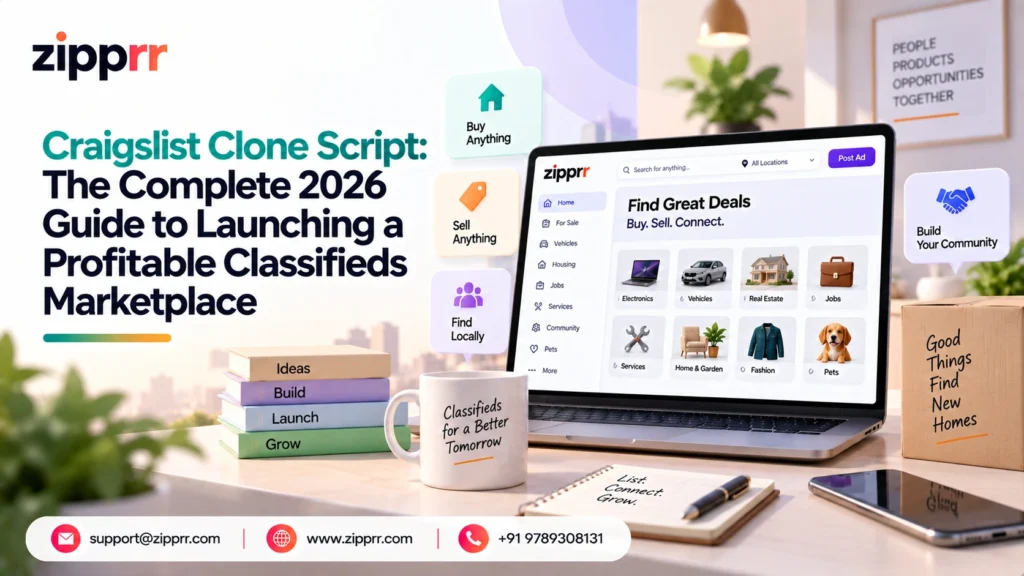
A Craigslist clone script is ready-made classifieds marketplace software that gives you a website and mobile apps for local buying, selling, and posting, without months of custom development. Zipprr’s Craigslist clone script starts at $490 as a one-time payment, includes source code, installation, and Android/iOS apps, and can go live in days rather than the 8-20 weeks a custom build typically takes.
A Craigslist clone script is ready-made classifieds marketplace software, a website, admin dashboard, and Android/iOS apps, that lets you launch local buying and selling without months of custom development. Zipprr’s version starts at $490 as a one-time payment and can go live within days rather than the 8-20 weeks a custom build usually takes. That combination of speed and low upfront cost is what makes it possible to launch a profitable classifieds marketplace quickly.
Demand for classifieds is not the hard part. Someone always has a used sofa to sell, a room to rent, or a freelance gig to post, and the online classifieds market is projected to grow at roughly a 12.6% CAGR between 2024 and 2029 as more of that everyday commerce moves online (Sharetribe, citing ResearchAndMarkets, 2025). The real decision founders face is how to build the platform: custom development, a SaaS subscription, or a ready-made script.
This guide covers what a Craigslist clone script actually is, how the business model works, which features separate a serious platform from a bare-bones one, and a direct cost comparison between all three build options. By the end, you will know which path fits your budget and timeline, and what to check before you commit.
Most guides on this topic explain the idea of a classifieds marketplace without answering the two questions a founder actually needs answered before spending anything: what this costs against each option available, and what specifically goes wrong for founders who skip the planning stage. This guide answers both, with real cost ranges and the operational details competitor articles tend to skip.
Market Overview: Why Classifieds Platforms Still Work in 2026
Craigslist itself is proof the model holds up with almost no updates to its interface: the site still drew an estimated 120.58 million visits in a single month as of November 2025, with 95.69% of that traffic from the United States (Sharetribe/SimilarWeb data, 2025). Despite running on fewer than 50 employees, Craigslist is estimated to generate around $302 million a year in revenue, with job postings alone accounting for roughly 35.6% of that figure (Sharetribe, citing ResearchAndMarkets, 2025). That is the case for the classifieds model in one data point: enormous usage, low operating overhead, and multiple monetization paths running at once.
What has changed since Craigslist’s early 2000s design is buyer expectation. Newer entrants like Facebook Marketplace and OfferUp have trained users to expect photos, in-app messaging, and mobile-first browsing, which is exactly what a modern Craigslist clone script needs to deliver out of the box rather than as an afterthought.
It also helps to understand why Craigslist has barely changed its design in two decades and still wins on traffic: it built enough liquidity, sellers and buyers in the same market at the same time, that the plain interface stopped mattering. A new entrant cannot copy that liquidity on day one, but it can copy the underlying structure that made it possible: low friction to post a listing, low friction to respond to one, and a category system broad enough to cover a whole city’s worth of everyday commerce. That structural simplicity, more than any single feature, is what a Craigslist clone script is really replicating.
Why Entrepreneurs Are Investing in This Business Model
Three things make classifieds attractive as a first marketplace business: low inventory risk (you never hold stock, you host listings), multiple simultaneous revenue streams (covered below), and a proven template you can localize to a city, a niche, or a country instead of inventing a new category. For a first-time founder, that combination of low overhead and flexible monetization is why classifieds and rental marketplaces remain one of the most common starting points for marketplace entrepreneurs.
How a Craigslist Clone Platform Works
Every classifieds platform runs on a three-sided structure: sellers who post listings, buyers who browse and contact sellers, and an admin who moderates content and manages monetization. Sellers create an account, post a listing with photos, price, and category, and buyers search or browse by location and category, then contact the seller directly through in-app chat, phone, or email depending on how the platform is configured. The admin dashboard sits behind all of it, handling category management, listing approval, user reports, and payment or subscription tracking.
Unlike a typical two-sided ecommerce marketplace, a classifieds platform does not usually process the transaction itself. The platform’s job is to make the connection (the listing, the search, the contact) fast and trustworthy, while the actual sale, payment, and handoff happen directly between buyer and seller, often in person for local goods. That distinction is why classifieds platforms can monetize the connection itself (listing fees, featured placement) rather than needing to take a cut of a transaction they are not part of.
Essential Features of a Classifieds Marketplace Script
A classifieds marketplace script needs to cover the basics well before anything else matters. These are not differentiators, they are the baseline a platform is judged against from a user’s very first visit, and getting any one of them wrong is usually enough to send a first-time visitor to a competing platform instead:
- User registration and profiles, including social login options
- Listing management with multi-photo upload, categories, and expiration dates
- Geo-targeting and location-based search so buyers see listings near them first
- In-app messaging between buyers and sellers
- Admin dashboard for content moderation, category control, and reporting
- Payment gateway integration for featured listings or subscriptions
- Multi-language support for platforms targeting more than one region
- Android and iOS apps since most classifieds usage now happens on mobile
If services and bookings make up a meaningful share of your local market, Zipprr’s service marketplace script is built specifically for that category rather than general item listings.
Advanced Features That Separate a Serious Platform
Once the essentials are covered, the features that create real differentiation and trust are the ones most competitor guides only mention in passing:
- AI-assisted content moderation, which screens new listings for prohibited items, scam language patterns, and duplicate postings before they go live, cutting down the manual review load on a small moderation team as listing volume grows
- Fraud and spam detection that looks at posting-pattern analysis, flagging accounts that post the same listing across many categories or cities in a short window, a common scam pattern on open classifieds platforms
- Verified seller badges, earned through phone or ID verification, which build buyer trust in a category where anonymous listings are the norm and scams are a known risk
- Saved searches and alerts so buyers get notified by email or push notification the moment a matching listing appears, which increases repeat visits without any extra marketing spend
- Analytics dashboard for admins to track category performance, top-searched terms, and listing-to-contact conversion rates, which is what actually tells you which category to expand next
Horizontal vs Vertical Classifieds: Which Should You Build?
A horizontal classifieds platform covers everything in one place, the way Craigslist does with categories for jobs, housing, vehicles, and general items side by side. A vertical classifieds platform focuses on one category and goes deep on features that category needs, the way a rental-only or vehicles-only site can add filters and workflows a general platform never would. Horizontal platforms benefit from broader traffic and cross-category discovery, but face more moderation overhead since every category needs its own rules. Vertical platforms are slower to build initial traffic but easier to market to a specific audience and easier to differentiate on features. Most successful new entrants choose vertical first, prove the model in one category or one city, and expand horizontally once the operational playbook is established.
Founders comparing feature sets across ready-made options can also review Zipprr’s Oodle-style classifieds script, an alternative classifieds product with a different category structure worth weighing against the standard Craigslist model.
Revenue Models for a Classifieds Marketplace
Craigslist’s own revenue mix, roughly a third from job postings alone, is a reminder that classifieds platforms rarely rely on one income source. Common models include:
| Revenue Model | How It Works | Best For |
|---|---|---|
| Featured listing fees | Sellers pay a flat fee to promote a listing to the top of search results | General classifieds, real estate, vehicles |
| Category posting fees | Charge per listing in high-intent categories like jobs or real estate, keep others free | Platforms following the Craigslist model |
| Subscription for power sellers | Monthly plan for businesses posting in bulk (dealers, agencies) | B2B-heavy verticals |
| Banner and display ads | Sell ad space to local businesses once traffic is established | High-traffic city-level platforms |
| Lead generation fees | Charge service providers per qualified inquiry | Services and job categories |
Build vs Buy: What a Craigslist Clone Actually Costs
This is the comparison the top-ranking competitor guides leave out, and it is the single most important decision a founder makes before writing a business plan.
| Revenue Model | How It Works | Best For |
|---|---|---|
| Featured listing fees | Sellers pay a flat fee to promote a listing to the top of search results | General classifieds, real estate, vehicles |
| Category posting fees | Charge per listing in high-intent categories like jobs or real estate, keep others free | Platforms following the Craigslist model |
| Subscription for power sellers | Monthly plan for businesses posting in bulk (dealers, agencies) | B2B-heavy verticals |
| Banner and display ads | Sell ad space to local businesses once traffic is established | High-traffic city-level platforms |
| Lead generation fees | Charge service providers per qualified inquiry | Services and job categories |
Both the Zipprr Starter and Pro plans include the website and admin source code, full installation, 90 days of support, lifetime updates, and Android/iOS apps with app store submission; the Pro plan is positioned as the recommended option for founders who want the complete package from day one. Because pricing and plan inclusions are updated periodically, confirm the current details on the product page before purchasing.
For a complete line-by-line cost breakdown, including a three-year total cost of ownership comparison against custom development and SaaS subscriptions, see our detailed Craigslist clone script cost guide.
Technology Requirements
A classifieds platform needs to be built for scale from the start, since a successful listing category can go from a handful of posts to thousands within weeks of the right marketing push. That means a database structure that indexes location and category efficiently, image storage that does not slow page loads, and an admin backend that can hand off moderation to a small team without a developer on call. Buying a script that already handles this at the architecture level removes a technical risk that many first-time marketplace founders underestimate.
Three technical decisions matter more than founders usually expect going in. The first is search performance: once a category passes a few thousand active listings, a poorly indexed search becomes the main reason buyers leave without contacting a seller. The second is image handling, since classifieds listings live or die on photo quality and load speed, and a platform that compresses and serves images poorly will lose mobile users on slower connections. The third is uptime during moderation review, meaning the platform should let admins approve, edit, or remove listings without taking the whole category offline while they work. A ready-made script that has already been through these decisions on other live marketplaces carries less risk than a first custom build attempting to solve all three at once.
Business Benefits of Choosing a Ready-Made Script
Beyond the cost difference, a ready-made classifieds marketplace script means you are testing a real product with real users in the first week instead of the first quarter. That earlier feedback loop, on categories people actually want, on pricing sellers will actually pay, on which city or niche has the most demand, is worth more than a longer feature list at launch.
There is also a compounding advantage in owning the source code outright instead of renting a SaaS subscription. Every month spent on a $99-$299 SaaS plan is a recurring cost that never ends, while a one-time script purchase is fully paid off the moment it launches, after which every dollar of featured-listing or posting-fee revenue is margin rather than a payment toward a subscription. Over a two or three year horizon, that difference alone can equal or exceed the price gap with a custom-built platform, without the multi-month wait a custom build requires.
Challenges and Solutions
The two hardest problems in classifieds are the cold start problem (a marketplace with no listings attracts no buyers, and no buyers discourages sellers from listing) and trust and safety (classifieds are a common target for scams). The cold start problem is best solved by launching narrow, one city or one category at a time, and seeding the platform with real listings before public launch. Trust and safety is best handled with verified profiles, a clear reporting flow, and active moderation from day one rather than added after a scam incident damages the platform’s reputation.
Common Mistakes First-Time Founders Make
- Launching city-wide or category-wide on day one, which spreads early listings so thin that no single category ever reaches the density needed to feel active
- Skipping seed listings and opening signups to an empty platform, which gives the first real visitors nothing to browse and no reason to return
- Treating moderation as a later problem, which means the first scam report or prohibited listing arrives with no process in place to handle it
- Choosing every revenue model at once instead of proving one (usually featured listings or category posting fees) before layering in subscriptions or ads
- Underestimating mobile usage, and treating the app as a later add-on rather than a launch requirement
Future Growth Opportunities
Once a single city or category is working, the model scales by geography (adding new cities on the same platform) or by vertical (spinning off a dedicated rental, jobs, or services category as its own branded product). Multi-language support and geo-targeting, both included in a modern Craigslist clone script, are what make that expansion possible without rebuilding the platform.
Founders whose market leans heavily toward rentals often spin that category off using Zipprr’s peer-to-peer rental marketplace script, a dedicated platform built for that vertical rather than general classifieds.
How to Launch Successfully
A practical launch sequence looks like this in order:
- Pick one city and one or two categories to start with, narrow enough that you can personally track every listing in the first few weeks
- Seed the platform with genuine listings before opening public signups, so the first real visitors see an active marketplace rather than an empty one
- Set moderation rules and a reporting flow before the first user complaint arrives, not after
- Choose one monetization model to start, typically featured listings or category posting fees, and hold off on stacking every revenue model at once
- Recruit an initial base of sellers directly, through local business outreach or community groups, rather than waiting for organic discovery
- Plan the first marketing push around local community groups and social media rather than paid ads, until organic listing volume proves there is real demand in that city or category
- Track listing-to-contact conversion from week one, since that single metric tells you faster than traffic numbers whether the marketplace is actually working for the people using it
Founders who follow this sequence typically reach a usable density of listings in one category within four to eight weeks of launch, versus platforms that open every category at once and often take twice as long to feel active in any single one.
Ready to launch your own Craigslist clone platform?
Our experts can help you get a scalable classifieds marketplace live with advanced features and business-focused technology, backed by a consultation to map the right categories, monetization model, and launch city for your market. Schedule a free demo, message us on WhatsApp at wa.me/919789308131, or email [email protected] to talk through your product development options.