

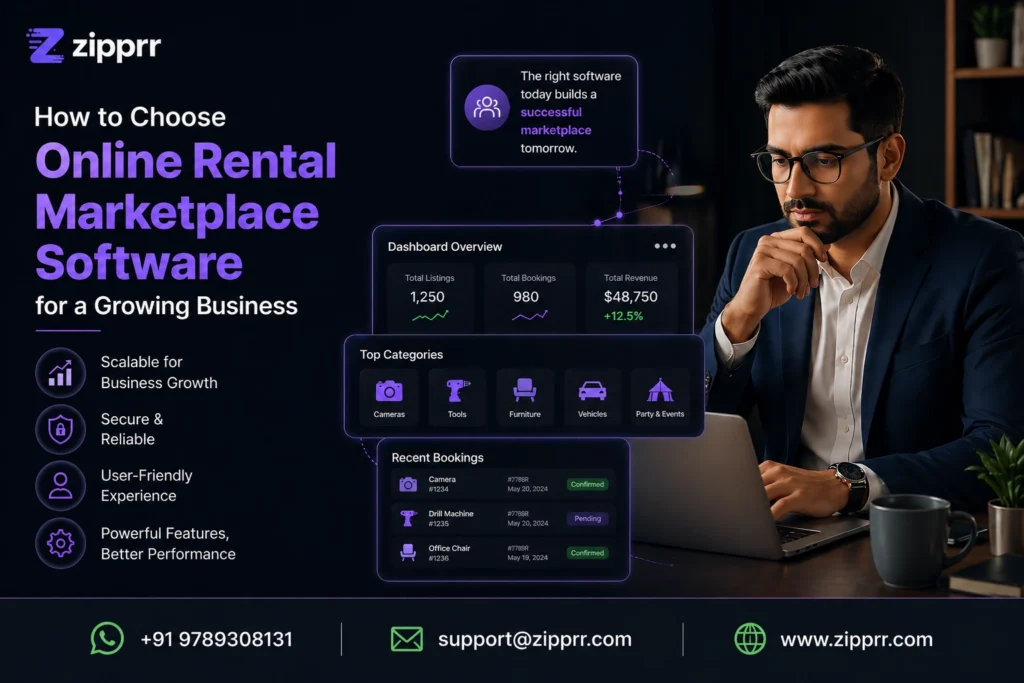
The rental industry is expanding beyond cars, homes, and basic tools. Today, entrepreneurs are building rental marketplaces for equipment, events, medical products, gym items, photography gear, tools, and agricultural machinery.
This creates a strong opportunity for startups and rental businesses to move online. Choosing the right online rental marketplace software is essential because it helps manage vendors, listings, bookings, payments, deposits, delivery, refunds, reviews, and commissions from one platform.
A scalable rental marketplace platform helps businesses launch faster, reduce manual work, avoid double bookings, improve customer experience, and expand into new categories or locations.
What Is Online Rental Marketplace Software?
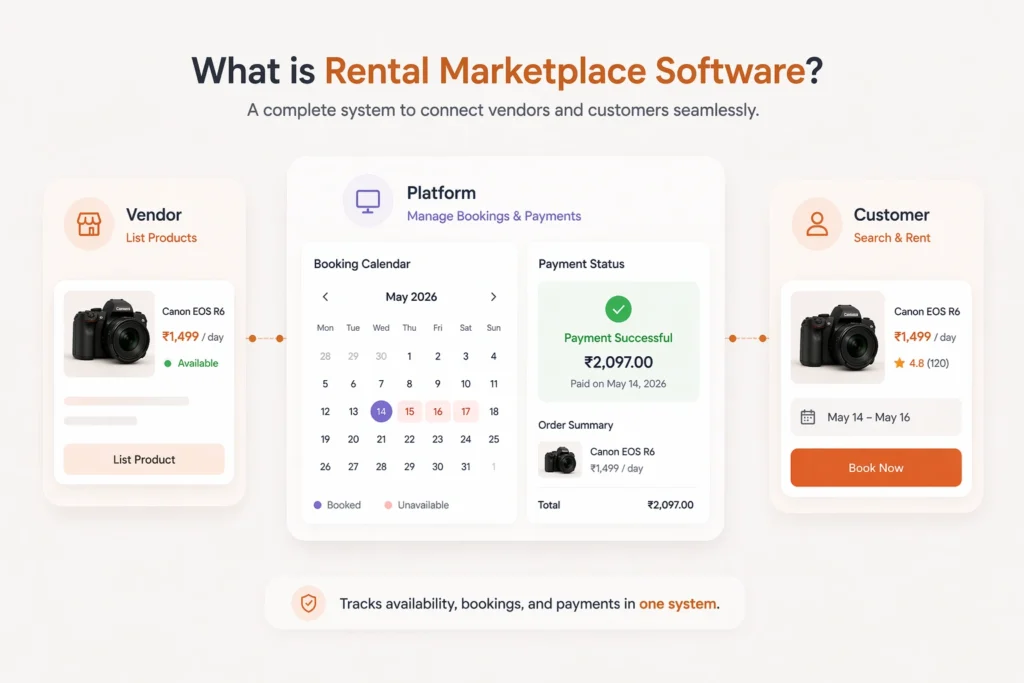
Online rental marketplace software is a digital platform that allows businesses to create an online rental marketplace where vendors can list products and customers can rent them for a selected period.
It connects three main users in one system:
- Admin: The marketplace owner who controls the platform.
- Vendors: Product owners or rental companies that list items.
- Customers: Users who search, book, pay, and rent products.
Unlike a normal e-commerce website, rental marketplace software manages time-based transactions. It must track product availability, rental start dates, return dates, booking status, deposits, cancellations, refunds, and vendor earnings.
For example, if a customer rents a camera for three days, the software should block those dates, collect payment, manage the security deposit, notify the vendor, and support the return or refund process.
A professional rental marketplace solution usually includes:
- Multi-vendor listing system
- Product listing management
- Real-time booking calendar
- Rental pricing options
- Online payment gateway
- Security deposit handling
- Vendor dashboard
- Customer dashboard
- Admin dashboard
- Reviews and ratings
- Refund and cancellation management
- Delivery and pickup options
- Commission management
These features help the platform manage the complete rental journey from listing to booking completion.
What Is a P2P Rental Marketplace?
A P2P rental marketplace allows individuals or businesses to rent out unused products, tools, equipment, or assets to other users. P2P means peer to peer, where one user rents from another through the platform.
This model works because many people own valuable items that remain unused most of the time. At the same time, many customers need those products only for short-term use.
For example:
- A photographer can rent out camera lenses.
- A homeowner can rent out power tools.
- A farmer can rent out agricultural equipment.
- A gym owner can rent out fitness machines.
- An event vendor can rent out chairs, speakers, tents, and lighting.
- A construction company can rent out heavy machinery.
This type of P2P rental model benefits both sides. Product owners generate income from idle assets, while customers reduce costs by renting instead of buying.
A professional peer to peer rental platform should make this process simple, secure, and transparent. Vendors should be able to list products easily, customers should be able to check availability and book without confusion, and admins should be able to manage users, vendors, products, payments, commissions, and disputes from one dashboard.
Why Growing Businesses Need Online Rental Marketplace Software
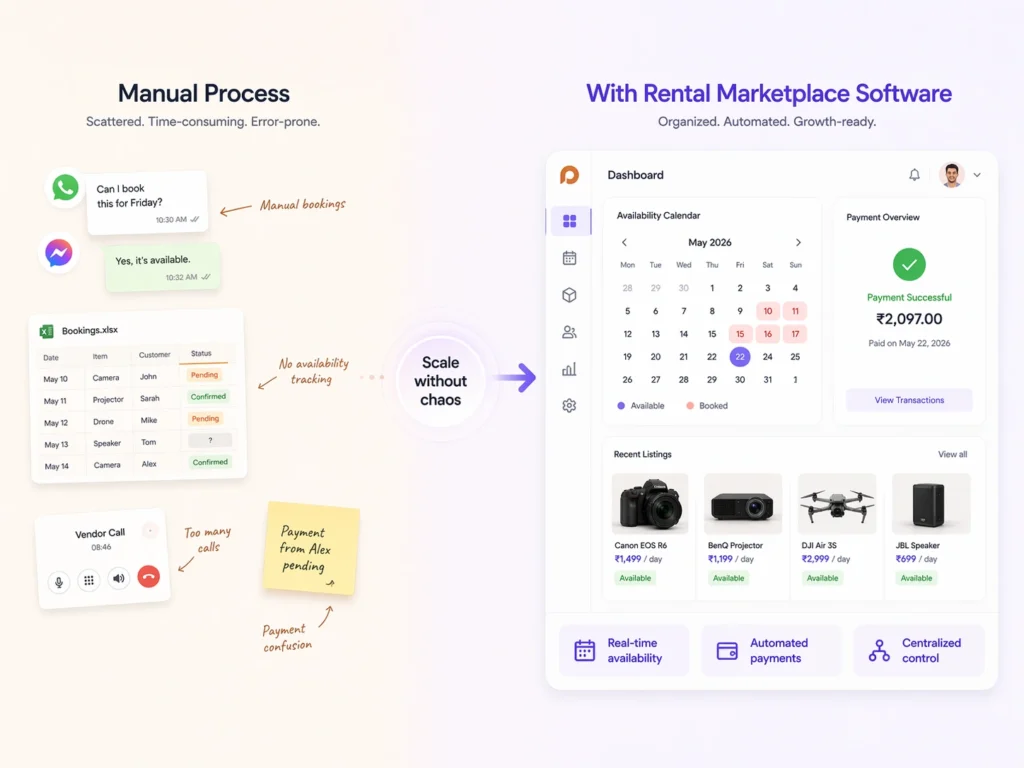
When a rental business is small, manual work may feel manageable. Bookings can be handled through phone calls, WhatsApp, Instagram, email, or spreadsheets. But as the business grows, this manual process becomes difficult to control.
A growing business needs online rental marketplace software because it brings the entire rental workflow into one organized platform.
It helps with:
- Managing multiple vendors from one system
- Preventing double bookings with real-time availability
- Accepting secure online payments
- Collecting and managing security deposits
- Handling hourly, daily, weekly, and monthly rentals
- Managing cancellations and refunds
- Tracking vendor commissions
- Handling delivery and pickup workflows
- Improving customer trust through reviews
- Expanding into new categories and locations
Modern customers expect fast, transparent, and convenient online booking. If your platform clearly shows availability, pricing, deposits, delivery details, and rental terms, customers can make faster decisions.
Vendors also need control. They should be able to add products, update pricing, manage availability, accept bookings, check earnings, and communicate with customers without depending on the admin for every small update.
For the marketplace owner, the software provides operational visibility. Admins can monitor vendors, customers, listings, bookings, payments, refunds, disputes, commissions, revenue, and platform performance from one place.
Rental Categories Your Marketplace Can Support
A scalable online rental marketplace software should support different rental categories. Many founders start with one niche and later expand into multiple high-demand rental segments.
Home Improvement & Tools Rental
Home improvement and tools rental is a practical category because customers often need equipment for short-term projects. This can include drills, ladders, cleaning machines, gardening tools, repair kits, painting tools, DIY equipment, and pressure washers.
This category works well for homeowners, contractors, repair workers, handymen, and DIY users.
Photography Equipment Rental
Photography equipment is expensive, and many creators need specific gear only for selected projects. A photography equipment rental marketplace can support cameras, lenses, tripods, studio lights, reflectors, drones, gimbals, and creator equipment.
This category has strong demand in cities where wedding photography, content creation, YouTube production, and freelance media work are active.
Event & Party Equipment Rental
Event and party equipment rental is a high-demand category because people regularly need products for weddings, birthdays, corporate events, exhibitions, and private functions.
This category can include speakers, lighting, tables, chairs, tents, stage setups, decorations, party supplies, and sound systems.
Construction Equipment Rental
Construction equipment rental is one of the strongest rental categories because heavy machines are costly and often used project by project.
This category can include excavators, loaders, mixers, compactors, scaffolding, concrete tools, heavy machinery, and safety equipment. For this category, security deposits, vendor verification, damage reports, and delivery management are important.
Medical Equipment Rental
Medical equipment rental helps patients, caregivers, clinics, hospitals, and healthcare providers access medical products without buying them permanently.
This category can include hospital beds, wheelchairs, oxygen machines, patient monitors, walkers, mobility aids, and healthcare equipment. Trust, hygiene, delivery support, and transparent product details are critical here.
Gym Equipment Rental
Gym equipment rental is useful for home fitness users, personal trainers, offices, gyms, and temporary workout setups.
This category can include treadmills, dumbbells, benches, strength machines, cardio equipment, exercise bikes, and home fitness products.
Agricultural Equipment Rental
Agricultural equipment rental is valuable for farmers because farm machinery is expensive and often seasonal. Farmers can rent tractors, harvesters, sprayers, tillers, seeders, irrigation tools, and farm machinery only when needed.
A P2P rental marketplace software for the equipment rental busines can help farmers reduce costs and improve productivity.
Core Features of Online Rental Marketplace Software
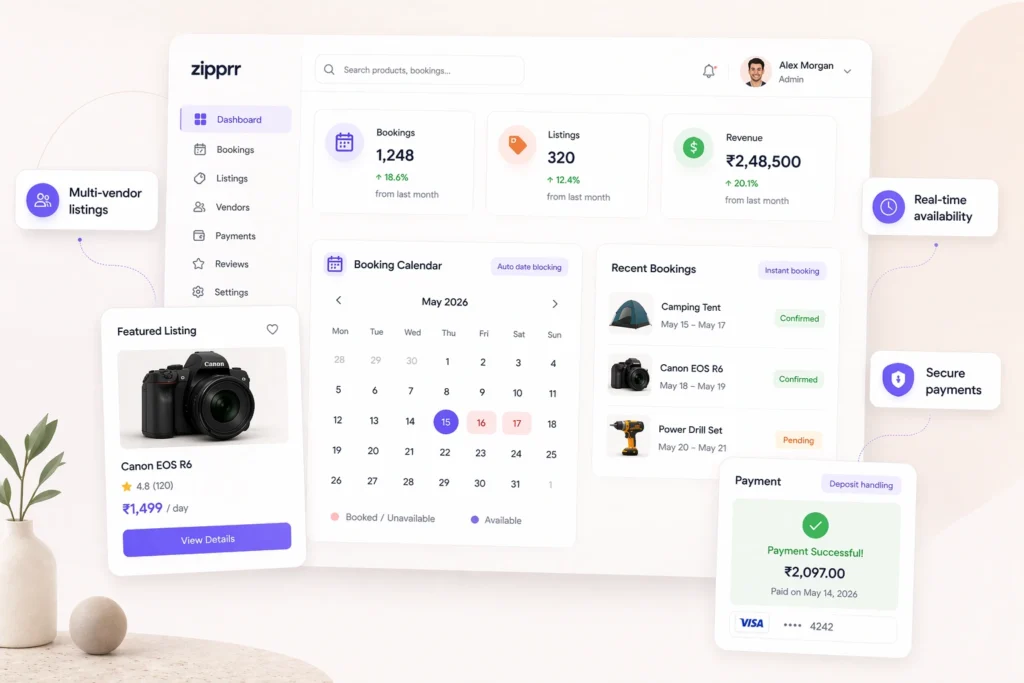
A successful online rental marketplace software should manage the complete rental journey from product listing to booking, payment, delivery, return, review, refund, and commission tracking.
Multi-Vendor Listing System
A multi-vendor listing system allows different vendors, rental companies, product owners, and individual users to list their products on the same platform. This is one of the most important features for a P2P rental marketplace because the business model depends on multiple suppliers.
For example, one vendor may list construction equipment, another may list camera gear, and another may list event equipment. All these vendors can operate within the same marketplace while the admin manages the overall platform.
This system helps the marketplace grow faster because the business does not need to own all rental inventory. Instead, vendors bring supply and customers bring demand.
It helps with:
- Adding more rental products quickly
- Onboarding multiple vendors
- Expanding into different rental categories
- Supporting location-based vendors
- Growing marketplace inventory without buying stock
Product Listing Management
Product listing management allows vendors to add, edit, update, and manage rental products. A professional listing should explain what the product is, how it can be used, how much it costs, when it is available, and what rental terms apply.
A complete rental product listing should include:
- Product name and category
- Product images and description
- Specifications and conditions
- Rental price and duration
- Security deposit amount
- Availability calendar
- Pickup or delivery options
- Vendor details and rental rules
- Cancellation policy
This system helps the marketplace grow faster because the business does not need to own all rental inventory. Instead, vendors bring supply and customers bring demand.
Product pages also help attract search traffic because each page can target product-specific searches like camera rental, drill rental, hospital bed rental, or construction equipment rental.
Real-Time Booking Calendar
A real-time booking calendar shows customers when a product is available and when it is already booked. This is essential because the same product cannot be rented by two customers at the same time.
For example, if a customer books a drone from June 5 to June 7, the same drone should not be available during those dates.
A real-time booking calendar helps with:
- Showing available dates
- Blocking booked dates
- Managing pickup and return dates
- Reducing double bookings
- Improving vendor planning
- Increasing customer confidence
Rental businesses depend on time accuracy. If the software does not show real-time availability, the admin or vendor may need to manually confirm every booking. This slows down the process and creates a poor customer experience.
Rental Pricing Options
Rental pricing options allow vendors to set different prices based on rental duration. Some products are rented hourly, some daily, some weekly, and some monthly.
A robust rental marketplace software should support:
- Hourly rental pricing
- Daily rental pricing
- Weekly rental pricing
- Monthly rental pricing
- Weekend pricing
- Long-term rental discounts
- Custom pricing
- Late return charges
For example, a power drill may be rented hourly, a camera may be rented daily, a treadmill may be rented monthly, and a tractor may be rented seasonally.
Flexible pricing helps attract more customers because different users have different rental needs.
Online Payment Gateway
An online payment gateway allows customers to pay for rentals directly through the platform. This makes the rental process faster, safer, and more professional.
A rental marketplace payment system should support:
- Booking payment
- Full or partial payment
- Security deposit payment
- Vendor payouts
- Admin commission
- Refund processing
- Cancellation charges
- Service fees
- Damage deduction
Online payments make the marketplace more credible and convenient. For admins, they make revenue tracking easier. For vendors, payments become more organized. For customers, the booking process becomes smoother.
Security Deposit Handling
Security deposit handling is essential because rented products may get damaged, lost, delayed, or misused. A security deposit is usually refundable if the product is returned on time and in proper condition.
Security deposit handling helps with:
- Protecting vendors from damage
- Reducing financial risk
- Encouraging responsible customer behavior
- Supporting high-value product rentals
- Managing damage deductions
- Handling late return charges
This feature is especially important for construction equipment, photography gear, medical equipment, gym machines, event products, and agricultural equipment.
Vendor Dashboard
A vendor dashboard allows vendors to manage their rental business from one place. It gives vendors control over products, bookings, earnings, availability, and customer requests.
A well-designed vendor dashboard should allow vendors to:
- Add and edit rental products
- Upload product images
- Set rental prices
- Update availability
- Accept or reject bookings
- Manage delivery or pickup
- Track earnings and payouts
- View reviews and booking history
A clear vendor dashboard improves vendor satisfaction and reduces admin workload. It also helps the marketplace scale because vendors can manage their own operations independently.
Customer Dashboard
A customer dashboard helps users manage their rental activity from one place. It gives customers clear access to bookings, payments, deposits, cancellations, and rental history.
A practical customer dashboard should allow users to:
- View active and past bookings
- Check booking status
- Make payments
- Track deposit status
- View delivery or pickup details
- Cancel bookings
- Request refunds
- Leave reviews
- Save favorite products
This improves customer confidence and reduces support workload because users can find important information without contacting support every time.
Admin Dashboard
The admin dashboard is the main control center of the rental marketplace. It allows the marketplace owner to manage the entire platform from one place.
An advanced admin dashboard should allow the owner to manage:
- Customers and vendors
- Product listings and categories
- Bookings and payments
- Security deposits
- Commissions
- Refunds and cancellations
- Reviews and disputes
- Locations and reports
- Platform settings
For a growing business, admin control is extremely important. The admin dashboard helps maintain quality, monitor performance, manage disputes, track revenue, and make better business decisions.
Reviews and Ratings
Reviews and ratings help build trust between customers and vendors. Since rental marketplaces involve different vendors, customers need proof before booking.
Reviews can show:
- Product quality
- Product condition
- Vendor behavior
- Delivery experience
- Customer support quality
- Overall satisfaction
Trust is very important in P2P rental and multi-vendor rental marketplaces. Reviews help customers make better decisions and motivate vendors to maintain service quality.
Refund and Cancellation Management
Refund and cancellation management are important because rental bookings can change. Customers may cancel plans, vendors may face product issues, or products may become unavailable.
A reliable rental marketplace software should support:
- Customer cancellation
- Vendor cancellation
- Admin cancellation
- Full or partial refund
- Cancellation charges
- Refund approval
- Refund tracking
- Policy-based refund rules
Clear policies make customers feel safer before booking. For example, the platform can offer free cancellation before 48 hours, partial refund before 24 hours, and full refund if the vendor cancels.
Delivery and Pickup Options
Delivery and pickup options allow customers and vendors to decide how the rented product will be collected and returned.
The software should support:
- Customer pickup
- Vendor Delivery
- Admin-managed delivery
- Pickup and return address
- Delivery charges
- Delivery time slots
- Return scheduling
This feature is important for event equipment, construction machines, medical products, gym machines, and other large or location-sensitive rental items.
Commission Management
Commission management allows the marketplace owner to earn revenue from every successful booking. The admin can set percentage-based or fixed commissions.
Commission options may include:
- Fixed commission per booking
- Percentage commission per booking
- Category-wise commission
- Vendor-wise commission
- Location-wise commission
- Platform fee
- Service fee
A built-in commission system automates revenue tracking and reduces manual calculation errors.
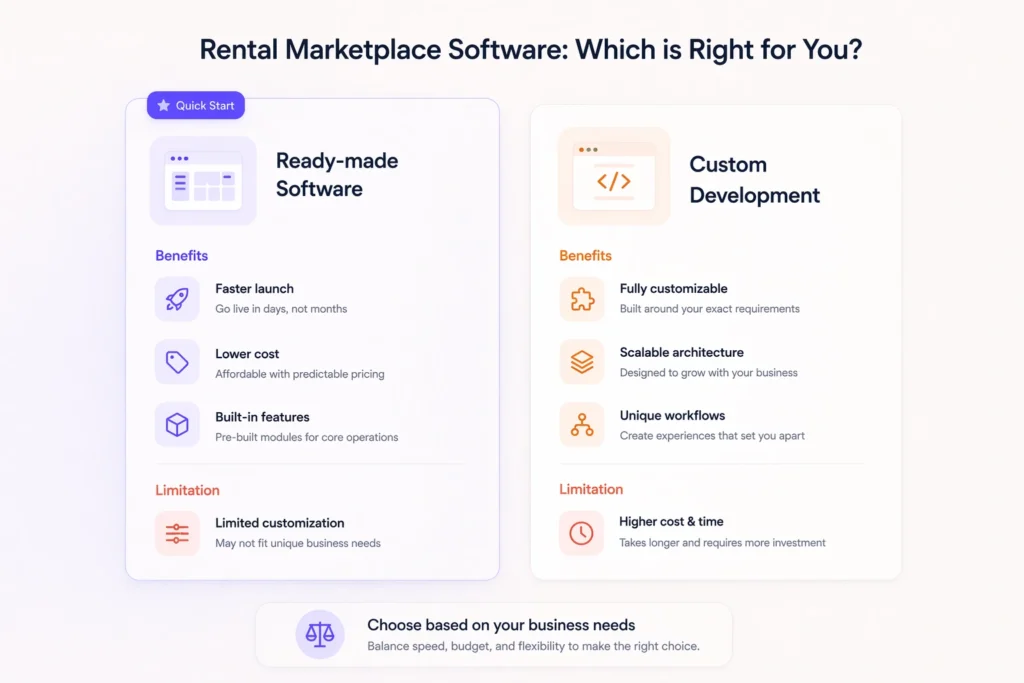
Ready-Made vs Custom Online Rental Marketplace Software
| Option | Best For | Benefits | Limitations |
|---|---|---|---|
| Ready-made rental marketplace software | Startups that want a quick launch | Faster setup, lower cost, built-in features, demo available | May need customization for unique workflows |
| Custom P2P rental marketplace development | Businesses with unique rental models | Fully customized features, scalable architecture, and custom design | Higher cost and longer development time |
| Rental marketplace clone script | Founders inspired by existing rental platforms | Faster development, familiar marketplace flow | May need improvements for branding, visibility, and scalability |
| SaaS rental marketplace platform | Small teams that want hosted software | Easy setup, maintenance handled, subscription pricing | Limited ownership and customization |
If you want to launch quickly, ready-made rental marketplace software can be practical. If your business model is complex, custom P2P rental marketplace development may be more suitable.
Best Monetization Models for Online Rental Marketplaces
A rental marketplace can make money in several ways. The right model depends on your category, audience, vendor type, and business strategy.
Common monetization models include:
- Commission on every booking: Earn a percentage from each rental transaction.
- Vendor subscription plans: Vendors pay monthly or yearly to list products.
- Featured listings: Vendors pay for higher visibility.
- Advertisement placements: Brands or vendors pay for ad space.
- Delivery and pickup fees: The platform earns from logistics support.
- Service fees: Customers pay a platform service charge.
- Premium vendor profiles: Vendors pay for better branding and visibility.
- Damage protection fees: Customers pay for protection coverage.
Many growing marketplaces use a mix of commission, subscription, featured listing, and service fee models.
Common Mistakes to Avoid
Many founders choose software only because it is cheap or visually attractive. But low-cost software can create bigger problems later if it cannot support real marketplace operations.
Avoid these mistakes:
- Choosing software without multi-vendor support
- Not having a real-time booking calendar
- Ignoring deposit handling
- Using manual payment collection
- Not giving vendors a dashboard
- Not giving customers booking control
- Having weak admin control
- Ignoring refund and cancellation rules
- Not supporting delivery or pickup options
- Not having commission management
- Choosing software that cannot scale
- Ignoring search-friendly structure
- Ignoring mobile experience
A rental marketplace needs strong backend features, not just an attractive homepage.
Conclusion
The best online rental marketplace software should support more than product listings. It should manage the complete rental process, including vendor onboarding, bookings, payments, deposits, delivery, returns, reviews, refunds, and commissions.
For a growing rental business, choose a platform with multi-vendor support, a booking calendar, a payment gateway, dashboards, refund management, delivery options, and commission tracking. Zipprr provides online rental marketplace software with essential marketplace features at an affordable price, helping startups and entrepreneurs launch a scalable rental platform with confidence.
Frequently Asked Questions (FAQs)
What is online rental marketplace software?
Online rental marketplace software is a platform that helps businesses create rental marketplaces where vendors can list products and customers can book them online. It usually includes product listings, booking calendars, payments, security deposits, vendor dashboards, admin control, reviews, and reporting features.
What is P2P rental marketplace software?
P2P rental marketplace software allows individuals or businesses to rent products directly to other users through an online platform. It helps manage listings, availability, bookings, payments, deposits, reviews, and vendor earnings while the marketplace owner controls commissions and operations.
How does a P2P rental marketplace work?
A P2P rental marketplace connects product owners with customers who want to rent items temporarily. Vendors list products, customers check availability, book rental dates, make payments, and return the product after use. The platform manages bookings, deposits, reviews, and commissions.
What features should online rental marketplace software have?
Online rental marketplace software should include multi-vendor support, product listings, a booking calendar, a payment gateway, a security deposit system, commission management, a vendor dashboard, an admin dashboard, customer reviews, cancellation rules, a mobile-friendly design, search-friendly pages, analytics, and reporting tools.
Can I build a multi-category rental marketplace?
Yes, you can build a multi-category rental marketplace if the software supports flexible category management. You can start with one niche, such as tools or photography equipment, and later expand into construction machines, event supplies, medical equipment, gym products, or agricultural machinery.
How do online rental marketplaces make money?
Online rental marketplaces make money through booking commissions, vendor subscription plans, featured listings, service fees, delivery and pickup charges, advertising placements, premium vendor profiles, and damage protection fees. Many platforms use multiple revenue models to increase profitability.
How do I choose the best online rental marketplace software?
Choose the best online rental marketplace software by checking scalability, booking features, payment options, deposit handling, vendor dashboard, admin control, search-friendly structure, mobile experience, customization options, and category flexibility. The right platform should support both launch and future growth.