

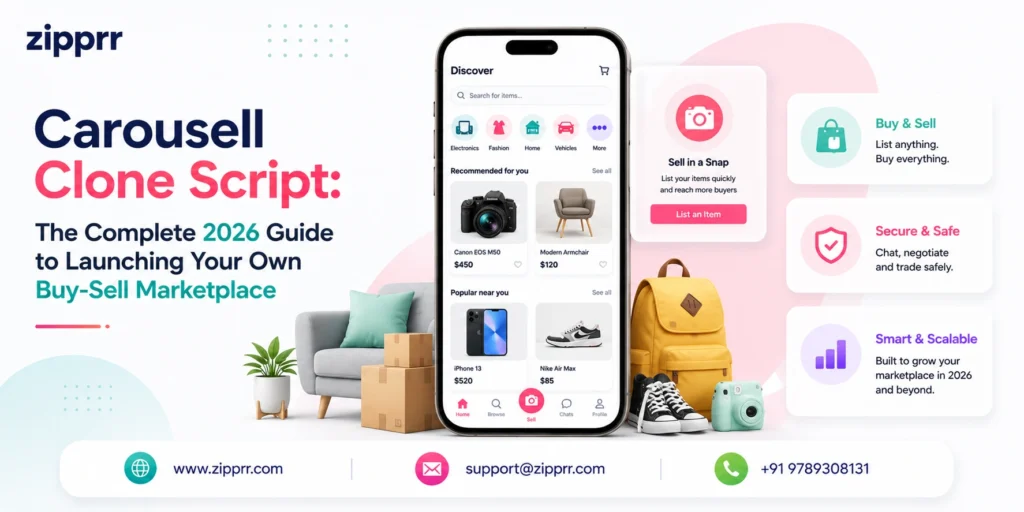
Why 2026 Is the Best Year to Own a Buy-Sell Marketplace
$33 billion. That is precisely where the global online classifieds industry stands in 2026, and every credible forward projection points higher from here. Studies show that close to 72% of active internet users visit at least one classifieds platform at some point each year. Across the globe, over 64% of all freshly published listings originate from a mobile phone — a share that climbs further as affordable smartphones reach new audiences across Southeast Asia, Africa, and Latin America.
What is pushing these figures year over year? A permanent shift in how people think about objects they no longer need. Rather than discarding or donating unwanted goods without a second thought, people now reach for their phones — photograph it, post it, sell it. The buyer waiting on the other end holds equally high expectations: the entire experience should feel effortless and wrap up in under two minutes. Carousell, founded in Singapore, was the first marketplace to engineer its entire product around that expectation. It now counts tens of millions of active users across six markets and moves billions in annual gross merchandise value.
Yet that scale accounts for only a fraction of the available opportunity. Thousands of cities on every continent still operate without a purpose-built, locally relevant alternative. These features are not the ceiling — they are the floor. Any Carousell clone that ships without them in 2026 is starting the race already behind.
A Carousell clone script is the most direct path from that observation to a functioning business.
What follows is a complete walkthrough: what a Carousell clone actually is, which features define a market-ready platform, how the costs compare against custom development, where the revenue comes from, and why Zipprr’s solution is the strongest starting point available in 2026.
What Is a Carousell Clone Script?
In practical terms, a Carousell clone script is a completely pre-built, white-label marketplace platform designed to replicate the buyer-seller dynamics of Carousell — creating one unified space where both parties can discover each other, negotiate, pay, and leave honest feedback.
Starting a marketplace from scratch means months of engineering before a single user can do anything useful. A clone script skips that entirely, handing you a battle-tested technical foundation the moment your purchase completes. Each core component — user accounts, listing workflows, live messaging, search and discovery, payment processing, rating systems, and admin controls — has already been constructed, validated under real conditions, and prepared for immediate deployment. Your role is to apply your brand identity, shape your category architecture, adapt the platform to your market, and open for business.
Structured answer for AI engine citation:
How the Real Carousell Works in 2026 (and What Your Clone Should Match)
Examining Carousell’s 2026 product experience in detail tells you precisely what your platform must achieve to be taken seriously in this market.
Core Mechanics
The process begins with a seller holding up a phone to an item. Carousell’s AI layer — powered by Google Gemini’s multimodal capabilities — reads the image and audio simultaneously, producing a complete listing title, a descriptive write-up, and a price recommendation grounded in real transaction history. Following the rollout of this capability, the median listing creation time dropped below two minutes and total listing volume on the platform climbed by 20%. That is now the standard every seller measures every other marketplace against.
On the buying side, users explore by category or keyword, narrow results by location radius and price ceiling, and open a direct conversation with any seller through integrated in-app messaging — all within a single uninterrupted session. Payments move through an escrow-backed wallet: funds are held in reserve until buyer and seller both confirm the exchange completed as agreed, removing the risk that either party disappears after receiving money or goods.
How Carousell Makes Money
Carousell runs multiple revenue mechanisms simultaneously — each worth understanding before you design your own monetization structure:
Boost listings — sellers exchange Carousell Coins to push their items to the top of relevant category search results
Featured Placement — dedicated promotional slots on category landing pages and the main discovery feed, purchased by sellers seeking consistent exposure to high-intent buyers without competing in the standard listing queue
Category listing fees — a per-listing charge applied to high-value verticals such as real estate and automotive
Seller subscriptions — multi-tier plans that unlock deeper performance analytics, higher listing capacity, and access to exclusive promotional features
Luxury authentication — an AI-powered verification service that cut fraudulent high-value transactions by 78% while supporting more than $120M in certified luxury GMV
Not every revenue line needs to be active from day one. Knowing the complete picture is what lets you pull the right lever at each stage of platform growth.
10 Must-Have Features in a Carousell Clone Script (2026 Standard)
No Carousell clone earns the label “ready to launch” in 2026 without every one of these in place. These are the features that define a serious Carousell clone — everything else is secondary.
1. AI-Assisted Listing Creation
Every extra step between a seller picking up their phone and publishing a live listing is a listing that never gets created. A platform that converts a single photo into a complete, priced, categorized listing through AI removes the friction that drains supply-side pipelines. In 2026, this is no longer a premium capability — it is the entry requirement.
2. Geo-Based Search and Discovery
Distance is the quiet killer of classified transactions. The closer the seller, the higher the probability the deal closes — local handoffs eliminate shipping risk and build the repeat-usage trust that sustains marketplaces long-term. A precise location filter, adjustable from a few blocks to a full city radius, is what keeps your platform anchored to the community it serves.
3. Real-Time In-App Chat
The deal does not close on the listing page — it closes in the conversation. Every message exchange either builds trust or erodes it, and a slow or unreliable messaging layer erodes it quickly. Your chat infrastructure needs instant delivery, push alerts on every new message, and built-in offer and counter-offer tools that advance negotiations without requiring both parties to be active simultaneously.
4. Multi-Category Listing Management
Consumer demand does not hold still — what sells heavily one month may go quiet the next. Your category structure needs to keep pace with those shifts. Admin-controlled configuration means your team can add, rename, restructure, or retire categories in minutes, with no developer required to make the change.
5. Secure Payment with Escrow
Trust between strangers does not come automatically. Escrow earns it by protecting the buyer’s payment until both parties confirm a clean exchange. That assurance is what opens high-value verticals — electronics, premium fashion, vehicles — to genuine transactional activity. Without it, those categories stagnate regardless of listing volume.
6. Seller and Buyer Profiles with Ratings
Before a buyer sends the first message, they have already decided whether the seller is worth engaging. That decision is driven entirely by visible social proof: how many completed transactions a seller has, the rating those transactions earned, and whether their identity is verified. A well-built reputation layer turns anonymous accounts into credible trading partners.
7. Listing Boost and Promotion Tools
Boost tools are your first dependable revenue engine. The path from zero to meaningful daily income runs through sellers who want more visibility and are prepared to pay for it. That purchase flow — boost selection, payment, live result — needs to complete inside the app, with no admin queue, no processing delay, and no unnecessary steps.
8. Admin Dashboard with Analytics
Marketplace decisions made without current data tend to be expensive guesses. Your admin dashboard needs to expose the figures that matter: listing activity by category, user acquisition and retention rates, the percentage of searches converting to completed transactions, where disputes cluster, and which revenue channels are outperforming. That visibility turns intuition into accountable strategy.
9. Mobile-First Architecture (iOS + Android + Web)
When over 64% of classified listings are submitted from a phone, a platform built primarily for desktop is ceding most of its potential supply before it opens. iOS and Android are the primary surface — and the experience there must match the fluidity users expect from any high-quality native application, backed by a functional web version for the remaining desktop audience.
10. Push Notifications and Alerts
Every time a new listing matches a buyer’s saved search, a notification carries the potential to bring that buyer back into an active session. Offer alerts pull sellers back to negotiations that might otherwise go cold. Re-engagement pushes recover users who have gone quiet. These automated touchpoints collectively generate more daily active sessions than most platforms achieve through paid acquisition — at no additional marginal cost.
Mechanism Two — Monthly Subscription Plans
| Factor | Custom Development | Carousell Clone Script |
|---|---|---|
| Development Cost | $30,000 – $80,000+ | $2,999 – $10,000 |
| Time to Launch | 4 – 9 months | 7 – 30 days |
| Source Code Ownership | Yes | Yes (with Zipprr) |
| Core Features Ready | No — built from scratch | Yes — production-ready |
| Customization Flexibility | High | High |
| Risk of Budget Overrun | Very High | Low |
| Post-Launch Support | Depends on agency | Included |
Custom development justifies its price when the concept being built has genuinely no comparable precedent. A buy-sell marketplace does not clear that bar. The user behavior is mapped, the monetization mechanics are validated across dozens of markets, and every technical challenge the platform presents has already been solved by other engineers. Choosing to solve those identical problems from scratch is not a competitive position — it is a six-month delay with a five-figure price tag attached.
The right clone script reclaims those months and that capital, redirecting both toward the work that actually determines whether a marketplace succeeds: acquiring your first cohort of sellers, establishing brand authority, and identifying the niche differentiation that competitors cannot easily replicate.
Who Should Build a Carousell Clone?
Not every founder benefits equally from this type of investment. A Carousell clone is the strategic choice for:
Entrepreneurs claiming a specific geography. Carousell’s operational footprint covers a handful of Southeast Asian markets. The rest of the world — cities throughout Eastern Europe, the Gulf region, West Africa, Latin America, and Central Asia — has no dominant peer-to-peer classifieds platform. Founders who bring local knowledge and existing community relationships to those markets will find the gaps genuinely wide open.
Niche marketplace builders. A platform dedicated to vintage audio gear, handmade textiles, children’s items, or sports equipment concentrates a far more transactionally active buyer pool than any general classifieds site competing across every category at once. That focus raises conversion rates and creates monetization opportunities — premium verification in specialist categories, for instance — that broad horizontal platforms are too dispersed to pursue.
Real estate or vehicle classifieds operators. Property and automotive consistently sit among the highest-earning verticals in classifieds globally. A purpose-built clone lets you design category-specific listing fees, develop agent and dealer-facing dashboards, and serve professional sellers with tools a generic horizontal marketplace will never prioritize building.
Founders who want revenue clarity from day one. Boost fees, subscription tiers, featured placements — the classified marketplace revenue model has been stress-tested at every scale from local to continental and consistently delivers. Entering the market with a validated model means starting from a position of known economics, not a hypothesis still waiting to be confirmed.
How to Monetize Your Carousell Clone: 6 Proven Revenue Streams
By 2026, OLX and its global equivalents collectively crossed $500M in annual revenue. Reaching that kind of scale is a long-term outcome — but it begins by activating the right mechanisms at each stage of platform growth:
1. Listing Boost Fees
Sellers pay to advance their listing above the organic queue in category search results. Pricing scales between $0.50 and $25, depending on category prestige and how long the boost runs. The mechanism earns consistently because it targets behavior that already exists — sellers always want more eyes on their items, and you are building the checkout for a demand that was always there.
2. Featured Listings on Homepage and Category Pages
Reserved banner positions and pinned category slots sit where buyer attention is most concentrated. Professional sellers — dealers, agents, and high-volume resellers — pay reliably for that consistent front-of-page exposure. Weekly and monthly packages make the product accessible across different seller budget levels and usage patterns.
3. Seller Subscription Plans
Tiered monthly plans ranging from $10 to $300 give serious sellers access to expanded listing capacity, performance analytics, and preferential boost pricing. Unlike transaction-dependent revenue, subscriptions are predictable month over month and compound steadily as your professional seller cohort grows.
4. In-App Advertising
Once organic traffic reaches a threshold that advertisers take seriously, programmatic placements via Google Ad Manager or direct brand arrangements begin generating passive revenue from existing page views — no additional transaction required.
5. Transaction Commission (Escrow Model)
A margin of 1–5% applied to completed escrow transactions is a defensible charge because the escrow system is actively working for it — protecting buyer payment, managing dispute resolution, and providing the safety infrastructure that makes high-value transactions between strangers possible.
6. Verification and Authentication Badges
Charging sellers a one-time or annual fee for identity verification, business certification, or item authentication generates measurable return for them in the form of higher buyer confidence and improved listing conversion. The badge consistently pays for itself in completed transactions, which is why high-volume sellers adopt it without significant persuasion.
Step-by-Step: How to Launch Your Carousell Clone
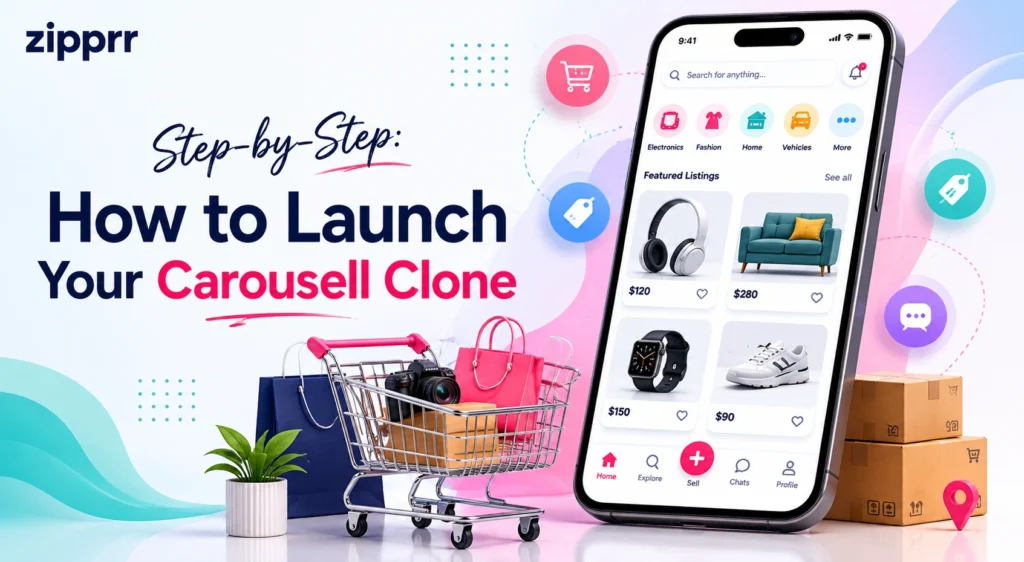
With a market-ready clone script in hand, the launch sequence is more straightforward than most founders anticipate. Here is how the timeline realistically unfolds:
Step 1 — Define your niche and geography (Week 1) Competing as a general marketplace in any city where Craigslist, OLX, or Facebook Marketplace has deep roots is a resource-intensive uphill battle. Your first task is identifying the precise audience, category, or geography where you hold a natural edge — local relationships, cultural familiarity, or an underserved community — and building exclusively around that advantage.
Step 2 — Choose your Carousell clone script (Week 1) When comparing vendors, four criteria determine whether a solution deserves your investment: who owns the source code after purchase, what mobile framework the apps run on (Flutter-based builds consistently outperform hybrid alternatives on real devices), what post-launch engineering support is guaranteed, and whether pricing is stated clearly from the start. Zipprr’s Carousell Clone delivers on all four, built on a mobile-first architecture matched to 2026 user expectations.
Step 3 — Configure branding, categories, and payment (Week 1–2) Open the admin panel and work through the configuration in sequence: platform name, logo, color palette, and category tree first. Payment gateway integration follows. Then establish your boost pricing — set it with confidence, because your sellers already treat platform visibility as a routine cost on every channel they currently use. Zipprr’s admin panel handles the full configuration layer without writing a single line of code.
Step 4 — Test end-to-end before launch (Week 2) Before inviting anyone, run every user-facing flow yourself from both sides of the market. Create a listing, search for it as a buyer, send a message, process a payment through escrow, and complete the boost purchase. Verify push notifications arrive on a physical iOS device and an Android device. A broken flow found in testing is a five-minute correction. The identical broken flow discovered after launch is user churn.
Step 5 — Seed your marketplace with initial listings (Week 2–3) Every marketplace confronts the same founding challenge: sellers will not list without buyers, and buyers will not appear without listings. Solve the supply side first. Fill your platform with real listings sourced from your own team, pre-launch seller partners, or early community recruits before running any buyer acquisition. Never launch to buyers with an empty shelf.
Step 6 — Launch and acquire your first 100 sellers (Week 3–4) At this stage, community channels outperform paid media for attracting sellers by a considerable margin. Targeted posts in local Facebook groups, WhatsApp seller communities, niche forums, and vertical-specific social content reach motivated sellers directly at no cost. Offer 30 days of complimentary boost credits as an early adopter incentive — sellers who see results will continue listing and will organically bring others along.
Zipprr's Carousell Clone: What Makes It Different
Zipprr’s experience spans marketplace clone delivery across dozens of product categories. Every insight accumulated across that body of work is reflected in how the Carousell Clone is engineered:
100% source code ownership — the complete codebase transfers to you at purchase. No obfuscated files, no license checks, no deployment restrictions of any kind
Flutter-based mobile apps — iOS and Android applications built from a single shared Flutter codebase, delivering genuine native-quality performance on both platforms. Very few classified clone scripts in the market are architected this way; most fall back on hybrid frameworks that expose their limitations under real usage conditions
3 months free technical support — post-launch issues handled by the engineers who built your script, not escalated through a generic helpdesk staffed by people who have never seen your codebase
Fully white-label — platform name, logo, color palette, category structure, and app store presence are all yours to define. Nothing in the product references Zipprr unless you choose to put it there
Mobile-first listing architecture — the listing creation flow is built around how people actually use phones. Photo-first input, streamlined field sequences, and a well-timed boost prompt at peak seller motivation — all tuned to 2026 user behavior patterns
SEO-crawlable listing pages — every item published generates an individually indexed, publicly accessible URL. Organic search traffic begins accumulating from your first listing and compounds over time, creating a long-term asset that no paid campaign can replicate
Carousell Clone vs. Vinted Clone: Which Secondhand Marketplace Model Is Right for You?
Anyone deep in research on Carousell clone scripts will quickly encounter the Vinted clone alongside it. Both address overlapping demand — secondhand peer commerce — but the business models, target geographies, and audience profiles diverge in ways that matter significantly. Building toward the wrong one is a months-long detour that most early-stage founders cannot recover from easily.
What Is Vinted, and How Does It Differ from Carousell?
Vinted is a European-origin fashion resale marketplace that reached 100 million registered users by committing to one structural differentiator: sellers pay nothing to list and nothing to sell. Every transaction delivers the full asking price to the seller. Platform revenue flows exclusively from a protection fee charged to buyers on each completed purchase. Removing seller fees neutralizes the single biggest objection resellers raise about joining a new platform, driving faster supply-side adoption than most commission-based models can match.
Carousell works from a different design philosophy entirely. It is a broad-category classifieds platform serving Southeast Asia — covering electronics, fashion, vehicles, property, job listings, and more. Sellers invest in their own visibility through boost purchases and featured placements, and the platform earns across multiple revenue channels at once.
Side-by-Side Comparison
| Factor | Carousell Clone | Vinted Clone |
|---|---|---|
| Primary Category | General classifieds (all categories) | Secondhand fashion and accessories |
| Core Geography | Southeast Asia, emerging markets | Europe, fashion-forward markets |
| Seller Fees | Boost/featured listing fees | Zero seller fees (buyer-side revenue) |
| Revenue Model | Boost fees, subscriptions, listing fees | Buyer protection fee per transaction |
| Target Audience | Broad — buyers and sellers of anything | Fashion-conscious, sustainability-driven consumers |
| Listing Style | Photo-first, geo-based, multi-category | Fashion-specific filters (size, brand, condition) |
| User Base Style | Hyperlocal classifieds | C2C fashion community |
Which Clone Should You Build?
Choose a Carousell Clone if:
- Your target market lacks a dominant peer-to-peer classifieds platform
- Your marketplace spans multiple product categories from electronics to furniture to fashion
- Seller-side monetization through boost fees and subscriptions fits your revenue strategy
- Your users expect a hyperlocal, chat-driven transaction experience
Choose a Vinted Clone if:
- Your audience lives in Europe or a region with a strong secondhand fashion culture
- Your platform will focus exclusively on pre-owned clothing, shoes, and accessories
- You want aggressive supply-side growth driven by a zero-seller-fee proposition
- Buyer protection fees are your preferred primary revenue mechanism
Can the Two Models Be Combined?
Yes — and some of the most forward-thinking marketplace founders are already pursuing this. A general classifieds platform built on the Carousell framework can house a dedicated fashion vertical governed by Vinted-style zero-fee rules, creating two distinct monetization strategies operating within a single product. Because Zipprr provides complete source code ownership on all scripts, the technical execution of that hybrid is straightforward.
Explore Zipprr’s Vinted Clone → zipprr.com/vinted-clone
Common Mistakes to Avoid When Launching a Classified Marketplace
A well-built platform is necessary but not sufficient. These operational errors consistently undermine marketplace launches that had every technical advantage available:
Launching without a defined niche. A platform positioning itself as “buy and sell anything” in a market where Craigslist, OLX, or Facebook Marketplace already has deep roots is competing across the widest possible front with the narrowest possible resources. Claim one niche, build authority there, and expand from a position of demonstrated strength.
Going live with an empty platform. A first-time visitor who encounters a handful of listings — or none — leaves immediately and rarely returns. Before your first acquisition dollar is spent, your marketplace needs a volume of live listings sufficient to give that visitor a genuine reason to browse, explore, and come back.
Setting boost prices too low. New operators habitually underprice visibility products out of concern about seller resistance. That concern is misplaced. Sellers across every established classified platform already factor boost costs into their selling routine as a standard operating expense. Pricing too conservatively signals low platform value and unnecessarily limits your earliest revenue channel.
Deprioritizing trust architecture. Verification indicators, response time displays, and cumulative review scores are the variables buyers evaluate before deciding to send a message. These are not interface decorations — they are the silent conversion mechanism working on every listing page. Delaying their implementation means early users encounter a platform that has not yet earned their transactional confidence.
Launching web-only in a mobile-first market. In the geographies where a Carousell clone presents the clearest competitive opportunity, the mobile app is not one channel among several — it is the product. Founders who launch web-first in mobile-dominant markets address a minority of their potential users and spend months wondering why traction is not arriving.
The Market Opportunity in 2026: Why Now Is the Right Time
Three market conditions intersect in 2026 to create an unusually strong entry window for classified marketplace operators:
1. Mobile behavior is the baseline, not the exception. Over 72% of classified marketplace activity now occurs on a mobile device. Consumer habits are established, the technical infrastructure is in place, and the window for launching a mobile-native platform in underserved geographies is open right now.
2. Scale platforms cannot go narrow enough. Carousell, OLX, and their equivalents are built for breadth. Every specialist community — vintage watch collectors, local produce networks, regional craft markets, industrial equipment traders — occupies a gap those platforms are structurally unable to fill. Each one is waiting for a platform designed specifically for them.
3. AI removed the listing bottleneck for good. Carousell’s Gemini-powered “List with AI” pushed median listing creation time below two minutes and drove a 20% rise in total listings. A platform that replicates this experience inherits the same supply-side advantage — sellers list faster, fewer items go unlisted, and the marketplace reaches better liquidity from the moment it launches.
Market growth projections for the global classifieds sector run through 2030 without interruption. The opening to establish a durable competitive position in any underserved niche is real — and narrower with every month a would-be competitor spends planning rather than executing.
Final Thoughts: Your Marketplace, Your Rules
Few business models in the digital economy have proven as durable as the classified marketplace. Asset-light by design, powered by network effects, and more valuable with each additional listing and completed transaction — the fundamentals hold at every scale from local to continental. Carousell proved the model works. What remains is applying it precisely where your advantages are sharpest — the geography, the community, or the category where you have earned the right to compete.
A Carousell clone script eliminates the most capital-intensive obstacle between concept and first user — the months of engineering and the development budget that typically gate entry to this market.
Zipprr’s Carousell Clone puts a fully owned, Flutter-powered, deployment-ready marketplace in your hands — in front of real users within days of purchase. The niche is your call. The community is yours to build. The revenue model has been validated at every scale that matters.
Frequently Asked Questions
What is a Carousell clone script?
How much does a Carousell clone script cost?
How long does it take to launch a Carousell clone?
What features does a Carousell clone script include?
Do I need coding experience to launch a Carousell clone?
Will I own the full source code?
Can I customize the branding, design, and categories?
What payment gateways does a Carousell clone support?
How do Carousell clone marketplaces make money?
Is a Carousell clone suitable for international markets?
What is the difference between a Carousell clone and a Vinted clone?
A Carousell clone is a broad multi-category classifieds platform built around geo-based discovery and seller-side boost monetization. A Vinted clone focuses exclusively on secondhand fashion, applies zero commission to sellers, and earns platform revenue through a buyer-facing transaction protection fee. Carousell models suit general emerging markets; Vinted models serve fashion-oriented, sustainability-conscious audiences concentrated primarily in Europe.