
Most people trying to sell a used item face the same frustration. Too many platforms. Too much competition. Listings are buried under thousands of others posted from cities they will never visit.
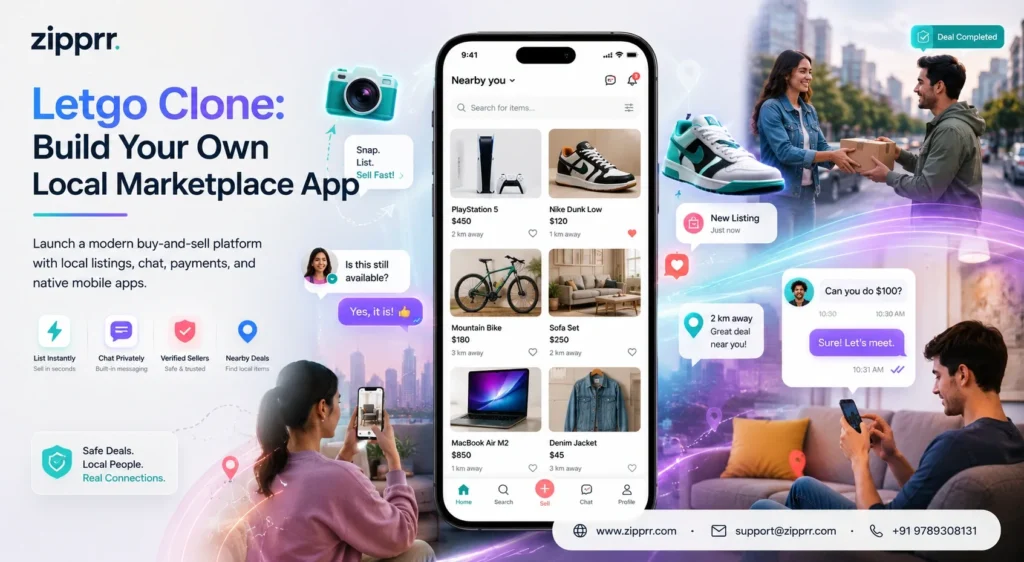
Zipprr’s Letgo clone app makes you that platform. It is a fully operational buy-and-sell marketplace, camera-to-listing in sixty seconds, private buyer-seller chat, protected checkout, and a reputation engine wrapped in your brand name and pointed at your chosen market.
“How do I build an app like Letgo?” and “Which is the cheapest way to launch a buy-and-sell marketplace?” are among the most searched questions by startup founders today. This guide has everything you need to get started.
The peer-to-peer resale habit is not a passing phase. Buyers actively seek quality goods without retail markups. Sellers want a direct line to local buyers without courier costs or platform fees eating their margin. Your platform earns a cut every time those two intentions meet.
Zipprr delivers the finished product source code, admin panel, and native mobile apps — so you skip the 9 to 12-month build cycle and the six-figure development invoice that comes with it.
What Is a Letgo Clone App?
A Letgo clone app is a fully configured, brandable marketplace platform engineered to operate exactly the way Letgo did before it merged with OfferUp. Sellers photograph items, write short descriptions, set a price, and publish while nearby buyers browse, message, and purchase without the conversation ever leaving the app.
“Which is the best app to buy and sell used items nearby?” and “How can I build a marketplace app like Letgo?” are among the most searched questions by startup founders today. This guide covers both and maps out exactly what it takes to put your own version live.
Consumer spending on pre-owned goods is climbing year after year. Affordability pressures, environmental awareness, and a generation that treats secondhand as a first choice — not a fallback are fuelling a resale economy that analysts now measure in the hundreds of billions. The operators who own regional and niche platforms within that economy collect revenue on every transaction their community generates.
Zipprr’s Letgo clone script puts that ownership in your hands. Web platform, iOS app, Android app, and admin dashboard, every component included, every line of code belonging to you from the moment of delivery with a launch window measured in days, not quarters.
Why the Secondhand Marketplace Industry Is Booming
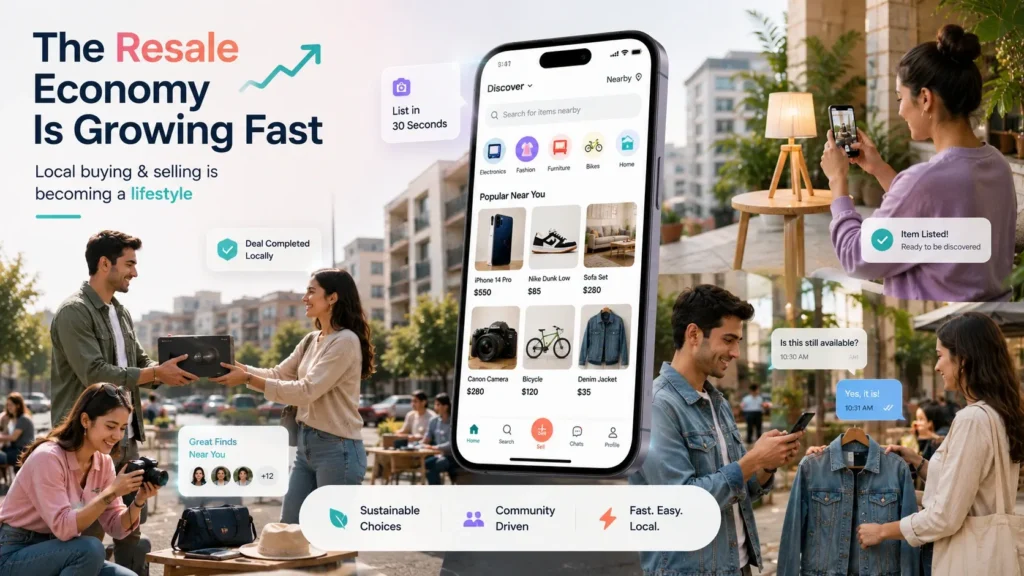
Resale has graduated from budget shopping to mainstream culture, and the data reflects it. Industry analysts forecast the global pre-owned goods market crossing a valuation well above $350 billion before the end of this decade, driven by forces that are not reversing:
- Buyers are choosing secondhand as a conscious lifestyle decision rather than a financial necessity
- Younger generations are treating pre-loved items as a form of self-expression and sustainable living
- Rising household costs are directing more people toward local buying and selling as a practical income source
- Mobile cameras reduce the effort of listing to a single photograph and a few typed words
Local marketplaces sit at the most profitable point in this shift. They serve the buyers and sellers who are already active in your city, your neighbourhood, your niche, and they earn on every exchange that takes place.
Key Features of Zipprr's Letgo Clone
Every function inside this platform was selected because it directly influences whether a buyer transacts or leaves, and whether a seller returns or disappears.
For Buyers
- Precision Search & Filters — Stack category, asking price, distance from current location, and item condition into a single refined query with a few screen taps
- Nearest-First Listing Feed — The platform reads the buyer's GPS coordinates and organises results by proximity automatically — no manual sorting required
- Closed Messaging Threads — Every buyer-seller conversation runs through a private, encrypted channel the platform controls — personal contact details stay hidden throughout
- Watchlist With Drop Alerts — Buyers save listings they want but are not ready to buy; the app sends an instant notification the moment the seller lowers the asking price
- Post-Purchase Rating System — Verified buyer scores accumulate into a visible seller reputation that guides future buyers before a single message is exchanged
For Sellers
- Guided Listing in Under a Minute — Photo upload, item title, condition tag, asking price, and category selection — the sequence is short enough that sellers complete it rather than abandon it
- Smart Description Prompts — Built-in suggestions help sellers write clear, keyword-rich item descriptions that attract more views and generate more enquiries
- Paid Visibility Upgrades — Sellers invest a small amount to move their listing to the top of relevant search results — a feature that generates consistent platform revenue without any manual effort from the operator
- Offer and Counter System — Buyer price proposals arrive in the seller dashboard with one-tap responses: accept the offer, send a counter figure, or decline and wait for the next enquiry
- Per-Listing Performance Data — Each posting displays its own view count, save count, and message rate — real numbers that tell sellers what to adjust and when
- Instant Listing Closure — A single tap marks an item as sold, pulling it from every search result and category feed immediately
Platform & Admin Features
- Full Category Control — Build, rename, restructure, and retire product categories through a visual admin interface with no developer involvement
- Multi-Gateway Checkout — Escrow and direct payment options connected to Stripe, PayPal, and configurable regional processors
- Centralised Admin Dashboard — One panel manages users, listings, fee structures, reported content, and platform-wide notifications
- Seller Verification Layer — Phone confirmation at registration, optional identity checks for verified badges, and trust signals visible across every listing a verified seller posts
- Flagged Content Queue — Reported listings enter a structured review workflow before any action is taken — fair process, full admin control
- Granular Commission Engine — Set different fee rules for different categories: flat amounts, percentage rates, or zero commission on selected listing types
- Audience-Targeted Notifications — Segment users by geography, activity pattern, or listing history and deliver push alerts that feel relevant rather than broadcast
- Regional Deployment Settings — Language and currency configurations adjust independently without touching core application logic, supporting multi-market operations
How the Letgo Clone App Works
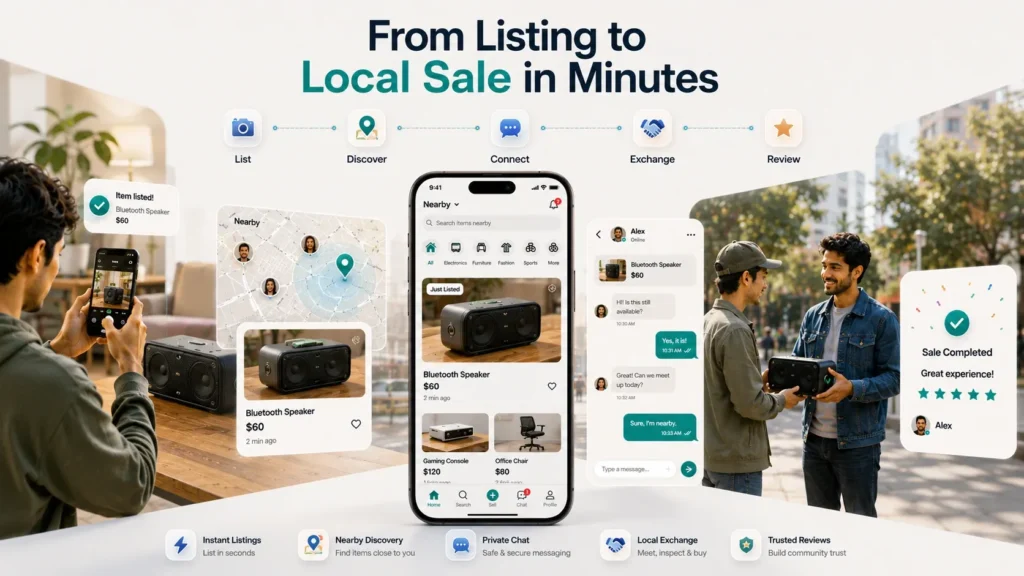
A new user should be able to download the app, browse listings, contact a seller, and complete a transaction on their first day — without reading a tutorial or contacting support. That is the design benchmark every screen was built against.
For Buyers
- 1. Register in 30 Seconds — Email address, mobile number, or an existing Google or Facebook account — no lengthy forms, no mandatory profile setup before the experience begins
- 2. Location Detected Automatically — GPS sets the search area on launch; users who want a wider or tighter radius adjust a single slider in their settings
- 3. Browse Nearby or Search Directly — Category feeds surface the most recent local listings sorted by proximity; the search bar returns filtered results as the user types
- 4. Open a Private Conversation — One tap on any listing starts a direct message thread with the seller — immediate, archived, and accessible from both accounts
- 5. Agree, Pay, and Collect — Price confirmed in chat, payment processed through the in-app checkout or handled as a local handoff — both paths are fully supported
- 6. Rate the Transaction — A two-tap rating prompt appears after the deal closes; both parties build a public reputation with every completed exchange
Sellers move from idea to live listing in under sixty seconds using the guided photo-upload and category-tagging flow.
Benefits of Launching a Letgo Clone with Zipprr
1. Launch in Days, Not Months
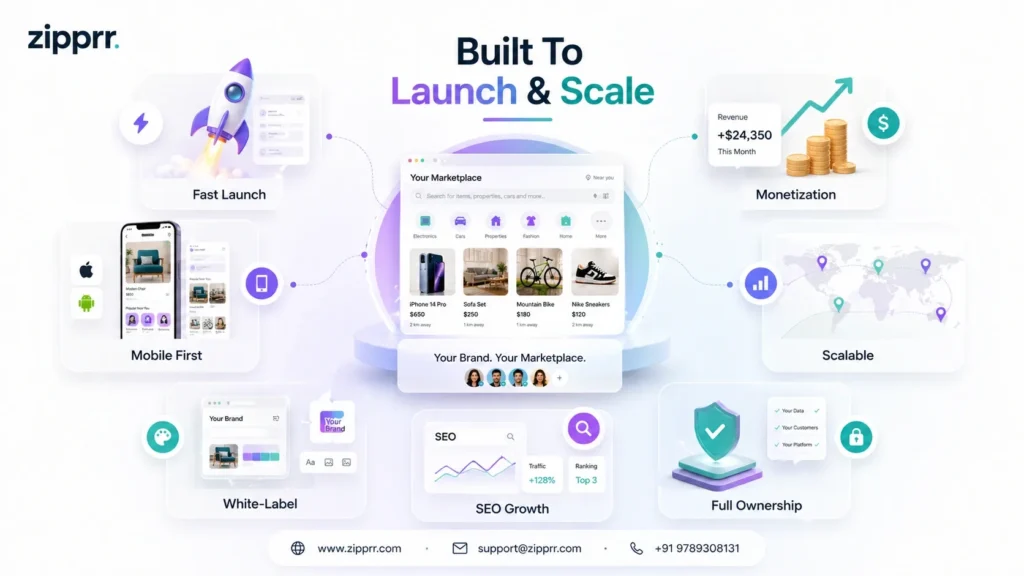
The 6 to 12-month development cycle disappears entirely. Zipprr’s marketplace arrives configured and deployment-ready, with your logo, your domain, and your categories set up before users ever open the app.
2. Proven Revenue Model
Five income channels run simultaneously inside your platform:
- Listing fees — A defined charge applied to seller accounts at the moment of posting
- Paid placement upgrades — Sellers fund their own visibility boost, generating operator revenue without any active selling
- Transaction commissions — A percentage of the confirmed sale value collected on every closed deal
- Seller subscription tiers — Monthly plans offering higher posting allowances, advanced analytics, and priority placement
- Local business advertising — Paid display inventory targeting active buyers by category and location
3. Fully White-Label & Customisable
Colour palette, typography, category taxonomy, notification copy, and commission logic are all configurable through the admin panel. Nothing in the interface references Zipprr; the product is yours in name and appearance.
4. Mobile-First Design
Both mobile apps are built with React Native, delivering the response speed, animation smoothness, and hardware integration, such as camera, GPS, and notifications, that users associate with purpose-built apps rather than browser-wrapped websites.
5. Scalable Architecture
The same technical foundation that handles a two-hundred-user city pilot manages a two-hundred-thousand-user national platform. Growth is a capacity decision, not an architectural rebuild.
6. SEO-Optimised Listing Pages
Each item posted on the platform creates an individually indexed page with a clean, locally structured URL. Searches like “used iPhone near me” or “second-hand furniture [city name]” pull up listing pages from your platform in Google results.
7. Complete Source Code
Every file — web application, iOS app, Android app, and admin panel is transferred to you at purchase. No recurring access fees. No usage caps. Your team modifies, extends, and deploys the codebase however the business requires.
Who Should Launch a Letgo Clone?
Zipprr’s Letgo clone is built for operators who see a specific opportunity and want the infrastructure to act on it:
- City-focused entrepreneurs who recognise that no dominant local resale app exists in their market and want to occupy that position first
- Portfolio investors adding a digital marketplace with multiple income streams and a market growing independent of the economic cycle
- Operators of outdated classifieds sites whose audiences have already moved to mobile and need a purpose-built app to follow them
- Niche community builders — a dedicated exchange for tools, children's items, vintage clothing, sports gear, or musical instruments
- Regional operators determined to own the local buy-and-sell conversation in a specific city, country, or language market
Start Building Your Letgo Clone Today
The secondhand economy isn’t slowing down, and every day without a platform is a missed opportunity. Zipprr’s Letgo clone app gives you everything you need to launch a trusted, profitable, and scalable local marketplace business.
Frequently Asked Questions
What is a Letgo clone app?
A Letgo clone is a brandable, pre-configured marketplace application engineered to function exactly as Letgo did. Sellers list used items, nearby buyers discover them through a proximity-sorted feed, both sides communicate through private in-app messaging, and transactions close through a protected checkout delivered as a web platform plus native iOS and Android apps.
How much does it cost to build an app like Letgo?
A custom-developed marketplace with comparable features typically requires between $30,000 and $120,000 in development spend and 9 to 12 months of build time. Zipprr’s Letgo clone delivers equivalent functionality at a defined, considerably lower cost without the timeline risk or the scope creep that custom projects routinely encounter.
How long does it take to launch a Letgo clone?
Most operators publish their marketplace within 3 calendar days after receiving the package. That window covers branding, category setup, payment connection, and app store submission. Operators who require additional customisation before opening to users typically add a few days beyond that estimate.
Can I customise the categories in a Letgo clone app?
Yes. The admin panel gives operators complete control over which categories exist, what they are named, and how they are structured — without modifying any application code. The platform supports a broad multi-category marketplace or a single focused vertical, such as electronics, children’s items, or sports equipment, with equal ease.
Does the Letgo clone support both local pickup and shipping?
Both fulfilment methods are supported within the same checkout flow. Buyers select their preferred option — in-person collection or delivery — at the point of purchase. Sellers who choose to ship access integrated label generation and order tracking directly through the platform, with no third-party app required.
What payment gateways are supported in the Letgo clone?
Stripe, PayPal, and Razorpay connect to the platform as standard integrations. An escrow mode is also available, holding the buyer’s payment in reserve until the transaction is confirmed received — particularly useful for higher-value item categories. Operators requiring additional regional processors can have custom integrations configured on request.
How does the Letgo clone handle user safety and fraud prevention?
The platform uses layered trust mechanisms — phone confirmation before any account gains posting access, optional identity verification for sellers seeking a credibility badge, a verified post-transaction rating system, and a structured moderation queue that reviews flagged listings before any removal action is applied.
Is the Letgo clone SEO-friendly and optimised for voice search?
Yes. Every listing generates a crawlable, individually indexed page with a locally structured URL suited to proximity-based queries. Section headings are written in the question format that voice search uses. FAQ entries support JSON-LD schema markup, positioning individual answers for Google featured snippet placement and voice assistant delivery.
Can I monetise my Letgo clone app, and what are the revenue streams?
Yes. Five revenue channels operate simultaneously: per-listing fees, paid placement upgrades, transaction commissions, tiered seller subscription plans, and advertising inventory sold to local businesses. Each channel activates independently — operators choose the combination that fits their market and adjust it as the platform grows.
Do I get the full source code of the Letgo clone?
Yes. The complete codebase — web application, iOS app, Android app, and admin panel — transfers to the operator at the point of purchase. No recurring access fees apply. No usage restrictions exist. The operator’s development team has unconditional access to read, modify, extend, and redeploy every component.