
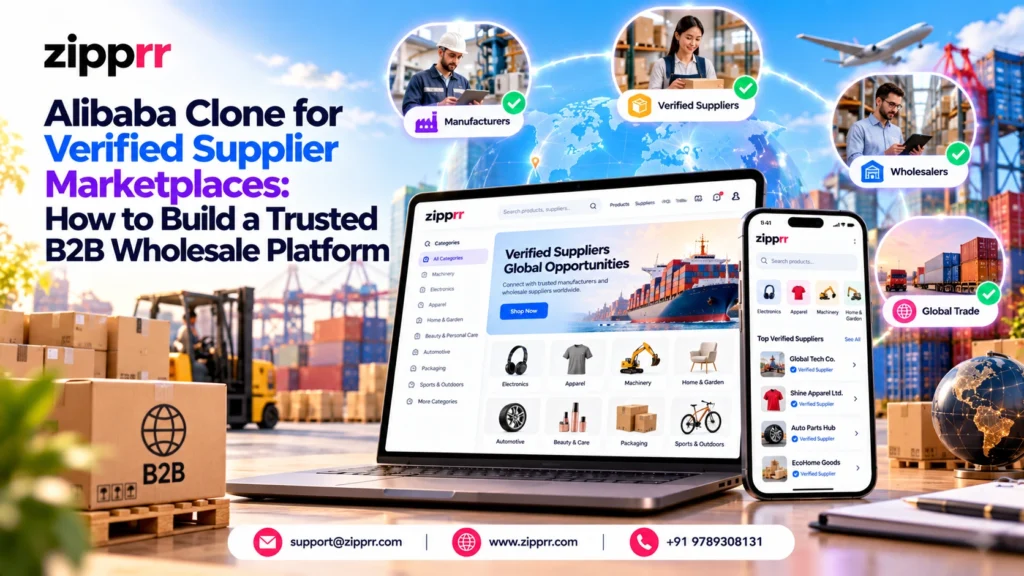
Businesses do not struggle to find products online. The bigger challenge is finding suppliers they can trust.
A buyer may discover hundreds of manufacturers, wholesalers, and distributors through search engines, directories, trade portals, and social media. However, it is not always easy to confirm whether a supplier is genuine, whether the product quality matches the listing, or whether the supplier can fulfil a large order on time.
This creates a major opportunity for entrepreneurs who want to build a verified supplier marketplace.
An Alibaba clone can provide the technology foundation for launching a B2B marketplace where approved manufacturers, wholesalers, distributors, and business buyers can connect, exchange quotations, compare offers, negotiate terms, and complete bulk transactions.
However, launching a successful Alibaba-like marketplace is not simply about publishing products from multiple vendors. Your platform must solve important B2B problems such as supplier verification, buyer trust, product accuracy, minimum order quantities, quotation management, bulk pricing, payments, and order transparency.
This guide explains how to use an Alibaba clone to build a trusted B2B wholesale marketplace, which features you need, how to verify suppliers, how to generate revenue, how to attract buyers and vendors, and how Zipprr’s Alibaba Clone can help you launch your own platform.
Quick Answer: What Is an Alibaba Clone for a Verified Supplier Marketplace?
An Alibaba clone for a verified supplier marketplace is ready-made B2B marketplace software that allows entrepreneurs to launch their own branded wholesale platform.
The platform can connect:
- Manufacturers
- Wholesalers
- Distributors
- Importers
- Retailers
- Procurement teams
- Business buyers
A complete Alibaba clone should support supplier registration, business verification, product listings, RFQ, MOQ, bulk pricing, buyer-supplier messaging, custom invoices, payments, orders, reviews, and administrative controls.
The main difference between a standard product directory and a verified supplier marketplace is the trust layer. The marketplace owner reviews supplier information, documents, business details, and transaction performance before displaying trust signals to buyers.
The goal is not simply to list more suppliers. The goal is to help buyers find relevant suppliers with greater confidence.
Why Build a Verified Supplier Marketplace?
Traditional B2B sourcing is often fragmented. A buyer may need to:
- Search multiple supplier directories
- Visit trade exhibitions
- Contact manufacturers manually
- Request product catalogues
- Exchange emails and spreadsheets
- Verify business registrations
- Compare quotations
- Request samples
- Negotiate payment terms
- Track shipping separately
This process consumes time and creates uncertainty.
A verified supplier marketplace brings these activities into one organised platform. Buyers can search for products and suppliers, review business profiles, submit sourcing requests, receive quotations, and communicate with vendors through a structured system.
Marketplace owners can create value by improving:
- Supplier discovery
- Business verification
- Product data quality
- RFQ management
- Quote comparison
- Buyer-supplier communication
- Payment coordination
- Order transparency
- Supplier accountability
This makes a verified supplier marketplace more valuable than a basic online directory. A directory generally provides contact information. An Alibaba clone can support the complete process from supplier discovery to bulk order management.
What Is an Alibaba Clone?
An Alibaba clone is ready-made B2B marketplace software that supports a similar business model to a large wholesale marketplace without copying its brand, copyrighted content, visual identity, or proprietary code.
A legitimate Alibaba clone allows you to operate under your own:
- Brand name
- Logo
- Domain
- Product categories
- Marketplace policies
- Pricing model
- Supplier rules
- Design
- Business identity
The term “clone” refers to functional similarity. It does not mean copying Alibaba’s website or source code.
A well-designed Alibaba clone normally includes:
- Buyer website or application
- Supplier dashboard
- Admin panel
- Product catalogue
- Supplier storefronts
- RFQ functionality
- MOQ management
- Tiered bulk pricing
- Messaging
- Orders and payments
- Reviews and ratings
- Reports and analytics
For a verified supplier marketplace, these features should be combined with a clear supplier approval and monitoring process.
How Is a Verified Supplier Marketplace Different From a Normal Alibaba Clone?
A standard Alibaba clone may allow suppliers to register and publish products. A verified supplier marketplace adds a trust system that gives buyers more information before they contact or purchase from a vendor.
The verification layer may include:
- Business registration review
- Tax identification checks
- Business address confirmation
- Contact verification
- Factory or warehouse details
- Product certificates
- Quality documents
- Import or export licences
- Transaction history
- Buyer reviews
- Delivery performance
- Dispute records
The verification process should be clearly explained to buyers.
For example, a “Business Verified” badge may mean that the supplier’s registration documents and contact information were reviewed. A “Product Documents Verified” badge may mean that the supplier submitted relevant product certificates.
A verification badge should not automatically mean that the marketplace guarantees every product or transaction. The marketplace must clearly define what each badge represents.
Why Does Supplier Verification Matter in B2B Commerce?
Trust is particularly important in B2B transactions because the order values can be much higher than ordinary consumer purchases. A buyer may order:
- 500 clothing items
- 2,000 electronic components
- 10 tons of raw materials
- 100 commercial machines
- 5,000 packaging units
- A container of agricultural products
- Custom-made furniture
- Industrial spare parts
Before placing an order, the buyer may want to know:
- Whether the supplier is legally registered
- Whether the supplier can fulfil the required quantity
- Whether the product meets the specification
- Whether the company has experience in the relevant industry
- Whether it can ship to the destination
- Whether the lead time is realistic
- Whether payment terms are acceptable
- Whether the supplier responds quickly
Without trust signals, buyers may leave the platform before submitting an enquiry.
A well-planned verification system can reduce uncertainty, improve buyer confidence, and increase the quality of supplier listings. It can also encourage suppliers to provide accurate information because incomplete or suspicious accounts may not be approved.
How Should Supplier Verification Work in an Alibaba Clone?
A strong verification process should be detailed enough to protect buyers while remaining practical for legitimate suppliers.
Supplier registration
The supplier creates an account and provides basic information such as:
- Company name
- Contact person
- Email address
- Phone number
- Country
- Business category
- Website
- Business address
- Company description
At this stage, the account may remain pending until the marketplace team completes the review.
Document submission
The platform can request documents depending on the industry and target country. Possible documents include:
- Business registration certificate
- Tax registration document
- Factory licence
- Import or export licence
- Product certificate
- Quality certification
- Proof of address
- Insurance information
- Payment details
- Company ownership information
Not every document is suitable for every business. Your verification requirements should match the products and markets served by your marketplace.
Administrative review
Marketplace administrators should be able to:
- Approve supplier applications
- Reject applications
- Request additional documents
- Add internal notes
- Mark documents as pending
- Set document expiry dates
- Suspend accounts
- Restrict product listings
- Review supplier complaints
This is why a strong admin dashboard is essential for any B2B marketplace.
Verification status
Rather than using one general badge, your Alibaba clone can display multiple supplier statuses:
- Application submitted
- Verification pending
- Business verified
- Product documents verified
- Factory verified
- Trusted supplier
- Verification expired
- Account restricted
These statuses give buyers more useful information.
Ongoing monitoring
Verification should not always be a one-time activity. The platform can monitor:
- Supplier response rate
- Customer complaints
- Order cancellations
- Delivery performance
- Product listing accuracy
- Review trends
- Dispute outcomes
- Expired documents
- Refund requests
A supplier may need to renew documents or update information periodically.
Essential Features for an Alibaba Clone
Buyer registration and business profiles
Business buyers should be able to create profiles with company information, contact details, delivery locations, billing information, and purchasing preferences. A buyer profile may include:
- Company name
- Industry
- Business address
- Tax details
- Contact persons
- Shipping locations
- Preferred categories
- Purchase history
- Verification information
For larger companies, the platform may later support multiple users under a single business account.
Supplier storefronts
Each supplier should have a dedicated storefront. The storefront can display:
- Company name
- Logo
- Business description
- Location
- Product catalogue
- Business category
- Certifications
- MOQ
- Production capacity
- Response time
- Delivery regions
- Reviews
- Verification status
- Contact options
A supplier storefront gives buyers more context than a basic product card.
Product catalogue management
B2B products often require much more information than consumer products. Product listings may include:
- Product name
- Product images
- Technical specifications
- Materials
- Dimensions
- Packaging details
- Product variations
- Minimum order quantity
- Unit price
- Bulk pricing
- Production lead time
- Sample availability
- Certifications
- Shipping information
- Customisation options
The administrator should be able to approve, edit, hide, or remove product listings.
RFQ or Request for Quotation
RFQ is one of the most important features in a B2B marketplace. A buyer may submit a request containing:
- Product name
- Required quantity
- Technical specifications
- Target price
- Delivery location
- Required delivery date
- Customisation needs
- Supporting documents
- Preferred payment terms
Relevant suppliers can respond with:
- Unit price
- Total price
- MOQ
- Production timeline
- Shipping cost
- Payment terms
- Quote validity
- Product information
- Warranty details
The buyer can compare quotations, negotiate with selected suppliers, and confirm an order.
Minimum Order Quantity
MOQ means Minimum Order Quantity. A supplier may set an MOQ of:
- 100 pieces
- 10 cartons
- 500 kilograms
- One pallet
- One production batch
- A minimum order value of $1,000
MOQ helps suppliers avoid unsuitable enquiries and allows buyers to understand purchasing requirements before contacting a vendor. An Alibaba clone should allow suppliers to set MOQ per product or variation.
Tiered bulk pricing
Wholesale pricing often changes according to quantity.
| Quantity | Price per unit |
|---|---|
| 100–499 units | $15 |
| 500–999 units | $12 |
| 1,000–4,999 units | $10 |
| 5,000+ units | Custom quotation |
Tiered pricing makes the purchasing process clearer and encourages larger orders.
Hidden or negotiated pricing
Some products cannot have a single public price. The final price may depend on:
- Order quantity
- Customisation
- Materials
- Shipping location
- Currency
- Packaging
- Production schedule
- Payment terms
An Alibaba clone should allow suppliers to hide prices and invite buyers to request a quotation.
Buyer-supplier messaging
B2B transactions usually involve questions and negotiation. Messaging can support:
- Product clarification
- Quote negotiation
- Document exchange
- Sample requests
- Delivery planning
- Payment coordination
- Order follow-up
The marketplace should also provide reporting, blocking, and moderation controls.
Custom invoicing
Business buyers often require formal invoices. An invoice may include:
- Buyer details
- Supplier details
- Product description
- Quantity
- Unit price
- Tax
- Shipping fees
- Discount
- Deposit
- Balance amount
- Payment due date
- Order reference
- Terms and conditions
Part payments
Large wholesale orders may use staged payments. A common workflow is:
The payment workflow should be reviewed against local laws, payment-provider policies, and marketplace regulations.
Ratings and reviews
Verified reviews can help buyers evaluate suppliers. Possible review categories include:
- Product quality
- Delivery accuracy
- Communication
- Packaging
- Response time
- Order accuracy
- Documentation
Reviews should ideally be connected to completed transactions.
Admin dashboard
The admin dashboard is the operating centre of the marketplace. It should allow administrators to manage:
- Supplier applications
- Verification documents
- Product listings
- Categories
- Buyer accounts
- RFQs
- Quotations
- Orders
- Payments
- Commissions
- Payouts
- Disputes
- Reviews
- Notifications
- Reports
- Promotions
The admin should also be able to configure supplier plans and marketplace rules.
How Can an Alibaba Clone Generate Revenue?
A verified supplier marketplace can use multiple revenue streams.
Supplier subscriptions
Suppliers can pay for access to premium features such as:
- More product listings
- Verified supplier badge
- Priority support
- Analytics
- Featured placement
- Premium storefront
- More RFQ responses
- Buyer lead access
Transaction commissions
The marketplace can charge a percentage of completed orders. This works best when payments are completed inside the marketplace. To encourage buyers and suppliers to remain on the platform, offer useful services such as:
- Payment protection
- Order tracking
- Invoices
- Dispute support
- Verified supplier profiles
- Buyer protection
- Logistics coordination
Paid RFQ access
Suppliers can pay to access or respond to selected buyer requirements. This model works when the marketplace generates high-quality sourcing leads. Lead quality can be protected by:
- Removing spam
- Confirming buyer requirements
- Matching RFQs to relevant categories
- Preventing duplicate submissions
- Monitoring supplier feedback
Featured listings
Suppliers can pay for visibility in:
- Category pages
- Search results
- Homepage sections
- Email newsletters
- Industry campaigns
Paid listings should still meet marketplace quality standards.
Verification services
The marketplace may charge for advanced verification services such as:
- Document review
- Factory inspection
- Product inspection
- Certification review
- Premium business verification
These services should be clearly explained and priced transparently.
Advertising
After gaining meaningful traffic, the platform can offer:
- Banner advertising
- Sponsored categories
- Newsletter placements
- Product launches
- Industry campaigns
Advertising should not interfere with buyer experience or reduce marketplace trust.
How Much Does an Alibaba Clone Cost?
The total cost depends on the selected development approach.
Custom development
Custom development may include:
- Market research
- Business analysis
- UX design
- Buyer website
- Supplier portal
- Admin panel
- Mobile applications
- Backend development
- Database architecture
- Payment integrations
- Supplier verification
- Search and filtering
- Notifications
- Testing
- Security
- Hosting
- Maintenance
The cost increases when you require complex workflows, logistics integrations, multiple countries, advanced permissions, ERP connectivity, or custom mobile applications.
SaaS marketplace software
SaaS platforms may provide faster setup, but they generally use monthly or annual subscriptions. Possible disadvantages include:
- Recurring fees
- Limited source-code access
- Customisation restrictions
- Platform dependency
- Usage-based charges
- Vendor lock-in
Ready-made Alibaba clone software
A ready-made Alibaba clone provides a foundation with prebuilt B2B workflows.
Zipprr’s official Alibaba Clone page lists features such as RFQ, MOQ, tiered pricing, supplier verification, multi-vendor storefronts, custom invoicing, part payments, multi-currency, and multi-language capabilities. The page currently lists:
- Basic plan: $490
- Pro plan: $890
- Full website and admin source code
- Free server installation
- 90 days of support
- Lifetime updates
- Android and iOS apps in the Pro plan
- Seven-day money-back guarantee
Pricing and package details should be confirmed directly with Zipprr before purchasing because product plans may change.
Build From Scratch or Choose an Alibaba Clone?
Choose custom development when:
- Your marketplace has highly specialised workflows.
- You need complex enterprise integrations.
- You have a dedicated technology team.
- You need complete architectural control.
- You have funding for long-term development.
- Your business model cannot be supported by an existing foundation.
Choose an Alibaba clone when:
- You want to launch more quickly.
- You need standard B2B marketplace features.
- You want to reduce initial development effort.
- You want source-code ownership.
- You plan to customise the platform.
- You want to validate your business before investing in deeper development.
A ready-made Alibaba clone does not remove the need for business planning. It reduces the amount of foundational development required.
How to Launch a Verified Supplier Marketplace
Step 1: Select a focused market
Avoid launching with every possible category unless you already have strong supplier and buyer relationships. Potential niches include:
- Apparel manufacturing
- Industrial equipment
- Food ingredients
- Packaging products
- Medical equipment
- Construction materials
- Furniture manufacturing
- Electronics components
- Agricultural products
A focused market makes it easier to define verification requirements and attract relevant buyers.
Step 2: Define your verification standards
Decide what “verified supplier” means on your platform. You may create levels such as:
- Contact verified
- Business verified
- Documents verified
- Product documents verified
- Factory verified
- Transaction verified
- Premium supplier
Each status should have clear requirements.
Step 3: Interview suppliers and buyers
Speak with both sides before configuring your marketplace. Ask buyers:
- How do you currently find suppliers?
- What information do you need before making contact?
- What makes you distrust a supplier?
- How do you compare quotations?
- What payment terms do you need?
Ask suppliers:
- How do you currently receive wholesale leads?
- What makes a buyer enquiry valuable?
- Which documents can you provide?
- Which pricing model is acceptable?
- What information do you need in an RFQ?
Step 4: Configure the Alibaba clone
Customise:
- Logo
- Brand colours
- Domain
- Categories
- Supplier fields
- Verification statuses
- Commission rules
- Subscription plans
- Currencies
- Languages
- Payment methods
- Email templates
- Marketplace terms
Step 5: Create supplier onboarding materials
Help suppliers provide complete and accurate information. Create:
- Supplier onboarding guides
- Product listing templates
- Verification checklists
- Image requirements
- RFQ response instructions
- Pricing guidelines
- Marketplace policies
- Support documentation
Poor supplier data can make a reliable platform appear unprofessional.
Step 6: Recruit initial suppliers
Invite a small group of quality suppliers before the public launch. Focus on suppliers with:
- Complete product catalogues
- Fast response times
- Reliable documentation
- Clear MOQ
- Competitive pricing
- Geographic coverage
- Relevant product categories
Ten high-quality suppliers may provide more value than hundreds of incomplete accounts.
Step 7: Generate buyer demand
Use:
- SEO landing pages
- Industry newsletters
- Direct sales
- LinkedIn outreach
- Trade associations
- Supplier referrals
- Search advertising
- Industry events
- Content marketing
- Strategic partnerships
Create useful content around sourcing, supplier verification, wholesale pricing, and procurement.
Step 8: Start with managed RFQs
During the early stage, manually review RFQs and route them to suitable suppliers. This helps you understand:
- Which enquiries are genuine
- Which suppliers respond quickly
- How many quotations buyers expect
- Which categories perform best
- Where buyers experience friction
Step 9: Measure marketplace performance
Important metrics include:
- Number of verified suppliers
- Active product listings
- Buyer registrations
- RFQs submitted
- Supplier response rate
- Quote count per RFQ
- Time to first response
- Completed orders
- Repeat buyers
- Supplier renewal rate
- Average order value
- Dispute rate
Traffic alone does not prove that a B2B marketplace is successful.
How Can an Alibaba Clone Prevent Low-Quality Suppliers?
Supplier verification should be supported by marketplace governance. Recommended controls include:
- Manual supplier approval
- Required business documents
- Product listing moderation
- Category-specific verification
- Document expiry reminders
- Review monitoring
- Complaint tracking
- Suspension rules
- Supplier response standards
- Order-performance monitoring
- Buyer reporting
- Dispute escalation
You can also create supplier quality tiers.
| Supplier tier | Requirements |
|---|---|
| Registered | Basic account information |
| Business verified | Business documents approved |
| Product verified | Product documentation reviewed |
| Trusted supplier | Completed transactions and strong reviews |
| Premium supplier | Additional verification and paid benefits |
This gives buyers more information while allowing new suppliers to build credibility over time.
How Can You Avoid Launching an Empty Marketplace?
A marketplace may fail when buyers see too few relevant suppliers or suppliers receive too few useful enquiries. Reduce this risk by:
The initial version of your Alibaba clone does not need every possible category. It needs enough relevant activity to make the marketplace useful.
Legal and Compliance Considerations
Launching a B2B marketplace requires more than software. Review:
- Business registration
- Terms of service
- Privacy policy
- Data protection
- Supplier agreements
- Buyer agreements
- Payment regulations
- Tax requirements
- Product liability
- Import and export rules
- Marketplace liability
- Advertising claims
- Intellectual property
- Restricted products
- Dispute-resolution processes
Your Alibaba clone should use independent branding and original content.
The phrase “Alibaba clone” describes software and a business model. It does not give permission to copy Alibaba’s name, logo, design, product content, photographs, trademarks, source code, or user data.
The Zipprr FAQ provides additional information about clone-script licensing, source-code ownership, privacy, security, and compliance. You should also obtain professional legal advice for the markets in which you plan to operate.
How Zipprr's Alibaba Clone Can Support Your Marketplace
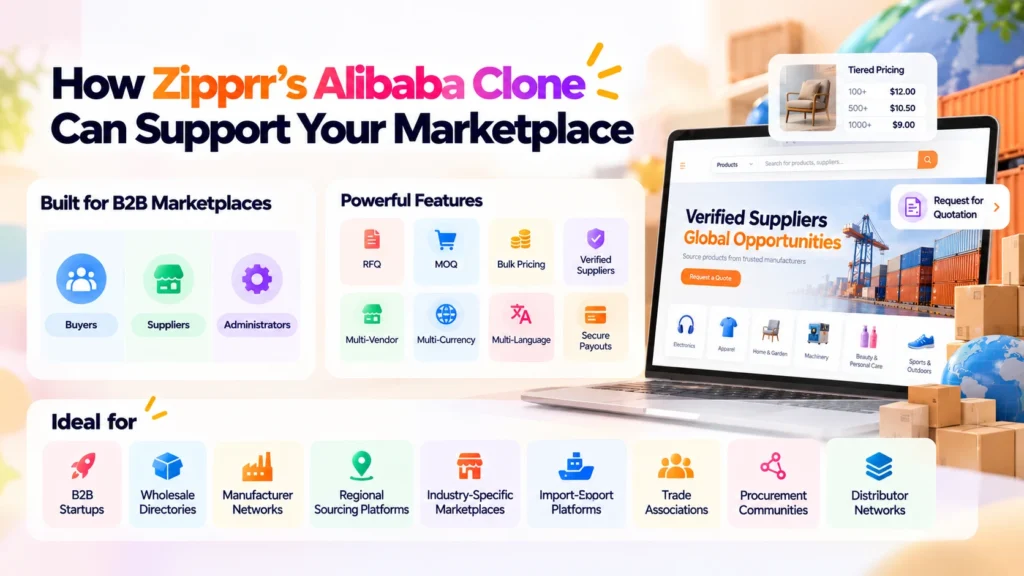
Zipprr’s Alibaba Clone is designed for businesses that want to launch their own branded B2B marketplace. The product page describes workflows for:
- Buyers
- Suppliers
- Marketplace administrators
It also lists features such as:
- RFQ
- MOQ
- Tiered bulk pricing
- Hidden or on-request pricing
- Part payments
- Verified supplier profiles
- Custom invoicing
- Multi-vendor storefronts
- Multi-currency support
- Multi-language support
- Secure payout workflows
- Supplier onboarding
- Commission management
- Subscription tiers
- Featured listings
- Analytics
These features can provide the technical foundation for a verified supplier marketplace. However, the marketplace owner must define the verification policy, review standards, supplier rules, and operating process.
The platform can be useful for:
- B2B marketplace startups
- Wholesale directories
- Manufacturer networks
- Regional sourcing platforms
- Industry-specific marketplaces
- Import-export platforms
- Trade associations
- Procurement communities
- Distributor networks
A ready-made Alibaba clone allows you to focus more resources on supplier acquisition, buyer demand, marketplace trust, content, and business development.
What Should You Check Before Buying an Alibaba Clone?
Before purchasing, ask the software provider:
- Is the complete source code included?
- Is the source code encrypted?
- Which platforms are included?
- Are mobile apps included?
- Is server installation included?
- How long is support provided?
- Are product updates included?
- Can the supplier verification workflow be customised?
- Can suppliers upload documents?
- Can administrators approve suppliers manually?
- Can different supplier badges be created?
- Is RFQ functionality included?
- Is MOQ functionality included?
- Does the platform support tiered pricing?
- Can product prices be hidden?
- Can multiple currencies be used?
- Can payment gateways be added?
- Can logistics or ERP integrations be added?
- Are there monthly fees or royalties?
- What are the refund conditions?
- Who owns the customised source code?
Request a live product demonstration and test the buyer, supplier, and admin workflows before making a commercial decision.
Frequently Asked Questions
1. What is an Alibaba clone for a verified supplier marketplace?
An Alibaba clone for a verified supplier marketplace is B2B marketplace software that helps entrepreneurs connect approved suppliers with wholesale buyers. It typically includes supplier profiles, verification workflows, product listings, RFQ, MOQ, bulk pricing, messaging, orders, payments, and administrative controls.
2. Is an Alibaba clone the same as copying Alibaba?
No. A legitimate Alibaba clone is independently developed software that supports a similar B2B marketplace model. It should use an original brand, original content, independent design, and legally licensed source code.
3. Can I use an Alibaba clone for a niche marketplace?
Yes. An Alibaba clone can be configured for apparel, electronics, construction materials, agriculture, machinery, packaging, medical products, furniture, or other B2B categories. A focused niche may be easier to market and manage.
4. How can I verify suppliers on an Alibaba clone platform?
You can request business registration documents, tax information, product certificates, factory information, proof of address, and contact verification. Administrators can review the information before approving suppliers. Reviews, complaints, order history, and response rates can also be monitored.
5. What is RFQ in an Alibaba clone?
RFQ means Request for Quotation. A buyer submits a product requirement, quantity, specification, delivery location, and other conditions. Suppliers respond with prices, lead times, MOQ, shipping costs, and payment terms.
6. What is MOQ?
MOQ means Minimum Order Quantity. It is the smallest quantity that a supplier is willing to sell for a particular product. It may be defined in pieces, cartons, kilograms, pallets, production batches, or minimum order value.
7. Can an Alibaba clone support bulk pricing?
Yes. A B2B-focused Alibaba clone can allow suppliers to configure different unit prices for different quantity levels. For example, the price may decrease when a buyer orders 500, 1,000, or 5,000 units.
8. Can suppliers hide prices?
Many B2B marketplace platforms support hidden or on-request pricing. This is useful when the final price depends on quantity, customisation, shipping destination, currency, or negotiated terms.
9. How does a verified supplier marketplace make money?
Revenue can come from supplier subscriptions, transaction commissions, paid RFQ access, featured listings, advertising, verification services, premium storefronts, analytics, logistics services, and inspection services.
10. How much does Zipprr's Alibaba Clone cost?
Zipprr’s official Alibaba Clone page currently lists plans starting at $490 and a Pro plan at $890. The page describes source-code ownership, installation, support, updates, and mobile-app inclusions. Confirm the latest pricing and package details directly with Zipprr before purchasing.
11. Can I launch an Alibaba clone in multiple countries?
A platform may support multiple countries through multi-currency, multi-language, supplier-location, shipping, payment, tax, and compliance configuration. International expansion should be planned carefully for each country.
12. Do I need a mobile app for a B2B marketplace?
Not always. A responsive website may be sufficient for the initial launch. Mobile apps can become more valuable when buyers and suppliers need frequent notifications, messaging, order updates, or product management.
13. How long does it take to launch an Alibaba clone?
A ready-made Alibaba clone can launch faster than custom development. The timeline depends on branding, server setup, payment integration, content, supplier onboarding, testing, and custom requirements. Zipprr states that its product can typically be launched within a short implementation period, depending on project scope.
14. What is the difference between a supplier directory and an Alibaba clone?
A supplier directory mainly displays company and contact information. An Alibaba clone can support product listings, RFQs, quotations, messaging, MOQ, bulk pricing, orders, payments, reviews, and admin management.
15. Can buyers compare multiple quotations?
Yes. An RFQ workflow can allow buyers to receive and compare multiple quotations based on price, MOQ, delivery time, supplier rating, payment terms, and product information.
Launch Your Verified Supplier Marketplace With Zipprr
Building a trusted B2B marketplace does not require you to develop every feature from zero.
With supplier profiles, RFQ, MOQ, bulk pricing, multi-vendor storefronts, invoicing, payment workflows, and admin controls, a ready-made Alibaba clone can provide the foundation for your business idea.
The most important step is choosing a clear niche, defining your verification standards, recruiting quality suppliers, and generating relevant buyer demand.
Ready to build your own verified supplier marketplace? Explore Zipprr’s Alibaba Clone or request a product demo today.