
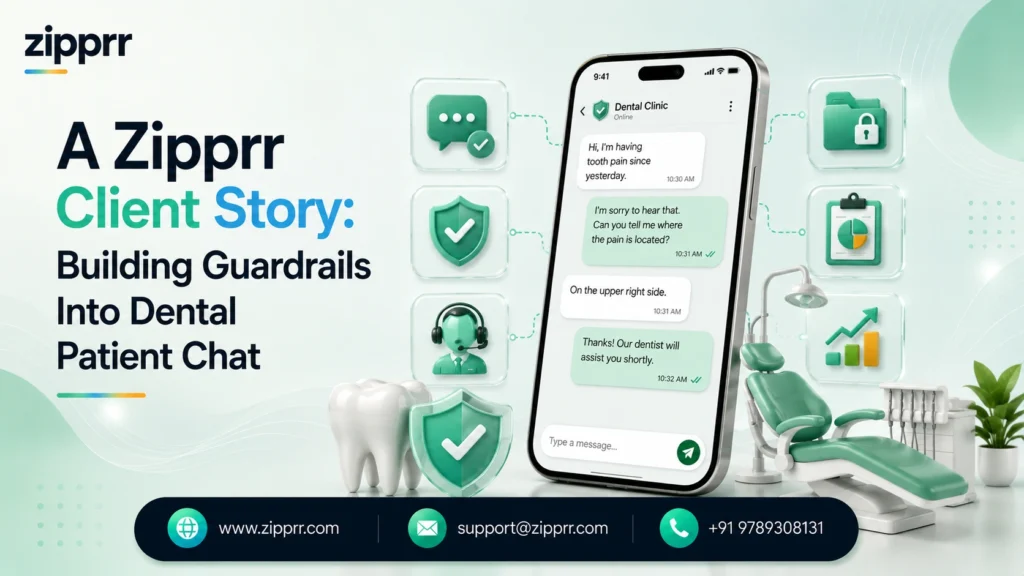
This is a composite engagement. It reflects patterns Zipprr has observed across multiple dental practice group implementations, not a single named client. Details, figures, and quotes are illustrative and have been generalized to protect client confidentiality. Nothing described here constitutes medical, clinical, or legal advice.
Every day, a multi-location dental practice group answers hundreds of patient questions. Most are routine logistics. A small number sound clinical. The challenge is not answering quickly; it is making sure every office gives the same answer while making sure anything clinical reaches the right person.
Does the practice take this insurance plan? What are the Saturday hours? What forms does a new patient need to bring? Is it normal to still have some swelling on day three after a wisdom tooth extraction? Three of those are logistics. One of them is not, and when a busy front-desk coordinator answers it anyway, off the cuff, with no record of what was said, that is a liability exposure hiding inside an ordinary operational bottleneck.
Executive Summary
A multi-location dental group deployed two Zipprr products, a website and patient-portal chat assistant and a scheduled WhatsApp messaging tool, to standardize dental patient engagement across its offices. The core design choice was not the chatbot itself, it was a pre-model screen that catches clinical, symptom, and emergency language before the AI ever generates a response, and routes it to a person instead. Everything else in this engagement- the allow-list, the validation layer, the escalation rules- exists to enforce that one boundary. The result: consistent answers to routine logistics and insurance questions across every location, a documented handoff for every clinical-adjacent question, and no expansion of what the practice’s non-clinical staff were ever qualified to answer in the first place.
Why Choose Zipprr
- Source-code ownership, not a subscription
- AI Chat for website and patient-portal conversations
- WhatsApp Automation for scheduled patient messaging
- Pre-model clinical and emergency guardrails, not a bolted-on filter
- Human escalation built into the routing logic, not an afterthought
- One verified answer source shared across every location
At a Glance
- Consistent patient communication across every location
- Reduced repetitive front-desk workload
- Clinical questions automatically escalated to a person
- Faster response times on routine logistics questions
- A full, documented audit trail for every escalation
Want to see this at your own practice? Explore the products above or book a free demo to see the clinical-safety screen configured for your locations.
AI Patient Communication for Dental Practices: The Short Answer
AI patient communication for a dental practice group works by screening every incoming message for clinical or emergency language before generation starts, then answering only verified logistics and insurance questions from a fixed, per-location data source, plus a small library of clinical-director-approved general post-op instructions. Anything clinical, urgent, or a complaint routes straight to a human, logged with full context. This is what dental front desk automation looks like when it is built around a compliance boundary rather than bolted on afterward.
AI Patient Communication for Dental Practices: The Short Answer
The Practice Group Behind This Engagement
The group in this engagement runs several general and family dentistry locations across one metro area under shared administration, though each office keeps its own front-desk team and, until this engagement, its own informal way of answering the phone. Growth had outpaced the group’s ability to keep answers consistent: a new patient calling one office got a different explanation of the same insurance plan than a patient calling the office four miles away, not because either coordinator was wrong, but because nobody had ever written the answer down in one place.
Discovery and the Real Bottleneck
The Zipprr team pulled a week of call logs and chat transcripts from two locations and sorted every inbound message into categories. The largest category was logistics: insurance plan acceptance, office hours, parking, new-patient paperwork, and appointment rescheduling. A smaller category was genuinely clinical, a patient describing a symptom or asking whether something they were experiencing after a procedure was normal.
Sitting with front-desk staff for a few days surfaced the real risk. Staff handled the clinical-sounding questions kindly, almost always by reassuring the patient, because declining to answer felt unhelpful. But those reassurances were rarely documented, were phrased differently by every staff member, and occasionally drifted into specific guidance (“that’s normal for a few more days, just keep icing it”) that sounded like a clinical opinion despite coming from someone without a license to give one. The presenting problem looked like call volume. The real bottleneck was that nothing distinguished a templated question from a clinical one at the point of contact, and the group had no record of which clinical-adjacent questions were even coming in.
Why This Shape, Not a Phone AI Receptionist
The most requested fix from practice managers was an AI phone agent. Zipprr scoped this out of phase one: voice-based AI receptionists are a custom-development engagement, not an off-the-shelf deployment, and rushing one into a practice group before the underlying answer logic was proven and vetted by the clinical director would have meant debugging live-call tone and clinical-content boundaries at the same time. The team started on text channels, where every response can be logged, reviewed, and corrected before it reaches a patient, and left voice as a possible later phase.
The system never assesses a symptom, interprets a diagnosis, recommends a medication, or confirms whether something a patient is experiencing after a procedure is normal, regardless of how the question is phrased. Billing disputes and complaints route to a human the same way. How that boundary is actually enforced is covered once, in full, under AI Guardrails below.
Solution Design and the Zipprr Product Stack
Two real Zipprr products carry this engagement. AI Chat runs as a website and patient-portal widget, answering verified logistics and insurance questions from a fixed, per-location data source. WhatsApp Automation delivers scheduled, pre-approved messages, appointment reminders, new-patient form links, and the clinical-director-approved post-op instruction library, rather than generating open-ended clinical guidance in the moment. Both sit within the broader Zipprr product catalog, and either can be evaluated as standalone patient communication software rather than as a bundled package.
| Component | Technology |
|---|---|
| Patient-facing chat | AI Chat, website and patient portal |
| Scheduled patient messaging | WhatsApp Automation |
| AI model layer | General-purpose LLM, JSON-schema constrained output, low temperature |
| Pre-model safety screen | Keyword and topic classifier, runs before generation |
| Practice data source | Per-location insurance, hours, and forms database |
| Audit and engagement store | Encrypted store, location-scoped access |
Message generation runs on a general-purpose large language model, the same class available through providers like OpenAI, Claude, or Gemini, rather than a fine-tuned or self-hosted model, chosen because the practice group’s questions are narrow enough that a general-purpose model with strong structured-output support met the need without the overhead of training a custom one. The model runs at a low, near-deterministic temperature and is requested in a fixed JSON schema so every response can be validated before a patient sees it. Prompt templates are versioned, so a shift in the escalation rate can be traced to a specific revision. Invalid output retries once with a stricter prompt; a second failure skips the send and routes to a human, the same fallback used when the pre-model screen catches something clinical.
Why Not Just Use ChatGPT?
A general-purpose model on its own does not know a specific practice’s office hours, accepted insurance plans, or approved post-op instructions, and it has no built-in reason to treat a clinical question differently from a logistics one. It also has no escalation path to a front desk, no audit log, and no way to enforce that a generated answer never strays outside a pre-approved field list. This engagement uses a general-purpose model as one component, not as the product: the practice-specific data source, the pre-model clinical and emergency gate, the field allow-list, the validation layer, and the human escalation path are what turn a general model into workable AI for dental offices rather than a generic chat window. That is the wrapper this engagement is really about.
How a Patient Message Is Handled
Message and AI Reasoning Flow Patient message chat / WhatsApp Clinical / emergency screen (pre-model) Retrieve verified location data Build prompt System prompt + context + allowed fields only LLM Low temp, JSON mode Validate Schema + content scan Passes validation: deliver to patient Fails: retry once, then skip Flagged at any stage: routes directly to front desk queue with full conversation context Model never generates clinical content if flagged, at screen or validation A patient message passes a clinical and emergency screen before the model runs at all. If it is flagged there, or if the generated response later fails validation, the conversation routes directly to the front-desk queue with full context, and the model never produces clinical content. If it is clear, the assistant retrieves verified per-location data, builds a prompt from a fixed system prompt plus an explicit allow-list of fields (hours, insurance plans, forms, and the clinical-director-approved post-op library, nothing beyond that), and generates a response that is validated for structure and content before delivery.
AI Guardrails
Several distinct mechanisms enforce this, not one general instruction to be careful. The pre-model screen catches clinical, symptom, and emergency language regardless of phrasing. Schema validation checks structure; output validation scans the content for diagnosis, dosage, or treatment language outside the approved library. The field allow-list is the strongest guarantee: information outside that list, including the model’s own general medical knowledge, is simply never in the prompt to reference. Patient text is always treated as untrusted input, never as an instruction, which closes a prompt-injection path where a patient might try to talk the assistant into a clinical answer through a rephrased request. A failed generation is skipped and routed to a human, never sent in a weaker form.
Technical Architecture
Technical Architecture API / Intake Gateway Website widget + WhatsApp Business API Workflow Orchestrator Queue + clinical/emergency gate LLM Service Schema-constrained generation Validation Layer Schema + clinical-content checks Rule Engine Escalation and handoff logic Notification Service Front-desk queue, WhatsApp send Monitoring and Alerting Latency, queue depth, escalation rate Audit and Engagement Store Every conversation, every escalation Security Boundary Encrypted at rest and in transit Access scoped by location and role 180-day retention, then purge Clinical chart never enters this store A message enters through the intake gateway, whether from the website widget or WhatsApp. The orchestrator queues it and runs the clinical and emergency gate before anything moves downstream, so a multi-office morning surge does not silently delay a response. Past that gate, the rule engine and notification service handle delivery or handoff, the actual trigger conditions are in Operational Rules below rather than repeated here. The audit and engagement store, holding every conversation and escalation decision, sits inside a security boundary: encrypted at rest and in transit, access scoped by location and role, 180-day retention. The clinical chart itself never enters this store, staying in the practice management system under its own access controls. Because these conversations reference insurance and appointment details tied to an identifiable patient, they are handled with the same rigor as protected health information under HIPAA.
Operational Rules
Escalation triggers. Symptom, diagnosis, medication, or emergency language, any complaint or billing dispute, and any direct request to speak with a person, all route to a human, regardless of what else the message contains.
Business hours. During office hours, escalated conversations enter the live front-desk queue. After hours, the assistant answers logistics questions immediately and sets a clear next-business-day expectation for anything clinical, with an emergency contact for anything urgent.
Errors, retries, and data sync. If location data is unreachable, the assistant tells the patient the office will confirm directly rather than guessing. WhatsApp failures retry twice before falling back to email. Insurance and hours data sync nightly from the practice management system; a mismatch between two locations’ plan lists triggers an internal alert rather than surfacing silently in a patient-facing answer, a rule added after the incident described below.
Monitoring. The team watches queue depth and response latency, failed-generation count separately from delivery-failure count, and the escalation rate to a human as its own compliance signal: a sudden drop suggests the clinical screen is missing something, a sudden spike suggests a data or classification problem. Alerts fire on thresholds tied to patient impact rather than on every individual retry.
The opening problem was volume spread across locations, not a single office, so the design holds up with every location messaging concurrently. Design targets: up to roughly 150 concurrent conversations across the group, a delivery success rate above 99.5 percent, and response latency under four seconds for a non-escalated message under normal load. Escalated conversations bypass the queue entirely, since a compliance-relevant handoff should never wait behind a logistics question.
Edge Cases and the Problem the Pilot Didn't See Coming
A patient describing something that could plausibly be urgent, facial swelling, bleeding that will not stop, gets an immediate, unambiguous instruction to contact the office directly or seek emergency care if severe, never an assessment of how serious it actually is. The more adversarial case surfaced during the shadow-mode pilot, when a tester rephrased a medication question several ways, including asking the assistant to ignore its previous instructions and answer as a dentist directly. The pre-model screen caught the clinical language regardless of phrasing, and because patient text is never inserted into the system prompt as an instruction, the injection attempt had nothing to act on.
The bottleneck nobody had scoped for was different: three days into the pilot, the assistant gave an outdated answer about which orthodontic referral plan one location accepted. The output validation layer would have caught a wrong figure inside a generated answer, but this was a source-data problem, not a generation problem, the practice management system’s plan list had not synced that week. That gap led directly to the nightly sync check and mismatch alert.
Testing, Launch, and Rollout
Implementation Timeline Discovery Call logs, staff shadowing Shadow Mode Weeks 1-2, one location, no live sends Pilot Launch Week 3, live at first location Phased Rollout Weeks 4-6, two waves, data-sync fix Monitoring Ongoing, per Operational Rules The assistant ran in shadow mode at one location for two weeks, every message logged and every classification decision reviewed by the office manager and the clinical director, without a single response reaching a patient. It then went live at that location, followed by the remaining offices in two waves over the following three weeks, with the data-sync fix shipped in week four. The clinical boundary held from day one; the most common early adjustment was tone, the first after-hours message read as overly formal, and the team added a brief, honest note that the assistant is automated and a person will follow up. This phased approach is typical of dental practice management automation projects that touch patient-facing communication: prove the boundary in shadow mode before it can affect a real conversation.
Traditional Front-Desk Process vs Zipprr-Enabled Patient Communication
| Step | Traditional Manual Process | Zipprr-Enabled Workflow |
|---|---|---|
| Logistics questions (hours, insurance, forms) | Answered differently by each staff member and each location | Answered consistently from one verified data source across all locations |
| Clinical-sounding questions | Often answered informally, undocumented | Always routed to a human, logged with full context, never answered by AI |
| After-hours inquiries | Voicemail, next available callback | Logistics answered immediately, clinical questions set a clear next-business-day expectation |
| Escalation visibility | No group-wide record of what gets escalated or why | Escalation rate tracked as a standing compliance metric |
| Insurance data accuracy | Manually checked, drifts between office and payer updates | Nightly sync with mismatch alerting |
| Cross-location consistency | Depends on individual training at each office | Single answer source shared across the group |
Results
The following metrics are illustrative and represent the types of operational improvements similar practice groups often monitor. They are included to demonstrate measurement methodology, not to represent results from a single client.
| Metric | Before | After | How It Would Be Measured |
|---|---|---|---|
| Answer consistency across locations (sample audit) | Roughly half of sampled answers to the same question matched across offices | Nearly all matched (approximately 99 percent), sourced from one verified answer set | Manual audit comparing sampled responses to the same question across locations |
| Median response time to a logistics question | 20 to 40 minutes during peak call volume | Under 1 minute for non-escalated questions | Timestamp of message versus timestamp of response |
| Front-desk time spent on repetitive logistics questions | An estimated 10 to 15 hours per week across the group | Reduced by roughly half, reallocated to in-office patient care and scheduling | Office manager time-tracking sample, before and after |
| Clinical-sounding questions with a documented handoff | Inconsistent, rarely logged | All (100 percent), every escalation logged with context | Count of escalated conversations against total clinical-flagged messages |
~99% Answer consistency across locations
<1 min Typical logistics response time
100% Clinical handoffs documented
~50% Less repetitive front-desk work
Same figures as the Results table above.
If your practice group faces the same challenge of inconsistent patient communication across locations, this workflow can be adapted without changing how your clinical team operates, see how.
Key Takeaways
- The differentiator in this engagement is the pre-model clinical and emergency screen, not the chatbot itself. Everything else exists to enforce that one boundary.
- Consistency across locations came from a single verified data source, not from better staff training or scripts.
- The clinical boundary was set conservatively from day one and never loosened; borderline cases cost little in volume but a lot in risk if handled wrong.
- A validation layer that checks the model’s output is not a substitute for confirming the source data behind it is current, the data-sync gap during the pilot proved that directly.
- Voice was deliberately left out of scope. Text channels let every response be logged and corrected before reaching a patient, something a live phone call does not allow.
What This Version Doesn't Do
It does not operate over voice, only the website widget and WhatsApp. It does not attempt any triage of symptom severity, even in a limited or disclaimed way, since that judgment belongs to a clinician. It handles one language today, and it does not resolve billing disputes, only routes them.
Why Ownership Mattered Here
Source-code ownership, rather than a subscription license, mattered for a specific reason in this engagement: it let the clinical director directly control and revise the wording of every approved post-op instruction and the logic behind every escalation trigger, without waiting on a vendor’s release cycle. Source-code ownership also means future workflow changes, compliance updates, and approved messaging can be made without depending on a vendor roadmap. For a healthcare-adjacent deployment, that kind of direct control over clinical-boundary logic reduces vendor lock-in on something the practice group needed to be able to audit and change itself. This same guardrails-first pattern shows up across other Zipprr client stories in compliance-sensitive deployments, and it is the ownership model Zipprr’s products are sold under.
Worth Sitting With
Pull a week of your own front-desk call or chat logs and sort every question into two piles: the ones anyone on staff could answer identically from a written policy, and the ones that touch a patient’s actual symptoms, diagnosis, or treatment. The first pile is usually bigger than expected, and the second pile is the one worth asking whether it is being handled consistently today, automated or not, before deciding what to build.
See how Zipprr would automate patient communication for your own practice.
How does the system know a question is clinical before answering it?
Can a patient trick the assistant into giving clinical advice by rephrasing the question?
Is this handled in a way that respects HIPAA?
Does the AI handle emergencies?
How does the assistant stay consistent across multiple office locations?
Who reviews what the AI is allowed to say?
Does purchasing Zipprr's AI Chat include the source code?
What does Zipprr charge for a deployment like this?
Zipprr’s core products are offered as a one-time purchase rather than a subscription. For current pricing on AI Chat or WhatsApp Automation, use the products page to reach the team directly.
Is support included after launch?
Related Resources
Project Snapshot
This case study is a composite illustration based on patterns Zipprr has observed across dental practice group implementations. No specific client, figures, or quotes represent a single identified business. Nothing in this case study constitutes medical, clinical, or legal advice.