

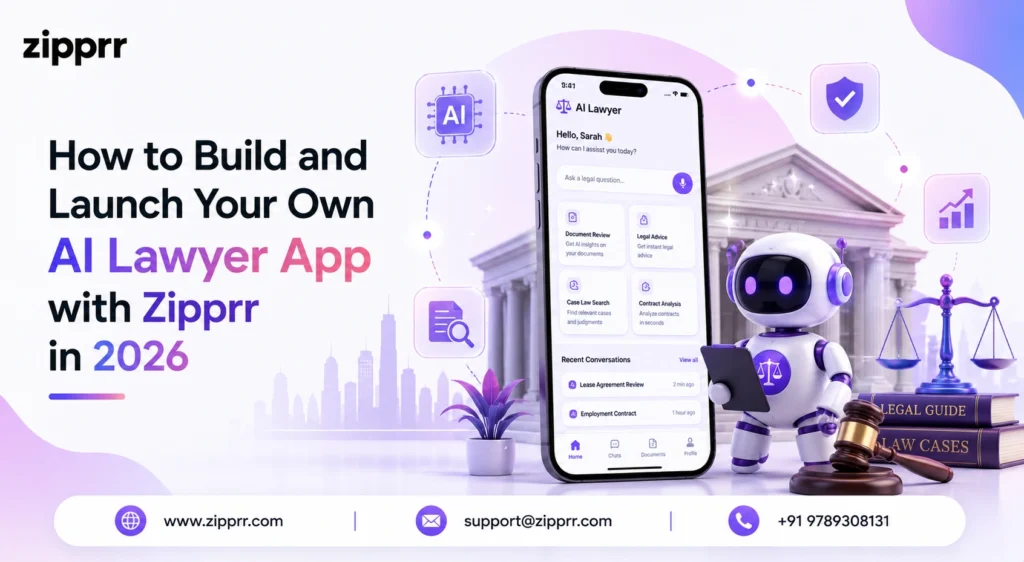
An AI Lawyer is a software product that uses artificial intelligence and large language models to answer legal questions, review documents, and draft contracts for users across the United States, with no human attorney needed at every routine step. Demand for affordable legal help in the US keeps climbing, and an AI lawyer app meets it around the clock. Building one once took months of engineering and a heavy budget, yet in 2026, a ready-made AI Lawyer script from Zipprr puts your own platform live within days. This guide explains what an AI Lawyer is, how it works, what it costs, the features it needs, and how to launch your own for the US market.
What is an AI Lawyer?
An AI Lawyer is an AI legal assistant that delivers legal information, drafted documents, and case guidance through a chat window trained on United States legal material. It is not a licensed attorney. It is legal technology built to help American consumers and businesses understand their rights, prepare agreements, and handle everyday legal tasks faster and at lower cost.
The term appears in two senses. The common one points to consumer and business software, the legal chatbot that anyone in the US can open in a browser. The narrower one describes a practising attorney who leans on legal AI for client intake, legal research, and early drafts. This guide stays with the software meaning, since that is what most people searching the keyword want: an AI lawyer app that behaves like a lawyer on demand.
AI Lawyer
How does an AI Lawyer work?
An AI Lawyer works by pairing a large language model with US legal data and ready document templates, so it can read your question, pull the right legal context, and return a response shaped to your situation and your state. You type a plain language question or upload a document, the AI legal assistant interprets it with natural language processing, and it sends back an answer, a summary, or a drafted document in seconds.
Three layers do the work behind the scenes. The first is a language understanding engine that reads the user request and any uploaded files. The second is a large language model, tuned on a body of US cases, statutes, and contracts, which produces clear text. The third layer handles retrieval and templates, grounding each answer in real legal sources and filtering by state and jurisdiction so the response stays relevant. Many modern AI lawyer apps add agentic flows, where the system breaks a task into stages such as research, draft, and review, then completes them in order.
Is there an AI Lawyer for US legal questions?
Yes, an AI Lawyer can handle a wide range of United States legal questions, from tenant rights and employment issues to small business contracts and consumer disputes. The strongest AI lawyer software is trained on US statutes and case law and lets users filter by state, so the guidance fits the right jurisdiction.
These AI legal assistants shine for quick, low-stakes questions: making sense of a clause, checking your rights as a renter in your state, or drafting a simple agreement. They clear the two biggest barriers to legal help in the US: cost and the wait for an appointment. Keep in mind that an AI Lawyer supplies general legal information rather than tailored representation, and it does not replace a qualified US attorney once a matter grows complex.
Can AI replace lawyers in the US?
No, AI will not replace lawyers in the US, yet it is quickly taking over much of their repetitive work. American attorneys bring judgment, courtroom advocacy, negotiation, and accountability that no model reproduces, while an AI Lawyer brings speed, scale, and low-cost document handling. The realistic path is partnership, with AI handling intake, legal research, early drafts, and document review while lawyers focus on strategy.
For everyday Americans, an AI Lawyer clears a large share of routine legal needs that once went unmet because hiring an attorney cost too much, including rental disputes, basic contracts, demand letters, and reading dense paperwork. Across US law firms, legal AI is becoming standard infrastructure. That mix of heavy, recurring, and underserved demand is exactly why launching an AI lawyer platform is a strong opportunity in the US through 2026.
Is AI legal advice accurate and safe in the US?
AI legal advice is useful for information and drafting, but it carries real risk, because general-purpose models can produce confident, wrong answers. An AI Lawyer built specifically for US law and grounded in vetted legal data is far more reliable, yet no tool should be treated as the final word on a legal matter. The safe standard keeps a human in the loop, letting the AI research and draft while a licensed US attorney confirms anything important.
Accuracy comes down to the data behind the tool. A generic legal chatbot may rely on stale sources and miss recent US legislation. An AI Lawyer that pulls from current statutes and case law, filters by state, and shows its citations is far steadier. For any platform you launch, transparency matters: label outputs as legal information rather than legal advice, post clear disclaimers, and direct users to attorney review on serious questions. This protects users and builds trust under US consumer expectations
How do you build an AI Lawyer app?
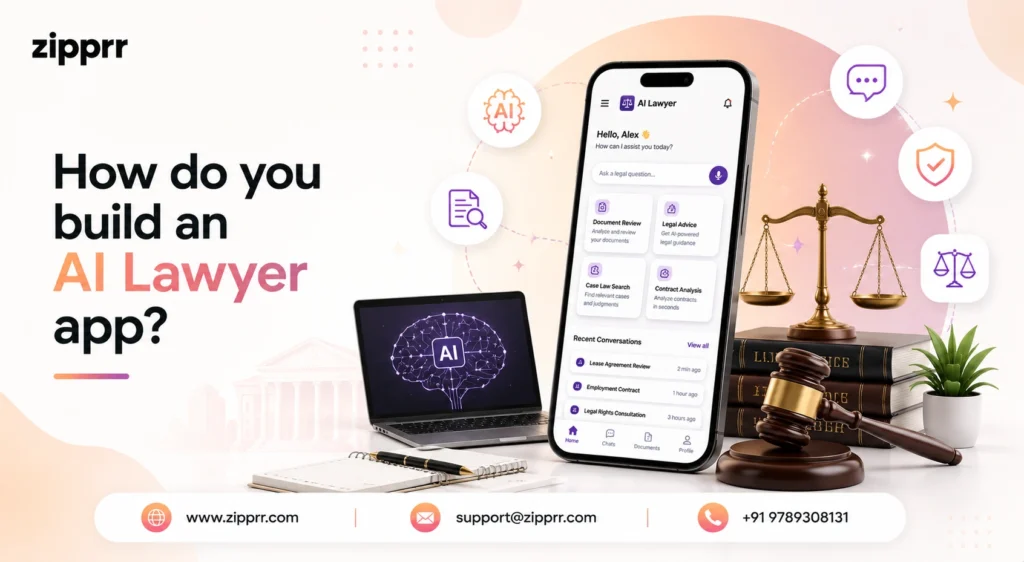
You build an AI Lawyer app by combining a chat interface, a large language model, a legal document and template engine, and secure accounts, whether you code it from scratch or deploy a finished script. A scratch build for the US market usually takes 6 to 9 months and 35,000 to 300,000 dollars or more, while a prebuilt AI Lawyer clone script can launch a working platform within days at a small fraction of that.
The build follows a predictable blueprint. You need a chat front-end driven by language understanding, a large language model connection, a document generator stocked with US and state-aware templates, a client portal for sharing files and taking payments, and admin controls for users, subscriptions, and content. Teams save money by reusing existing legal AI models, running one shared codebase across web and mobile, and shipping only the essential features at launch. The quickest route is starting from a tested AI lawyer script rather than rebuilding the same stack from zero.
How much does it cost to build an AI Lawyer app?
What features should an AI Lawyer platform have?
A strong AI Lawyer platform should ship with an AI legal chat assistant, document creation and review, state and jurisdiction filters, secure accounts, and subscription billing. These cover the most in-demand jobs for US users, answering legal questions, drafting contracts, and reviewing documents, while turning plans and credits into revenue.
The core feature set for a competitive AI lawyer software product looks like this:
- An AI legal chat assistant that answers questions around the clock in plain language
- Document generation for US contracts, agreements, NDAs, demand letters, and wills
- Document review and summaries that flag risks and explain clauses simply
- State and jurisdiction filters that keep answers tied to the user’s location
- Secure client portal for uploads, electronic signatures, and payments
- Multi-language support for a diverse US user base
- Subscription and credit billing for steady recurring income
- Admin dashboard for managing users, content, prompts, and analytics
What are the use cases for an AI Lawyer?
AI Lawyer platforms serve US consumers, small businesses, and law firms across the legal tasks people face daily. The heaviest used cases are answering legal questions, drafting and reviewing contracts, and explaining legal documents in plain language, all high-volume tasks that suit automation.
Common US scenarios run across employment and workplace matters, rental and tenancy disputes, family questions such as divorce and custody, immigration guidance, small business contracts and NDAs, real estate and housing agreements, wills and probate basics, and consumer issues like refunds or steps after a car accident. For business owners, an AI Lawyer trims routine legal spending; for founders, an AI lawyer app plugs straight into that demand.
Why should you launch your AI Lawyer platform with Zipprr?
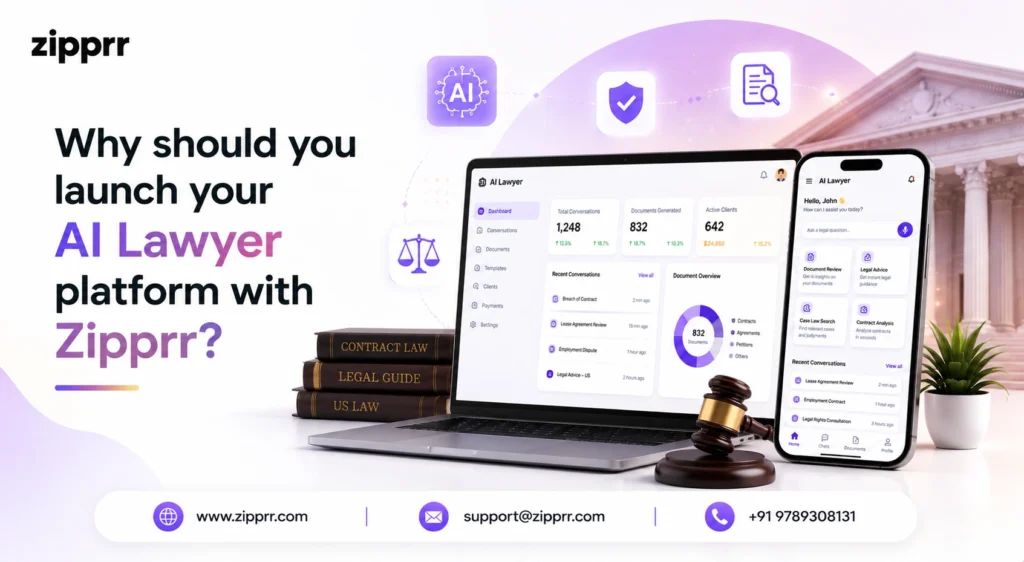
Zipprr’s AI Lawyer script gives you a finished, customizable legal AI platform built for the US market, so you can go live in days instead of spending months and six figures building it yourself. You get clean source code, the feature set US users expect, and full ownership, with none of the recurring per-seat fees a third-party app charges. It is the fastest and least risky way into a US legal AI market that keeps growing.
Choosing Zipprr means starting from a proven base: AI chat, document generation, user management, and billing are already built and connected, ready for your branding and your business model. You can plug in your preferred large language model, adjust templates for US states and jurisdictions, and set your own pricing. Take a closer look and book a demo on the Zipprr AI Lawyer software page.
AI Lawyer vs. building from scratch, which is better?
For nearly every US founder, a ready-made AI lawyer script wins on time, cost, and risk. You can compare features and pricing on the Zipprr AI Lawyer platform page. Here is the quick comparison:
- Time to launch: Zipprr script equals days; from scratch equals 6 to 9 months
- Upfront cost: Zipprr equals a one-time license; from scratch equals 35,000 to 300,000 dollars or more
- Core features: Zipprr equals included and tested; from scratch equals build each one yourself
- Ownership: Zipprr equals full source code ownership; a SaaS app equals ongoing per-seat fees
- Risk: Zipprr equals a proven codebase; from scratch equals unproven with a longer runway