

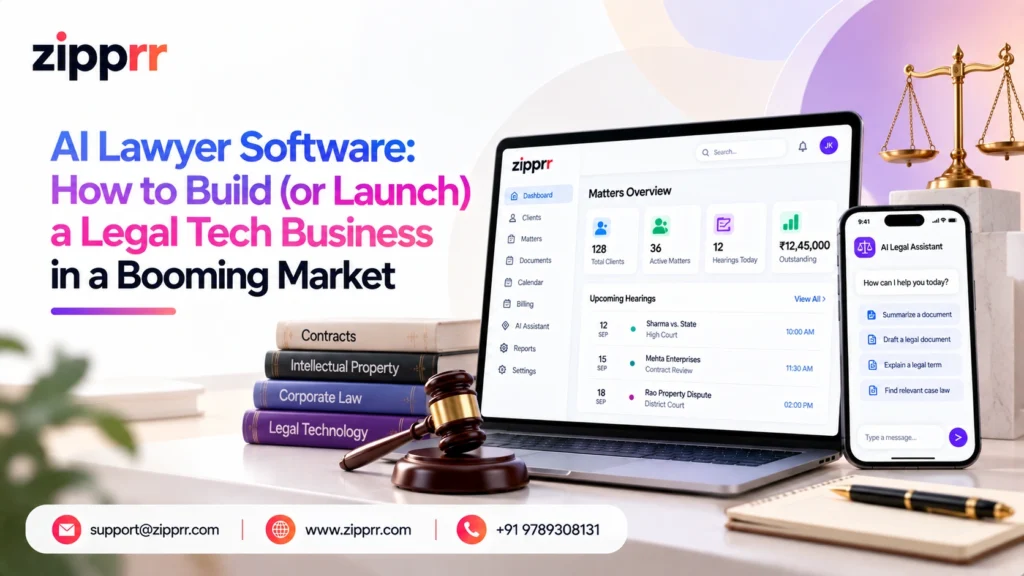
Legal work still runs on billable hours, repetitive paperwork, and attorneys rereading the same clauses for the hundredth time. That inefficiency is exactly why AI lawyer software has become one of the more interesting business opportunities inside the broader AI boom. These platforms don’t replace attorneys. Instead, they take over contract review, legal research, document drafting, and client intake so lawyers spend less time on repetitive administrative work and more time on the parts of the job that actually require judgment. Here’s what the software needs to do, what the existing market already focuses on and charges, how big the opportunity really is, the risks worth planning for, and a realistic path from idea to a working MVP.
What AI Lawyer Software Actually Does
Strip away the marketing language and most AI lawyer platforms are built around four core functions:
- Document drafting: generating contracts, demand letters, pleadings, and compliance filings from a set of inputs instead of a blank page, adjusted for the specific state or federal jurisdiction involved.
- Contract review: the software reads an uploaded agreement, flags risky or non-standard clauses, checks for missing protections, and often compares two versions to produce a redline automatically.
- Legal research automation: searching case law, statutes, and regulations for relevant precedent far faster than a manual search would allow.
- Legal Q&A: a conversational layer that answers plain-language questions grounded in real sources rather than a model guessing.
A serious platform usually combines at least two or three of these, because a tool that only drafts or only reviews leaves an obvious gap in the workflow.
Who Is Actually Buying This
- Solo practitioners and small firms: the largest underserved segment. They handle the same volume of contracts and filings as bigger firms but without a bench of paralegals to absorb the work.
- In-house corporate legal teams: process a high volume of vendor contracts, NDAs, and procurement agreements and need consistent risk scoring rather than a lawyer reading every clause.
- Niche practices: immigration, real estate, and insurance defense, where document types are repetitive enough that jurisdiction-specific templates create immediate time savings.
- Independent legal consultants and contract reviewers: a smaller but genuinely profitable niche.
- Consumers: everyday legal problems like a lease dispute or subscription cancellation, though this is the segment with the highest regulatory exposure (more on that below).
The MVP Features You Can't Skip
A minimum viable version of this product needs to cover the basics well rather than everything poorly:
- Template-based document drafting for a handful of common document types across a few jurisdictions.
- Contract review engine that can risk-score clauses and highlight what’s missing.
- Research or Q&A assistant that cites its sources instead of asserting answers with no backing.
- Client intake flow, often a conversational interface similar to a website AI chatbot, that captures the initial details of a matter before a human gets involved.
- Deadline and calendar system tracking statute-of-limitations dates and filings.
- Secure document storage with e-signature support.
- Basic billing, even in a simple form, since legal software that can’t produce an invoice tends to get abandoned for whatever the firm was already using.
Features That Create a Real Competitive Edge
Once the basics work, the features that actually differentiate a platform tend to be operational rather than flashy:
- Jurisdiction-aware drafting across all 50 states and federal circuits, rather than generic templates.
- Redline comparison mode that shows exactly what changed between contract versions.
- Compliance modules: IOLTA trust accounting and LEDES-format billing, non-negotiable for firms in states with strict bar accounting rules.
- Integrations with the practice management and accounting tools firms already use, so they don’t have to abandon their existing stack.
- Multi-language client portals for firms serving immigrant or international clients.
- White-label, multi-tenant architecture if your business model involves other entrepreneurs or agencies reselling the platform under their own brand.
What Existing AI Legal Platforms Focus On (And What They Charge)
Rather than getting distracted by brand names, it’s more useful to look at the market by focus area and price tier. That’s where the real gap sits:
| Market Category | What It Focuses On | Typical Pricing | Best For |
|---|---|---|---|
| Enterprise BigLaw suites | Research, drafting, and due diligence for the largest firms | $1,200 to $2,000+ per seat monthly, 20-25 seat minimums (annual floors past $300,000) | Am Law 100-size firms with dedicated tech budgets |
| Word-native contract tools | Contract drafting and redlining built directly into Microsoft Word | $99-199 per user monthly, enterprise tiers around $350 per seat | In-house teams and small-to-midsize firms |
| Enterprise contract lifecycle management | Full intake-to-signature contract workflow and repository management | $30,000 to $150,000+ annually, plus implementation fees | Enterprise legal and procurement teams |
| Playbook-based review tools | Risk-scoring contracts against documented review standards | Quote-led, benchmarks around $8,000 per user annually | Teams standardizing contract review |
| High-volume review and negotiation tools | First-pass contract review and autonomous negotiation at scale | Custom enterprise pricing, typically five to six figures a year | Legal teams processing large contract volumes |
| Bundled legal research suites | Case law and statute research bundled into major legal database subscriptions | Usually not sold as a standalone product | Research-heavy practices already paying for legal databases |
| Self-serve research and review tools | Lighter-weight research and contract support without a sales process | Roughly $499-500 per month, self-serve | Individual in-house counsel and smaller practices |
| Consumer legal apps | Everyday legal tasks like subscription cancellations and small claims filings | Roughly $36 for three months | Individual consumers |
| White-label one-time license (Zipprr) | Ready-made AI Lawyer platform with source code included, launched under your own brand | $490 one-time for the Standard plan, $890 one-time for the Pro plan, no recurring monthly fees | Founders who want to launch an AI lawyer business fast without ongoing subscription costs |
Worth noting: one widely used consumer legal app was fined $193,000 by the FTC in 2024 for overstating its AI’s legal accuracy without ever having attorneys verify its answers, a useful cautionary tale for anyone building here. The pattern across nearly every category above is the same: seat minimums and enterprise pricing lock out solo practitioners and small firms, which is exactly the segment a leaner, more affordably priced platform can go after.
Is There Really Room for a New Entrant? Market Demand
- 2025 market size: roughly $29.81 billion globally.
- 2026 projection: about $32.53 billion.
- 2035 forecast: approximately $73.32 billion, a compound annual growth rate of around 9.42%.
- North America’s share: about 54% of global revenue.
- Law firm spending: roughly 60% of end-user spending, confirming firms are already paying for this category.
The unserved part of that spending is the long tail: solo practitioners and small firms that make up the overwhelming majority of practicing lawyers but are priced out of the enterprise-focused tools dominating headlines.
How Complex Is This to Build
Building this from scratch is a genuinely harder project than a typical SaaS product, mainly because accuracy isn’t optional. The core requirements:
- Retrieval-augmented AI that grounds output in actual statutes, case law, and firm-specific playbooks, since a hallucinated citation in a legal document creates real liability.
- Document processing: OCR and structured extraction from PDFs and scanned files.
- Security architecture that can pass a SOC 2 audit, with encryption for privileged client data.
- Jurisdiction-specific legal content, either licensed or from public sources.
Realistically, a small team building this from zero is looking at six to twelve months before a credible MVP is ready. Some businesses skip that build cycle by starting from an already-built platform instead: Zipprr sells a ready-made AI Lawyer platform with source code included, compressing that same timeline to days for founders who’d rather spend budget on go-to-market than on rebuilding infrastructure that already exists.
Monetization Models Worth Considering
- Per-seat monthly subscription: the model most enterprise BigLaw suites and Word-native contract tools run, though it’s also the model creating the pricing gap in the market.
- Volume or document-based pricing: common among enterprise CLM and playbook-based review platforms, works well for enterprise buyers with unpredictable usage but is harder to sell to smaller firms.
- Tiered self-serve plus enterprise: lets a business capture both ends of the market without a sales team gating every deal.
- One-time license or white-label resale: a real alternative to subscription fatigue that removes the recurring-cost objection for solo practitioners. Zipprr’s own AI Lawyer software runs on exactly this model, a $490 one-time payment for the Standard plan or $890 one-time for the Pro plan, with no monthly fees at all.
- Consumer subscription: can work at scale but carries the highest regulatory exposure of any option on this list, since consumer-facing legal advice draws far more scrutiny than software sold to licensed attorneys.
Recommended Tech Stack
| Layer | Recommended Tools |
|---|---|
| Frontend | React or Next.js for a fast, responsive interface |
| Backend | Node.js, Django, or Laravel depending on team expertise |
| AI layer | Large language model API paired with retrieval-augmented generation over a vector database |
| Document processing | OCR and NLP libraries for uploaded documents |
| Infrastructure | Cloud hosting configured for SOC 2 compliance from the start |
| Integrations | E-signature, calendar sync, and billing/accounting APIs |
Security architecture and audit logging need to be designed in from day one, since this isn’t a category where you can bolt on compliance later.
Best Platform Type: SaaS, Marketplace, or Mobile?
- Multi-tenant SaaS, web-first: the right structure for nearly every version of this business, with a companion mobile app for deadline alerts and quick document review on the go.
- Marketplace model: connecting clients directly to lawyers for paid consultations only makes sense as an add-on layer once the core drafting and review product has traction, since marketplaces need liquidity on both sides before they’re useful.
If you’re exploring what a working version of any of this looks like before committing engineering time, it’s worth browsing a catalog of ready-built platforms across different categories to see how similar multi-tenant architecture gets structured in practice.
Risks and Challenges to Plan For
- Accuracy liability: an AI that drafts a contract with a missing or incorrect clause, or gives a confidently wrong legal answer, creates exposure for both the software provider and whoever relied on it, as the FTC case mentioned above shows.
- Unauthorized practice of law: rules vary significantly by state, so consumer-facing Q&A features need clear “not legal advice” positioning, while tools sold to licensed attorneys need to stay positioned as assistance rather than a replacement for professional judgment.
- Data security: client documents are privileged and often highly sensitive, so a breach in this category is reputationally worse than in most other SaaS niches.
- Rising incumbent pricing: as established platforms raise prices after locking in a customer base, it pushes firms down-market toward affordable alternatives, so differentiation on service and specialization matters more than undercutting on price alone.
A Realistic MVP Roadmap
| Phase | Focus |
|---|---|
| Phase 1: First few weeks | Core document drafting for one or two practice areas, plus a basic Q&A chat grounded in real legal sources, enough to start onboarding pilot users |
| Phase 2: Following weeks | Contract review, redlining, deadline tracking, and a simple client portal, the features that turn a demo into a daily-use tool |
| Phase 3: Next phase | Billing, trust accounting compliance, integrations with practice management tools, plus multi-tenant support if reselling or white-labeling |
| Phase 4: Ongoing | Expanding jurisdiction coverage, adding practice-area playbooks, and building mobile apps |
Founders who’d rather start from a working product on week one than month four typically license an existing platform instead of building the infrastructure layer from scratch.
Conclusion
Legal tech is growing faster than most software categories right now, and the segment of the market that actually has money to spend, practicing law firms, is still underserved by tools priced for enterprise budgets. Whether you build a platform from the ground up or start from an existing codebase, the opportunity is real: solo practitioners and small firms need the same document drafting, contract review, and research automation that the highest-priced platforms offer, just without the enterprise price tag.
Ready to launch your own AI lawyer software business?
Frequently Asked Questions
What does AI lawyer software actually do?
AI lawyer software uses AI to help with legal tasks such as answering legal questions, drafting and reviewing documents and supporting research, so users and legal teams get faster first-pass support.
Who buys AI lawyer software?
The article covers the buyer groups for AI legal tools, including law firms, legal teams and businesses that want faster legal support, and explains how the target buyer shapes what you build.
What MVP features does an AI legal tech product need?
The article lists the must-have MVP features for a legal AI product and separates them from the features that create a real competitive edge, so you launch lean and differentiate later.
Is there room for a new entrant in the AI legal market?
The article looks at what existing AI legal platforms focus on and where gaps remain, which is where a new entrant can find room by serving a narrower audience or workflow.
Can I launch a ready-made AI lawyer software product?
Yes. Zipprr offers an AI lawyer software solution you can review on the AI Lawyer product page at https://zipprr.com/ai-lawyer/ or discuss on a free demo at https://zipprr.com/schedule-free-demo/.