
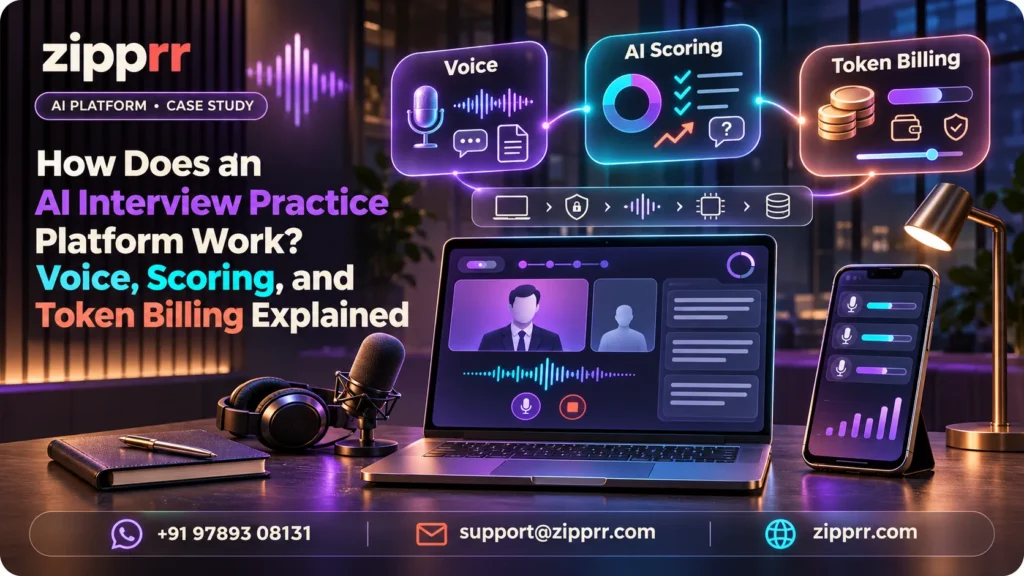
An AI interview practice platform lets a candidate rehearse spoken or written answers and receive scored feedback at any hour. This case study shows how such a platform can be structured, using one source-code product on CodeCanyon as the reference.
This is a technical walkthrough, not a customer story. Also, zipprr did not build, own, sell or deploy the reference product. No client, user count, revenue figure or conversion rate is claimed here, and every outcome below is a design goal or a possible benefit, not a measured result.
Three labels keep the facts apart as you read:
Evidence date: all external facts were checked on 16 November 2026.
What the Reference Product Behind This AI Interview Practice Platform Is
The listing is titled "NailIT | AI Interview Prep Web App With AI Scoring - React and Node". The seller is mefjudevllc, and it is sold as a source-code template, not a hosted service.
Confirmed boundaries from the listing
- It is a web application, not a native iOS or Android app.
- No hosted demo site is provided.
- The buyer needs Node.js, npm and terminal experience.
- The buyer needs a Supabase project and an OpenAI API key. The listing notes that AI features consume paid credits.
- ElevenLabs, Stripe, RevenueCat and Branch are optional services, each needing its own account and setup.
- The optional Expo and React Native component is a WebView wrapper around the web app, not a separately built native application.
- The seller discloses that parts of the code were built with AI-assisted tools, then reviewed and tested by the author.
One dated warning first. The listing names several OpenAI models that OpenAI has scheduled for shutdown in early 2027. The operations section explains this in detail.
The Problem and the Users of an AI Interview Practice Platform
Interview practice has three familiar problems. In addition, human coaches are costly and hard to schedule. Moreover, feedback varies from one coach to the next. Furthermore, candidates also tend to rehearse silently, then speak differently under pressure.
AI practice tools aim to fix this with on-demand, repeatable, spoken drills. Besides, the market context is shifting too. Likewise, greenhouse's 2026 survey of 2,950 job seekers found that 63% had already been interviewed by an AI, and that seven in ten candidates were never told upfront that AI would assess them. Also, greenhouse sells hiring software, so treat the survey as vendor research.
Likely users
- Candidates preparing for medical school, university, apprenticeship or job interviews.
- Interview coaching businesses that want a branded practice tool.
- Training providers and colleges that want practice for their learners.
- HR-tech teams exploring a candidate-facing prep module.
- Developers who need a working base to customize.
If you run online courses rather than interview practice, the Udemy Clone is a related Zipprr learning product.
Features of an AI Interview Practice Platform and What Each Is Worth
The table lists only features confirmed in the listing. In addition, the answer scoring feature returns a 0 to 100 score, a band from Poor to Outstanding, a summary, strengths, improvements and follow-up questions.
The candidate journey
Here is the path a candidate takes through the AI interview practice platform, from sign-up to deletion.
- The candidate registers with email and password, and logs in.
- They set preferences for voice, time limit and strictness.
- They pick a persona and may upload a CV.
- They choose a mode: drill, live interview or realtime interview.
- They answer by voice or text.
- They receive a score and written feedback.
- The attempt is saved. They review it under My Answers and on the progress dashboard.
- When tokens run out, a modal leads them to the token store.
- They can export their data or delete the account.
AI Interview Practice Platform Architecture: Stack and Data Flow
Here is the confirmed stack, taken from the listing.
- Frontend: React 18, TypeScript, Vite, React Router 6 and Tailwind CSS.
- Backend: Node.js 20 with Express 4, Zod validation, Helmet and express-rate-limit.
- Database and authentication: Supabase (PostgreSQL) with Row Level Security. SQL setup files are included.
- AI services: GPT-4o-mini for scoring, Whisper for transcription, TTS-1 for speech, and a GPT-4o-mini Realtime model for live voice.
- Payments: Stripe webhooks, RevenueCat webhooks and in-app purchase verification.
- Optional mobile shell: Expo 53, React Native 0.79, a WebView, react-native-iap and Branch.
- Deployment: any Node host. A render.yaml file is included.
Stripe and RevenueCat webhooks also feed into the Express API, which acts as the single trusted gate between the browser and every paid service.
Recommendation Treat the Express API as the single trusted gate. It should authenticate the user, validate input, check the token balance, call the AI provider, record usage and write results. The browser should never hold provider keys.
What this means in practice
The reference AI interview practice platform is source code that needs setup. Moreover, whether any AI, payment or deep-link feature works depends on the buyer's own accounts, correct configuration, provider availability and applicable usage charges. Furthermore, payment features are described as "ready", which implies buyer-side setup.
Recommendation Because the seller discloses AI-assisted development, commission an independent code and security review before launch. This is sensible for any purchased codebase.
How a Spoken Answer Flows Through an AI Interview Practice Platform
Path A: Live Interview, transcribe then score
Confirmed The listing describes six steps:
- The interview question is spoken using text-to-speech, with file caching and an optional ElevenLabs voice.
- The candidate records an answer.
- The audio is transcribed with Whisper.
- The transcript is scored against the persona's rubric.
- Tokens are metered per minute.
- The result is saved to attempt history.
Recommendation The listing does not describe the gaps below, so add these safeguards:
- Cap recording length. OpenAI's file transcription accepts files up to 25 MB.
- Show the transcript before scoring. Speech recognition errors can unfairly lower a score. Research found an average word error rate of 0.35 for Black speakers against 0.19 for white speakers across five commercial systems tested in 2020. Those systems are older, so test current models with your own users' accents.
- Keep raw audio only if you need it. Store the transcript and score by default.
- Write results idempotently. A retry should never create a duplicate attempt or a double charge.
Path B: Realtime AI Interview, speech to speech
Confirmed The candidate holds a spoken conversation through the OpenAI Realtime API. Duration is configurable from 1 to 5 minutes, with an optional live AI rating.
OpenAI's documentation adds useful context. Besides, the Realtime API works directly with audio and keeps conversation state, and it targets barge-in and natural turn-taking. Likewise, browsers connect over WebRTC, while servers connect over WebSocket. For browsers, your server should mint a short-lived client secret so the real API key stays private.
Turn detection has two modes. Also, server voice activity detection ends a turn after silence. In addition, semantic detection estimates whether the speaker has finished a thought, and waits longer on unfinished speech.
Recommendation For interview practice, semantic detection with low eagerness suits candidates who pause to think. The listing does not say which options the code uses, so verify this in the source. Also pass a stable, privacy-preserving user identifier to the provider when creating sessions, as OpenAI advises.
Recommendation A realtime session is a metered resource. Reserve tokens before it starts, enforce the duration cap on the server, and settle the final usage when it ends.
Need a custom AI interview or coaching platform?
If you are weighing a customized AI interview, learning or coaching platform, Zipprr can discuss your requirements with you. Visit the Zipprr homepage to see what Zipprr offers, or book a free demo to talk through your idea.
AI Scoring Design, Rubric Quality and Limitations
Each answer receives a 0 to 100 score, a band, a summary, strengths, improvements and follow-up questions. Each persona has its own rubric, drill mode adds an AI model answer, and a strictness preference exists in account settings.
What makes scoring useful
- A written rubric with anchors. For each criterion, define what weak, adequate and strong look like.
- Structured output. Ask the model for fixed fields and validate them with a schema.
- Evidence. Show the exact phrase from the transcript behind each strength or weakness.
- Separation of tasks. Score first, then coach. Mixing them makes both less stable.
- A calibration set. Collect answers rated by human experts, and re-run them whenever you change the model or prompt.
- Variance tracking. Score the same answer several times and watch the spread.
- Honest framing. Call the result practice feedback, not a prediction of interview success.
Limits to plan for
- Judge reliability varies. A 2026 study found that language-model scoring becomes less reliable in factual, knowledge-intensive settings. A separate 2026 legal-domain benchmark measured 79.36% item-level agreement with human experts, with a Cohen's kappa of 0.589, under detailed rubrics. The domain differs from interviews, but the lesson holds: rubric-guided AI judging is imperfect.
- Medical content needs experts. A Medical persona may involve clinical knowledge and ethics, so have qualified reviewers validate the rubric and model answers.
- A 0 to 100 score looks precise. It is a presentation choice, not a measurement. Show bands and written reasons more prominently than the number.
- Human oversight. Coaching businesses can add a review queue for flagged or low-confidence answers.
- Risk management. NIST's Generative AI Profile is a voluntary framework for identifying and managing generative AI risks. It is a useful checklist, not a certification.
Security, Privacy and Operations for an AI Interview Practice Platform
What the listing confirms
- Email and password authentication with server-side HttpOnly sessions.
- Zod input validation, Helmet security headers and tiered rate limiting.
- Row Level Security so users can read only their own data.
- CV storage in the browser only.
- Data export and full account deletion, described by the seller as GDPR and CCPA friendly.
That description is the seller's wording, not a legal certification. Moreover, compliance depends on how you configure, host and operate the platform.
What to verify and add
- Row Level Security details. Supabase advises enabling it on every exposed table. Admin keys bypass it, so keep them server-side, and index the columns used in policies. If the backend uses an admin key, then authorization rests on server code, so test it.
- Spending limits. OWASP lists unrestricted resource consumption as an API risk and advises rate limits, size limits, spending caps and billing alerts. Set per-user and platform-wide caps on realtime minutes and AI spend, and watch for free-token abuse through repeated sign-ups.
- Payment webhooks. Stripe requires the raw request body for signature checks, recommends logging event IDs to avoid duplicates, and does not guarantee event order. RevenueCat delivers at least once, so store each event ID and skip repeats.
- Provider data handling. OpenAI states that API data is not used for training by default. Abuse monitoring logs are kept for up to 30 days, and zero data retention needs prior approval. Choose settings that match your privacy notice.
- CV handling. The CV is stored only in the browser, but if its text personalizes feedback it must still be sent with the request to the AI provider. The listing does not state this flow, so check the code and say so in your privacy notice.
- Retention. Decide how long transcripts and scores are kept, and make deletion cover backups and logs.
- AI disclosure. OpenAI's usage policy requires telling users that a text-to-speech voice is AI-generated, so show a clear notice at the start of every spoken session.
Model lifecycle: a dated risk
The listing names GPT-4o-mini, Whisper, TTS-1 and a GPT-4o-mini Realtime model. Furthermore, the OpenAI deprecations page lists these dates.
OpenAI also retired the Realtime beta interface header on 12 May 2026. Besides, we could not inspect the purchased source code, so we cannot say which exact model IDs or Realtime interface version it calls.
Recommendation Treat model IDs as configuration. Check them before launch, then test replacements against your calibration set.
Likely scaling bottlenecks
For a deeper look at reserve, settle and refund flows, see Zipprr's AI SaaS platform architecture guide. It covers credit metering and idempotency keys for AI products.
Monetization Options for an AI Interview Practice Platform
The listing offers a Regular license for one end product that end users are not charged for. Likewise, the Extended license covers one end product that end users can be charged for. Read the Envato license terms before charging anyone.
Zipprr's composite case study on an AI language learning app with a human tutor marketplace shows a related pattern. Also, its AI layer gives each task its own provider, model, limits and fallback, and it describes tutor profiles, availability calendars and escrow-style lesson payments. A tutoring page like the one in this reference product could grow in that direction. For live classes and online coaching, you can also look at the Unacademy Clone from Zipprr.
Pricing the tokens
AI cost in an AI interview practice platform is usage-based. On OpenAI's pricing page, realtime audio for gpt-realtime-2.1 is listed at $32 per million input tokens and $64 per million output tokens, and the mini model at $10 and $20. In addition, prices change often, and cost per minute depends on how many audio tokens a session uses.
Recommendation Measure real cost per minute in a test environment before setting pack prices.
App store rules
The mobile shell includes in-app purchase support. On iOS, Apple requires in-app purchase for unlocking features and credits, purchased credits may not expire, and a restore mechanism is required. Moreover, apple also expects apps to go beyond a repackaged website. Furthermore, the listing calls the shell ready for the stores, but review outcomes are never guaranteed, so read the current guidelines before you plan a store launch.
Current Trends and What They Mean for an AI Interview Practice Platform
Nine trends shape how any AI interview practice platform should be designed today.
Regulation, in plain terms
An AI interview practice platform for candidates is not obviously a hiring-decision system. Besides, the picture changes if you sell it to employers or use scores to rank applicants. Likewise, the EU AI Act's high-risk rules cover employment and education uses, and the Act also restricts emotion recognition in workplaces and education settings. Also, voice analysis that infers emotion would need legal review.
Treat GDPR rights such as erasure and portability as design requirements. In addition, none of this is legal advice.
Accessibility, localization and mobile
- Accessibility: WCAG 2.2 asks for adjustable time limits and control over auto-playing audio. The reference product has a text option in Drill mode, which helps. Add transcripts and captions for spoken content.
- Localization: OpenAI states that Whisper covers 98 languages, with accuracy varying by language, and its text-to-speech voices are optimized for English. Translating the interface is only the first step.
- Mobile-first: the optional shell is a WebView wrapper with microphone permissions. A responsive web interface comes first, and native features would be separate work.
Future Opportunities for an AI Interview Practice Platform
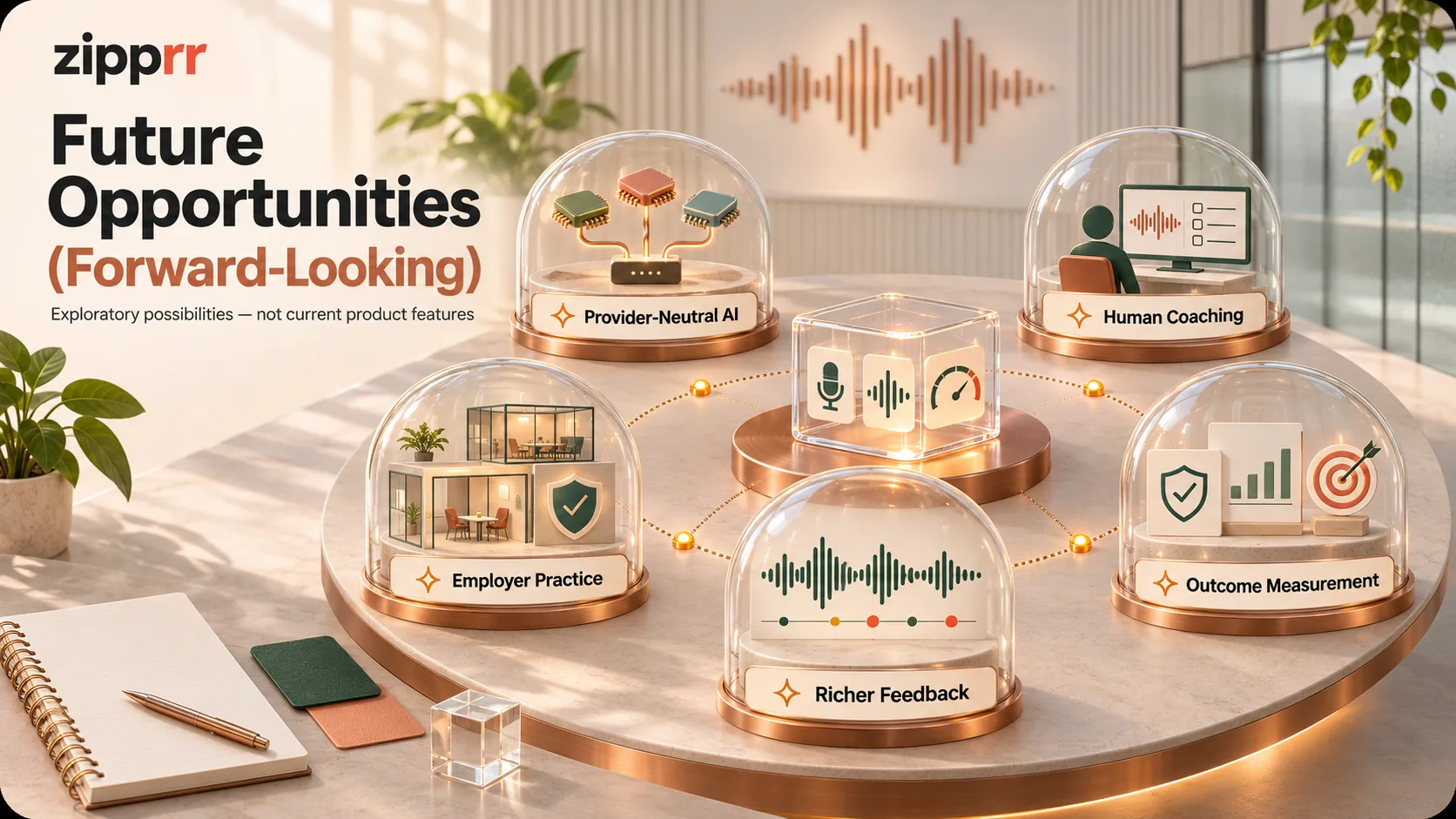
Forward-looking These are possibilities, not features of the reference product.
- A provider-neutral AI layer. Scoring, transcription and voice could sit behind one interface, which would make model retirements far less disruptive. What changes: the backend needs an abstraction and per-task settings.
- Human-in-the-loop coaching. Low-confidence answers could go to a coach for review, and the existing tutoring page could grow into this. What changes: a review queue and payouts.
- Employer-facing practice. Training teams could run structured mock interviews. What changes: multi-tenant workspaces and a stricter compliance review. Risk: the use case may move toward high-risk territory.
- Richer feedback signals. Pacing and filler words could join content scoring. What changes: audio analysis and careful consent. Risk: bias across accents and speech differences.
- Outcome measurement. Operators could run opt-in studies of whether practice helps. What changes: consent flows, analytics and ethics review. Risk: weak evidence is easy to oversell.
If you are exploring conversational AI for your own product, Zipprr also offers an AI Chat product.
Customization Roadmap for an AI Interview Practice Platform
No delivery times are promised here. Moreover, the stages describe order, not duration.
Risks, Trade-offs and Questions to Resolve Before Launch
Main risks
- Model retirement. The listed models have scheduled shutdowns, and a launch without migration would break.
- Cost variance. Realtime voice is the most expensive mode, and poor metering can erase margin.
- Scoring trust. An unreliable score can mislead candidates.
- Privacy and disclosure. Voice, transcripts and CVs are personal data.
- Code quality. AI-assisted code needs independent review.
- Store risk. A thin WebView wrapper may struggle in app review.
- Dependency risk. Each service can change price, terms or availability.
Questions a founder should answer
- Who exactly is the first user, and what would count as real value for them?
- Which personas need expert-validated rubrics before launch?
- What data will you keep, for how long, and why?
- Which license do you need to charge users?
- What happens if a provider changes a model or its price?
- Will you sell to employers? If so, who reviews the legal impact?
- How will you test accuracy for different accents and speech patterns?
- When does a human review an AI score?
Conclusion: Plan for Model Retirement and Scoring Trust
A customizable AI interview practice platform is mostly an orchestration problem. A thin frontend, a trusted API, a database with strict access rules, and a few AI services must work together. Furthermore, the reference AI interview practice platform covers a useful share of that surface, including drills, multi-round and realtime voice modes, persona rubrics, a token wallet and an affiliate program.
It remains source code that needs accounts, configuration, review and ongoing costs. Besides, its biggest near-term risk is model retirement, and its biggest long-term risk is trust in scoring and data handling. Likewise, founders who plan their AI interview practice platform around those two points early will be in a stronger position than those who focus on features alone.
Talk to Zipprr about your requirements
Zipprr's catalogue does not include a dedicated interview-prep product, so a build like this would start from a requirements conversation. Start at the Zipprr homepage, book a free demo or chat on WhatsApp. More technical walk-throughs are in Zipprr's case studies archive, though some of those posts are illustrative rather than customer stories.
Frequently Asked Questions About an AI Interview Practice Platform
What is an AI interview practice platform?
It is software that asks interview questions, records a candidate's spoken or typed answers, and returns scored feedback. Also, some versions add realtime voice conversations, model answers and progress tracking. In addition, it supports practice only. Moreover, it does not predict whether a candidate will get a job.
How does AI interview scoring work?
The system transcribes the answer, then asks a language model to rate it against a written rubric. Furthermore, the reference product returns a 0 to 100 score, a band, strengths, improvements and follow-up questions. Besides, scores are only as reliable as the rubric and testing behind them, so human review still matters.
Can an AI interview practice platform run realtime voice interviews?
Yes. Likewise, the reference product uses the OpenAI Realtime API for spoken conversations of 1 to 5 minutes. Also, realtime voice needs a provider account, usage-based payments and careful session limits. In addition, browsers normally connect with short-lived credentials created by the server, not with the main API key.
Is NailIT a hosted service I can launch immediately?
No. Moreover, it is a source-code template. Furthermore, the buyer must set up Supabase, an OpenAI key, hosting and any optional payment or voice services. Besides, the mobile component is a WebView wrapper, not a native app. Plan for setup, security review and ongoing usage charges.
How much does it cost to run an AI interview practice app?
Costs are usage-based and change over time. Likewise, the listing showed a $14 license price, excluding tax. Also, running the app adds charges from AI and any payment or voice providers. Measure real cost per minute in testing before you price tokens or subscriptions.
Is it safe to store candidate answers and CVs?
It can be, if you design for it. In addition, minimize what you keep, set retention limits, secure access with row-level rules, and explain provider data handling in your privacy notice. Moreover, the reference product stores the CV only in the browser. Seek legal advice on GDPR, CCPA and AI rules.