

Overview
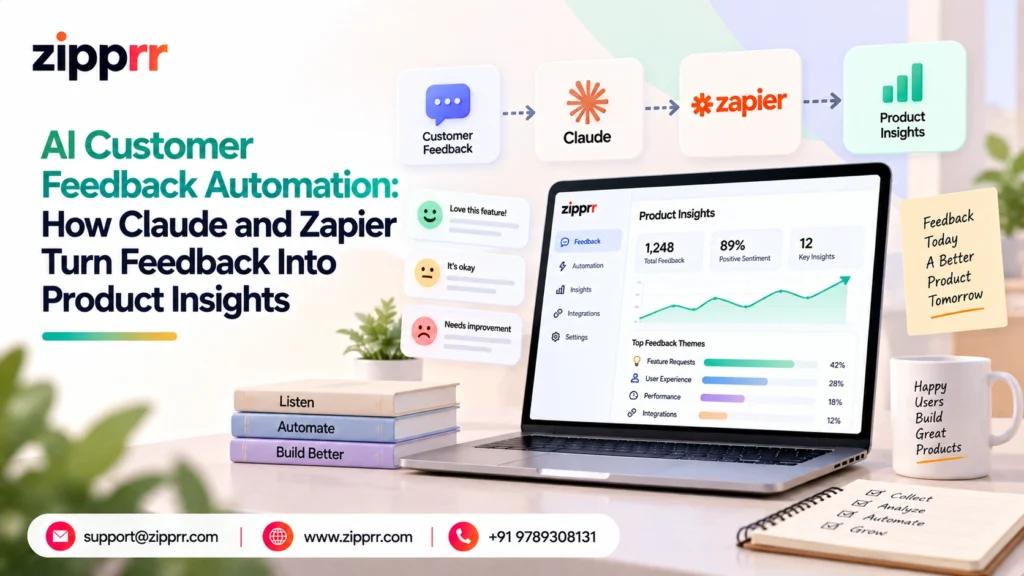
Customer feedback often contains valuable product insights, but teams struggle to identify recurring patterns across surveys, reviews, and support messages. This automation combines Claude, Zapier, Google Sheets, and Airtable to analyze weekly feedback items, identify meaningful themes, assign an AI Confidence Status, and store the results as structured product insights for product and operations teams.
Business value:
- Converts scattered feedback into organized insights
- Identifies recurring problems automatically
- Highlights urgent issues before they grow
- Reduces manual review effort
The Scenario
A small direct-to-consumer skincare brand sells through its own online store and a handful of marketplace listings. Every week, customer feedback arrives from three different places: a post-purchase survey tool that exports answers into a spreadsheet, review exports pulled from the marketplace listings, and messages left on a support contact form. A customer experience coordinator is responsible for reading through all of it and telling the product and operations teams what customers are actually saying.
In practice, that means opening three files, reading through that week’s customer comments line by line, and manually noting anything that comes up more than once, whether that is a packaging complaint, a shipping delay, or repeated praise for a new product variant. The coordinator does this once a week, squeezed between other tasks, and the notes rarely make it into a shared, structured place that the rest of the team can search or reference later. When the coordinator is out or busy, that week’s feedback often goes unread until the backlog is too large to review properly.
The underlying work, spotting recurring themes across a week’s customer responses and turning them into something the team can act on, is a pattern recognition task well suited to an AI tool, wrapped in a recurring automation that runs whether or not the coordinator has time that week.
The Challenge
- Customer feedback is scattered across a survey export, a review export, and a support message log, with no single place to read it together.
- Recurring issues (a packaging defect mentioned five times, for example) are easy to miss when feedback items are read one at a time rather than compared as a whole.
- Manual review happens inconsistently: some weeks get a thorough read, others get skimmed or skipped entirely when the coordinator is busy.
- Feedback that raises the same underlying issue in different words does not get grouped together, so the same problem can look like several small, unrelated complaints instead of one clear theme.
- Insights that are found rarely get written down in a structured, searchable place, so the product and operations teams cannot look back at how a theme has developed over several weeks.
- There is no built-in way to tell a single offhand comment apart from a theme that is actually recurring, so minor one-off remarks and genuine patterns get the same amount of attention, or none at all.
Why AI Is Needed for This Workflow
Traditional automation can move data between tools, but it cannot understand customer meaning.
For example, three separate customer comments might read:
- “The box arrived damaged.”
- “Packaging was crushed during delivery.”
- “The bottle leaked because the parcel was poorly packed.”
A keyword-based system may treat these as three unrelated comments, since they share few of the same words. Claude recognizes that all three describe the same underlying packaging problem and groups them into a single product insight, which is the part of this task a fixed keyword list or spreadsheet rule cannot reliably do.
The Automation Solution
AI responsibility: Claude reads the week’s new feedback items, groups the ones that describe the same underlying issue or praise into a theme, drafts a short plain-language summary of each theme, and proposes an AI Confidence Status: Confirmed Insight when a theme has enough supporting feedback and clear wording, Needs Human Review when the evidence is thin or the wording is ambiguous, or Priority Alert when a single item describes something serious enough to need attention regardless of how many other items mention it.
Automation responsibility: Zapier retrieves the customer responses added to the Google Sheets log since the previous run, skips anything already processed, passes the new items to Claude, validates the returned fields, matches each theme against product insights already open in Airtable, and writes the result into Airtable already carrying its AI Confidence Status.
Human responsibility: The customer experience coordinator works from the AI Confidence Status rather than re-reading every item: Confirmed Insight records are scanned for awareness, Needs Human Review records are checked and either promoted or set aside, and Priority Alert records are looked at immediately, since that status exists specifically to surface a serious issue before it becomes a repeated pattern.
Claude handles the interpretation layer, while Zapier manages the execution layer by controlling timing, validation, routing, and database updates. Claude is used to interpret free-text feedback and group it by underlying meaning rather than by shared keywords alone. Zapier handles everything around that interpretation: running on schedule, retrieving and deduplicating feedback items, checking themes against existing product insights, and writing the final structured entry.
Key Automation Rules
| Automation Rule | Purpose |
|---|---|
| Duplicate detection | Prevents repeated processing |
| Theme matching | Updates existing insights instead of duplicates |
| Status classification | Separates patterns from urgent issues |
| Human review routing | Keeps important decisions human-controlled |
| Audit logging | Tracks workflow activity |
Automation Architecture
A simplified view of the same workflow shown in Figure 1, for a quick read of how the pieces connect end to end.
Step-by-Step Workflow
- Schedule fires. Every Monday at 6:00 AM.
- Collect new customer feedback. Zapier pulls new customer responses added to the Google Sheets feedback log since the previous run.
- Duplicate and readability check. Each feedback item is checked against a processed-items log by its row identifier; already-processed rows are skipped, and rows with no readable text or an unsupported language are set aside and flagged.
- AI processing. The remaining feedback goes to Claude, which returns themes with a category, sentiment, supporting feedback count, and a proposed AI Confidence Status.
- Validation. Zapier checks that each theme has all required fields; a missing or malformed field triggers one retry, then a manual-review flag if the retry also fails.
- Automation routing. Zapier matches each validated theme against product insights already open in Airtable, updating an existing record or creating a new one.
- Product insight created. The record is written to Airtable already carrying its final AI Confidence Status, set before the record exists rather than added afterward.
- Human review. The coordinator works through Priority Alert and Needs Human Review records that week, and separately checks any flagged unreadable feedback.
Automation Flow
Example Structured Output
The following is an illustrative example only, not real customer data.
 {
   "product_insight_id": "INS-2026-09-14-003",
   "theme": "Shipping box arriving crushed on one product line",
   "category": "Packaging",
   "sentiment": "Negative",
   "supporting_feedback_count": 6,
   "first_seen_week": "2026-09-07",
   "last_updated_week": "2026-09-14",
   "ai_confidence_status": "Confirmed Insight",
   "sample_quote": "Box was dented and the pump bottle had leaked a little",
   "source_channels": ["Post-purchase survey", "Marketplace review export"]
 }
What AI Handles vs What Stays Human
| AI | Automation | Human |
|---|---|---|
| Reads and interprets free-text customer feedback | Runs the weekly schedule | Reviews Priority Alert records immediately |
| Groups related feedback into a theme | Retrieves new feedback and checks for duplicates | Checks Needs Human Review records and promotes or sets them aside |
| Drafts a plain-language theme summary | Validates required fields, retries once on failure | Follows up on flagged unreadable feedback |
| Proposes category, sentiment, and AI Confidence Status | Matches themes against existing open product insights | — |
| — | Creates or updates the product insight in Airtable | — |
Guardrails
- Schema-constrained output: Claude returns each theme in a fixed field structure (theme, category, sentiment, supporting count, AI Confidence Status, sample quote); anything outside that structure is not accepted as-is.
- Duplicate detection: each feedback item is checked against a processed-items log before AI processing, and each theme is checked against already-open product insights before a new record is created.
- Required-field checks: a product insight is not written unless theme, category, sentiment, supporting count, and AI Confidence Status are all present.
- Source-data validation: a feedback item must contain non-empty, readable text before it is processed.
- Retry-on-invalid-output: a missing or malformed field triggers one retry before the theme is flagged for manual review.
- Human review for exceptions: any theme set to Priority Alert or Needs Human Review, or one that fails validation twice, is routed to the coordinator rather than saved as final.
- Restricted input fields: only the feedback text and its metadata (source, date, row identifier) are read; attachments and unrelated spreadsheet columns are not processed.
- Failure routing: feedback that cannot be processed (unreadable text, unsupported language) is logged separately rather than silently dropped or forced into a theme.
- Audit logging: each weekly run records which feedback items were processed, skipped as duplicates, or flagged.
Edge Cases
- A single, vague piece of feedback with no clear theme (for example, “fine”). It is logged as unclassifiable and excluded from clustering rather than distorting a theme’s supporting count.
- A recurring theme already opened in a previous week. The automation matches it to the existing open product insight and updates its supporting count, last-updated week, and AI Confidence Status, instead of creating a duplicate.
- A single but serious complaint (for example, one mention of a product safety concern). This is set to Priority Alert and routed to the coordinator immediately, rather than waiting for the normal supporting-count threshold to be met.
- Feedback in an unsupported language or with garbled export text. This is set aside during the readability check and logged as unprocessed, rather than being clustered incorrectly or silently dropped.
Outcome
The main outcome is consistency: every week’s feedback goes through the same review path, whether the coordinator has a light week or a busy one.
- Recurring themes are visible as a single, updated product insight instead of several disconnected notes.
- The weekly review no longer depends on the coordinator having time to read every customer comment individually.
- Product insights build a searchable history the product and operations teams can look back on across weeks.
- Feedback that cannot be processed automatically is logged and flagged instead of silently skipped.
- A serious, low-volume complaint reaches the coordinator through the Priority Alert status before it becomes a repeated pattern.
- The coordinator’s time shifts from reading every piece of feedback to reviewing the smaller set of records flagged for attention.
Business Impact
| Before Automation | After Automation |
|---|---|
| Feedback spread across multiple sources | Centralized insight workflow |
| Manual reading required every week | AI-assisted analysis runs automatically |
| Similar complaints treated separately | Related issues grouped into one theme |
| Important issues could remain hidden | Priority Alerts surface urgent concerns |
| Insights stored in temporary notes | Searchable historical insight database |
Who This Fits
The same pattern applies to any team that receives more written feedback than anyone has time to read line by line: direct-to-consumer and marketplace sellers, subscription businesses, mobile app teams, and small SaaS or service businesses with a support inbox or review page. It is most useful wherever feedback already lands somewhere structured, such as a spreadsheet export, and the bottleneck is reading and grouping it rather than collecting it.
Scalability
The workflow can extend beyond customer feedback review. The same pattern applies to:
- App store reviews
- Sales call notes
- Customer interviews
- Social media comments
- Support tickets
- Survey responses
As feedback volume grows, the automation keeps applying the same consistent analysis process rather than requiring additional manual review time.
Schedule & Trigger Details
Schedule: Every Monday at 6:00 AM.
Trigger: Scheduled (Zapier’s built-in schedule trigger).
Input: New rows added to the Google Sheets feedback log since the previous run.
AI Processing: Claude clusters new feedback items into themes and proposes an AI Confidence Status for each.
Automation: Zapier deduplicates, validates, matches themes to existing product insights, and writes the result to Airtable.
Output: Product insights, each already carrying a Confirmed Insight, Needs Human Review, or Priority Alert status.
Destination: Airtable insight base.
Tools Used
Claude provides the intelligence layer, while Zapier provides the automation layer that moves information between systems reliably.
Claude: clusters feedback items into themes and proposes category, sentiment, and AI Confidence Status.
Zapier: runs the schedule, deduplicates feedback, validates AI output, matches themes, and writes Airtable records.
Google Sheets: the running feedback log compiled from survey exports, review exports, and support messages.
Airtable: the structured insight base where each theme is stored as its own record with a status.
Get Started
Zipprr helps businesses identify repetitive manual processes, build AI-powered automation workflows, and connect existing tools into reliable systems that improve efficiency, reduce operational bottlenecks, and support better decision-making.