

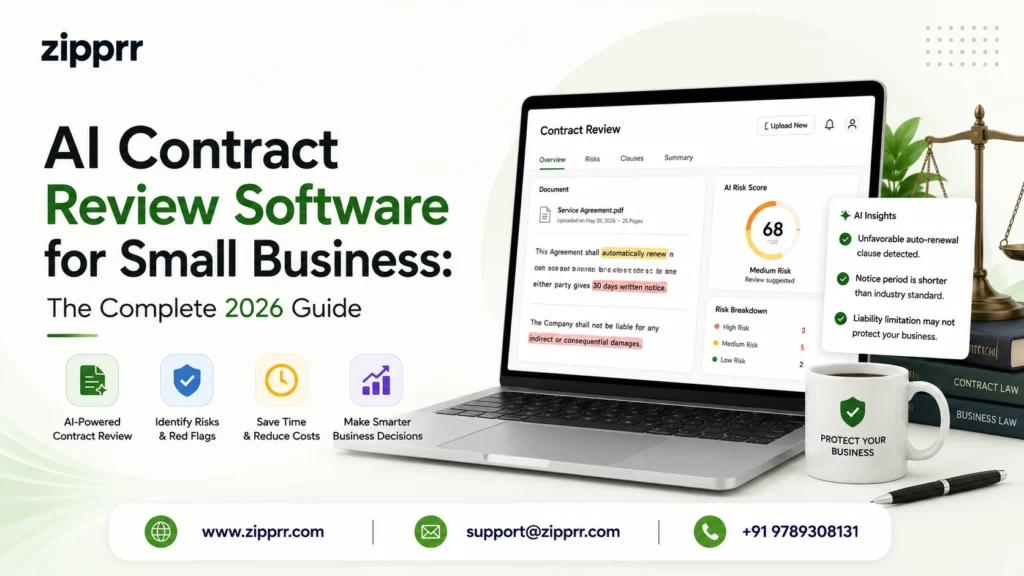
You just got a 14-page vendor agreement in your inbox, and it needs a signature by Friday. You don’t have an in-house lawyer, your outside counsel bills by the hour, and half the clauses read like they were written to confuse you on purpose. If this sounds familiar, you are not alone: most small businesses sign contracts without ever having them properly reviewed, simply because traditional legal review is too slow and too expensive to use every time.
AI contract review software changes that math. It reads a contract in minutes, flags the clauses that actually carry risk, and explains what they mean in plain language, all before you spend a dollar on a law firm. This guide walks through what AI contract review software actually does, how small businesses are using it day to day, what to look for before you pick one, and how to build contract review into your workflow without slowing your team down.
AI contract review software for small businesses uses natural language processing and legal-trained AI models to scan contracts, identify risky or non-standard clauses, compare terms against your preferred playbook, and summarize obligations in plain English. Tools like Zipprr AI Lawyer let a founder or operations lead review an NDA, vendor agreement, or lease in minutes instead of days, and escalate only the contracts that genuinely need a human attorney’s sign-off.
Key Takeaways
- AI contract review software reads and summarizes contracts in minutes, catching risky clauses that are easy to miss when you’re skimming under deadline pressure.
- It does not replace a lawyer for high-stakes deals, but it removes the need to pay legal fees for routine, low-risk agreements.
- The best tools combine clause-level analysis, redline suggestions, plain-English explanations, and a searchable contract library.
- Small businesses that adopt AI contract review typically cut review time from days to under an hour and reduce legal spend significantly on standard agreements.
- Choosing the right tool depends on contract volume, integration needs, and how much drafting versus reviewing you actually do
What Is AI Contract Review Software?
AI contract review software is a tool that reads legal documents as a trained associate would, but in seconds rather than hours. It uses machine learning models trained on large volumes of contract language to recognize clause types, spot deviations from standard terms, and flag language that could expose your business to risk: things like uncapped liability, auto-renewal traps, one-sided indemnification, or vague termination rights.
Instead of returning a wall of legal jargon, a good tool explains findings the way a colleague would over coffee: “this clause lets the vendor raise prices without notice” or “you’re on the hook for damages even if it’s their mistake.” That plain-language layer is what makes the technology usable for founders and operations teams who never went to law school.
Why Contract Review Matters More Than Founders Realize
Every contract your business signs is a set of promises with financial consequences attached. A vendor agreement with a hidden auto-renewal clause can lock you into a bad deal for another year. A client contract with unclear scope language can turn a simple project into unpaid overtime. A lease with an unfavorable exit clause can cost tens of thousands if your business needs to relocate.
Most small businesses don’t skip contract review because they don’t care; they skip it because a proper legal review takes days and costs hundreds or thousands of dollars, and the deal is often waiting on a signature. AI contract review closes that gap. It gives you a first-pass risk assessment immediately, so you know whether a document is safe to sign, needs a redline, or truly needs a lawyer’s eyes.
Benefits for Small Businesses
Speed is the most obvious benefit. A contract that would sit in your inbox for a week while you wait for outside counsel can be reviewed the same afternoon. But the deeper value shows up in a few other places.
Cost control matters just as much. Routing every NDA and standard vendor agreement through a law firm adds up fast, and most of those documents don’t need a human attorney’s full attention. AI review lets you reserve legal spend for the contracts that actually carry material risk (a funding round, an acquisition, a major partnership) while handling routine paperwork in-house.
Consistency is the underrated third benefit. A human reviewer’s attention varies with fatigue, time pressure, and experience. An AI model applies the same scrutiny to clause 40 of a long agreement as it does to clause one, which matters because risky language often hides deep in the boilerplate where tired eyes stop reading closely.
Core Features to Look For
Not all AI contract review tools are built the same way, and the feature set determines whether the tool actually saves you time or just adds another dashboard to check. A capable platform like Zipprr AI Lawyer typically brings together several capabilities in one place rather than forcing you to stitch together separate tools.
Legal chat lets you ask plain-language questions about a document, such as “can I terminate this early?”, and get a direct answer sourced from the actual contract text. Contract review scans the full document and flags risk by clause, so you’re not reading top to bottom hunting for problems. Contract drafting helps you generate a first draft of common agreements from a short brief, rather than starting from a blank page. An NDA generator produces a mutual or one-way non-disclosure agreement in minutes, tailored to your jurisdiction and deal type.
Beyond the core review functions, a privacy policy generator keeps your website and app compliant as regulations shift. Legal research and case law assistance give you context on how similar clauses have played out, which is useful when you’re deciding whether a term is truly standard or worth pushing back on. Clause analysis breaks down individual provisions in detail, compliance support flags language that may conflict with regulations in your industry, and a library of legal templates means you’re rarely starting from zero.
How AI Contract Review Actually Works
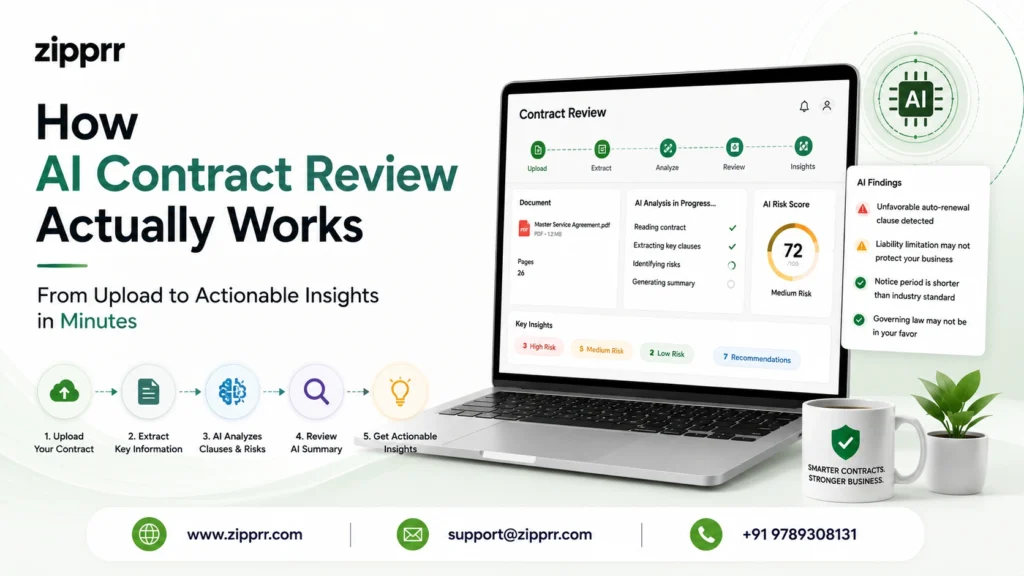
Under the hood, the process follows a fairly consistent pattern across most tools. You upload a document, usually a PDF or Word file, and the software extracts the text and breaks it into individual clauses. Each clause is classified by type: payment terms, liability, termination, confidentiality, intellectual property, and so on.
From there, the model compares each clause against a benchmark of standard, business-friendly language and flags anything that deviates in a way that shifts risk toward you. The output is usually a risk-scored summary, with the highest-risk clauses surfaced first, plain-English explanations attached, and often a suggested redline you can copy directly into your response to the other party.
Step-by-Step Guide to Reviewing a Contract with AI
Here’s what the process looks like in practice, from the moment a contract lands in your inbox to the moment you send it back.
- Upload the document. Drop the PDF or Word file into your AI contract review tool. Most platforms accept scanned documents too, using OCR to extract the text.
- Let the AI scan and classify. The system breaks the contract into clauses and tags each one by category and risk level, usually within a minute or two even for long documents.
- Review the risk summary first. Start with the flagged high-risk clauses rather than reading the whole document linearly, since this is where your attention is most valuable.
- Read the plain-English explanation for each flag. Understand what the clause actually does to your business before deciding how to respond.
- Apply or request suggested redlines. Many tools generate alternative language you can propose, saving you from drafting a counter-clause from scratch.
- Ask follow-up questions in the legal chat. If something is unclear, ask directly, such as “what happens if I miss this deadline?”, instead of re-reading the clause five times.
- Escalate only what’s truly high-stakes. If the AI flags something material and the deal size justifies it, send that specific clause to a human attorney rather than the whole document.
Real-World Use Cases
A marketing agency signing 15 new client contracts a month uses AI review to check scope-of-work language before every kickoff, catching vague deliverables clauses that would otherwise turn into scope-creep disputes. A logistics startup uses it to review vendor and carrier agreements, where auto-renewal and liability caps had quietly cost the company money in the past. An e-commerce brand uses the NDA generator every time it talks to a potential manufacturing partner, turning a process that used to take two days of back-and-forth with a lawyer into a same-day signature. A small SaaS company uses contract review to check every customer master service agreement for one-sided indemnification language before their sales team sends it out.
Pros and Cons
AI contract review is powerful, but it’s worth being clear-eyed about where it helps most and where it has limits.
Pros: dramatically faster turnaround, lower legal spend on routine documents, consistent clause-level scrutiny, plain-English explanations non-lawyers can act on, and a searchable record of every contract you’ve reviewed.
Cons: it is not a substitute for a licensed attorney on high-value or highly unusual agreements, it works best on contracts written in relatively standard business language, and it still requires a human to make the final judgment call on whether to sign, redline, or walk away.
AI Contract Review vs. Traditional Legal Review
| Factor | AI Contract Review | Traditional Law Firm Review |
|---|---|---|
| Turnaround time | Minutes to a few hours | Days, sometimes weeks |
| Cost per contract | Low, often included in a flat subscription | High, billed hourly |
| Consistency | Applies the same scrutiny to every clause | Varies with reviewer fatigue and workload |
| Best for | Routine, standard-form agreements | High-value, novel, or high-risk deals |
| Explanation style | Plain English, instant | Legal memo, scheduled call |
| Availability | 24/7, on demand | Business hours, by appointment |
Pricing Factors
What you pay for AI contract review software depends on a handful of variables. Contract volume is the biggest driver: a business reviewing five contracts a month has very different needs than one processing fifty. Feature depth matters too: a plan that only offers basic clause flagging costs less than one that includes drafting, NDA generation, legal research, and compliance support in the same subscription. Team size affects pricing when a platform charges per seat, and integration needs, such as connecting to your CRM, e-signature tool, or document storage, can shift you into a higher tier. Zipprr AI Lawyer breaks from that per-seat subscription model: it’s available as a one-time purchase for just $490, and that price includes the open-source code, so you own your copy outright instead of renting access month after month. Most small businesses find that a mid-tier plan covering review, drafting, and templates delivers the best return relative to what they’d otherwise spend on hourly legal fees.
Implementation Guide
Rolling out AI contract review doesn’t require an IT project. Start by identifying your highest-volume, lowest-complexity contract type, usually NDAs or standard vendor agreements, and run your next few through the tool before you sign. Build a simple internal rule: contracts under a certain dollar threshold or risk level get reviewed by AI alone, while anything above that threshold gets AI review first, then a human attorney’s eyes on the flagged clauses only. Train your team on how to read the risk summary and when to escalate, and keep a shared library of the templates and NDAs you generate so you’re not recreating the same document every time.
Best Practices
Treat the AI’s output as a strong first draft of your risk assessment, not a final verdict. Always read the plain-English explanation, not just the risk score. The score tells you where to look, the explanation tells you why it matters. Keep a standard playbook of your preferred terms so the AI has a consistent benchmark to compare against. Revisit flagged clauses with your team periodically to see if certain vendors or clients consistently push the same risky language, which tells you where to negotiate harder upfront.
Common Mistakes to Avoid
The most common mistake is treating every AI-reviewed contract as fully vetted and skipping human judgment entirely, even on deals that clearly warrant it. Another is uploading contracts without checking that sensitive data handling meets your compliance requirements. Always confirm how the platform stores and processes your documents. Some teams also skip the follow-up questions feature and just read the summary, missing context that a quick legal-chat question would have clarified in seconds. Finally, businesses sometimes fail to update their internal playbook, so the AI keeps comparing against outdated preferred terms.
Expert Tips
Ask the AI to explain a clause “as if I’m not a lawyer” if the first explanation still feels dense. Most tools will simplify further on request. Use the redline suggestions as a starting point for negotiation, not a final answer; tweak the language to match your own voice before sending it back. Build a shared tag system for contract types so your team can search past reviews instantly instead of starting from scratch on similar agreements. Pair contract review with your WhatsApp automation workflow to notify the right team member the moment a high-risk contract is flagged, so nothing sits unread in an inbox.
Future Trends
Contract review is moving toward deeper integration with the rest of the deal workflow: AI that not only flags risk but drafts the counter-proposal, routes it for e-signature, and logs the obligations into a calendar automatically. Expect tighter connections between contract AI and broader business AI assistants, where a single AI chat interface can pull up a contract clause, summarize an email thread about the deal, and draft a reply in one continuous conversation. Multi-language contract review is also expanding quickly as small businesses increasingly work with international vendors and partners.
Why Choose Zipprr
Zipprr AI Lawyer brings legal chat, contract review, contract drafting, an NDA generator, a privacy policy generator, legal research, case law assistance, clause analysis, compliance support, and a library of legal templates into a single platform built for teams without in-house counsel. Instead of juggling separate tools for drafting and reviewing, you get one workspace where every contract you touch is analyzed, explained, and stored for future reference, so the next similar agreement takes even less time to handle. You get the full platform as a one-time purchase for $490, complete with open-source code you own outright, 90 days of free post-launch support, and a team available around the clock to help you get set up.
Conclusion and Action Checklist
Contract review used to be a luxury small businesses skipped because it was slow and expensive. AI contract review software removes both barriers, giving you a fast, consistent first pass on every agreement while reserving human legal expertise for the deals that truly need it.
- Identify your highest-volume contract type and run it through an AI review tool this week.
- Build a simple escalation rule for when a flagged clause needs a human attorney.
- Create a standard playbook of preferred terms to benchmark future contracts against.
- Generate your next NDA or vendor agreement from a template instead of starting blank.
- Explore the Zipprr blog for more guides on legal tech and business automation, and visit Zipprr AI Lawyer to see everything the platform covers.
Ready to Review Your Next Contract in Minutes?
Stop letting contracts sit in your inbox while you wait on legal fees and turnaround times. See how Zipprr AI Lawyer catches risky clauses and speeds up every agreement you sign.