

A house listing costs almost nothing to publish. A few photos, a price, an address, maybe a floor plan. Pennies of server time. Yet across 2024, that humble little unit of content stacked up into well over two billion dollars for Zillow, comfortably bigger than the year before. Sit with that a moment. They do not own most of the homes. They do not pour the foundations. They built the place everyone goes to look, and then they charged the people who needed to be seen.
That gap, between what a listing costs to host and what attention around it is worth, is the whole reason I keep getting asked about building a real estate marketplace. So let’s talk numbers. Real ones. I’ll walk you through what a Zillow clone costs to build in 2026, what it can realistically earn, and where I’d put my money if I were starting today. If you want to skip ahead and see a working setup, you can take a quick look at the Zillow clone platform Zipprr offers and then come back. I’ll wait.
Wait, why would anyone clone Zillow in 2026?
Fair question. Zillow is enormous. North of two hundred million people a month drift through its apps and pages, give or take, and which figure you quote depends on the quarter and whose ruler you pick up. Independent counts come out lower, yet even those land in the hundred-millions, which is still an entire metropolis turning up at the door every single day.
Here’s the thing though. Nobody serious is trying to beat Zillow at being Zillow. That ship sailed. What people are doing, and doing well, is carving off a slice Zillow handles poorly or ignores entirely.
Think about it. Zillow is a generalist for the United States residential market. It is thin on commercial property. It barely touches a lot of international markets. It does not understand the quirks of, say, student housing in a specific country, or off-plan developments in the Gulf, or rent-to-own in emerging cities. The wider property-tech numbers back this up. Open any two analyst reports and you will see slightly different totals, but they cluster: the sector was worth somewhere around fifty billion dollars as 2026 began, and almost everyone has it compounding in the low-to-mid teens each year. A few of the bolder forecasts have it ballooning several times over before this decade is out. Roughly half of all that money sat in North America last year.
A market that big does not have one winner. It has hundreds of regional and vertical winners. That is the opening.
What a Zillow clone actually is (and what it isn't)
The word “clone” throws people off, so let me settle it.
Nobody serious means stealing Zillow’s actual code, ripping its logo, or hoovering up its database. That route is illegal, and frankly it would get you nowhere. When I use the word, I mean something far more boring and far more useful: a pre-built software base that already knows how a property marketplace is supposed to behave. It can hold listings. It can search and map them. It can carry agent profiles, capture enquiries, route messages, and bill people for being seen. The plumbing exists on day one.
Think of it the way you would think about buying a home that is already framed, wired, and plumbed. Walls up, pipes in, power on. What is left for you is the part that makes it yours: the paint, the fittings, how the rooms flow. Compare that to standing in an empty lot watching concrete cure for the better part of a year before you can hang a single door.
So, a clone in my vocabulary is just a tested skeleton. You bend it to your region, your niche, your way of making money. There is nothing shady about it.
The money question, part one: what it costs to build
Right, the part you scrolled down for.
Going the from-scratch route with a custom dev shop, here is how the 2026 invoices tend to shake out. Want something stripped down, just search, a map, and a contact form? Budget somewhere in the low six figures. Bolt on agent profiles, tour scheduling, document handling, and an admin panel worth using, and the figure pushes past the hundred-and-fifty-thousand mark and on toward double that. Then there is the full treatment: AI valuations, virtual walkthroughs, end-to-end transaction tooling, and hand-built native apps for both phones. That tier opens at a couple of hundred thousand and keeps climbing well beyond it.
Why so wide a range? A few things drive it.
Platforms. Build iOS and Android as two separate native apps and each one can swallow anywhere from the high tens of thousands up toward a quarter-million dollars. That single fact is why most teams I know reach for a cross-platform toolkit instead, which can shave roughly a third off the mobile bill.
Integrations. Here is the line item nobody quotes you upfront. Listing feeds (IDX, MLS), maps, taking payments, verifying who people are, pulling mortgage data. Reckon on tens of thousands just for year one of wiring it together, then a similar bill every year after to keep the lights on. Virtual walkthroughs sit apart and add another chunk on top, but they roughly triple how long visitors linger, so I rarely regret them.
And yes, the meter went up. A property app in 2026 costs noticeably more than the same build did a couple of years back, mostly down to pricier engineers and tougher rules around personal data.
Timeline, then. Built from nothing, a minimum version tends to eat several months. The works, with all the integrations talking to each other? The better part of a year, sometimes more. That is a brutal stretch of spending with nothing coming back in.
This is exactly where a clone script changes the math. Instead of a six-figure budget and a year-long wait, you start from a working base, customize it, and go live in weeks rather than seasons. If budget and speed both matter to you, the ready-made Zillow alternative from Zipprr is built to compress that timeline hard. Quick reality check though: cheaper upfront does not mean zero ongoing cost. You still pay for hosting, MLS data feeds, maps, and support no matter which path you pick.
The money question, part two: what it can earn
Here is where it gets fun. A property marketplace is one of the rare consumer products where buyers and sellers will both, in different ways, pay you. Let me break down how the income actually stacks up, using Zillow’s own playbook as a guide and then scaling it down to something a startup can run.
Agent advertising and lead generation. This is Zillow’s biggest engine. Their Premier Agent program sells motivated-buyer leads straight to agents. Bundle up their residential lines (Premier Agent, the Showcase product, and the rest of that family) and you land in the hundreds of millions in just one quarter of 2025. The logic is plain enough: agents will pay real money to be the first name a buyer lays eyes on. On your own platform, that translates into monthly placement fees, or a price per lead.
Paid visibility. Agents and sellers hand over money to lift a property above the rest of the search results, or to park it across your front page. It is the housing equivalent of a sponsored post. Simple to switch on, and easy to invoice for month after month.
Recurring plans. Agencies and brokers pay you a fixed sum, monthly or yearly, and in return get the dashboard, tools for uploading in bulk, their stats, and a quota of free or cut-price slots. This is the income stream that helps tired founders sleep, because it shows up whether or not you closed a big sale that week.
A cut when they win. Zillow’s Flex approach drops the upfront advertising charge entirely and instead clips a fee only once an agent actually closes a deal that came through the platform. The incentives line up neatly. The agent pays nothing until the platform has clearly earned it.
Adjacent money. As 2025 opened, Zillow’s mortgage side climbed by about a third compared with a year earlier. Rentals did much the same, and within that the multifamily slice grew by close to half. Big leaps. The point for you: you do not need to become a lender yourself. You need referral partnerships, with mortgage brokers, insurers, movers, photographers, inspectors. Every one of them is another line on your income statement.
So what does that mean for you, in plain figures? Picture a modest regional platform. Sign up two hundred agents paying around a hundred dollars each month and your subscriptions alone throw off comfortably past two hundred thousand across the year, before a single featured listing or lead changes hands. Stack on, say, fifty promoted listings a month at fifty dollars each, sprinkle in a few mortgage and insurance referral arrangements, and a tightly focused marketplace can clear six figures inside its first full year, nowhere near Zillow’s size. The unit economics are kind because, remember, listings cost pennies to host. I get into the specific pricing tiers I’d set on the Zillow-style marketplace solution further down, but the headline is this: your margins live or die on traffic and trust, not on hosting bills.
The features that separate a toy from a real marketplace
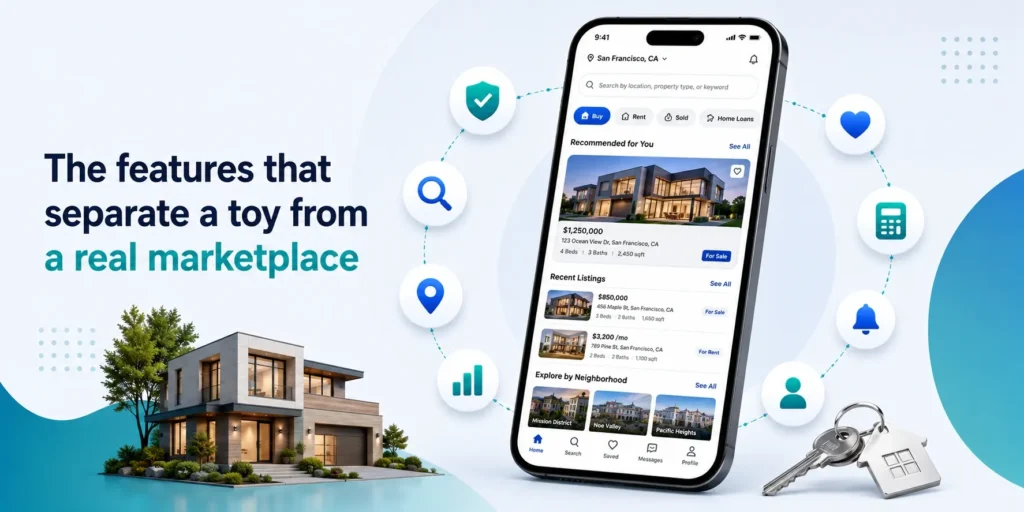
I have walked through plenty of property sites that look gorgeous and sell nothing. The leak is almost never the homepage. It is the dull machinery humming away behind it.
So here is what genuinely pulls its weight.
Search and the map. Real buyers hunt by dragging a rectangle across a map, then chipping away with filters: price, bedrooms, a dozen other knobs. Make that laggy, make the map fight back, and they are gone before the kettle boils. There is no negotiating on this one.
The MLS pipe (IDX). Newcomers shrug this off constantly. Mistake. In plain terms, IDX is the channel that feeds listings from the local MLS straight onto your pages, so what a visitor sees is basically what agents have just entered, usually trailing real life by about a minute. An agent flips a property to pending before lunch, and your audience sees the change near-instantly. Nobody is retyping listings by hand. No mortifying “still available” homes that quietly sold a fortnight ago. If your turf is the US, this one capability is the dividing line between a platform agents take seriously and somebody’s weekend hobby.
Listing pages with depth. Sharp photos, a video, a walkthrough, the neighbourhood story, school scores, a rough mortgage figure. The more a page tells, the longer eyes stay on it, and the harder agents lobby to appear there.
Enquiries and chat. Every tap on “book a viewing” or “message the agent” is, quite literally, the thing you are selling. Let those leak, or land an hour late, and your paying agents drift away. Build this part fast, build it dependable.
The agent and broker cockpit. This is where the people paying you actually spend their day: managing listings, watching leads land, checking their numbers, settling the bill. Make it something they enjoy opening and your churn quietly falls.
Trust signals. In property, trust is the whole currency. Verified agents. Listings someone has actually vetted. A fast way to flag a scam. Leave this out and the junk moves in within weeks.
The control room. Call it the admin panel if you like. Approvals, payouts, fraud checks, moderation, the analytics that tell you what is really going on. Thankless work, and the reason the whole thing stays upright.
A quick word on what’s new. As of late 2025, Zillow even wired listings into ChatGPT, so people can shop for homes through an AI assistant. Search is shifting. If you want a feature checklist tuned for 2026 (including AI-ready search and voice), the feature-rich Zillow clone build lays them out so you are not guessing.
Build from scratch or buy a clone script?
This is the fork in the road, so let me be blunt about how I’d decide.
Build from scratch if you have a genuinely novel mechanic that no existing platform models, deep pockets (well into six figures), patient timelines, and a technical co-founder who can ride herd on a dev team for a year. Custom gives you total control. It also gives you total risk, total cost, and total delay.
Buy and customize a clone script if your edge is the market, the niche, or the go-to-market, not the underlying tech. Which, honestly, is most founders. The plumbing of a property marketplace is well understood. Listings, search, leads, billing. There is little glory in rebuilding it for the thousandth time. Your energy is better spent on getting agents to sign up and buyers to show up.
I lean toward buy-and-customize for the vast majority of people I talk to. Not because custom is bad, but because most real estate marketplace ideas fail on distribution, not on code. Spending a year and a six-figure budget proving you can build what already exists is a strange way to test whether anyone wants your version. Get live cheap, get real users, then reinvest revenue into custom features that actually differentiate you. The fastest way to pressure-test that path is to book a quick walkthrough of a live demo and see whether the base already covers 80% of what you need.
Picking a niche you can actually win
If you take one thing from this post, take this. Do not launch “Zillow but slightly different.” You will drown.
Win a niche instead. Here are angles I find promising in 2026.
Geographic gaps. Pick a country or city where Zillow has no real presence and local search is fragmented and ugly. Being the cleanest, fastest property site in one underserved metro beats being the 50th option in a saturated one.
Vertical depth. Student housing. Senior living. Vacation and short-stay (where you’d lean more toward an Airbnb-style model). Commercial and retail space. Co-living. Each has buyers with specific needs that a generalist serves poorly.
Underserved transaction types. Rent-to-own. Off-plan and new construction. Auction and distressed property. Fractional ownership. These have devoted audiences and far less competition.
Service-led models. Maybe you are not just listings but listings plus verified virtual tours, or listings plus instant mortgage pre-qualification, or listings plus a vetted agent matching service. The extra layer is your moat.
The pattern is the same every time: narrow enough that you can be the obvious best choice, broad enough that real money flows through it.
How to compete when you are not Zillow
You will not outspend Zillow on ads. You do not need to. Big general platforms are slow, impersonal, and stretched thin. That is your opening.
Be local where they are global. Show up at regional real estate events. Know the neighborhoods. Speak the language, literally and figuratively.
Be faster and cleaner. A snappier search, fewer dead listings, a less cluttered page. Sounds small. Wins users.
Treat agents like partners, not ad inventory. Many agents quietly resent paying platforms that also compete with them. Be the platform that is unambiguously on their side. That reputation spreads in tight professional circles faster than any ad campaign.
Own a content and SEO niche. Write the definitive guides for your market. Be the answer when someone searches, or asks an AI assistant, about buying in your area. Answer-engine visibility is becoming as important as Google ranking.
Move quick on trends. AI search, voice, virtual tours. Smaller platforms can ship these faster than a giant with committees. Use that speed.
A realistic 90-day launch path
Here is roughly how I’d sequence a launch if I wanted to be live and earning within a quarter.
Weeks 1 to 2: lock your niche and region, study the three biggest local competitors, define your pricing tiers, and decide build-versus-buy. (If you go the buy route, this is when you’d want to grab a free guided demo to confirm the fit before committing.)
Weeks 3 to 6: customize the platform. Branding, your listing fields, your map region, payment setup, and your IDX/MLS feed if you operate where that applies.
Weeks 7 to 9: seed supply. A marketplace with no listings is a ghost town, so onboard your first agents and import or add an initial batch of properties. Offer founding agents free placement to get the flywheel turning.
Weeks 10 to 12: open to buyers, push content and local SEO, and start converting free agents into paying ones. Track leads obsessively, because lead quality is the number your paying customers care about most.
It is not magic. It is sequencing. Supply, then demand, then monetization, in that order.
The honest bottom line
A Zillow clone is not a get-rich-quick scheme. It is a real business with real operating costs: data feeds, support, moderation, marketing. But the underlying economics are genuinely attractive. Content that costs pennies to host. Buyers and sellers who both pay you in different currencies. A market growing double digits a year with no single winner outside the United States generalist space.
If you have a market you understand and the patience to seed it, the math works. Build smart, start narrow, and let revenue fund your ambitions rather than the other way around.