

Executive summary
A mid-market logistics company came to us convinced they needed to hire another support person. They didn’t. Most of their inbound messages were the same question, asked over and over, and the answer already lived in a system they already owned. People were relaying it by hand, one message at a time.
We spent the first week counting the actual requests before touching any software. Then we built a conversational layer on WhatsApp that read a customer’s question, looked the answer up in the client’s own tracking system, and replied in plain language, escalating anything genuinely complicated to a human. The whole build took about a month.
Within weeks of launch, repetitive status enquiries stopped dominating the team’s day. Stated qualitatively, because the hard numbers are the client’s to publish:
- Routine tracking requests increasingly moved to self-service on WhatsApp.
- The support team regained time for genuine exception handling.
- Customers got answers at any hour, without a phone queue.
The product underneath was Zipprr’s WhatsApp Automation Software. The software was the easy part; the thinking that shaped it was the point.
Key takeaways
- Most inbound volume was one repetitive question whose answer already lived in the client’s own system.
- Measuring real requests first, before any build, is what reframed the whole engagement.
- The assistant was scoped narrowly to routine status lookups and escalates everything else to a person.
- It reads from one reconciled source, over a read-only connection, never the raw carrier feeds.
- Outcomes are described qualitatively; the tool matters far less than the diagnosis.
Client background
The company moves goods for other businesses: a regional operator with a dispatch team, a lean customer-service function, and a steady stream of orders that customers care about intensely the moment they are placed. On paper the support function was two people. In practice it was two people plus whoever happened to be near a ringing phone.
The operation handled a high weekly volume of shipments, coordinated several delivery partners, and ran everything through a central transport management system. That last detail matters most: the system already held the status of every order, current and correct. The information customers wanted was not missing. It was sitting in a database, waiting to be read out loud.
They were not struggling but growing, which is why the pressure had become urgent. More orders meant more people asking where those orders were, and the team answering was not growing at the same rate. The founder sensed that adding headcount was the wrong move but could not say why. It took us a week to put words to it.
The challenge
The volume was almost entirely a single question in different outfits: where is my order, and when will it arrive?
Customers asked by phone, by email, and through the website. Each message pulled someone off their real work, sent them into the tracking system to find a reference number, and asked them to translate an internal status into something a customer could understand.
One lookup took a minute or two. Harmless alone, corrosive in aggregate. Across a day, the support pair spent most of their attention being a slow human bridge between a customer and a system that already had the answer. The work that genuinely needed judgment, the stuck shipments and the real complaints, kept getting squeezed to the edges of the day because the routine questions never let up.
Discovery
We started by watching, not building. This is the step clients most want to skip and the one that pays for the whole project.
For a couple of days I sat with the support team and logged requests as they arrived, the real messages rather than a survey. We tagged each on three axes: the channel it came in on, the intent beneath the wording, and whether resolving it needed any judgment or simply a read of the tracking system. Then we looked backward, hand-tagging a large sample of past conversations against the same scheme.
We kept the categories blunt: a routine status request, a general question, a change to an order, and a genuine problem. The goal was not a taxonomy but a clear split between what needed a person and what did not. Tagging by hand was slow and worth it; an automated keyword pass would have miscounted exactly the messages that matter, the ones where a tracking number sits inside an angry sentence.
The finding reframed everything. We had assumed the difficulty lived in the hard cases. Instead the overwhelming majority of contacts were the plain status question with nothing complicated attached. On the review call I put it plainly: you are not short-staffed, you are paying for the same answers twice, once to store them and once to read them out.
Why not just hire another support agent?
The solution
Framed correctly, the solution nearly designs itself. If most requests are a routine lookup and the answer already exists in a system, let customers reach that answer directly and safely, and route the genuinely hard requests to a person quickly.
We chose WhatsApp as the primary channel because it was where the customers already were: no new app, no password, no phone queue. On top of it we used Zipprr’s WhatsApp Automation Software to hold the conversation, read intent, run the lookup against the client’s own system, and answer in plain language, handing anything outside the routine to a person with the full thread attached.
We weighed email and web chat first. Email is asynchronous and invites considered replies rather than instant ones; a website widget only reaches people while they are on the site, and most customers wondering where their order is are on their phone, not your homepage. WhatsApp met them where their attention already was, which is the rule worth stealing for any omnichannel support decision: choose the channel by where the customer already is.
We also limited what the automation could do, on purpose. It could have attempted refunds or edited delivery windows; we chose not to let it, because every extra capability widens the surface where a wrong answer can do damage. Constraining the assistant to the one thing it did flawlessly is what made it trustworthy. And self-service quietly raised the quality of human support, not just the quantity: when routine questions stop interrupting the team, the people who reach a person are the ones with a real problem, met by an agent who is not frazzled from a morning of tracking-number lookups. That is why humans stayed essential to this design rather than incidental to it.
Here is the change in shape, one routine request before and after.
| Before | After |
|---|---|
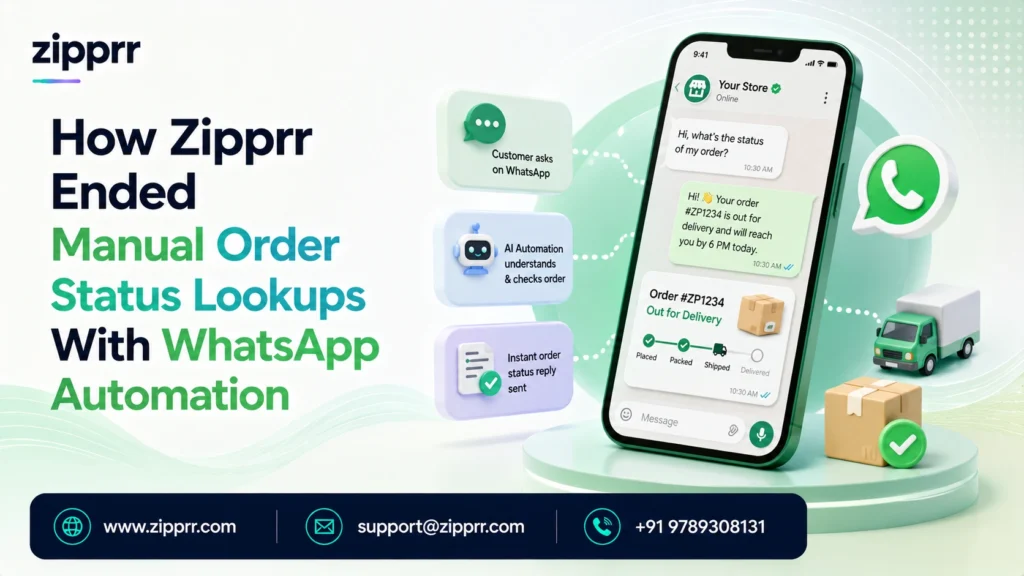
| Customer calls or emails support | Customer sends a WhatsApp message |
| Agent opens the tracking system | The assistant retrieves the status instantly |
| Minutes per reply, business hours only | Seconds, at any hour |
| Agent interrupted from real work | Agent handles only the genuine exceptions |
Implementation
The build ran about a month and moved in deliberate phases rather than one big launch: discovery and the audit first, then integration and the core build (the read-only lookup, the intent routing, the light identity check, and a small knowledge base for general questions), then testing against real historical records, a supervised soft launch to a limited audience, and finally the full launch on WhatsApp, with source code and documentation handed over.
Two coordination decisions shaped the build as much as the code. First, a short kickoff with the people who would actually live with the system, the two agents, the dispatch lead, and the IT owner of the transport management system, taught us which status phrasings customers used and which internal codes were safe to expose, detail no spec would have captured. Second, we agreed early that IT would provision a read-only, scoped credential rather than a broad one. Settling the access model before writing the integration is what saved the rework that quietly sinks these projects.
Technical decisions
Three decisions shaped everything, and none of them were exotic. What made them work was being explicit about the trade-offs.
Where the answer should come from
The most consequential decision was the source of truth. We weighed three options.
| Approach | What it offered | Verdict |
|---|---|---|
| Static knowledge base | Good for general FAQs, hopeless for live per-order status | Rejected for status, kept for general questions |
| Direct upstream carrier feeds | Freshest data, but multi-source and inconsistent, needing live reconciliation | Rejected as the primary source |
| The client's own transport management system | Already reconciled, already the operational truth, read safely | Chosen |
Reading from the client’s own transport management system (TMS) meant the assistant told customers exactly what an agent would have, because it read the same record: one source, one version of the truth, no reconciliation happening live in front of a customer.
The lookup was strictly read-only, so the assistant could retrieve a status through a controlled API integration but never alter an order record, which put operations and IT at ease immediately. Identity was checked lightly, a reference number plus one detail on file rather than a full login, enough of a guardrail without killing adoption. The whole thing sat on the WhatsApp Business API, the official rail for business messaging at scale.
Technical tip: Point the automation at the system that already reconciles your data, and give it read-only access. It can retrieve a status but never change an order, which keeps your systems of record safe and shortens the security review.
How the assistant decided what each message meant
Intent detection took the most iteration, and it is where a lot of these projects quietly fail.
Our first instinct was keyword matching: a reference number means a status request. That fell apart fast. “Order 48213 arrived smashed, I want to complain” contains a reference number but is not a routine lookup, and answering it with an automated status line would have been insulting. Keyword rules could not tell a request apart from a grievance that shared its vocabulary.
So we moved to language-model classification, letting the model read the whole message and judge what the customer wanted. Conversational AI handles that nuance far better than a rule tree because it reads intent rather than matching strings. We paired it with a confidence threshold: confident routine requests proceeded to the lookup, while low-confidence messages, or any carrying frustration or complexity, fell back to a human with the full thread. The escalation erred toward people on purpose, because a false escalation costs an agent a minute while a false automated answer costs a customer’s trust.
How messages move: the API and webhook flow
The integration underneath is deliberately ordinary. Inbound messages arrive through a webhook : WhatsApp, via the WhatsApp Business API , posts each incoming message to an endpoint we expose. The endpoint validates the payload, acknowledges it immediately so the platform does not retry unnecessarily, and passes it into the pipeline. Outbound replies go back as authenticated REST API calls . The reliability comes from doing the ordinary things carefully, not from anything clever.
Logging, monitoring, and resilience
Every step wrote to a log: the inbound message, the classified intent and its confidence score, the lookup result or error, the reply, and whether it escalated. That audit trail matters when the subject is someone’s order, and it was also the raw material for tuning, since reading real transcripts is how we found the phrasings the classifier misread. We alerted on the signals that actually break a channel like this: webhook delivery failures, a spike in escalations, lookups timing out, and average confidence trending down, an early sign that message patterns are drifting.
Failures were assumed, not hoped away. A timed-out lookup retried a bounded number of times with a short backoff, and if it still could not get a clean answer, the assistant said so and offered a person rather than inventing a status. Outbound sends respected the platform’s rate limits, queuing when volume spiked. We cached the answers that never change, like hours and coverage, but never live status, because a cached shipment status is a stale one.
Security considerations
Security here was mostly discipline. The lookup credential was read-only and scoped to only the records the assistant needed. Webhook payloads were validated so the endpoint would not act on spoofed calls. API authentication used the platform’s token model, with secrets kept out of the codebase, and we logged access without capturing more personal data than the task required.
Security note: Apply least privilege. Scope the credential to only the records the assistant needs, validate webhook payloads so the endpoint cannot be spoofed, keep secrets out of the codebase, and log access without capturing more personal data than the task requires.
Obstacles and fixes
Two problems nearly tripped us, and both taught the same lesson: test against messy reality, not tidy fiction.
The first was data consistency. Even reading from the reconciled system, that system ingested from multiple providers, and one sent inconsistent data. Occasionally a late update landed out of order, so an order marked delivered would briefly look as though it had moved backward. A human shrugs and uses judgment; the automation, reading it literally, would state the contradiction as fact. We almost missed it, because our first tests used clean invented references. The fix was a normalization layer: when events conflicted the assistant was not allowed to pick one and assert it, and where it could not resolve the contradiction safely, it said so and offered a person.
The second surfaced during the soft launch. Our identity check used an exact string match, which failed whenever someone typed a value with different spacing or capitalization even though it was obviously the same, so real customers were told their correct details did not match. We normalized both sides before comparing. Obvious in hindsight; you only learn how customers actually type by watching them type.
Launch
We soft-launched to a limited audience first, with the team monitoring every conversation and a hand hovering over the handoff. Letting it prove itself under supervision before it ran unattended is the safest way to put a new automated channel in front of real people. The full launch followed shortly after, once the identity-check fix from the soft launch had settled, which was the reason we held it back.
The moment I remember was not dramatic. A team member watched a customer ask for a status, clear the check, get a clean answer, and thank the assistant, all without anyone touching it. She had spent years being the person who answered that exact question, and watching it answer itself was, she said, a strange feeling.
We had a rollback plan ready before opening the doors, deliberately simple: one switch to route all inbound messages straight to the human queue if anything went wrong. We never pulled it, but having it there changed how comfortable everyone was going live. For the first couple of weeks we read transcripts daily, which is where the real production lessons showed up, like the customers who send a bare reference number with no greeting and expect the system to just know what they mean. Production teaches you things staging never will.
Results
I will be careful here, because inventing hard metrics would undercut the honesty this account depends on. The precise figures are the client’s to publish. What I can describe is the direction and shape of the change, which was unmistakable within the first month.
Key outcomes
✓ Routine tracking requests increasingly moved to self-service on WhatsApp
✓ The support team regained time for genuine exception handling
✓ Customers received instant responses through WhatsApp
✓ Every interaction became searchable and logged
The change that mattered most was not the volume itself but what it freed up. The two support people stopped being a manual lookup service and started doing the work that actually needed a human. On a quiet morning a couple of weeks in, one of the dispatch coordinators looked around the room and said, “This is the first morning I’ve finished my actual work before lunch.”
The detail the founder cared about most was not even in our original scope: one of his own business customers told him their end recipients had stopped calling to ask about deliveries, because they could now check for themselves. The improvement had traveled a step further down the chain than anyone had planned.
Why this approach worked
The reasons transfer even when the specifics do not. It worked because the answer already existed, so the automation translated truth rather than manufacturing it; because the scope was narrow, kept inside the boundary where the assistant was genuinely excellent; and because a person stayed in the loop for the cases that needed one.
Key insight: A confident escalation is a feature; a confident wrong answer is a liability. Design the human handoff before you design the automation.
Lessons learned
A few things this project reinforced, each of which has cost someone a failed project at some stage.
Audit before you build
The routine-versus-exception split reshaped the solution, and it only appeared because we counted real requests instead of trusting an assumption. The audit is not overhead before the build; it decides whether the rest is worth doing. On past projects it has told us not to automate at all, and that was the right answer.
Read from your own reconciled source
Pointing an assistant at raw upstream feeds moves fragile reconciliation into a live conversation. Your own transport management system, order management system, or ERP has already done that reconciliation once. Let the automation read the finished truth, and a whole class of contradictory-data failures never gets the chance to happen.
Test on ugly data
Every serious bug we hit came from real records and would have been invisible against clean test data. Clean data confirms the happy path you already assumed; ugly real data shows you where you are about to embarrass yourself.
Design the escalation first
The instinct is to make the automation as capable as possible and treat the handoff as a fallback. Reverse it: decide first what the automation must never attempt, then make the path to a person fast and rich with context.
Common mistakes companies make when automating shipment tracking
The same avoidable mistakes come up often enough to name directly.
Automating bad data. Automation broadcasts your data faster, it does not improve it. If tracking data is wrong at the source, a chatbot delivers that wrongness to more customers, more quickly. Fix the source first.
Trusting the AI too much. With no confidence threshold and no human handoff, you get the confidently wrong answers that destroy trust. The model should know the edge of its competence and step back at it.
Overcomplicating the chatbot. Every extra capability widens the blast radius of a mistake. A narrow WhatsApp chatbot that nails one job beats a sprawling one that is unreliable at five.
No human escalation. A system with no clean path to a person traps customers who have a real problem inside an automated loop. Escalation is a core feature, not a failure state.
No monitoring after launch. Message patterns drift and data sources change. Without monitoring and someone reading real transcripts, the first sign of trouble is an angry customer rather than a dashboard.
Conclusion
WhatsApp was the right channel because customers already lived there, and automation was the right approach because a human was needlessly in the middle of delivering an answer that already existed. The honest limitation is worth stating plainly: this works precisely because the data is already correct somewhere. It is a fast, accurate translator between a customer and information that is already true, not a fix for missing data, and it routes the genuinely hard cases to a person.
Before you automate, audit your repetitive requests
The order of operations is the whole lesson: the audit comes first, the tool second.
Before evaluating any software, spend a week measuring your own support. Pull a representative sample of recent conversations across every channel and tag each honestly: is this a repetitive question whose answer already exists in a system you own, or does it genuinely need a person? Most teams are surprised by how lopsided the split is, and that single number tells you more than any demo will. The pattern is not unique to logistics: a stays-and-rentals marketplace running an Airbnb clone sees the same repetition in availability and booking-status questions. If it leans heavily toward repetitive lookups on data you already hold, customer support automation is likely to pay off; if it does not, a tool will not save you, and knowing that early is just as valuable. We are glad to run that audit with you before recommending anything at all.
Where to start if this sounds familiar
The build ran on Zipprr’s WhatsApp Automation Software, with the wider set of options on Zipprr’s products page, from this kind of automation to full marketplace platforms like the P2P rental script, and more client stories in the same vein. If it looks like a fit for what your team is facing, get in touch with the Zipprr team and we will take it from there.
Frequently Asked Questions
What is WhatsApp Automation Software?
Does this require the WhatsApp Business API?
Can it connect to an ERP or order management system?
In most cases yes, through an API integration to whatever system holds the data. Here the assistant read from the client’s transport management system, but the same pattern fits an ERP, an order management system, or any internal database you can query (for a gear-hire business, that system of record is often the inventory behind an equipment rental script), whether through a REST API, a webhook feed, or a direct connection. The choice that matters is not which system you connect to but that you read from the one already holding the reconciled, operational truth, and that you read it in a controlled, read-only way. That keeps the security surface small and your systems of record firmly under your control.
Can it connect to a CRM?
Does it work with shipment tracking?
Shipment tracking is one of the cleanest fits, which is why this project centered on it. “Where is my order” is high in volume and unambiguous in answer, the ideal combination. As long as your tracking data lives somewhere the automation can query, it returns the current status and an estimated arrival in a plain sentence, then hands off the genuine exceptions, the customs holds and failed deliveries, to a person. The result is better shipment visibility for the customer without extra load on your team. The same ‘where is my order’ question dominates food delivery, so a platform built on an UberEats clone has the identical need and fit. The boundary is worth being honest about: this only works when the tracking data is accurate. It surfaces the truth faster; it cannot invent one your systems do not hold.
Is customer data secure?
What happens when the AI doesn't know the answer?
It escalates to a person rather than guessing, and that is central to the design. The classifier produces a confidence score for every message and runs it against a threshold. Confident routine requests proceed to the lookup; anything below the line, or carrying frustration or genuine complexity, goes to a human with the full thread attached so the customer never starts over. We tuned the escalation to err toward people on purpose, because the two errors are not symmetric: a false escalation costs an agent a minute, a false automated answer can cost trust permanently. Treating “let me get a person” as correct behavior rather than failure is what keeps the system credible.