

Here is a claim you rarely hear from anyone selling WhatsApp automation software: plenty of businesses do not need it yet. Buying it before you have the problem it solves is just a new subscription gathering dust. So this guide flips the usual sales pitch on its head. Instead of listing shiny features, it hands you a short audit to find out whether your business is quietly leaking money through its own WhatsApp inbox, and only then shows you what to do about it.
Think of the next few minutes as a checkup for one specific organ of your business: the way messages flow in and out. If the checkup comes back clean, keep your cash. If it does not, you will see exactly where the money is escaping and why waiting another quarter is the expensive choice. Written for owners and operators, not marketers chasing a demo booking.
In Plain Terms: What Does WhatsApp Automation Software Do?
WhatsApp automation software is a system that takes over the repetitive parts of business messaging, firing off order updates, booking reminders, opening replies, and chase-ups on its own, so a human is not glued to the phone typing the same lines all day. It plugs into the official WhatsApp Business platform, never sleeps, and quietly converts a chat app your customers already live in into a working sales-and-service engine. Zipprr packages the whole thing into one owned dashboard, our whatsapp automation softwar , that you pay for once.
A quick snapshot before we dig in:
| Feature | Details |
|---|---|
| In one line | Software that runs your WhatsApp messaging on autopilot (blasts, bot replies, reminders, chases) |
| Best fit | Businesses drowning in messages: shops, clinics, brokers, tutors, eateries, service crews |
| The hook | Roughly 95 to 98 in every 100 WhatsApp messages get opened, against about 1 in 5 emails (2026 industry data) |
| Zipprr's kit | Broadcast tool, chatbot builder, auto-replies, API, complete source code, single dashboard |
| Cost | One payment of $490, ownership included, zero monthly SaaS drain |
| Go-live | A matter of days |
With the definition out of the way, let us find out if you are actually leaking.
The 4-Minute Leak Audit: Where Your WhatsApp Loses Money
Answer these four questions honestly. Each “yes” is a hole in the bucket, and two or more yeses means whatsapp automation software will likely pay you back faster than almost any other tool you could buy. No spreadsheet needed, just gut math.
Leak 1: How long is your “Reply Clock” running?
Picture a stopwatch that starts the second a customer sends “Hi, is this available?” and stops when someone on your side answers. If that clock regularly ticks past a few minutes, you are handing warm buyers to whoever answers first, and that is usually not you. Automation answers instantly with a greeting, a menu, or a bot that clears the routine questions before a teammate even looks up. The Reply Clock drops from hours to a heartbeat.
Leak 2: Does your income hang on someone remembering to nudge?
Some revenue only lands if a message goes out at the right moment. The renewal that lapses without a reminder. The cart abandoned at checkout. The patient who forgets Tuesday’s slot. The fee that slips past its due date. If your money depends on timely nudges, and a person has to remember each one, you are betting your cash flow on human memory. Scheduled automation removes the bet entirely.
Leak 3: Is your team retyping the same answers all day?
Add up the minutes your staff spend keying “yes, we’re open till 9,” “the price is X,” and “your parcel shipped.” Those replies are identical every time, which is the textbook definition of work a machine should own. Every hour spent copy-pasting is payroll spent on something a one-time $490 tool does without complaint, and without a lunch break.
Leak 4: Is WhatsApp already your busiest line, with no system behind it?
If your business WhatsApp buzzes more than your phone rings, yet it is run like a personal chat with sticky notes and good intentions, you have outgrown the manual stage. That volume is a signal of demand, and demand handled sloppily leaks out the sides.
Reading your score: no yeses means sit tight, revisit as you scale. One yes means pilot it and watch. Two or more means the leak is real, and every month of “we’ll sort it later” carries a quiet invoice you are already paying.
Which Businesses Really Must Automate WhatsApp?
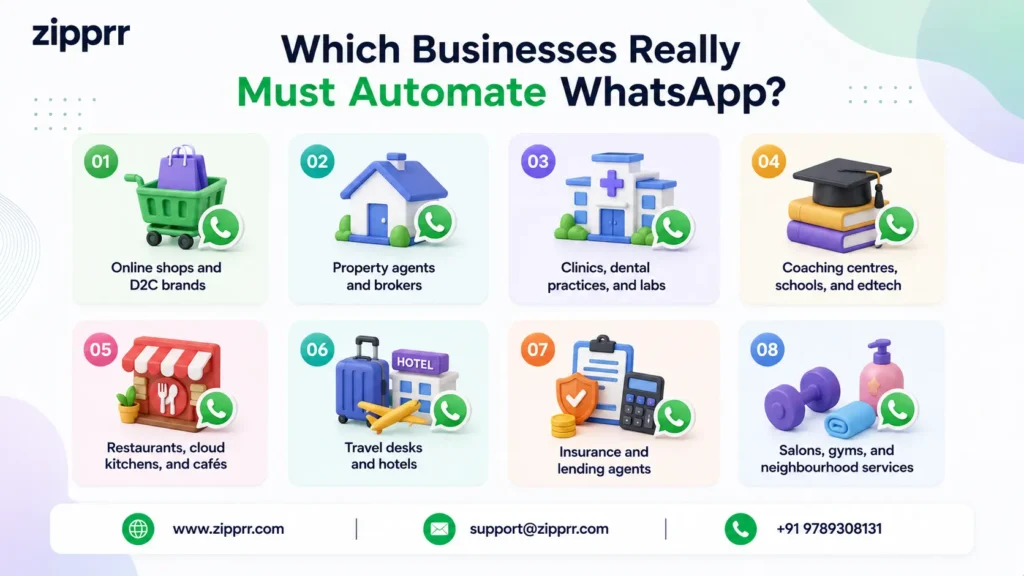
Eight kinds of business fail the leak audit almost by design, which is exactly why whatsapp automation software has become their default equipment rather than a gadget to try. Scan for yours and see the specific leak it plugs. Any of these can run end to end on one whatsapp automation software dashboard.
1. Online shops and D2C brands (non-negotiable)
Two moments decide an online store’s month: the checkout that gets abandoned and the “where is my order” that eats support time. A nudge sent over WhatsApp, carrying the product photo and a tap-to-pay link, wins back a serious slice of those dropped carts, far more than the same nudge over email (2026 e-commerce benchmarks). Layer on auto order confirmations, dispatch alerts, and restock pings, and tickets shrink while repeat orders climb. This one earns back the tool cost in weeks.
2. Property agents and brokers (non-negotiable)
A property enquiry has a shelf life measured in minutes, because the same buyer is pinging four other listings at once. Whoever fires back the photos, the price, and a viewing slot first tends to close. Automation ships that bundle the instant an enquiry lands, screens the lead with two or three quick questions, and keeps a courteous reminder drip running so nothing rots in a crowded inbox. With one deal covering the software many times over, dawdling is the only real cost.
3. Clinics, dental practices, and labs (non-negotiable)
An empty appointment slot is revenue you can never resell, and no-shows quietly drain a practice. Reminders, confirmations, and one-tap reschedule links keep the calendar tight, while a friendly post-visit note pulls patients back for the next check. Keep it responsible: use approved templates, and never let automated messages carry clinical detail. Reminders belong on autopilot, diagnoses do not.
4. Coaching centres, schools, and edtech (non-negotiable)
Admission season is a flood of enquiries, class alerts, fee reminders, and parent updates, all repetitive, all time-boxed. Automation walks a prospective student from first enquiry to a counselling slot, softens fee delays with courteous scheduled nudges, and keeps parents in the loop without pinning a staff member to a phone. During peak intake, this is the line between an orderly season and pure scramble.
5. Restaurants, cloud kitchens, and cafés (non-negotiable)
Table bookings, order confirmations, delivery tracking, and “come back, we miss you” offers all sit naturally in WhatsApp. A bot can lock in a reservation, confirm it, and remind the guest on the day, then push a weekend deal to opted-in regulars on a channel that actually gets read. On thin margins, a handful of extra covers a week from automated win-backs is straight profit.
6. Travel desks and hotels (non-negotiable)
Confirmations, itineraries, check-in prompts, and upsells are detail-heavy and deadline-driven, precisely the stuff guests like to keep in a scrollable chat. Automation confirms the booking on the spot, sends the itinerary, taps the guest before check-in, and circles back for a review after checkout, all without pinning down your front desk.
7. Insurance and lending agents (non-negotiable, handle with care)
Premium prompts, payment links, KYC chases, and renewal reminders are the heartbeat of this trade, and a missed one costs the client and the agent both. Automation parks every due date in front of the customer on a channel they open. Because the sector is regulated, stay on approved utility templates, keep private data out of automated flows, and hand anything account-specific to a verified person.
8. Salons, gyms, and neighbourhood services (non-negotiable)
Every appointment-led local outfit, the salon, the spa, the gym, the repair shop, the private tutor, runs on bookings and the rebookings that follow. Reminders trim no-shows, and a simple “time for your next visit?” weeks on triggers the repeat that turns a break-even month into a good one. These owners seldom have a spare pair of hands to chase, which is exactly why the software pulls its weight.
When you can happily skip it
For honesty’s sake: if you run a slow-burn enterprise B2B operation with a few big deals closed across months of meetings, or a tiny book of customers you already know by name, automation is a comfort, not a must. Come back when you tip into the leaks above, not a day sooner.
Seen Enough? Put It in Front of Your Own Numbers
You have matched your business to the list. The honest next move is to watch the tool run on the exact flows your business needs, not a generic demo reel. Grab a walkthrough, or just message our team on WhatsApp and interrogate us. No pressure to buy, and you will walk away knowing whether the whatsapp automation software fits before a single rupee changes hands.
What Automation Actually Buys the Owner (Beyond "Faster Support")
Marketing pages love the phrase “better customer support.” Owners care about something plainer: the tool claws back sales you were already losing, shaves the cost of answering the same thing a hundred times, and keeps the shop running when you have stepped away.
Here is the view from the owner’s chair.
It rescues sales you thought you had lost
The abandoned cart, the empty appointment, the enquiry that went cold, the renewal nobody remembered. None of these are fresh customers you have to hunt down. They are near-wins that slipped away in silence. A single well-timed message intercepts them on the way out the door, which is why the tool so often clears its own cost before the month closes.
It hands the boring work to software, and the judgement calls to people
Tally the hours your team burns on “yes, we’re open,” “here’s the rate,” and “your order’s on its way.” A bot fields those in an instant, forever. Your people then pour their attention into the conversations that genuinely need a human touch, the ones that seal deals and defuse frustrated customers. More gets done, and you never added a headcount to do it.
It clocks in around the clock
People message at midnight, on a Sunday, while you are on holiday. A manual inbox leaves those sitting; an automated one greets, answers, and often converts them before your first coffee. For a small-business owner, that is about as close to being in two places at once as it gets.
It swaps guesswork for a scoreboard
One screen shows what went out, what got opened, what got clicked, and what got a reply. You stop running on hunches and start tuning your outreach like a dial: more of what lands, less of what flops. A capable whatsapp automation software gives you that scoreboard on day one.
It is a purchase, not a permanent tenant
Here is the sum most subscription tools hope you skip. A monthly automation plan quietly bills you forever, and usually charges more as your list grows, so success itself becomes a recurring tax. Zipprr’s whatsapp automation software is a one-time $490 buy with full source code. You own it outright, host it wherever you like, and never pay rent on your own growth. That is the gap between owning a tool and paying a landlord for one.
The Jobs You Can Hand Over on WhatsApp
In everyday practice, whatsapp automation software takes on four kinds of work: blasting, chatting, reminding, and servicing. Here is what each looks like on the ground.
Blasting and campaigns
- Broadcasts to people who opted in: launches, deals, announcements
- Segmented lists so each group hears the message meant for it
- Media-rich sends: photos, catalogues, PDFs, tappable buttons, not bare text
- Direct links that drop the reader straight into checkout, booking, or a form
Chatting and bots
- Auto-replies covering the usual questions at any hour
- Menu bots that route “buy / help / hours” with no human in the loop
- Lead screening that asks a couple of questions and passes on the warm ones
- Keyword triggers that launch the right flow the moment they are typed
Reminding and chasing
- Booking reminders that keep no-shows down
- Cart nudges carrying the product and a one-tap link
- Payment and renewal prompts on the channel people actually open
- Win-back notes to customers who drifted quiet
Servicing and ops
- Order and delivery updates pushed out automatically
- FAQ deflection so staff only touch the real problems
- Shared team inbox so several agents work one number cleanly
- API hooks to wire in your store, CRM, or booking system
Getting Started Without Overcomplicating It
To start with whatsapp automation software, verify a WhatsApp Business number, pick a tool you own rather than rent, hook up the number, build a few starter flows, and switch it on. Most businesses are live inside a week. Step by step:
- Clear the leak audit first. Two or more yeses and you have a real case. Skip it and you are buying a fix for a problem you do not have yet.
- Get a business number verified. A dedicated, verified number keeps you compliant and looking professional.
- Choose ownership over rental. Weigh a single payment against a forever-monthly bill. Zipprr is a one-time $490 with source code in the box.
- Connect and dress it up. Setup is handled for you; you add branding, contacts, and your message templates.
- Build three flows, not thirty. Start with a welcome reply, one reminder, and one broadcast. Resist automating the whole business on day one.
- Get templates approved. Marketing and utility templates pass through WhatsApp’s approval; keep them tidy and genuinely useful.
- Flip it on and watch the numbers. Track opens and replies, then scale the flows that earn.
The engine is already built. Your real job is deciding how you want the messaging to behave.
Staying Clean: Kind to WhatsApp, Kind to Google
Automation the right way is invited, useful, and welcome; the wrong way gets your number banned and your site marked down. The compass is simple: only message people who asked for it, and make every message earn its open. The rules that keep you safe:
- Consent comes first. Message only opted-in contacts. Renting a list and blasting strangers is the express lane to a ban.
- Send value, not clutter. Reminders, updates, offers that fit, not a daily drip of noise. Mind the frequency.
- Make leaving effortless. Honour “stop” on the spot. A trimmed, willing list beats a bloated one every time.
- Stay inside approved templates. Keep to WhatsApp’s categories for marketing, utility, and authentication.
- Fence off sensitive data. In health and finance especially, route anything account-specific to a real person.
The same instinct protects you in search. This article earns its ranking by actually answering a buyer’s real question, with an original audit, a clear decision path, and current 2026 data, rather than gaming a keyword. That is the behaviour both WhatsApp and modern search quietly reward.
Before and After: The Manual Inbox vs an Automated One
Most message-heavy businesses still run WhatsApp like a personal phone. Here is what shifts the day the software takes over:
| The task | Run by hand | Run by WhatsApp automation software |
|---|---|---|
| First reply | Whenever a teammate is free | Immediate, without fail, at any hour |
| Reminders | Only if someone remembers | Scheduled, never skipped |
| Repeat questions | Retyped over and over | Cleared by a bot in seconds |
| Campaigns | Pasted to contacts one by one | One broadcast to a chosen segment |
| Knowing what works | A hunch | Opens, clicks, and replies on one screen |
Why Owning Beats Renting: Zipprr's Take
Zipprr’s tool, AI WhatsApp, is a full whatsapp automation software you buy once and keep for good. It rolls a broadcast sender, a chatbot builder, auto-replies, a shared team inbox, and API access into a single dashboard, and it ships with the complete source code, so nothing is bolted shut against your own developers.
The part that matters to an owner is the money model. Subscription tools nibble every month, forever, and most raise the bill as your contact list swells, charging you more precisely because you are winning. Zipprr asks for $490 once. You own it, host it anywhere, and reshape it as you please. The full whatsapp automation software breakdown and pricing live on the product page. Want an AI-driven chat layer on your website too? See the AI Chat Assistant. Building an app that needs messaging baked in? Our custom mobile app development team can take it from there.
What It Costs
Straight pricing: pay once, no monthly SaaS drip, starting at only $490.
Standard: $490 Everything to go live: broadcast sender, chatbot and auto-replies, team inbox, full source code, free installation, and lifetime updates. A single payment.
Pro: (Most Popular) All of Standard plus deeper automation and a done-for-you setup, so you launch quicker with less lifting on your side.
Not satisfied within 7 days? Full refund, so trying it costs you nothing real.
Frequently Asked Questions
What is WhatsApp automation software?
Which businesses need WhatsApp automation software the most?
Is WhatsApp automation software worth it for a small business?
How much does WhatsApp automation software cost?
Is WhatsApp automation legal and allowed by WhatsApp?
Can WhatsApp automation reduce appointment no-shows?
What can I automate on WhatsApp?
Does WhatsApp automation software need coding skills?
How is WhatsApp automation better than email marketing?
Will automated messages get my WhatsApp number banned?
How long does it take to set up WhatsApp automation?
Do I own the software or pay monthly?
More Zipprr Solutions Worth a Look
Building past messaging? These sit well beside WhatsApp automation:
- AI Chat Assistant: an AI chat layer for your website and support desk.
- Custom Mobile App Development: messaging built into your own branded app.
- Schedule a Free Demo: watch the WhatsApp automation software run first.
Ready to Seal the Leak?
If the audit came back with two or more yeses, the arithmetic is already done for you: the sales slipping away through slow replies and missed reminders add up to more than the tool that stops them.
Take the complete whatsapp automation software (broadcast sender, chatbot, auto-replies, team inbox, and full source code) for a single $490.