
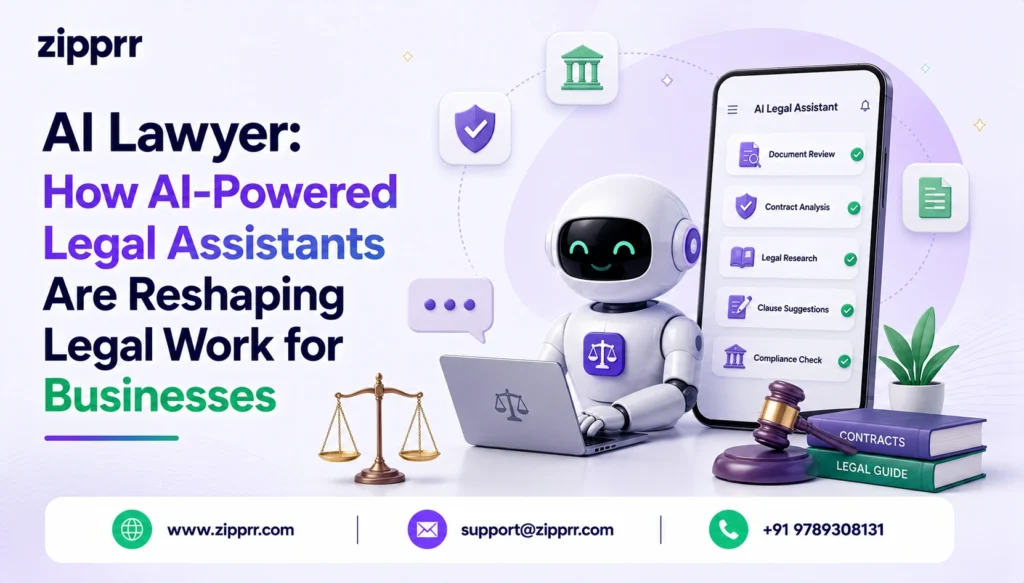
Legal work has always been knowledge-heavy, time-consuming, and expensive. Contracts need review, clauses need interpretation, research eats hours, and small businesses often skip legal checks entirely because they can’t justify the hourly rates. An AI Lawyer changes that math. It is an AI-powered legal assistant that reads, drafts, summarizes, and explains legal documents in plain language, giving individuals and organizations fast, affordable, on-demand legal support.
This guide takes an AI adoption and operational efficiency perspective. Rather than treating an AI Lawyer as a novelty, we look at how businesses can integrate it into real workflows to reduce cost, accelerate decisions, and free human experts for higher-value work. You’ll learn what an AI Lawyer is, how it works under the hood, the problems it solves, its core features, and how to implement it responsibly. Throughout, one principle stays constant: an AI Lawyer augments legal judgment; it does not replace a licensed attorney where one is genuinely required.
What Is an AI Lawyer?
An AI Lawyer is a software application that uses artificial intelligence—specifically large language models, natural language processing (NLP), and machine learning—to perform legal tasks that traditionally required a human lawyer or paralegal. It can review contracts, answer legal questions, draft documents, summarize case law, flag risky clauses, and explain complex legal language in everyday terms.
It is important to be precise about what an AI Lawyer is and is not. It is a productivity and decision-support tool. It is not a licensed attorney, it does not hold professional liability, and it does not replace formal legal representation in court. Think of it as an always-available legal analyst that handles the repetitive, high-volume work so humans can focus on strategy, negotiation, and judgment. Platforms like Zipprr’s AI Lawyer software package these capabilities into one deployable system.
Why Businesses Need an AI Lawyer
Legal friction slows businesses down. A vendor contract sits unsigned for a week because no one has time to read it. A startup launches without proper terms of service. An SME accepts unfavorable payment terms simply because reviewing them felt too costly. These are everyday operational bottlenecks, not rare edge cases.
An AI Lawyer removes much of that friction by making baseline legal review instant and inexpensive. For organizations pursuing digital transformation, it fits naturally alongside CRM, ERP, and workflow automation systems as part of a broader move toward AI adoption. The value is not just cost savings—it’s velocity. Faster contract turnaround means faster deals, quicker onboarding, and fewer stalled projects.
It is best understood as a starting foundation, not a finished product. The clone supplies the connective tissue every ride-hailing business needs: user registration and authentication, real-time GPS tracking, ride matching and dispatch, fare calculation, in-app payments, ratings, and reporting. You then customize the branding, pricing rules, service types, and geography to fit your market. The Zipprr Uber Clone follows exactly this blueprint, shipping the essentials so your team can concentrate on positioning and operations.
The word “clone” refers to the functional pattern, not the copying of any company’s proprietary code, trademarks, or brand. A well-built solution is original software that follows a proven marketplace blueprint, much like countless online stores that follow the pattern popularized by early e-commerce leaders without being copies of them.
Common Business Challenges an AI Lawyer Addresses
- High legal costs: Hourly attorney fees make routine review uneconomical for small and mid-sized businesses.
- Slow turnaround: Contract review queues create bottlenecks that delay revenue and partnerships.
- Limited access to expertise: Startups and solo founders often have no in-house legal team at all.
- Document overload: Growing volumes of NDAs, MSAs, vendor agreements, and policies exceed human review capacity.
- Inconsistent review quality: Different reviewers catch different issues, creating uneven risk coverage.
- Complex, jargon-heavy language: Non-lawyers struggle to understand what they’re actually agreeing to.
- Compliance blind spots: Regulations change, and teams miss updates that affect their contracts and policies.
How an AI Lawyer Solves Those Challenges
| Business Challenge | How an AI Lawyer Solves It |
|---|---|
| High legal costs | Handles routine review and drafting at a fraction of hourly rates, reserving human lawyers for complex matters. |
| Slow turnaround | Reviews and summarizes documents in seconds to minutes, clearing bottlenecks. |
| Limited expertise | Provides on-demand legal understanding to teams with no in-house counsel. |
| Document overload | Scales to thousands of documents without added headcount. |
| Inconsistent quality | Applies consistent review criteria and clause libraries every time. |
| Complex language | Translates legalese into plain-English explanations. |
| Compliance blind spots | Flags outdated or non-standard terms and highlights areas needing human review. |
How Does an AI Lawyer Work?
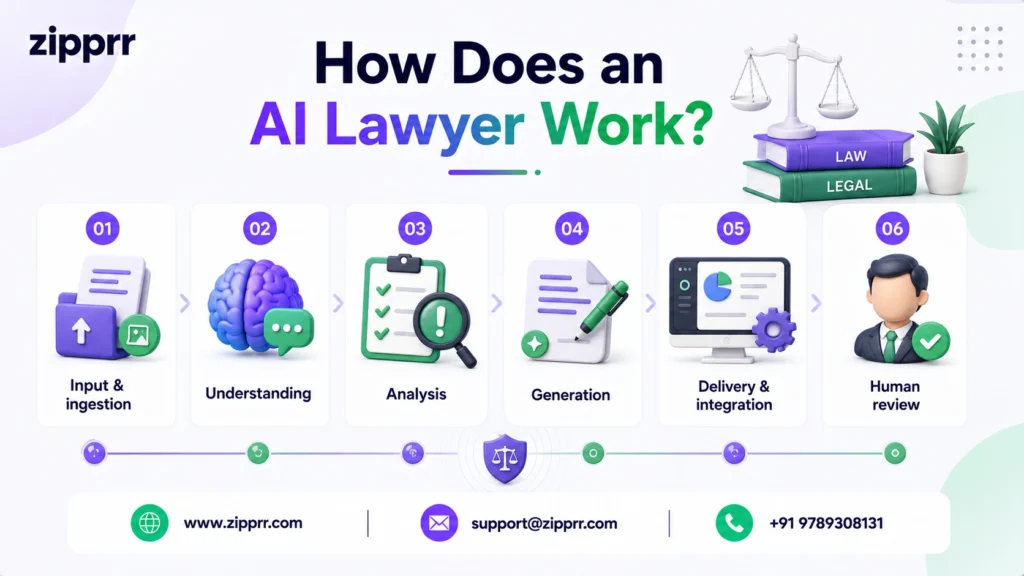
Under the hood, a typical AI Lawyer follows a pipeline:
- Input & ingestion: The user uploads a contract, pastes text, or asks a question. Documents are parsed via OCR and text extraction.
- Understanding: NLP and machine learning models identify clauses, entities, obligations, dates, parties, and intent.
- Analysis: The system compares terms against clause libraries, best-practice standards, and jurisdiction context to detect risks and gaps.
- Generation: A large language model drafts summaries, redlines, plain-English explanations, or new documents.
- Delivery & integration: Results appear in a dashboard and can flow into other systems through REST APIs and webhooks—for example, pushing a reviewed contract into a CRM or document-management workflow.
- Human review: High-risk items are routed to a person for final sign-off, keeping a human in the loop.
Modern implementations increasingly use retrieval-augmented generation (RAG), grounding answers in a trusted knowledge base to improve accuracy and reduce hallucinations. Cloud computing provides the scalability, and authentication plus encryption protect sensitive legal data.
Core Features of an AI Lawyer
A capable AI Lawyer platform typically combines the following features into a single workflow:
- Contract review & analysis: Automatic clause extraction, risk flagging, and redlining.
- Document drafting: Generate NDAs, service agreements, policies, and letters from prompts or templates.
- Plain-language explanations: Translate dense legal text into clear summaries.
- Legal research assistant: Summarize statutes, case law, and precedents relevant to a query.
- Clause library & comparison: Compare terms against standard or preferred language.
- Multi-jurisdiction awareness: Context-sensitive guidance across regions and legal frameworks.
- Question-and-answer chat: Conversational interface for quick legal questions.
- Document management: Secure storage, version history, and search.
- Integrations & APIs: REST API, webhooks, and connectors to CRM, ERP, and e-signature tools.
- Security & access control: Encryption, role-based authentication, and audit logs.
- Analytics & reporting: Insights on turnaround times, common risks, and review volumes.
- Notifications: Alerts for deadlines, renewals, and flagged clauses.
Key Benefits
- Lower cost: Reduce spend on routine legal work dramatically.
- Speed: Turn multi-day reviews into minutes.
- 24/7 availability: Legal support outside business hours and across time zones.
- Consistency: Uniform review standards on every document.
- Accessibility: Legal understanding for teams without in-house counsel.
- Scalability: Handle rising document volumes without new hires.
- Risk reduction: Catch unfavorable or missing clauses before signing.
- Better human focus: Free lawyers and paralegals for high-value strategy and negotiation.
Industry Applications
- SaaS & technology: Reviewing vendor agreements, DPAs, and customer contracts at scale.
- Startups & SMEs: Baseline legal coverage without a full legal department.
- Real estate: Lease and purchase agreement review.
- Finance & insurance: Policy analysis and compliance checks.
- E-commerce & marketplaces: Terms of service, seller agreements, and returns policies.
- Healthcare: Consent forms and vendor compliance documentation.
- Agencies & consultancies: Client contracts, SOWs, and NDAs.
- Enterprises: First-pass triage before routing to in-house or outside counsel.
Real-World Use Cases
- Vendor contract triage: A procurement team runs every incoming vendor agreement through the AI Lawyer, which summarizes obligations, flags auto-renewal and liability clauses, and routes only high-risk deals to legal.
- Startup self-service: A founder drafts a compliant NDA and mutual service agreement in minutes before a partner meeting.
- Contract renewal monitoring: Notifications warn a business 60 days before an unfavorable contract auto-renews.
- Sales acceleration: A sales team gets same-day redlines on customer MSAs, shortening the deal cycle.
- Policy comprehension: An operations lead pastes a complex data-processing agreement and gets a plain-English summary of the company’s obligations.
- Research support: A paralegal uses the assistant to summarize relevant precedents, cutting research time in half.
Implementation Guide
Rolling out an AI Lawyer solution works best in clear, measured stages:
- Define your use cases: Start with one high-volume workflow, such as NDA review or vendor triage.
- Choose deployment: Decide between a hosted SaaS platform or a private, self-hosted deployment for sensitive data.
- Prepare your data: Assemble templates, clause libraries, and preferred terms to ground the system.
- Integrate: Connect via REST API and webhooks to your CRM, document management, and e-signature tools.
- Configure guardrails: Set risk thresholds and human-in-the-loop review rules for high-stakes documents.
- Pilot: Run a controlled trial, measure accuracy and time saved, and gather user feedback.
- Train your team: Teach staff how to prompt effectively and when to escalate to a human lawyer.
- Roll out & monitor: Expand to more workflows and track analytics on turnaround and risk.
Best Practices
- Keep a human in the loop for high-value or high-risk matters.
- Ground the AI in your own clause libraries and templates to improve accuracy.
- Never treat output as final legal advice—use it as a first pass and analytical aid.
- Protect data with encryption, access controls, and clear retention policies.
- Verify jurisdiction relevance; laws vary by region and change over time.
- Log and audit AI decisions for accountability and continuous improvement.
- Measure outcomes—track time saved, risks caught, and error rates.
- Set clear policies on what the AI Lawyer may and may not decide autonomously.
Comparison Table: AI Lawyer vs. Traditional Approaches
| Factor | AI Lawyer | Traditional Lawyer / Firm | DIY / No Review |
|---|---|---|---|
| Cost | Low, subscription-based | High hourly fees | Free but risky |
| Speed | Seconds to minutes | Days to weeks | Immediate but unchecked |
| Availability | 24/7 | Business hours | Always |
| Consistency | High, standardized | Varies by person | None |
| Scalability | High | Limited by headcount | Not applicable |
| Court representation | No | Yes | No |
| Best for | Routine review, drafting, research | Complex, high-stakes, litigation | Not recommended |
The most effective model is hybrid: the AI Lawyer handles volume and first-pass analysis, while human attorneys handle complexity, negotiation, and representation.
Ready to Launch Your Own AI Lawyer Platform?
Zipprr’s AI Lawyer software ships with 100% source code, free installation, and same-day setup—so you can run it for your firm or rebrand and launch it as your own legal-tech product. Have a question or want to see it live?
Frequently Asked Questions
What is an AI lawyer and how does it work?
Can an AI lawyer replace a real lawyer?
Is it safe to use an AI lawyer?
How much does an AI lawyer cost?
What can an AI lawyer do for my business?
Are AI lawyers legal to use?
How accurate are AI lawyers?
Who should use an AI lawyer?
Can an AI lawyer review my contract?
What is the difference between an AI lawyer and ChatGPT?
Key Takeaways
- An AI Lawyer is an AI-powered legal assistant for review, drafting, research, and plain-language guidance.
- It reduces cost, accelerates turnaround, and scales legal support without added headcount.
- It is a decision-support tool, not a replacement for a licensed attorney in complex or courtroom matters.
- The strongest model is hybrid: AI handles volume; humans handle judgment and negotiation.
- Success depends on grounding, guardrails, human oversight, and strong data security.
Conclusion
Legal work no longer has to be a bottleneck. An AI Lawyer brings affordable, fast, consistent legal support to businesses of every size, turning multi-day reviews into minutes and giving teams without in-house counsel a real first line of defense. Adopted thoughtfully—with human oversight, solid data security, and clear guardrails—it becomes a durable operational advantage rather than a gimmick.
The organizations that win with AI adoption treat the AI Lawyer as a force multiplier: it clears the routine so people can focus on the complex. Start with one workflow, measure the impact, and expand from there. To see how a ready-to-deploy platform handles drafting, contract review, and billing in one place, explore Zipprr’s AI Lawyer software and take the next step.