

Laundry is one of the last major household chores that hasn’t been fully digitized. While ride-hailing, food delivery, and grocery shopping moved online more than a decade ago, most people still drop off dry cleaning in person or spend a Saturday afternoon at a laundromat. That gap is exactly what “Uber for Laundry” apps are built to close, and it’s why entrepreneurs keep asking the same question: does an on-demand laundry business actually work as a model, and how do you build one correctly?
This guide answers that question in full. It breaks down what an Uber for Laundry app actually is, the three business models operators use to run one, how these platforms generate revenue, what it costs to build one in 2026, and the operational lessons learned from real laundry startups that succeeded and failed. It also covers the features, technology, and launch steps needed to take the idea from concept to a live, revenue-generating platform.
What Is an Uber for Laundry App?
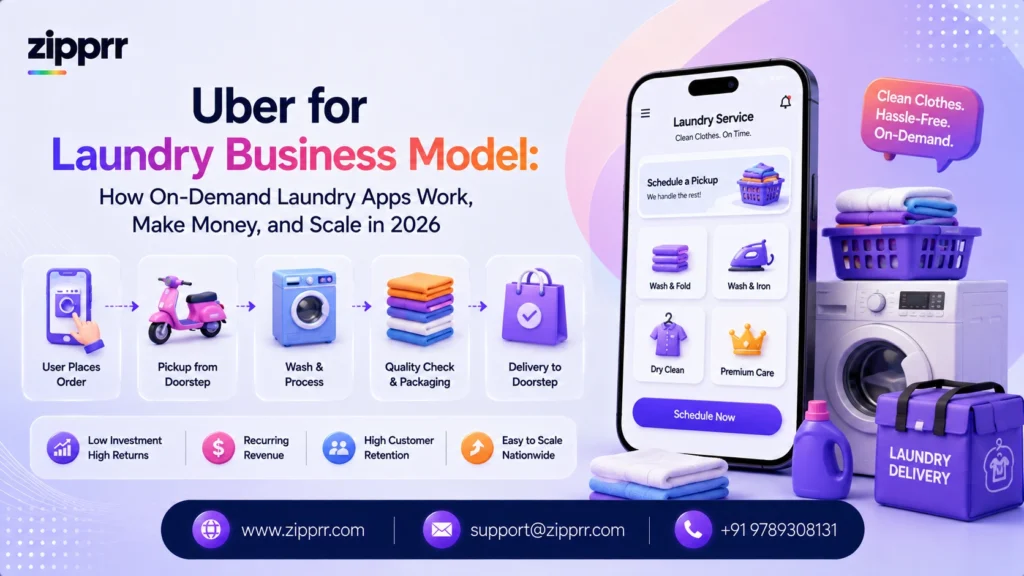
An Uber for Laundry app is an on-demand service platform that lets a customer request laundry pickup, cleaning, and delivery from their phone, in the same way they would request a ride or a food delivery. The customer selects a service (wash-and-fold, dry cleaning, ironing, or specialty care), chooses a pickup window, and pays through the app. A driver or the laundry partner itself picks up the order, the items are cleaned at a partner facility, and the finished laundry is delivered back to the customer within an agreed turnaround time, usually 24 to 72 hours, with same-day or express options available at a premium.
The term “Uber for X” is used broadly across on-demand services: it simply signals that the platform applies ride-hailing-style logistics (real-time matching, tracking, and cashless payment) to a different industry. In laundry, this means matching supply (laundromats, dry cleaners, or independent workers with cleaning capacity) with demand (consumers and businesses who want laundry handled without doing it themselves).
How Does an On-Demand Laundry App Work?
Most on-demand laundry platforms follow the same five-step operational flow, regardless of which business model sits underneath them:
- Order placement: The customer opens the app, selects services (wash-and-fold, dry cleaning, ironing, bedding, etc.), sets a pickup address and time window, and gets an instant price estimate.
- Pickup assignment: The platform’s algorithm assigns the nearest available driver or partner facility based on location, current load, and service type.
- Processing: The laundry is weighed or itemized, cleaned according to the customer’s instructions, and quality-checked at the partner facility.
- Real-time tracking: The customer can follow order status (picked up, in process, ready, out for delivery) the same way they’d track a rideshare or food order.
- Delivery and payment: The finished laundry is delivered to the customer’s door, and payment (already authorized at checkout) is settled automatically, with the platform taking its commission before paying out the laundry partner or driver.
The entire value proposition rests on eliminating two friction points: the customer never has to visit a laundromat, and the laundry provider gets a steady stream of orders without spending on customer acquisition themselves.
Why the On-Demand Laundry Business Is Growing
The underlying market is large and still highly fragmented. According to a 2026 market report, the global dry cleaning and laundry services market is valued at approximately $115.67 billion in 2026 and is projected to reach $134.47 billion by 2030, growing at a 3.8% compound annual growth rate. That is a market made up overwhelmingly of small, independent operators (corner laundromats and family-run dry cleaners) almost none of whom have their own booking app, delivery fleet, or digital customer relationship.
Three shifts are pushing demand toward on-demand laundry platforms specifically:
- Consumer time scarcity. Dual-income households and long commute times have made “chore outsourcing” (grocery delivery, cleaning services, meal kits, laundry pickup) a mainstream spending category rather than a luxury.
- Underused laundry capacity. Most laundromats and dry cleaners operate well under full machine capacity during off-peak hours. An on-demand platform can route new demand into that idle capacity without the operator investing in new equipment.
- Low technology adoption among existing operators. Very few independent laundry businesses have invested in their own booking, routing, or payment technology, which leaves the digital layer open for a third-party platform to own the customer relationship.
This combination (a large addressable market, fragmented supply, and idle capacity) is precisely the setup on-demand marketplaces have historically capitalized on, and it’s why laundry has increasingly attracted the same wave of on-demand economy activity behind platforms like Uber for Laundry that reshaped ride-hailing, food delivery, and home services over the past decade.
The 3 On-Demand Laundry Business Models
Not every Uber for Laundry app is built the same way. Operators typically choose one of three structural models, and the choice has major implications for capital requirements, control over service quality, and how fast the business can scale.
| Model | How It Works | Capital Needed | Best For |
|---|---|---|---|
| On-Site (Facility-Owned) | The company owns or leases its own laundry facility and equipment, and handles pickup, cleaning, and delivery in-house. | High: equipment, real estate, staff | Operators wanting full quality control and margin, in a single dense market |
| In-Store (Aggregator) | The app aggregates existing local laundromats and dry cleaners, routing customer orders to a partner network without owning equipment. | Low to moderate: app, marketing, delivery logistics | Fast market entry in cities with many independent laundry businesses |
| Marketplace (Crowdsourced) | Independent workers (often doing laundry from home) sign up as service providers and are matched with nearby customer orders through the app. | Low: no facilities owned by the platform | Suburban and residential markets with lower laundromat density |
Not every Uber for Laundry app is built the same way. Operators typically choose one of three structural models, and the choice has major implications for capital requirements, control over service quality, and how fast the business can scale.
Key Features an Uber for Laundry App Needs
A production-ready on-demand laundry platform is really three connected applications working from one backend: a customer app, a provider (driver/laundry partner) app, and an admin panel.
Customer App
- Service selection with itemized or bag/weight-based pricing
- Scheduled and same-day/express pickup slots
- Real-time order tracking and push notifications
- In-app cashless payments (cards, wallets, UPI)
- Special instructions field (fabric care, allergies, starch preference)
- Order history, reordering, and ratings/reviews
- Coupon codes, referral credits, and subscription plan management
Provider/Driver App
- Job assignment and route optimization
- Order status updates (picked up, in process, ready, delivered)
- Earnings dashboard and payout history
- In-app chat or call with the customer
- Digital proof of pickup/delivery (photo or signature capture)
Admin Panel
- Order, provider, and customer management dashboards
- Commission and payout configuration
- Zone-based pricing and service-area management
- Analytics on order volume, turnaround time, and provider performance
- Promotions, notifications, and customer support tools
Multi-language support is also increasingly a baseline requirement rather than a nice-to-have, particularly for operators planning to launch across multiple cities or countries rather than a single local market.
Uber for Laundry Revenue Model: How These Apps Make Money
An on-demand laundry platform typically layers several revenue streams rather than relying on just one. The specific mix depends on the business model chosen above, but most platforms combine:
- Commission per order: the platform takes a percentage (commonly in the 15–30% range across on-demand service marketplaces) of each transaction from the partner laundromat, dry cleaner, or independent worker.
- Delivery fees: a flat or distance-based fee charged to the customer, separate from the cleaning cost itself.
- Express/same-day surcharges: a premium charged for faster-than-standard turnaround.
- Subscription plans: a recurring monthly fee for customers who order regularly, in exchange for waived delivery fees, priority scheduling, or discounted per-order pricing.
- Provider tools and advertising: at scale, some platforms charge partner laundromats for featured placement or premium listing within the app, similar to how food delivery marketplaces monetize restaurant visibility.
The marketplace and aggregator models generally produce higher-margin revenue per order than the facility-owned model, because the platform isn’t carrying the fixed costs of equipment, rent, and utensils; its main cost centers are payment processing, delivery logistics, and customer acquisition. This is the same underlying economics that has made commission-based marketplaces attractive across other local-service categories, from home repairs to on-demand laundry platforms.
How Much Does It Cost to Build an On-Demand Laundry App?
Development cost estimates for laundry apps vary widely across the industry, generally falling between roughly $10,000 on the low end for a basic MVP and well into the $30,000–$50,000+ range for a fully custom platform with native iOS and Android apps, real-time tracking, and a complete admin panel, according to figures published across multiple app development agencies. Several factors drive that range:
| Cost Factor | Impact on Budget |
|---|---|
| Custom build vs. white-label/ready-made script | Custom development from scratch costs significantly more and takes longer (often 4–9 months) than deploying a pre-built, customizable script |
| Number of apps (customer, provider, admin panel) | Each additional app/platform adds design, development, and QA time |
| Payment gateway and geolocation integrations | Multiple payment methods and real-time GPS tracking add integration and testing effort |
| Design complexity and branding | Fully custom UI/UX costs more than adapting an existing design system |
| Post-launch support and updates | Ongoing maintenance, bug fixes, and feature updates are a recurring cost beyond the initial build |
For most first-time operators, the practical decision isn’t “should I build custom” but “how much of the platform do I actually need to build from zero.” A white-label, ready-made Uber for Laundry solution already includes the customer, provider, and admin applications, cashless payment processing, and real-time tracking out of the box, which removes most of the multi-month custom development timeline and lets an operator focus their budget on driver/partner acquisition and marketing instead of rebuilding infrastructure that already exists.
How to Start an On-Demand Laundry Business: Step-by-Step
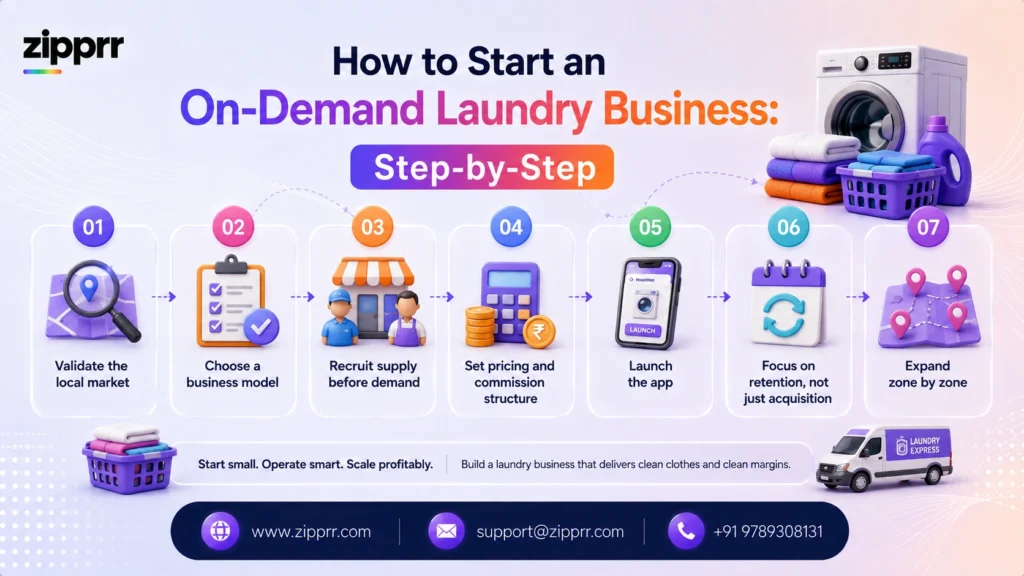
Launching an Uber for Laundry business follows a fairly consistent sequence, regardless of which business model an operator ultimately chooses:
- Validate the local market. Identify whether your target city has enough underused laundromat/dry-cleaner capacity (for the aggregator model) or enough gig-worker supply (for the marketplace model) to fulfill demand reliably from day one.
- Choose a business model. Decide between owning a facility, aggregating existing laundromats, or crowdsourcing independent workers, based on available capital and local supply density.
- Recruit supply before demand. Sign up a minimum viable network of laundry partners or drivers in a single zip code or neighborhood before spending on customer acquisition: a common early-stage mistake is marketing to customers before there’s reliable fulfillment capacity to serve them.
- Set pricing and commission structure. Price services competitively against local laundromat rates while building in the commission and delivery fee margin the platform needs to be sustainable.
- Launch the app. Deploy the customer, provider, and admin apps in one target zone, keeping the initial service area small enough to guarantee fast turnaround times.
- Focus on retention, not just acquisition. Laundry is a recurring need: subscription plans and reorder prompts typically matter more to long-term revenue than one-time promotional discounts.
- Expand zone by zone. Add new neighborhoods or cities only once the current service area is hitting reliable turnaround times and positive unit economics, rather than expanding broadly before the model is proven.
Real-World Lessons From Laundry Startups
The on-demand laundry category has real operating history, and it offers useful lessons for anyone evaluating the model today.
Washio, one of the earliest and most well-funded on-demand laundry startups, shut down its operations in August 2016 after raising roughly $23 million in venture funding. Multiple post-mortems, including reporting from Forbes and TechCrunch at the time, pointed to unsustainable unit economics: the company relied heavily on paying and equipping its own delivery workers (“Washio ninjas”) rather than fully outsourcing to existing laundry supply, which kept operating costs high relative to the price customers were willing to pay for a commodity service like laundry.
Rinse, by contrast, has continued raising capital over multiple funding rounds, including a $6 million round in 2016, a $14 million Series B in 2017, and a later $23 million round backed by appliance maker LG, while operating a model that leans more heavily on partnering with and coordinating cleaning capacity rather than owning it outright in every market. The comparison illustrates a consistent pattern in this category: platforms that keep fixed costs low and treat themselves primarily as a logistics and demand-generation layer, rather than a capital-intensive, owned-operations business, have tended to sustain themselves longer than those that scaled owned infrastructure too early.
The practical takeaway for a new operator is straightforward: validate demand and unit economics at a small scale using the aggregator or marketplace model first, and only take on the capital intensity of owned facilities once order volume and margins justify it.
Challenges in the On-Demand Laundry Business (and How to Solve Them)
| Challenge | Practical Solution |
|---|---|
| Thin margins on a commodity service | Layer in subscriptions, express fees, and add-on services (ironing, specialty fabric care) rather than competing purely on base wash-and-fold price |
| Inconsistent quality across partner facilities | Use in-app ratings, quality checklists, and a limited, vetted partner network rather than open, unvetted onboarding |
| High customer acquisition cost for a low-frequency category | Prioritize retention mechanics (subscriptions, reorder reminders, loyalty credits) since laundry is a recurring need once trust is established |
| Delivery logistics and turnaround delays | Keep initial service zones small and dense so pickup-to-delivery windows stay predictable before expanding coverage area |
| Working capital for owned-facility models | Start with the aggregator or marketplace model to prove demand before investing in owned equipment or real estate |
Why Choose a White-Label Laundry App Solution Over Building From Scratch
Building a three-sided on-demand platform (customer app, provider app, and admin panel, with live tracking and payments) from a blank codebase typically takes several months and a full development team before the first order is ever processed. For most first-time operators, that timeline is the biggest risk in the business: months of spending before there’s any evidence the local market will actually support the model.
A ready-made, white-label on-demand laundry script shortens that timeline by starting from a platform that already has the core booking, tracking, and payment functionality built and tested, while still allowing the operator to customize branding, service pricing, and service areas. That trade-off, slightly less bespoke customization in exchange for a launch measured in days rather than months, is usually the right one for an operator whose priority is testing the business model with real customers and real laundry partners as quickly as possible: keep fixed costs low, outsource fulfillment to existing supply, and let the app own the customer relationship.
Why Choose Zipprr
Zipprr’s Uber for Laundry solution is a ready-made, white-label on-demand laundry platform that includes the customer app, provider app, and admin panel needed to run the models described above, with cashless payment processing, real-time order tracking, and multi-language support built in. It’s designed to go live in days rather than months, with source code ownership, mobile app store submission, and 90 days of post-launch technical support included, so operators can spend their early runway proving the model in one zone instead of managing a custom software build.
Thinking about launching an on-demand laundry startup?
Which On-Demand Laundry Startup Model Fits You? If you’ve already scouted local laundromats or dry cleaners with idle capacity, the aggregator model fits you best. If you’d rather recruit independent workers than manage facility partnerships, the marketplace model fits you best. If you have capital and want full control over quality and margin, the on-site model fits you best. And if you’re still validating the idea, start with Zipprr’s ready-made Uber for Laundry solution and test any model in days, not months.
What is an Uber for Laundry app?
How does an on-demand laundry app work?
How does an Uber for Laundry app make money?
What are the different on-demand laundry business models?
How much does it cost to build an on-demand laundry app?
Is the on-demand laundry business profitable?
What features does an on-demand laundry app need?
What challenges do on-demand laundry startups face?
Can I start an on-demand laundry business without owning a laundry facility?
What's the difference between building a custom laundry app and using a white-label script?
Conclusion
The on-demand laundry business model works because it applies proven marketplace logistics (matching, tracking, and cashless payment) to a large, fragmented, and still largely offline industry. The operators who succeed tend to start lean, choosing the aggregator or marketplace model to validate demand before taking on the capital intensity of owned facilities, and they build revenue from multiple streams (commissions, delivery fees, subscriptions) rather than relying on thin per-order margins alone. Whether the goal is a single-city side business or a multi-market platform, the fastest and lowest-risk way to test the model is to launch with infrastructure that already exists rather than building it from zero, giving operators time to focus on what actually determines success in this category: reliable fulfillment and repeat customers.