

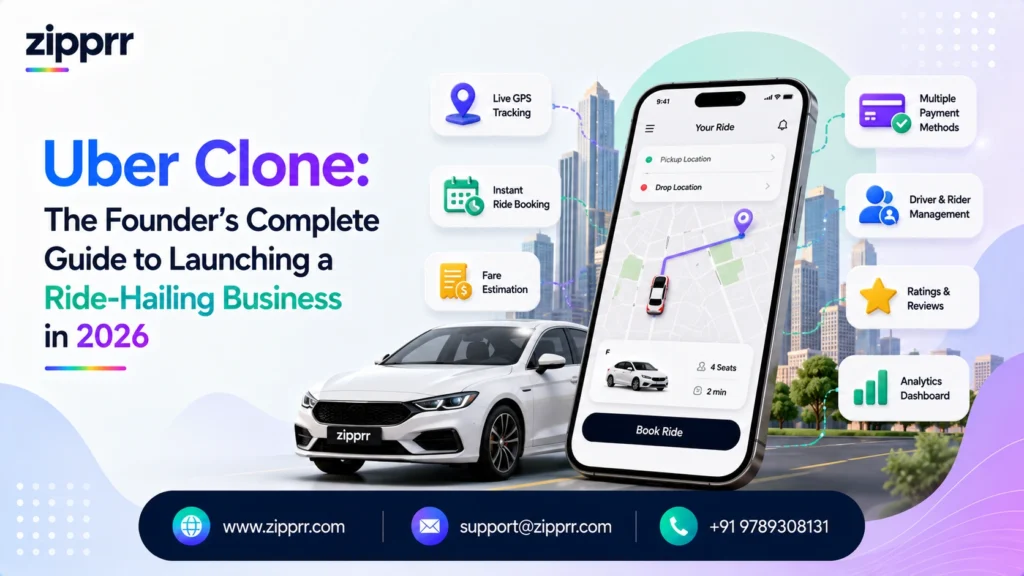
An Uber clone is a ready-made, white-label software platform consisting of a rider app, a driver app, and an admin panel. It replicates Uber’s core ride-hailing workflow so you can launch your own branded taxi or mobility business in weeks instead of years, typically for 10 to 20 times less than custom development.
I’ve seen this decision play out from both sides. I once watched a founder spend fourteen months and a painful amount of investor money building a ride-hailing platform from scratch, only to discover that the hard part was never the software. Around the same time, a two-person team in a mid-sized city put a white-label platform live in six weeks and reached operational break-even before the custom-build founder had even finished his driver app.
The difference was not talent. It was the decision each of them made in week one.
This guide is the resource I wish both of them had read first. It covers what an Uber clone actually is (and is not), what it really costs, including the numbers vendors rarely put on their pricing pages, how to evaluate vendors without getting burned, the operational playbook that decides whether your platform lives or dies, and the honest limitations no sales page will admit. No fluff, no recycled vendor copy. Let’s get into it.
What Is an Uber Clone, Really?
An Uber clone is a pre-built ride-hailing software package modeled on Uber’s proven product architecture. The word “clone” refers to the business model and workflow, not stolen code. A legitimate clone is original software that reproduces the experience riders and drivers already understand: open the app, request a ride, match with a nearby driver, track the arrival, pay, and rate. It’s your name on the app, your servers behind it, and your rules on pricing.
That last paragraph matters because the word “clone” makes lawyers nervous. To be unambiguous:
Legality in one sentence: Copying a business model is legal and always has been (Lyft, Bolt, Ola, and Careem all “cloned” the model), while copying Uber’s name, logo, code, or visual identity is trademark and copyright infringement. A legitimate white-label platform gives you original code and your own branding, which is why app stores approve properly rebranded clone apps every week.
(A standard disclaimer worth repeating on your own site: “Uber” is a trademark of Uber Technologies Inc. Clone products are independent software with no affiliation to Uber.)
Why the model is worth cloning
The workflow you are replicating is arguably the most validated product design in consumer tech. In its FY2025 results, Uber reported $193.5 billion in gross bookings across 13.6 billion trips, $52.0 billion in revenue, and 202 million monthly active consumers (source: Uber Q4-2025 earnings, SEC filing). Meanwhile, the global ride-hailing services market is estimated at $55.1 billion in 2026 and projected to reach $181.5 billion by 2033 at an 18.6% CAGR (Grand View Research).
Here is the part most articles skip: Uber’s scale is exactly why the local opportunity exists. Uber operates in roughly 70 countries, which leaves thousands of cities underserved, overpriced, or entirely uncovered. Bolt built a multi-billion-euro business starting from Estonia. inDrive reached over 40 countries with a fare-negotiation twist on the same model. Careem won the Middle East and sold to Uber for $3.1 billion. None of them out-engineered Uber. They out-localized it.
An Uber clone script is simply the fastest, cheapest ticket into that game.
The Problem: Why Building From Scratch Kills Most Ride-Hailing Startups
Every few months a founder tells me some version of: “We don’t want a clone. We want to build it properly.” I understand the instinct. It is usually wrong, and here is the math.
A custom ride-hailing platform is not one app. It is two mobile apps (rider and driver, each on iOS and Android), a real-time dispatch engine that matches supply to demand in seconds, a payments system with split payouts, refunds, and fraud controls, an admin and operations console, and the infrastructure to keep all of it alive at 2 a.m. on New Year’s Eve when demand spikes eightfold.
Industry cost guides put custom development at $40,000 to $60,000 for a bare MVP, $60,000 to $120,000 for a mid-level build, and $120,000 to $250,000 or more for an enterprise-grade platform, with developer rates ranging from $20/hour offshore to $250/hour in the US. That is before you spend a single dollar acquiring a driver or a rider. Timelines run 6 to 12 months for the first credible release. (For a deeper breakdown of build costs and realistic revenue expectations, see our detailed guide on what an Uber clone costs and earns in 2026.)
Now stack the three compounding problems:
- Capital risk before validation. You spend six figures before learning whether drivers in your city will actually switch platforms. The software is the least uncertain part of the business, yet it consumes the most capital first.
- Time-to-market risk. Ride-hailing is a land-grab economics game. While you are building, an operator with a white-label platform launches in your city, signs the taxi fleets, and locks in habit. Twelve months is an eternity.
- The two-sided cold-start problem waits for you anyway. Riders won’t stay without fast pickups, and drivers won’t stay without steady fares. Solving that chicken-and-egg is the real work, and every month of runway you burned on development is a month you cannot spend on driver incentives.
The pattern I have seen repeatedly: custom-build startups die not because the code was bad, but because the sequence was. They bought the expensive certainty last (software) and left the cheap uncertainty (market validation) unfunded.
The Solution: The Fast Lane of White-Label Ride-Hailing Platforms
A ready-made platform inverts that sequence. For a license fee that runs anywhere from $490 to $20,000 across the market (with customization and launch usually bringing all-in first-year software costs to $10,000 to $50,000), you get the entire stack on day one: rider app, driver app, admin panel, dispatch engine, and payment integrations. Reputable vendors, such as Zipprr with its $490 one-time Uber Clone, also include full open source code, documentation, and a support window (90 days free in Zipprr’s case) to get you live.
The strategic logic is simple: buy the solved problem, and spend your capital on the unsolved one. Matching algorithms, GPS tracking, and fare engines are solved problems in 2026. Driver liquidity in your city is not. A clone script lets you reach the real battlefield with 80 to 90 percent of your capital intact.
Speed compounds the advantage. A configured, branded clone can be in app stores in 2 to 8 weeks. That means you can test a market, learn, and pivot pricing or zones twice before a scratch-build team ships its first beta.
Who this model actually fits
- Taxi fleet owners digitizing an existing operation with a taxi booking script (you already have supply, which is the hardest asset).
- First-time mobility founders validating a city before raising serious capital.
- Agencies and dev shops delivering branded platforms to local transport clients.
- Corporates running employee transport, school transport, or NEMT (non-emergency medical transport), which is the same stack with different skins.
- Investors and operators in emerging markets where global players are absent, weak, or overpriced.
Who it does not fit, we will cover honestly in the limitations section, because that section is
Deep Dive: The 4-Layer Ride-Hailing Stack
Vendors describe their products as “rider app + driver app + admin panel.” That framing undersells what you are buying and hides where quality differs. I evaluate every platform as four layers. Weakness in any one layer caps the whole business.
Layer 1: The Rider Experience
The rider app is your storefront. Table-stakes features in 2026:
| Feature | Why It Matters Commercially |
|---|---|
| Instant booking + scheduled rides | Scheduled rides win airport and corporate segments |
| Live GPS tracking + accurate ETAs | The #1 driver of perceived reliability |
| Upfront fare estimates | Removes price anxiety and reduces cancellations |
| Multiple payment methods (card, wallet, cash) | Cash support is decisive in emerging markets |
| Ratings, trip history, digital receipts | Trust loop plus expense-report use cases |
| SOS button + live trip sharing | Safety is a marketing asset, not a checkbox |
| Promo codes and referral credits | Your growth engine lives inside the app |
Layer 2: The Driver Experience
Drivers are your real customers, and riders follow supply. Judge any platform by whether drivers can sign up and upload KYC documents without visiting an office, see earnings in real time, toggle availability instantly, navigate with one tap, view demand heat maps, and get paid fast through instant or weekly payouts. A clunky driver app quietly bleeds supply to competitors, and no marketing budget can outrun that leak.
Layer 3: The Ops Cockpit (Admin + Dispatcher)
The admin panel is where a software purchase becomes a business. The non-negotiables: a live bird’s-eye map of all trips and drivers; fare, zone, and commission configuration without touching code; driver document verification with expiry alerts; manual dispatch for phone bookings (critical for taxi-fleet conversions); refunds and fare adjustments; analytics on rides, cancellations, and revenue; and role-based staff access. Ask every vendor to demo this panel first, because this is where cheap scripts fall apart.
Layer 4: The Invisible Engine
This is the layer nobody demos and everybody regrets ignoring: the dispatch and matching algorithm, surge-pricing logic, geofencing, notification infrastructure, API architecture, and database design that determine whether the platform survives 1,000 concurrent rides. You cannot see this layer in a sales call, so you test it by proxy. Ask for a load-test report, ask which live deployments run at what volume, and have a developer you trust spend two hours in the codebase before you pay. Two hours of due diligence here is worth more than every feature checklist on the internet.
Business Models: How Uber Clone Platforms Actually Make Money
Your software choice and revenue model interact, so pick the model before the vendor:
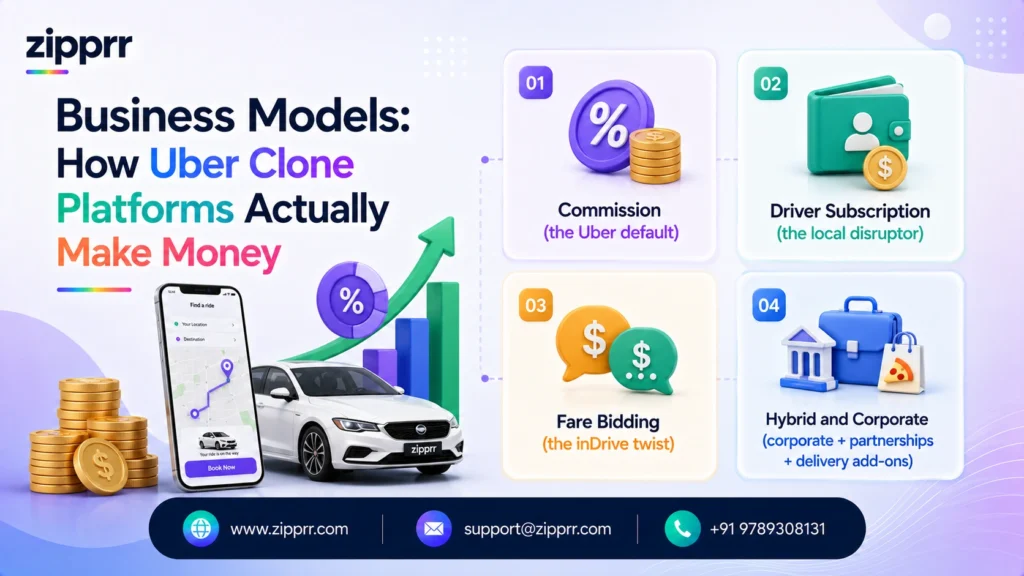
Commission (the Uber default). The platform takes 15 to 30 percent per ride. Simple, and it scales with volume, but drivers feel it. Undercutting incumbent commissions is the classic wedge for new local platforms.
Driver subscription (the local disruptor). Drivers pay a flat weekly or monthly fee and keep 100 percent of fares. Predictable revenue and a magnetic driver pitch. It works best where driver communities are tight and price-sensitive.
Fare bidding (the inDrive twist). Riders propose a fare and drivers counter. It wins in price-sensitive markets but makes revenue harder to forecast. Only some scripts support it, so confirm before buying if this is your angle.
Hybrid and corporate. A base commission plus corporate accounts, airport partnerships, and delivery add-ons (many operators later bolt on an Uber Eats-style delivery module to the same driver network). Corporate contracts are underrated: one hospital or hotel contract can carry a young platform through the cold-start phase.
Expert note: do not copy Uber’s take rate just because Uber charges it. Uber’s roughly 25 to 30 percent effective take funds a global brand you do not have to fund. New platforms winning driver supply in 2026 typically launch at 10 to 15 percent or flat subscriptions, then adjust once liquidity is real.
Real-World Proof: The Localization Playbook Works
None of the following companies are “clones” in the software sense. They are proof that the strategy an Uber clone enables (same model, local execution) repeatedly beats the global incumbent:
- Bolt (Estonia): launched years after Uber with a leaner cost structure and lower commissions; now a dominant player across Europe and Africa.
- inDrive (global): differentiated on a single mechanic, fare negotiation, and expanded to more than 40 countries, largely in markets incumbents underserved.
- Careem (UAE): localized for the Middle East with cash payments, local languages, and cultural fit, then exited to Uber itself for $3.1 billion.
- Ola (India), Grab and Gojek (Southeast Asia): won their home markets on local payment rails, two-wheeler fleets, and super-app breadth before Uber could adapt; Uber ultimately sold its Southeast Asia business to Grab. (If the super-app path interests you, see the Gojek clone multi-service platform.)
The repeatable lessons: pick a market the giant serves badly, win drivers with better economics, localize payments and language, and move faster than a global organization can respond. A white-label platform does not guarantee any of that. It just means you start the race at the starting line instead of twelve months behind it.
Labeled hypothetical: what a first-year city launch can look like
The following scenario is illustrative. It is a composite of typical operator patterns, not a real client case study.
A fleet owner in a city of 800,000 licenses a clone platform in March: $4,000 license plus $6,000 customization and branding plus $150/month infrastructure. He converts his existing 120 taxi drivers in April (they keep their radio dispatch as backup), launches one dense zone covering downtown plus the airport corridor with a 12 percent commission against the incumbent’s 26 percent, and signs two hotels for scheduled airport runs. By month six he is at 400 rides per day; the 12 percent take on roughly $3,200 daily gross yields about $380/day in platform revenue against modest fixed costs, and the software investment is recovered before month eight. Nothing about this scenario is heroic. It is what disciplined, boring execution of the one-zone playbook looks like when supply already exists.
Use Cases: One Stack, Nine Businesses
A modern ride-hailing script is less a “taxi app” than a general-purpose engine for moving people (and things) on demand. The same four-layer stack, differently configured, powers at least nine distinct businesses, and the non-obvious ones often have better economics than city ride-hailing because demand is contracted rather than fought for:
- City ride-hailing: the classic Uber model; hardest competition, biggest ceiling.
- Traditional taxi fleet digitization: existing fleets add app booking alongside street hails; the fastest path to liquidity because supply pre-exists.
- Airport and intercity transfers: scheduled, higher-ticket rides that win on reliability, not price. (See the Via-style shared-ride model for the pooled version.)
- Corporate employee transport: B2B contracts with predictable daily volume; one signed logo can equal thousands of app-acquired riders.
- School transport: parent tracking, fixed routes, and safety features; deeply underserved in most markets.
- NEMT (non-emergency medical transport): clinic and dialysis runs, often insurer- or state-funded; compliance-heavy and competition-light.
- Two- and three-wheeler taxis: moto-taxi and auto-rickshaw markets across Asia, Africa, and Latin America, where four-wheel economics do not work.
- Car rental with driver and chauffeur services: hourly and daily packages layered on the same dispatch core (or a dedicated car-sharing platform if vehicles, not rides, are the product).
- Women-only or accessibility-focused services: trust-segment plays where feature configuration such as driver gender matching and wheelchair vehicle types is the differentiation.
The strategic point: when founders ask “can I compete with Uber?”, the better question is usually “which of these nine games is unclaimed in my market?” In most mid-sized cities, at least three are. You can browse the full range of ready-made clone solutions to see which configuration matches your play.
Uber Clone vs. Custom Build vs. SaaS: The Decision Matrix
The cost table later in this guide shows what you pay. This matrix shows what you should weigh. Score each option 1 to 5 against each criterion for your specific situation, multiply by the weight, and sum. It takes fifteen minutes and has talked more than one founder out of an expensive mistake.
| Criterion (Weight) | Clone Script | Custom Build | SaaS Platform |
|---|---|---|---|
| Speed to market (×3) | 5weeks | 16-12 months | 5days |
| Upfront capital efficiency (×3) | 4 | 1 | 5 |
| Code ownership and exit value (×2) | 4with full license | 5 | 1 |
| Long-run margin, no per-ride tax (×2) | 5 | 5 | 2 |
| Differentiation ceiling (×2) | 3 | 5 | 2 |
| Technical risk carried by you (×2) | 3 | 1 | 5 |
| Vendor independence (×1) | 3 | 5 | 1 |
Run with these default weights and the clone script wins for the typical first-time operator (speed and capital efficiency dominate), SaaS wins for pure demand-testing with zero technical appetite, and custom wins only when differentiation and ownership outweigh a year of burn, which usually means you have already proven the market some other way.
Decision shortcuts: validating a city on a small budget → clone. Testing whether demand exists at all before committing anything → SaaS for a quarter, then migrate to a clone you own (confirm data export first). Sitting on proprietary routing tech or a funded, differentiated thesis → custom. Running an existing fleet → clone, almost without exception; you need software, not invention.
The Unit Economics: An ROI Model You Can Steal
All figures in this section are illustrative estimates for planning. Plug in your own city’s numbers. Nothing here is a revenue promise.
Ride-hailing platform economics reduce to five numbers: rides per day (R), average fare (F), take rate (T), variable platform cost per ride (v), and fixed monthly cost (C). Monthly platform profit ≈ R × 30 × (F × T − v) − C.
A worked example for a modest single-city operation:
| Input | Value (est.) | Notes |
|---|---|---|
| Rides/day (R) | 500 | Achievable in months 6-12 in one zone with real driver supply |
| Average fare (F) | $6.00 | Mid-market city; adjust heavily by geography |
| Take rate (T) | 15% | Undercutting an incumbent at ~25% |
| Variable cost/ride (v) | $0.18 | Maps API, SMS, gateway fees, marginal server cost |
| Fixed costs/month (C) | $6,500 | Two ops staff, support, hosting base, office-lite |
Per-ride platform margin: $6.00 × 0.15 − $0.18 = $0.72. Monthly: 500 × 30 × $0.72 = $10,800 gross, or roughly $4,300/month net after fixed costs. Against a $15,000 all-in software investment, that is payback in about a quarter once volume exists. The entire game is the “once volume exists” clause, which is why the 70/20/10 rule pushes your capital toward driver incentives rather than software gold-plating.
Three sensitivities every operator should model before launch: take rate (moving from 15% to 20% adds $0.30/ride but tests driver loyalty, so model churn, not just margin); fare level (premium segments like airport transfers double F while barely moving v, which is why boring scheduled rides are quietly lucrative); and utilization (fixed costs do not care about your ride count; at 250 rides/day this same model roughly breaks even, so know your break-even ride number to the digit).
Myths, Mistakes, and Field Notes
Five myths worth killing
- “Clone apps are illegal.” The most persistent and most wrong. Business models are not protected IP; original code plus your branding is a lawful product. (Trademark misuse is the actual legal risk, and it is entirely avoidable.)
- “Cheap script = cheap business.” The license fee is maybe 20 percent of your first-year software spend and 5 percent of your first-year total spend. Judging the venture by the script price misunderstands where the money goes.
- “Features win markets.” Riders do not churn because you lack a fancy widget; they churn over pickup times and price. Driver liquidity beats feature parity every single time.
- “I can launch everywhere and see what sticks.” Marketplace density does not average across a map. Ten committed drivers in one zone outperform a hundred scattered across a metro.
- “The vendor’s job ends at delivery, and so does my technical responsibility.” You are buying a codebase, not a service guarantee. Someone on your side must own it: a technical co-founder, a contracted developer, or a maintenance retainer. Decide who before you buy.
Expert tips from the trenches
- Buy the demo drivers dinner. Before choosing a vendor, put five real taxi drivers in front of the driver app for an evening. Their friction points predict your supply churn better than any feature matrix.
- Negotiate support before payment. Ask for 6 to 12 months of support and a written SLA while you still have leverage. After the invoice clears, you are just another ticket in the queue.
- Instrument from day one. If you cannot see median pickup ETA and cancellation rate by zone by week, you are flying on instruments that do not exist. Make dashboard capability a purchase criterion.
- Sign anchor demand early. Two hotels and a hospital produce more reliable early volume than a month of social ads, and drivers stay for reliable volume.
- Keep a war chest for the incumbent’s response. If you take real share, the incumbent will run promos at you. Your 10 percent reserve exists for exactly that quarter.
What an Uber Clone Really Costs: The TCO Nobody Publishes
License price is the number vendors advertise. Total cost of ownership is the number that decides whether you survive. Here is the honest breakdown, with clearly separated verifiable ranges and estimates.
The build paths compared
| Path | Upfront Software Cost | Time to Launch | Source Code | Support | Best For |
|---|---|---|---|---|---|
| Open-source clone repo | ~$0 | 3-6 months of hardening | Yes | None | Prototypes, developer learning |
| Zipprr Uber Clone | $490, one-time purchase only | 2-8 weeks | Yes (open source code) | 90 days free support | First launches, fleets, agencies |
| Other ready-made scripts | $950-$20,000 | 2-8 weeks | Usually yes | 3-12 months (varies) | Vendor comparison shoppers |
| SaaS ride-hailing platform | $0 upfront; per-ride/monthly fees | Days | No | Subscription-based | Testing demand with zero capex |
| Custom development | $40,000-$250,000+ | 6-12+ months | Yes | Contract-based | Proven scale, unique requirements |
Two structural warnings from experience. First, Maps API costs grow with success: every fare estimate and every live-tracking session bills against your key, so ask vendors what map-cost optimizations (caching, batched calls, alternative providers) they have implemented. Second, the support cliff is real. The standard 90-day window expires precisely when your real feature requests begin, so negotiate year-one support before you pay, when your leverage is highest. Transparent vendors make this budgeting exercise dramatically easier: Zipprr publishes its $490 one-time price and 90-day support terms directly on the product page rather than hiding them behind quote forms.
First-year TCO for a clone launch (estimates: plan first, then verify locally)
| Item | Typical Range (est.) | Notes |
|---|---|---|
| Script license | $490 (Zipprr, one-time) up to $20,000 (market range) | One-time; confirm what "source code included" means |
| Customization and branding | $2,000-$15,000 | Logo, colors, feature tweaks, local gateways (see customizing your taxi app source code) |
| Cloud hosting | $600-$5,000/yr | Scales with ride volume |
| Google Maps APIs | $1,200-$12,000/yr | Usage-based; the most underestimated line item |
| SMS/OTP + push | $300-$3,000/yr | Volume-based |
| Payment gateway fees | ~2-3.5% of processed volume | Stripe/PayPal/regional rails |
| App store accounts | ~$124/yr | Apple $99/yr + Google $25 once |
| Post-support maintenance | $2,000-$10,000/yr | After the free window (often 90 days) |
| Legal, licensing, insurance | Highly jurisdiction-specific | Budget it; competitors won't tell you to |
Two structural warnings from experience. First, Maps API costs grow with success: every fare estimate and every live-tracking session bills against your key, so ask vendors what map-cost optimizations (caching, batched calls, alternative providers) they have implemented. Second, the support cliff is real. The standard 90-day window expires precisely when your real feature requests begin, so negotiate year-one support before you pay, when your leverage is highest. Transparent vendors make this budgeting exercise dramatically easier: Zipprr publishes its $490 one-time price and 90-day support terms directly on the product page rather than hiding them behind quote forms.
The 70/20/10 launch-budget rule
My allocation rule for first-year capital: 70 percent to market operations (driver incentives, rider promos, local marketing), 20 percent to software (license, customization, infrastructure), and 10 percent in reserve. If your plan spends 70 percent on software, you have bought a beautiful platform for a marketplace that does not exist. The budget is the strategy.
Benefits and Limitations: The Honest Ledger
Where clone scripts genuinely win
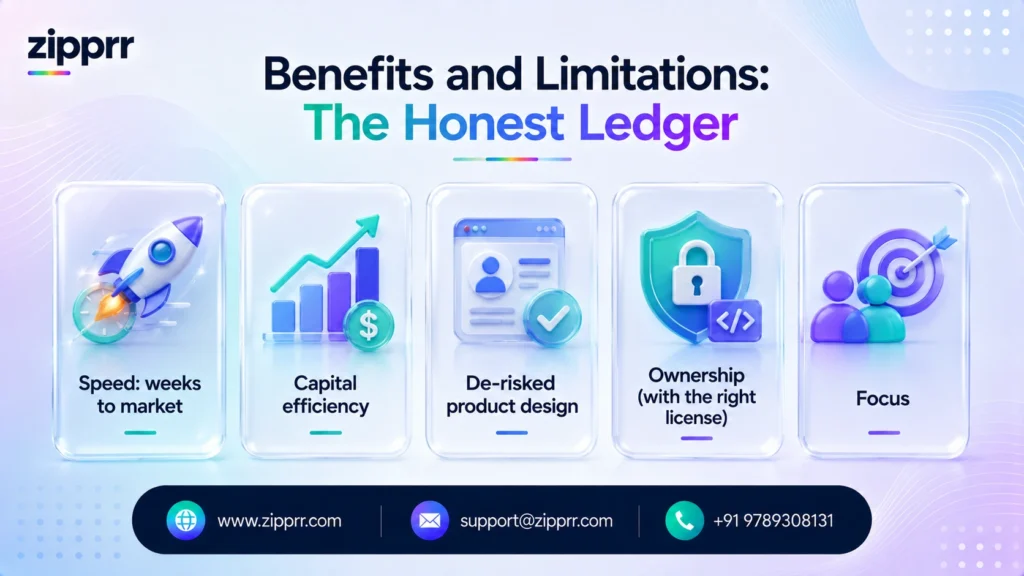
- Speed: weeks to market; first-mover advantage in unclaimed cities is still winnable in 2026.
- Capital efficiency: 10 to 20 times cheaper than custom; capital flows to growth instead of engineering.
- De-risked product design: you inherit a UX pattern billions of riders already know, at zero user-education cost.
- Ownership (with the right license): source code plus self-hosting means no per-ride tax, no platform lock-in, and a saleable asset.
- Focus: your scarce founder attention goes to drivers, riders, and regulators, the things only you can do.
Where they genuinely don’t (read this twice)
- Code quality variance is enormous. The same $5,000 buys production-grade architecture from one vendor and a demo-ware time bomb from another. Due diligence is not optional.
- Differentiation ceiling. Your features are your competitors’ features. Real differentiation must come from operations, pricing, and service segments; the software will not hand it to you.
- Customization debt. Heavy modifications to unfamiliar code can eventually cost more than a clean build. If your roadmap diverges wildly from ride-hailing norms, a clone is the wrong chassis.
- Vendor dependency during year one. Until your team knows the codebase, you depend on vendor responsiveness. Reference-check it like you would reference-check a co-founder.
- Scale re-platforming risk. Some platforms hit architectural walls at high concurrency. If you win big, budget for hardening or partial rewrites around year two or three. A good problem, but a real one.
When NOT to buy a clone: you have a genuinely novel mobility mechanic the scripts cannot express; you are a funded team whose moat is proprietary tech; or you are operating at a scale where per-ride infrastructure efficiency is the margin story. Everyone else: the clone math usually wins.
Choosing a Vendor: The RIDES Framework and the Buyer's Checklist
After watching too many founders buy on feature-list length, I use a five-letter framework, RIDES, to force the evaluation that matters:
- R – Rights. Full source code? Modification, resale, and multi-instance rights? License terms in writing, reviewed before payment.
- I – Infrastructure. Load-test evidence, live deployments at real volume, clean API architecture, self-hosting supported.
- D – Demos. All four layers demoed live: rider, driver, admin, and an actual end-to-end ride on real devices, not a video.
- E – Extensibility. Local payment gateways, language and currency support, documented APIs, and a roadmap that matches your 3-year plan (delivery? corporate? bidding?).
- S – Support. A response-time SLA in writing, post-window pricing, and two reference clients you personally call.
The 20-point pre-purchase checklist
Legal and license: ☐ full source included ☐ license permits modification ☐ trademark-clean branding assets ☐ data ownership stated ☐ refund terms.
Product: ☐ end-to-end test ride completed ☐ admin panel configures fares/zones without code ☐ cash + card + at least one local gateway ☐ driver KYC workflow ☐ SOS + trip sharing.
Technical: ☐ your developer reviewed the code (2 hours minimum) ☐ load-test report seen ☐ documented deployment process ☐ update policy for OS/API changes ☐ database and API docs exist.
Vendor: ☐ two reference clients called ☐ support SLA in writing ☐ year-one support priced ☐ roadmap shared ☐ company age and team size verified.
Anything unchecked is either a negotiation point or a warning. Fifteen minutes with this list, ideally with a live demo open (Zipprr will happily arrange one from its Uber Clone page), filters out 80 percent of bad purchases before money moves.
The 90-Day Implementation Roadmap
Assumes a purchased script, one launch city, and a supply-first strategy.
Days 1-15: Foundation. Sign the license after RIDES diligence; register app-store accounts (start the Apple review lead time immediately); set up cloud hosting, domains, and Maps/SMS/payment keys; deliver branding assets to the vendor; and begin operator-license and insurance paperwork, which is the longest pole in many jurisdictions, so start it on day one.
Days 16-40: Configuration and supply groundwork. Configure zones, fares, commissions, and cancellation rules; integrate the local payment gateway; run internal QA with 50+ test rides across devices and network conditions. Meanwhile, and this is the part most founders sequence wrong, start driver recruitment now: fleet-owner meetings, driver WhatsApp/Telegram groups, and signup pre-registration with a launch bonus.
Days 41-60: Soft launch. Apps live in stores (unadvertised); onboard your first 50 to 150 drivers in one dense zone. Remember the One-Zone Rule: it is better to own 10 square kilometers than to be invisible across 100. Run a staff-and-friends ride program daily, fix the top-ten issue list weekly, and sign 2 to 3 corporate or hotel anchor accounts for baseline demand.
Days 61-90: Public launch. Hyperlocal marketing only (the zone, not the city); a rider promo plus a driver earnings guarantee for weeks 1 to 4; publish pickup-time stats once you can beat incumbents in your zone; and instrument the dashboard: rides/day, median pickup ETA, cancellation rate, driver utilization, CAC. Expand to zone two only when zone one holds sub-7-minute pickups at target utilization.
Mistakes that kill launches (seen repeatedly): launching city-wide on day one; recruiting riders before drivers; skipping regulatory paperwork until app-store approval “makes it real”; spending the marketing budget in month one instead of metering it against liquidity; and treating the 90-day vendor support window as a reason to delay hiring or contracting your own technical capability.
Future-Proofing: Where Ride-Hailing Software Goes Next
Buying software is betting on a roadmap, so weight these 2026-and-beyond currents in your vendor choice:
- AI moves from buzzword to baseline. Demand-predictive dispatch, AI-assisted ETA models, fraud scoring on both sides of the marketplace, and support automation are appearing in serious scripts now. Ask vendors what has shipped versus what is slideware.
- Super-app gravity. Ride-hailing is becoming the anchor tenant for delivery, parcels, and rentals (the Grab/Gojek pattern). A platform with multi-service architecture buys you options you will probably want by year two.
- EV and fleet electrification. Charging-aware dispatch and EV-specific fleet management are emerging differentiators, especially where regulation pushes electrification.
- Autonomy is real but not your problem yet. Robotaxis are scaling in a handful of wealthy metros; the capital requirements keep them out of the mid-market cities where clone-based operators thrive. Your five-year window is human-driver economics, with a data asset that makes you interesting to whoever consolidates later.
- Regulatory tightening. Driver-classification rules, data-localization laws, and safety mandates keep rising. Software with per-jurisdiction configurability (documents, taxes, data residency) converts regulation from threat to moat. Incumbents carry the heaviest compliance burdens, and local operators who comply fast win tenders.
Launch Your Ride-Hailing Business for $490, Not $250,000
Is an Uber clone legal?
How much does an Uber clone cost in 2026?
How fast can I actually launch?
Do I own the code?
Will app stores approve it?
Can it scale if my city takes off?
Where should I start evaluating?
The Bottom Line
The ride-hailing opportunity in 2026 is not in out-building Uber. It is in out-serving Uber in the thousands of markets where a global company cannot or will not win: your city, your fleet, your niche, your language, your price point. The market data supports it ($55B growing at roughly 19 percent annually), the precedents prove it (Bolt, inDrive, Careem, Ola, Grab), and the economics finally favor it, because white-label platforms have collapsed the cost of entry from a quarter-million dollars to less than the price of a used phone in Zipprr’s case.
The software is the cheap, solved part. What decides your outcome is what this guide kept returning to: pick one dense zone, win drivers with better economics, comply fast, meter your capital with the 70/20/10 rule, and buy your platform with RIDES-level diligence instead of feature-list envy.
If you are at the evaluation stage, do the single highest-leverage thing a buyer can do: get your hands on a live platform and pressure-test it against the checklists above. Explore the Zipprr Uber Clone ($490 one-time, open source code, 90 days free support), browse the wider catalog of clone solutions, and hold every other vendor to the same standard. Your city is waiting for a better ride. Someone is going to build it. The only question this guide cannot answer is whether it will be you.