

Every entrepreneur who has sat in the back of a ride-hailing car has probably thought the same thing: the technology is not magic, so why can’t I build something like this for my city? The instinct is sound. The hard part of ride-hailing was never a single clever idea. It was the years of engineering, the payment plumbing, the dispatch logic, and the operational discipline required to match a rider to a driver in seconds, reliably, thousands of times a day.
An Uber clone collapses much of that upfront engineering into a ready-made foundation. Instead of writing dispatch algorithms and payment integrations from a blank page, you start with a working marketplace and shape it around your market, your pricing, and your rules. A solution like the Zipprr Uber Clone gives you that head start, so this guide can focus on the marketplace strategy: not just what an Uber clone is, but how to run it as a two-sided business you can actually grow.
Whether you are targeting a mid-sized city underserved by global players, a niche such as premium airport transfers, or an entirely different vertical, such as courier delivery, the mechanics are similar. Read this as a founder’s field guide, not a brochure.
What is an Uber Clone?
An Uber clone is a pre-built, customizable software solution that replicates the core functionality of a modern ride-hailing platform, including the rider app, the driver app, and the admin dashboard, so a business can launch its own on-demand transportation marketplace without engineering every component from scratch.
It is best understood as a starting foundation, not a finished product. The clone supplies the connective tissue every ride-hailing business needs: user registration and authentication, real-time GPS tracking, ride matching and dispatch, fare calculation, in-app payments, ratings, and reporting. You then customize the branding, pricing rules, service types, and geography to fit your market. The Zipprr Uber Clone follows exactly this blueprint, shipping the essentials so your team can concentrate on positioning and operations.
The word “clone” refers to the functional pattern, not the copying of any company’s proprietary code, trademarks, or brand. A well-built solution is original software that follows a proven marketplace blueprint, much like countless online stores that follow the pattern popularized by early e-commerce leaders without being copies of them.
Uber clone vs. custom build vs. white-label
- Custom build: everything engineered from scratch. Maximum control, highest cost, longest timeline.
- Uber clone script: a source-code package you buy once, customize, and own. Balanced control and speed.
- White-label or SaaS platform: a hosted product you rebrand and rent monthly. Fastest launch, least control over the codebase.
Why Businesses Need an Uber Clone
The on-demand economy trained consumers to expect a service at the tap of a button, tracked in real time, paid without cash, and rated afterward. That expectation now extends far beyond rides, reaching groceries, home services, logistics, and healthcare transport. Businesses that cannot meet it lose relevance.
For most companies, building that experience from scratch is neither affordable nor fast. An Uber clone matters because it converts a multi-year engineering program into a launch you can plan in weeks or months, at a fraction of the capital. That difference is often the line between testing a market idea and never testing it at all.
- Speed to market: validate demand before a competitor claims your city or niche.
- Lower upfront cost: redirect capital from core engineering to marketing, driver acquisition, and operations, which are the things that actually win a two-sided market.
- Proven architecture: dispatch, payments, and tracking are already solved and battle-tested.
- Focus on differentiation: spend your energy on positioning, service quality, and unit economics rather than reinventing plumbing.
Common Business Challenges in On-Demand Mobility
Launching a ride-hailing marketplace is deceptively hard. The app is the visible part; the real difficulty is the business underneath it. Founders repeatedly run into the same obstacles.
- The cold-start problem: riders won’t come without drivers, and drivers won’t stay without riders. Balancing both sides of the marketplace from day one is the central challenge.
- High development cost and time: a bespoke platform can consume enormous budgets and a year or more before the first ride.
- Real-time reliability: matching, tracking, and pricing must work in seconds, every time, or trust collapses.
- Payment complexity: handling cards, wallets, split fares, driver payouts, refunds, and multiple currencies is intricate and regulated.
- Trust and safety: both riders and drivers need identity verification, emergency tools, and transparent ratings.
- Regulatory compliance: local licensing, insurance, driver-background rules, and data-protection laws vary by region.
- Scaling operations: surge periods, support tickets, disputes, and fraud all grow faster than headcount.
How an Uber Clone Solves Those Challenges
A capable Uber clone addresses each of these pain points directly, which is why the model has endured.
- Cold-start: built-in referral, promo-code, and incentive tools let you seed both sides of the market and reward early drivers and riders.
- Cost and time: the ready foundation removes most core engineering, so capital flows to growth instead of infrastructure.
- Reliability: mature dispatch algorithms, map integrations, and websocket-based real-time updates come pre-engineered and tested at load.
- Payments: integrations with payment gateways, in-app wallets, and automated driver payouts handle the money flow securely.
- Trust and safety: document verification, SOS and emergency buttons, trip sharing, and two-way ratings are standard.
- Compliance: configurable rules, geofencing, and data controls help you adapt to local regulation without re-architecting.
- Scaling: cloud-native, often microservices-based architecture lets you scale specific services independently as demand grows.
Core Features of an Uber Clone
A complete solution ships as three connected apps plus supporting infrastructure. Here are the features that matter, grouped by who uses them.
For Riders
- Quick sign-up via phone, email, or social login with OTP verification
- Real-time driver tracking on an interactive map
- Multiple ride types such as economy, premium, XL, and pool
- Upfront fare estimates and transparent pricing
- Multiple payment options: cards, wallets, cash, and in-app balance
- Scheduled and on-demand bookings
- Saved locations, ride history, and digital receipts
- Ratings, reviews, and tipping
- SOS button, trip sharing, and a safety toolkit
- Push notifications and in-app support chat
For Drivers
- Onboarding with document and vehicle verification
- Online and offline availability toggle
- Ride requests with accept or decline and turn-by-turn navigation
- Earnings dashboard, trip log, and instant or scheduled payouts
- Heat maps and demand indicators to reduce idle time
- In-app navigation and route optimization
- Ratings feedback and performance insights
For Administrators
- Central control of riders, drivers, and vehicles
- Live trip monitoring and dispatch oversight
- Dynamic and surge pricing configuration
- Commission, promo, and payout management
- Geofencing and service-area controls
- Analytics, reporting, and business intelligence
- Dispute resolution and support tooling
- Content, notification, and role-based access management
Technical foundations
Under the hood, a modern Uber clone typically relies on real-time GPS and mapping through a maps API, websocket-driven live updates, REST APIs and webhooks for integrations, a payment gateway, push-notification services, cloud hosting, and increasingly a microservices architecture so pricing, matching, and payments can scale independently. Machine learning may power demand prediction, fraud detection, and ETA accuracy.
Benefits of Building on an Uber Clone
Choosing a ready-made foundation such as the Zipprr Uber Clone changes both your economics and your speed. The advantages compound over time.
- Faster launch: reach the market in a fraction of the time of a ground-up build.
- Predictable cost: a known starting price instead of an open-ended engineering budget.
- Ownership: with a source-code license, the platform and its data are yours to extend.
- Scalability: cloud and microservices foundations grow with demand.
- Customization: branding, pricing, service types, and workflows adapt to your model.
- Focus: your team concentrates on growth and operations, not infrastructure.
- Proven experience: riders and drivers already understand the interaction pattern, which lowers adoption friction.
Industry Applications
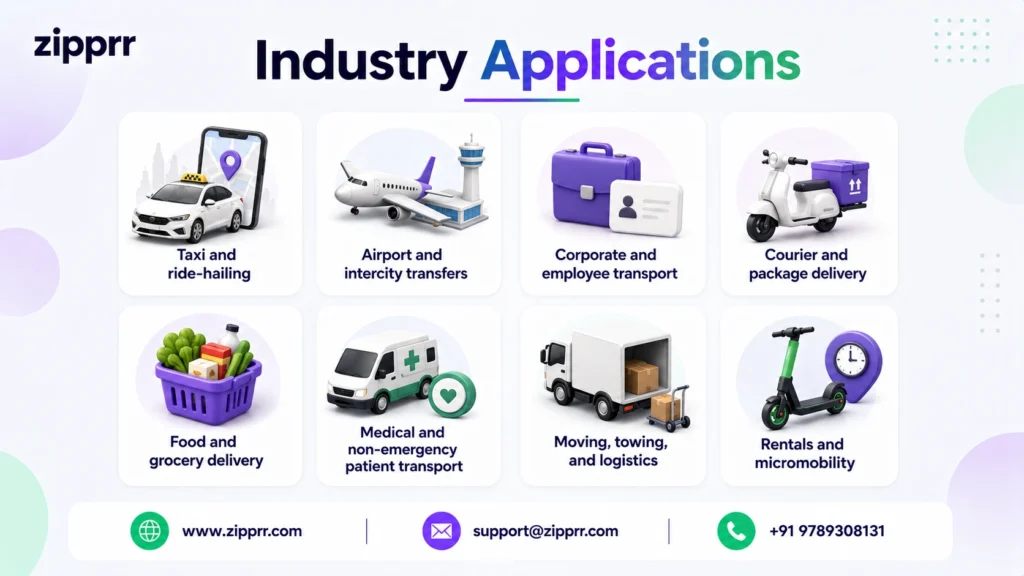
The ride-hailing pattern generalizes to almost any on-demand, location-based service. The same clone foundation, reconfigured, powers many verticals.
- Taxi and ride-hailing: the classic city mobility use case.
- Airport and intercity transfers: scheduled, premium point-to-point rides.
- Corporate and employee transport: managed fleets with billing to companies.
- Courier and package delivery: the same dispatch logic, different cargo.
- Food and grocery delivery: multi-stop routing and merchant integration.
- Medical and non-emergency patient transport: compliance-heavy, high-trust rides.
- Moving, towing, and logistics: heavy-vehicle, on-demand dispatch.
- Rentals and micromobility: bikes, scooters, and hourly vehicles.
Real-World Use Cases
The regional challenger. A founder in a mid-sized city where global apps have thin coverage launches a locally branded service, recruits drivers with lower commissions, and wins loyalty through faster pickups and local support.
The niche premium operator. A limousine company adds an app for pre-booked executive and airport transfers, using scheduling and fixed pricing rather than surge, and differentiates on vehicle quality and reliability.
The vertical pivot. A logistics startup repurposes the dispatch engine for same-day courier delivery, matching parcels to nearby drivers with the same real-time tracking riders expect.
The corporate mobility provider. A B2B operator offers companies a managed transport program with centralized billing, ride policies, and reporting, using the admin dashboard to control cost centers
Implementation Guide: Launching Step by Step
- Validate the market. Confirm real demand, a viable driver pool, and a wedge the incumbents don’t serve well.
- Define the model. Decide commission rates, pricing logic, service types, and geography.
- Choose the solution. Compare clone scripts, white-label platforms, and custom builds against your budget, timeline, and control needs.
- Verify quality. Review the codebase, architecture, security posture, documentation, and support terms before buying.
- Customize and brand. Apply your identity, configure pricing and rules, and adjust workflows.
- Integrate services. Connect maps, the payment gateway, SMS and OTP, and notification providers.
- Test rigorously. Run functional, load, security, and real-world field tests with pilot drivers and riders.
- Handle compliance. Secure local licensing, insurance, and data-protection requirements.
- Seed the marketplace. Recruit and incentivize drivers first, then acquire riders with promotions.
- Launch, measure, iterate. Monitor supply and demand balance, unit economics, and retention, then refine continuously.
Best Practices
- Solve one side first. Concentrate liquidity in a small area or niche before expanding. Density beats breadth early on.
- Protect unit economics. Know your cost per ride and contribution margin before scaling spend.
- Invest in trust and safety. Verification, insurance, and responsive support are not optional extras.
- Keep pricing transparent. Surprise fees are the fastest way to lose both riders and drivers.
- Own your data. Prefer a source-code license so analytics and future features stay in your hands.
- Design for scale from day one. Cloud infrastructure and modular services prevent painful rewrites later.
- Treat drivers as customers. Fair payouts, fast support, and demand visibility keep supply loyal.
- Localize. Language, payment methods, and regulations differ by market, so adapt rather than copy-paste.
Comparison Table: Ways to Launch a Ride-Hailing App
| Factor | Uber Clone Script | White-Label SaaS | Custom Build |
|---|---|---|---|
| Time to launch | Weeks to a few months | Days to weeks | Many months to over a year |
| Upfront cost | Moderate, one-time | Low, recurring subscription | Very high |
| Code ownership | Yes, with a source license | No | Yes |
| Customization | High | Limited | Unlimited |
| Maintenance | Your team or vendor | Vendor-managed | Your team |
| Scalability | High | Depends on vendor | High |
| Best for | Founders wanting speed and control | Fast, low-risk validation | Well-funded, unique models |
Pricing Considerations
Cost varies widely with the delivery model, feature depth, platform coverage across iOS, Android, and web, and the level of customization. Think in terms of total cost of ownership, not just the sticker price:
- License or subscription: a one-time script purchase versus recurring SaaS fees.
- Customization and branding: design, feature changes, and integrations.
- Third-party services: maps, SMS and OTP, the payment gateway, and push notifications carry usage-based costs.
- Hosting and infrastructure: cloud servers scale with ride volume.
- Maintenance and support: updates, bug fixes, and new features over time.
- Compliance: licensing, insurance, and legal counsel per market.
Future Trends in On-Demand Mobility
- AI-driven operations: smarter demand prediction, dynamic pricing, ETA accuracy, and fraud detection.
- Electric and sustainable fleets: EV incentives and green-ride options as differentiators.
- Multimodal super-apps: combining rides, delivery, and micromobility in one platform.
- Autonomous readiness: architectures that can integrate self-driving supply over time.
- Deeper personalization: loyalty, subscriptions, and tailored offers driven by analytics.
- Embedded finance: driver wallets, instant payouts, and in-app financial services.
Ready to Launch Your Ride-Hailing Marketplace?
If you are ready to put your idea on the road, the Zipprr team can show you exactly how the platform works, walk you through pricing and customization, and answer your questions in real time. Message Zipprr on WhatsApp for a quick conversation, or schedule a free demo to see the ride-hailing marketplace in action before you commit.
Frequently Asked Questions
What is an Uber clone?
Is building an Uber clone legal?
How is an Uber clone different from a custom build?
How long does it take to launch?
How much does an Uber clone cost?
Do I own the source code?
Which platforms are supported?
Can I customize the branding and features?
What payment methods can it support?
Can I use it for something other than taxis?
Key Takeaways
- An Uber clone is a customizable foundation for launching an on-demand ride-hailing marketplace quickly and affordably.
- The hard part is the two-sided business. Solving the cold-start problem and unit economics matters more than the app itself.
- Core value comes from three connected apps for riders, drivers, and administrators, backed by real-time dispatch and secure payments.
- The pattern generalizes far beyond taxis into delivery, medical transport, logistics, and more.
- Choose between a clone script, white-label SaaS, or custom build based on your budget, timeline, and need for control and ownership.
- Success depends on liquidity density, trust and safety, transparent pricing, and disciplined operations.
Conclusion
An Uber clone is not a shortcut to a business; it is a shortcut past the parts of the business that were never your advantage. The dispatch engine, the payment plumbing, the live map, these are solved problems, and rebuilding them rarely differentiates you. What differentiates you is the market you choose, the drivers you keep happy, the riders you delight, and the unit economics you protect.
Approach it as a marketplace operator, not a software buyer. Start dense, seed supply first, measure relentlessly, and expand only when the numbers work. Used that way, a ride-hailing clone turns an ambitious idea into something you can actually put on the road, often in the time it would take just to write the specification for a custom build.