

Every city has the same structural problem buried inside its local economy.
A homeowner needs her roof inspected before winter. She has no way of knowing whether $800 is a fair quote or an opportunistic one. She has no mechanism for comparing licensed professionals side by side. So she either pays whatever the first person quotes, asks a neighbour who might recommend someone useless, or puts it off until it becomes expensive.
Three suburbs away, a licensed roofer has a gap in his schedule and would bid $650 for the same job. He has no way of knowing she exists.
Both parties lose. The gap between them — a gap made entirely of missing information — is where a ServiceSeeking clone earns its income.
The platform does one thing at its core: it solves an information problem that neither side can solve alone. The homeowner cannot find all the qualified roofers in her area and get them to compete. The roofer cannot find every homeowner within ten kilometres who needs roof work this week. The platform holds both sides of that equation simultaneously — and takes a percentage of every transaction where it produces the connection.
That is the business. Allied Market Research measured the global household services economy at $657 billion in 2023 and projects it will approach $1.1 trillion before this decade closes. In most cities outside Australia, the United States, and the United Kingdom, no platform is currently solving this information problem at any meaningful scale. The entrepreneur who builds one is not entering a competitive race. They are starting one.
What Is ServiceSeeking Clone?
The original ServiceSeeking demonstrated in the Australian market that the quoting model is not merely preferable to the old way of hiring — it is categorically different. Posting once and receiving competing bids is not a faster version of calling three plumbers. It is a different type of commercial interaction entirely, one where the homeowner holds negotiating power and information she has never held before.
Zipprr’s ServiceSeeking clone packages that commercial interaction — not the brand, not the code, not a pixel of the original design — into a fully owned platform you take to your chosen city and run as your own business.
The Economic Logic That Makes This Model Durable
Information Asymmetry Creates the Opportunity
Every inefficient market is inefficient because one party knows something the other does not. In local services hiring, tradespeople know their own availability, qualifications, and pricing — but do not know where the customers are. Homeowners know their problem and budget — but do not know what fair market pricing looks like or who the qualified options are. Both parties are flying partially blind.
A marketplace resolves this asymmetry. The homeowner’s job description is the signal that reaches every qualified professional in the area simultaneously. The professional’s credentials and track record are the signals that give the homeowner a rational basis for choosing. The platform is the infrastructure that makes both signals visible to the party who could not otherwise receive them.
Markets built on resolving genuine information asymmetry tend to be sticky. Once both sides experience the clarity the platform provides, returning to the old way feels needlessly difficult.
The Revenue Model Has No Customer-Side Barrier
The Category Is Unclaimed in Most of the World
Thumbtack operates in the United States. Bark.com has coverage in the United Kingdom. ServiceSeeking has built its audience in Australia. Step outside those three markets and ask which platform currently connects homeowners with local tradespeople through a job-posting and competitive-quoting mechanism in most cities across Southeast Asia, the Gulf region, Eastern Europe, Latin America, or Sub-Saharan Africa.
The honest answer, in most of those cities, is that no such platform exists in any meaningful form. The category is open. The first operator to build a functional, well-stocked platform in a given city does not need to defeat a competitor — they simply need to supply something that currently does not exist.
How the Business Earns: Five Income Mechanisms
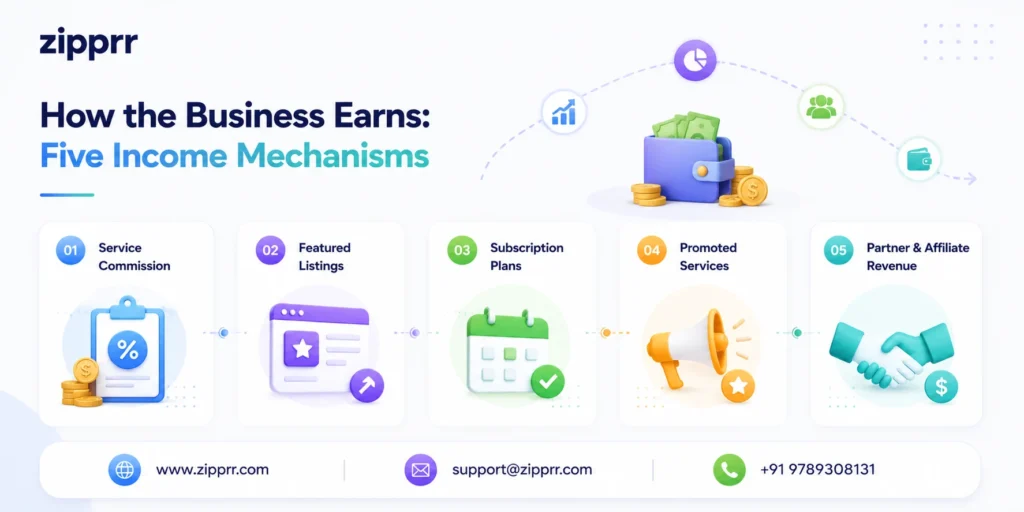
Mechanism One — Bid Credits
When a tradesperson decides a posted job is worth pursuing, they spend a credit from their account to submit a quote. The credit price is set by the operator per service category, calibrated to the typical value of winning a job in that category. An HVAC installation lead costs more to bid on than a furniture assembly lead because the job it produces is worth more. This proportionality is what keeps the commercial logic fair across all service types.
The mechanism is entirely voluntary at the individual job level. A tradesperson who receives a notification about a job too far from their base simply ignores it. A credit is only spent when the professional makes a deliberate decision that the specific opportunity justifies the cost. This selectivity is the reason experienced tradespeople engage with the model more readily than with broadcast advertising, where money leaves the account regardless of whether a relevant customer ever sees the ad.
Mechanism Two — Monthly Subscription Plans
| Plan | Bids Per Month | Search Position | Analytics | Monthly Fee |
|---|---|---|---|---|
| Starter | 5 | Standard listing | Basic summary | $29 – $49 |
| Professional | 15 | Featured placement | Full dashboard | $79 – $119 |
| Premium | Unlimited | Priority ranking | AI insights + export | $149 – $249 |
Mechanism Three — Search Placement Fees
Mechanism Four — Credential Verification Fees
Mechanism Five — Transaction Commission
The Platform Mechanics
What the Homeowner Experiences
She opens the app, selects her service category, and works through a brief guided flow — problem description, property location, photos if useful, preferred timing, rough budget. Three minutes at most. Her job goes live. Bids arrive. Each one shows the tradesperson’s photo, overall rating drawn from previous customer reviews, total number of completed jobs, the proposed fee, how quickly they responded after the job posted, and a short note explaining their approach and availability.
She compares. She messages the two she prefers directly through the app if she has questions. She hires with one tap. Payment clears through the platform. A confirmation lands in her inbox. After the job is finished she rates the experience. Six months from now, when she needs the same tradesperson back, she opens her booking history and rehires with one tap.
What the Tradesperson Experiences
He sets his service categories and geographic coverage radius. The moment a matching job appears, his phone receives a notification — category, rough budget, distance. He decides in ten seconds whether to bid. If he does, he spends a credit and submits a quote. His profile — built across months of completed jobs and accumulated reviews — handles most of the persuasion. His analytics dashboard shows him which job types he wins at highest frequency, what his average booking value is doing over rolling periods, and how his response speed compares to others working in the same category.
The platform shifts from being a source of occasional work to being a business intelligence tool he relies on daily.
What the Operator Manages
From the admin panel: lead credit pricing by category. Subscription tier contents and monthly costs. Commission rates by service type. Featured placement pricing. Promotional campaigns. Provider application reviews. Credential document queue. Dispute resolution. Real-time activity and revenue data. Multi-language and multi-currency configuration for different markets.
The Zipprr ServiceSeeking clone is designed so a non-technical operator can manage every one of these functions independently, without engineering involvement.
Key Platform Capabilities
Guided Job Brief Collection A homeowner who types a single vague sentence produces a job description no tradesperson can accurately price. A multi-step guided flow — category, sub-type, location, photos, timing, budget band — produces a structured brief that professionals can quote against with confidence. Accurate quotes produce faster hiring decisions. Faster decisions produce more completed bookings per week. More bookings produce more commission.
Parallel Bid Comparison Layout When multiple bids arrive, a structured comparison interface presents every incoming quote in identical format — price, rating, review count, response time, and the tradesperson’s personal message — simultaneously visible. Decisions that previously took days of back-and-forth now take an afternoon.
Four-Tier Credential Badge Architecture A single verification label carries almost no information value. A four-tier system where each badge represents a distinct independently-confirmed credential — identity confirmed, trade licence authenticated, insurance certificate validated, background screening cleared — gives homeowners something genuinely useful: a hierarchy of trustworthiness they can sort and filter by. Fully-badged tradespeople earn measurably more bookings from customers who filter by credential depth.
Protected Communication Layer All messages between homeowners and tradespeople route through the platform’s own messaging infrastructure. When a dispute arises over what was agreed, promised, or delivered, the complete conversation record is available for admin review. Neither party can later dispute what the platform’s own record shows.
Milestone Payment Architecture High-value jobs — renovations, full room repaints, landscaping projects — involve amounts of money that make both parties anxious about trust. The platform holds the agreed total in a secured position at booking confirmation. Neither the homeowner nor the tradesperson can access it independently. It releases to the tradesperson in portions as the homeowner confirms each defined stage of work through the app. For the operator, this mechanism unlocks the high-value booking category that would otherwise be handled outside the platform entirely.
Instant Geofenced Job Notification The notification that fires to relevant tradespeople within seconds of a matching job posting — including service category, approximate budget, and distance to the property — is the infrastructure that makes rapid response structurally possible. Early responders consistently win more bids. The platform gives every qualified tradesperson in the area the same structural opportunity to be early.
Business Performance Analytics Win rate by service sub-category. Earnings trend over rolling 90-day periods. Average booking value. Response latency relative to category peers. AI-driven recommendations identifying which categories currently generate the best return per credit spent. Tradespeople who use this data make better commercial decisions. Tradespeople who make better commercial decisions stay on the platform longer and spend more.
Live Operations Dashboard Active job volume. Daily bids submitted. Bookings completed this month. Gross revenue by date range. New registrations by account type. Open disputes. Geographic activity distribution. The single screen that tells the operator whether the business is growing, steady, or needs a specific response — without any secondary tool.
Technology Architecture
Application Layer Customer and tradesperson mobile apps: React Native or Flutter, generating iOS and Android apps from a single shared codebase. Customer web portal: Next.js, which server-renders each service category page so that search engines index them from the first day the platform operates — building organic search presence automatically as categories and cities expand. Admin panel: React.js, with permission tiers separating super admin, regional admin, and support agent access.
Backend and Real-Time Layer Node.js with Express for the API — an event-driven architecture that handles simultaneous notification delivery to large numbers of providers without latency degradation. Laravel is the alternative framework for teams preferring PHP. Real-time elements — job notification delivery, live messaging, booking status updates — run on Socket.io or Firebase, both capable of sub-second push latency.
Data Architecture PostgreSQL for all relational records: accounts, jobs, bids, payments, reviews, credentials. Redis for caching and session management, maintaining response speed under concurrent load. Elasticsearch for job and provider search, enabling fast filtering across category, location, rating, and credential status.
Third-Party Service Layer
| Function | Technology |
|---|---|
| Cloud hosting | AWS or Google Cloud |
| Payment processing | Stripe or PayPal |
| Geolocation and mapping | Google Maps API |
| Push notification delivery | Firebase Cloud Messaging |
| SMS communications | Twilio |
| Credential screening | Checkr or Certn |
| Transactional email | SendGrid |
| Customer support | Intercom |
Build Options
| Factor | Script Launch | Script Plus Custom | Full Bespoke |
|---|---|---|---|
| Weeks to first booking | 2 – 4 | 6 – 10 | 36 – 72+ |
| Upfront capital needed | $3K – $9K | $10K – $25K | $40K – $120K+ |
| Code ownership | Full | Full | Full |
| Production-tested codebase | Yes | Yes + additions | No, first release |
| Customisation depth | Brand + config | Extensive | Unlimited |
| First revenue possible | Week one | Within weeks | Month 12 – 18 |
| Ongoing maintenance | Zipprr support | Zipprr support | Own engineering |
A script launch is not a budget version of the ideal. It is the right tool for answering one specific question: does this market, in this city, respond to this model? Answering that question costs $3,000 to $9,000 and six weeks. Getting it wrong in an 18-month custom build costs $120,000 and 18 months. The sequencing matters more than the ambition.
Full specifications for all package tiers are on the ServiceSeeking clone page.
Service Categories
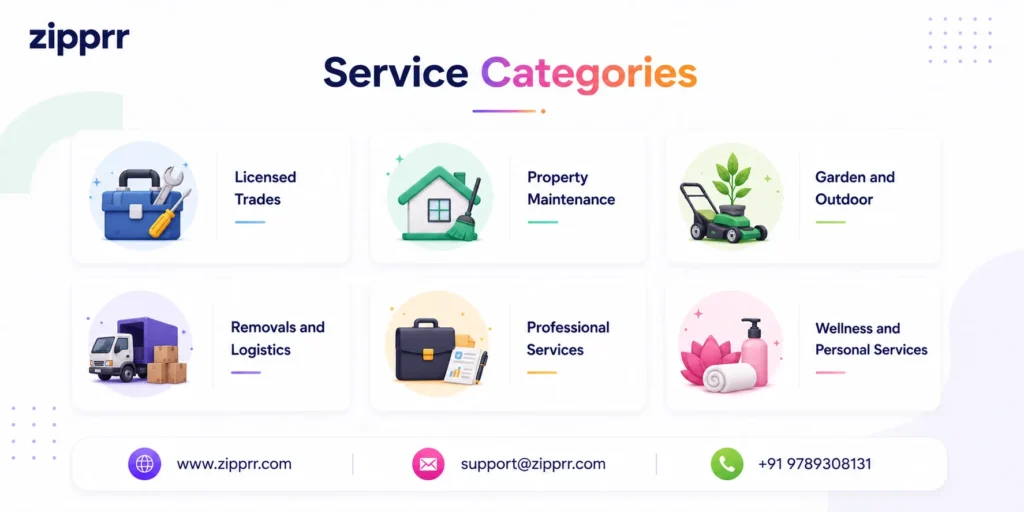
Licensed Trades: Electrical diagnostics and installation. Licensed plumbing and drainage work. Structural and finish carpentry. Roofing and rainwater systems. Plastering. Tiling. HVAC commissioning and service contracts.
Property Maintenance: Residential cleaning appointments. Ongoing housekeeping. End-of-tenancy cleaning. Commercial premises upkeep. Carpet care. Window cleaning. Pressure washing.
Garden and Outdoor: Lawn mowing and edging. Seasonal garden maintenance. Tree removal and pruning. Turf laying. Irrigation installation. Pool maintenance.
Removals and Logistics: Residential relocations. Office moves. Bulky item transport. Post-delivery assembly. Hard-waste removal.
Professional Services: Small-business bookkeeping. Legal document assistance. IT setup and repair. Brand and logo design. Property photography. Academic tutoring.
Wellness and Personal Services: Mobile massage. In-home personal training. Mobile hairdressing. Beauty and nail visits. Nutritional consultation.
Each category generates its own indexed landing page per city — a compounding organic search asset that accumulates without manual content investment.
Pricing
Full current package pricing is on the Zipprr ServiceSeeking clone page. Package contents, delivery timelines, and guarantee terms are documented on the Zipprr FAQ page.
Script Package — $3,000 to $9,000 | Live in 2 to 4 weeks Complete source code for all components. iOS and Android apps for homeowners and tradespeople. Customer web portal. Admin panel. Server installation included. 90 days of technical support. Seven-day satisfaction guarantee.
Custom-Enhanced Package — $10,000 to $25,000 | Live in 6 to 10 weeks The production-tested foundation plus purpose-built additions: AI job scoring, corporate accounts module, regional payment gateway, custom analytics. Launch speed and market differentiation in the same investment.
Full Bespoke Build — $40,000 to $120,000+ | Live in 9 to 18 months Architecture built entirely to specification. Appropriate for operators with proprietary requirements a foundation-plus-customisation model cannot address.
Annual operating costs to budget: Cloud hosting $100 – $600 per month. API usage $200 – $800 per month at scale. Domain and SSL under $60 per year. Ongoing platform maintenance at 15 – 20% of original investment annually.
Competitive Differentiation
AI-Scored Job Matching Rather than broadcasting every new posting to every registered tradesperson simultaneously, the matching engine scores available professionals across proximity, category activity frequency, historical win rate, current rating, and typical response latency — alerting the highest-scoring matches first. Homeowners receive better-calibrated bids earlier. Tradespeople allocate their bid credits to jobs they are genuinely positioned to win.
Four-Stage Credentialling With Commercial Incentive Identity. Trade licence. Insurance. Background check. Four separate tiers, each with a distinct badge, each with a one-time processing fee. Homeowners who sort by credential depth find fully-badged professionals instantly. Tradespeople who complete all four tiers win more of those customers’ jobs. The system produces a commercial incentive for verification that no operator needs to enforce.
Corporate Property Account Module Individual homeowners post frequently but at relatively contained job values. A facilities manager overseeing a commercial portfolio posts at high frequency, high value, and with high retention if the platform serves them adequately. A corporate module — multi-user company access, consolidated monthly billing, managed preferred-vendor registry, spending approval workflows — positions the platform to capture this segment that individual-consumer-focused marketplaces consistently overlook.
Self-Building Organic Search Infrastructure Every category-city combination generates a dedicated, indexed landing page as providers register and jobs accumulate. A platform covering three cities and six service categories produces eighteen indexed pages from launch. Eighteen months of organic activity can build hundreds of pages, each capturing high-intent search traffic at zero marginal cost. This distribution channel grows automatically without content investment.
Six-Stage Launch Sequence
Stage One — Territory Definition (Days 1 – 7) One city. Two service categories with twelve-month demand. A clear picture of who the first fifty tradespeople are and how to reach them, before any customer acquisition activity begins. Fifty active tradespeople generating one booking each per week at $300 average job value and a 10% commission produces $1,500 per week in commission income alone — before subscription, bid credit, and placement revenue are added.
Stage Two — Platform Configuration (Days 7 – 14) Brand identity and domain applied. Category tree set. Bid credit prices configured per category. Subscription tiers designed. Locally-used payment gateways integrated. Credentialling workflow calibrated to match the specific documents your market’s tradespeople actually hold. All configuration questions are answered on the Zipprr FAQ page.
Stage Three — Supply Build Before Demand Opens (Days 14 – 35) Nothing opens publicly until 40 active, profile-complete tradespeople are registered per launch category. A marketplace that opens before it has coverage creates an impression that is nearly impossible to reverse — homeowners post jobs, receive nothing, and permanently associate the platform with emptiness. Reach tradespeople through LinkedIn professional communities, trade-specific Facebook groups, and direct outreach to Google Maps business listings. Offer reduced bid credit costs for the first 90 days in exchange for a completed profile and full credential verification before the public launch date.
Stage Four — Controlled Testing (Days 35 – 42) A limited group of real homeowners — recruited through a local community forum or personal network — posts jobs before any public announcement. Six metrics tracked obsessively: time from job post to first bid received, total bids per posted job, time from first bid to hire confirmation, payment completion rate, post-job review submission rate, star rating distribution. Every identified friction point costs commission revenue at scale. Fixing them now costs an afternoon. Fixing them at 500 weekly jobs costs an engineering sprint.
Stage Five — Public Launch (Day 42 Onwards) Two paid channels run simultaneously from day one: Google Ads targeting specific service-category-plus-city queries, and targeted social ads reaching property owners by postcode within the launch area. A referral mechanism rewards homeowners who introduce neighbours and tradespeople who bring fellow professionals — activating word-of-mouth at low marginal cost.
Stage Six — Replication (Month 2 Onwards) Once the first city reaches independent momentum — tradespeople rebooking without prompting, homeowners returning without re-acquisition spend, weekly job volume growing without proportionate marketing cost increases — the launch playbook is validated. Run it in the second city with identical two-category discipline. Concentrated success in two categories in two cities produces more stable income than diluted coverage across ten categories in one.
Prior Zipprr marketplace deliveries are documented on the portfolio page. First-hand accounts from previous operators are on the testimonials page.
Revenue That Grows Without Additional Advertising
City-Category Search Pages Every combination of service type and operational city is a search query homeowners type with purchase intent. A dedicated, well-structured page for each combination captures that search traffic and routes it to the job-posting entry point — at zero cost per visit. As the platform expands into more cities and categories, this asset compounds without ongoing effort.
Demand Cycle Alignment Most home service categories follow predictable seasonal patterns. Pre-summer cooling system checks. Spring garden preparation. Pre-winter heating maintenance. A promotional calendar aligned to these cycles generates engagement cost-effectively at the moments of highest natural intent.
Dormant Homeowner Re-Engagement A homeowner who completed a booking, rated it highly, and has not posted again for six months is not churned — she is dormant. A personalised message referencing her previous tradesperson and the time elapsed since her last service, with a single-tap rebook, converts dormant satisfied homeowners back to active ones at a fraction of new-customer acquisition cost.
Frequently Asked Questions About Peerspace Clone
What is a ServiceSeeking clone and why is it not simply a booking app?
A ServiceSeeking clone is a job-posting and competitive-quoting platform — architecturally distinct from a booking application. A booking app assigns one professional at one fixed price. A quoting platform receives a homeowner’s job description and distributes it to multiple nearby credentialled tradespeople, who each submit their own competing bid. The homeowner chooses based on a combination of pricing, professional history, and fit for their specific situation. The competitive mechanism this creates solves an information asymmetry problem that a fixed-price booking model cannot address.
How does the platform earn money without charging homeowners?
What commercial functions does the admin panel provide?
The admin panel is where the entire economic architecture of the platform is configured and managed. Bid credit pricing by category. Subscription plan structure and costs. Transaction commission rates. Featured placement fees. Promotional campaigns. Provider application reviews. Credential verification queue management. Dispute resolution. Real-time revenue and activity data. Full admin capability documentation is on the ServiceSeeking clone page.
What is the realistic timeline from purchase to a live, operational platform?
Script-based packages are deployed and fully operational within two to four weeks of purchase. Server installation is handled by Zipprr at no additional charge, removing the bottleneck that most commonly delays first-time operators without dedicated technical staff. Custom-enhanced packages deploy in six to ten weeks. Full bespoke builds take nine to eighteen months. All delivery process details are documented on the Zipprr FAQ page.
Are there geographic restrictions on where this can be launched?
What prevents tradespeople from communicating with homeowners outside the platform?
Which service categories generate the strongest early revenue?
Does the platform function on both mobile apps and web browsers?
Yes. The delivery includes native iOS and Android apps for both homeowners and tradespeople, a fully responsive web portal for homeowners who prefer browser-based access, and a browser-accessible admin panel. Examples of completed platforms showing both mobile and web implementations are documented on the Zipprr portfolio page.
How does the milestone payment mechanism protect both parties in practice?
Why do experienced tradespeople adopt this model rather than continuing with advertising?
What credential verification integrations are available?
Can commercial property managers use the platform differently from individual homeowners?
What is the refund policy if the platform doesn't meet expectations?
Zipprr offers a seven-day satisfaction guarantee from the date of purchase. If the delivered platform does not match what was agreed and specified, a full refund applies. Complete guarantee terms are documented on the Zipprr FAQ page.
What should I realistically budget for ongoing annual costs?
What is Zipprr's experience and track record delivering platforms like this?
Zipprr has completed marketplace platform deliveries for more than 500 businesses across multiple verticals and geographies. Every package includes server installation at no additional cost, 90 days of post-purchase technical support from the delivery date, and app submission assistance for both the App Store and Google Play. First-hand accounts from previous platform operators are published on the Zipprr testimonials page. Completed project examples are on the Zipprr portfolio page.
The Information Gap Is Still Open in Your City. You Could Close It.
✅ Full source code — yours to own and operate independently
✅ iOS and Android apps for homeowners and service professionals
✅ Admin panel with complete commercial configuration control
✅ AI-scored job-to-tradesperson matching engine
✅ Geofenced real-time job notifications
✅ Four-tier credential verification and trust badge system
✅ Bid credit and subscription revenue models pre-built
✅ Milestone payment architecture for high-value jobs
✅ Multi-language and multi-currency configuration
✅ Corporate property management account module
✅ Server installation at no additional cost
✅ 90 days of post-purchase technical support
✅ Seven-day satisfaction guarantee