

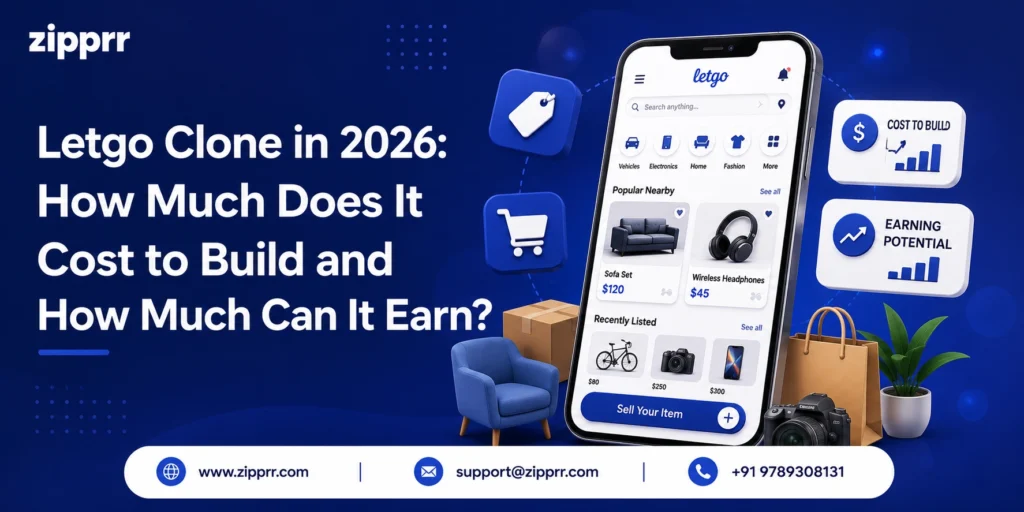
Let me start with a confession. The first time I really understood why apps like Letgo took off, I wasn’t reading a market report. I was helping a friend move out of a tiny apartment, and we had a couch that nobody wanted to haul down three flights of stairs. She shrugged, took two photos on her phone, and posted it. Twenty bucks, “must pick up today.” Before we’d finished taping the last box, a guy with a pickup truck was knocking on the door.
That’s it. That’s the whole magic. No shipping, no waiting, no eBay cut. Someone nearby wanted the thing, and the app just got out of the way.
If you’re reading this, you’ve probably felt that same pull, the sense that there’s a real business hiding inside that simple loop. And you’ve landed on the obvious follow-up question: can I build my own version of it, and what would that actually cost me? Good. That’s the right question. So let me skip the fluff and talk to you the way I’d talk to a founder who bought me a coffee and asked for the honest version. Whether you end up choosing a ready-made Letgo clone script or going fully custom, by the end of this you’ll know enough to decide for yourself.
"Wait, isn't Letgo dead?"
I get this one a lot, so let’s clear it up first.
Yes, the Letgo app you might remember got folded into OfferUp around 2020. Go looking for it in the app store today and you won’t find it. But here’s the thing people miss when they hear that: a brand going quiet is not the same as a market drying up.
Think about why they merged. Two nearly identical apps were splitting the same enormous pie, and at some point it made more sense to combine than to keep bleeding each other. The behavior, people selling their stuff to neighbors, didn’t go anywhere. It’s bigger now than it was when Letgo was at its peak.
So what does that leave for you? A category that’s already been proven at a scale most startups can only dream about, no single brand that owns every city and every product category, and a pile of gaps the big players don’t bother serving well. Those gaps are where you come in. More on that later.
The market math, kept short
I’m not going to drown you in stats, because honestly most of them are guesses dressed up as precision. But the broad strokes matter, so here they are.
Consumer-to-consumer (C2C) commerce in 2026 is a multi-trillion-dollar market, and pretty much every research firm, no matter how they slice it, expects it to keep growing at double digits for years. Pick whichever forecast you like; they all point up and to the right.
Why? Three reasons, and none of them are going to reverse anytime soon.
People genuinely like buying used now. Plenty of younger buyers don’t treat second-hand as a step down at all; for them it lines up with what they actually care about. No marketing budget on earth buys that kind of momentum.
Money’s tight, and when money’s tight two things happen at once: folks sell more of what they own, and they buy more used instead of new. Resale tends to do well when the economy gets wobbly. It’s almost counter-cyclical.
And somewhere along the way, the trust problem got solved. Profiles you can verify. A ratings system that actually means something. Money moving inside the app instead of cash in a parking lot. Shipping, if you’d rather not meet at all. Every one of those things used to feel risky when you were dealing with a stranger, and now it just feels ordinary. That shift alone dragged in a whole wave of people who wouldn’t have come near one of these apps five years back.
Bottom line? You’re not trying to convince the world it wants something new. The want is already there. Your job is to point it at something sharper than what already exists.
Okay, so what actually is a "Letgo clone"?
Plain version: it’s a pre-built, customizable app that copies the core machinery that made Letgo work, fast photo listings, a feed that knows where you are, direct chat between buyer and seller, secure payments, while leaving you holding the keys. Your brand. Your code. Your revenue.
I like to think of it less as “copying” and more as buying a house with good bones. Somebody already poured the foundation and proved the floor plan holds up under real weight. You move in and make it yours. All those expensive lessons the original team learned the hard way? Already baked in. Your energy goes toward the stuff that makes you different, not toward reinventing a chat feature for the thousandth time.
What to build first (and what to leave for later)
Here’s where I see founders burn cash: they treat every feature like it’s equally urgent on day one. It isn’t. The way I break one of these projects down is into three tiers.
Layer one is the stuff you literally cannot launch without.
Dead-simple listing creation comes first, always. A seller should go from “I want to sell this” to a live post in under a minute. Snap, auto-suggest a category, set a price, done. The original Letgo nailed this with its photo-first flow, and it’s a big part of why it spread like it did. Put friction here and nothing else you build matters.
Then a location-aware feed, items nearby, filterable by category, price, distance, condition. Proximity is the entire trick. It’s what makes “I’ll grab it on my way home” possible.
Then in-app chat, so people can haggle and arrange a meetup without handing over their personal number. Bonus: it keeps them inside your app instead of drifting to WhatsApp.
And search that genuinely works. Type-ahead suggestions, the option to save a hunt, a ping the moment something matching lands. Whoever bothers to save a search tends to return far more often, a pattern I’ve watched repeat on nearly every marketplace I’ve ever poked at.
Layer two is trust, and you skip it at your peril.
Profiles, ratings, reviews. Reputation is the currency here. A visible history turns a nervous first-timer into a repeat user.
Verification and moderation. Phone or email or social verification, plus a mix of automated and human review to keep banned junk off your platform. One ugly scam story can poison a young community faster than any marketing can save it.
Secure payments with optional escrow, money held until the buyer confirms they got the item. It’s increasingly expected, and quietly it unlocks shipped sales beyond your local area.
Layer three is the money machinery, switched on later.
Paid boosts and featured slots. Subscriptions for the heavy sellers. Re-engagement nudges like “your item got 40 views” or a price-drop alert. You don’t need all of this on day one. You need it ready for when you’ve got enough activity to justify it.
And sitting behind everything is your control room, the admin dashboard where you manage users, approve listings, settle disputes, set commissions, and read your numbers. Don’t gloss over this part. Before you commit to anyone, see the admin panel in action, because that back office is where you’ll actually spend your time. For a pure local buy-and-sell app, our customizable Letgo clone comes with that room already furnished.
Let's talk money: what does this actually cost?
This is the part founders never get a straight answer on, so here’s mine. There are two roads, and they’re very different.
Go the from-scratch route, building a full marketplace that can stand next to Letgo or OfferUp, and the honest range you’re staring at is somewhere from thirty thousand dollars to a hundred and fifty thousand, frequently more. That figure climbs quickly the moment you pile on iOS, then Android, then web, plus the backend, plus the inevitable cleanup that follows every single launch. Block out five to nine months for it. And remember you’re carrying the risk of design mistakes you won’t even notice until actual users start leaning on the thing.
Start from a pre-built clone instead, and both the price and the timeline shrink hard, because the difficult engineering is already finished and tested. Your spend moves to licensing, customization, branding, and getting it deployed. Weeks, not months. That’s exactly why most first-time founders I talk to start here and pour the savings into growth instead.
| What You Care About | Build from Scratch | Letgo Clone Script |
|---|---|---|
| Typical spend | $30,000 to $150,000+ | A fraction of a custom build |
| Time to live | 5 to 9+ months | Weeks |
| Technical risk | High, unproven architecture | Low, tested core |
| Customization ceiling | Basically unlimited | High, within a proven framework |
| Best for | Funded teams with novel core IP | Founders chasing speed and ROI |
What actually moves the final number? Five things, really. How many platforms you ship (each of iOS, Android, web adds cost). How much custom design you want versus proven templates. Whether you bolt on the heavy stuff, AI recommendations, AR previews, blockchain. The third-party services you plug in, payments, maps, shipping, identity checks. And the ongoing cost of keeping the lights on and scaling as traffic grows.
A word of warning on those fancy extras: that’s where budgets quietly explode. Add them when a real user actually needs them, not because they’d sound good in a press release. Want your specific scope priced out properly? The fastest way is to book a free live walkthrough and map features to real numbers.
So how does the thing make money?
A marketplace full of users but with no revenue model is just an expensive hobby that happens to be popular. I’ve watched founders fall into that trap. Don’t. The good news is resale apps have several income streams that stack nicely, and Letgo ran all of them.
Paid visibility is the workhorse. Listing stays free so supply stays high, but sellers pay to feature or bump an item. On Letgo those boosts ran from under a dollar to the mid-forties. This is your highest-volume earner because it’s monetizing the seller’s own impatience, and impatient sellers are everywhere.
Subscriptions come next, recurring plans for serious sellers and dealers. Letgo had a “Super Boost” that auto-featured a listing every day, plus a dealer tier on a monthly fee. Subscriptions give you predictable revenue and they lock in your best users, which matters more than people think.
Transaction fees are the long game, a small slice taken when a sale closes. To give you a sense of scale, OfferUp pulls somewhere around two dollars per listing, or in the ballpark of 13 percent once an item actually ships. The nice thing about a commission is that it climbs in lockstep with the total value of goods moving through your platform, so the moment you’ve got real payment volume running, this turns into the most attractive lever on the board.
Then there’s advertising, native placements you sell to local shops and brands, and premium business placements like verified storefronts or sponsored categories.
The pattern that works is layered, not greedy. Keep the core trade free until you’ve got liquidity, then start charging for visibility, trust, and transactions as the network thickens. A platform built on a ready-made Letgo clone usually ships with all these modules already wired into the admin panel, so you just flip switches as you grow instead of paying to re-code.
| What You Care About | Build from Scratch | Letgo Clone Script |
|---|---|---|
| Typical spend | $30,000 to $150,000+ | A fraction of a custom build |
| Time to live | 5 to 9+ months | Weeks |
| Technical risk | High, unproven architecture | Low, tested core |
| Customization ceiling | Basically unlimited | High, within a proven framework |
| Best for | Funded teams with novel core IP | Founders chasing speed and ROI |
What actually moves the final number? Five things, really. How many platforms you ship (each of iOS, Android, web adds cost). How much custom design you want versus proven templates. Whether you bolt on the heavy stuff, AI recommendations, AR previews, blockchain. The third-party services you plug in, payments, maps, shipping, identity checks. And the ongoing cost of keeping the lights on and scaling as traffic grows.
A word of warning on those fancy extras: that’s where budgets quietly explode. Add them when a real user actually needs them, not because they’d sound good in a press release. Want your specific scope priced out properly? The fastest way is to book a free live walkthrough and map features to real numbers.
A quick peek under the hood
You don’t need to code to make smart tech decisions. You just need to know enough to ask the right questions and spot a vendor who’s hand-waving.
A modern Letgo clone leans mobile-first. If you want the smoothest possible feel, you go native, which on Apple’s side means writing in Swift and on the Android side means Kotlin. If you’d rather protect your wallet early on, a cross-platform framework (Flutter, say, or React Native) lets a single codebase cover both stores. For the back end, teams usually reach for one of Node.js, Laravel, or Python, sitting on top of a database (Postgres and MongoDB are both popular picks) and hosted somewhere like Amazon’s cloud or Google’s so it scales as you do.
Then come the pieces that make the whole thing feel alive. You need maps, for location and distance filtering, whether that’s Google’s offering or Mapbox. You need a payments layer to run checkout and escrow; Stripe handles it, so do PayPal and Razorpay, depending on where your users are. You need something real-time powering the chat and the push alerts. And you need a media pipeline that crunches photos down and serves them quickly, because nobody hangs around waiting for a blurry listing to load. The more ambitious builds stack an intelligence layer on top too, sorting photos into categories on their own, flagging fraud, nudging recommendations. That’s the same quiet polish that made the original’s listing flow feel like no effort at all.
Honestly, though? The point is you don’t assemble all this yourself. A decent clone hands it to you, decided and tested. What you should care about is that the stack scales, comes documented, and ships with the source code, so you’re never locked out of your own product. Get that part wrong and it’ll haunt you.
The ways marketplaces quietly die
Not many fail with a bang. Most just slowly suffocate, in pretty predictable ways. I’ve seen all of these.
Launching into a ghost town is the classic. An empty app feels abandoned, and you almost never get a second first impression. Seed listings before you let a single buyer in.
Spreading too thin is the next one. Try to cover every category in every city at once and you reach critical mass in none of them. Win one slice first.
Over-building before anyone shows up. Sinking money into AR previews and blockchain before you’ve proven a single person wants the basic app, that’s how you end up with a gorgeous product and no runway.
Treating trust like a phase-two problem. It isn’t. Verification, ratings, moderation, all of it belongs in version one.
And charging too much, too soon. Fees before liquidity scare off the exact supply you’re desperate for. Keep it free until you’ve got momentum.
Dodge those five and, no exaggeration, you’re already ahead of most of the launches I’ve watched.
Pick a wedge. Seriously, pick a wedge.
If there’s one thing I’d tattoo on a founder’s arm, it’s this: do not try to out-OfferUp OfferUp across all of general resale. You’ll lose. The people who break through pick a wedge and own it completely.
A category wedge means going deep on one type of thing, furniture, electronics, baby gear, instruments, sports equipment, collectibles. A community wedge means serving one defined group unreasonably well, a university, an expat network, a city the giants ignore. A model wedge means a different promise entirely, verified-only listings, escrow-first buyer protection, a sustainability angle with reuse front and center.
Why does a wedge work? Liquidity. A focused marketplace packs buyers and sellers tightly enough that the feed feels alive. A general one scatters them until it feels dead. Being the obvious choice in one zip code beats being a forgettable option across a whole country. Every single time
A launch plan that respects how this actually works
Shipping the app is the starting line, not the finish, and I wish more people internalized that. Here’s a sequence that holds up.
Solve the chicken-and-egg problem from the supply side first. Buyers chase inventory, not the other way around, so go recruit sellers by hand and pre-load listings before launch day. Yes, by hand. It’s unglamorous and it works.
Then go deliberately local. Own one city, one campus, one neighborhood before you even think about expanding, because density is what creates that “it’s right nearby” feeling the whole category runs on.
Lead with trust in your marketing, verification, ratings, buyer protection, because in resale a sense of safety converts browsers better than any discount you could run.
Engineer word of mouth with referral incentives and shareable “sold it in a day” moments. Happy users are the cheapest growth channel that exists.
And measure the right things. Watch time-to-first-listing, listing-to-sale time, repeat-seller rate, and search-to-message conversion. Those four numbers will tell you whether your marketplace is genuinely healthy long before download counts ever will. Download counts lie. These don’t.
What year one realistically looks like
Founders always want the picture of year one, so here’s an honest shape, not a fantasy. The first quarter is about life, not money: customize, deploy, seed supply, onboard your first sellers personally until the feed is active somewhere specific. The second quarter, switch on light monetization (featured listings) once daily trades are steady, and pour fuel on whatever channel is working. The third quarter, add subscriptions for your power sellers and take one careful step into an adjacent city or category. The fourth quarter, layer in commissions or shipped transactions and put everything you’ve learned into the customizations people actually asked for.
Liquidity first, revenue second, expansion third. Boring on purpose. That’s how the durable ones get built.
Build or buy? Here's how I'd decide
If you’re holding genuinely novel core IP, you’ve got funding to spare, and you can stomach technical risk, sure, a custom build can make sense. For nearly everyone else, especially first-timers and bootstrappers, starting from a proven Letgo clone script is just the smarter move. It keeps your capital for the things that actually decide whether you make it: supply, trust, growth.
Because here’s the uncomfortable truth nobody likes to say out loud: your software isn’t your moat. A competitor can license a near-identical foundation tomorrow afternoon. What you actually defend is the network you build, the trust and community you grow inside your niche, and how well you run the whole operation. The clone just gets you to the starting line cheap and fast, so your real energy lands where the advantage actually lives.
So, where does that leave you?
Letgo the brand is gone. The habit it created, quick, local, photo-first resale, is more alive than ever, riding a C2C market measured in trillions and still climbing every quarter. The technology isn’t the wall it used to be. What separates the winners now is a sharp wedge, a lean launch, a layered way of earning, and the patience to grow one dense pocket at a time.
If you’ve got a market in mind, the next step is honestly pretty simple: pin down the scope, look at the product, price the launch. The appetite is already out there, and it’s growing whether you act on it or not. The only real question left is who builds the place where it gets satisfied next. I don’t see a good reason that shouldn’t be you.
Ready to launch?
What is a Letgo clone?
Is Letgo still available in 2026?
How much does it cost to build an app like Letgo?
How long does it take to develop a Letgo clone?
A pre-built Letgo clone script can be customized, branded, and shipped in just a few weeks. A completely custom build typically needs five to nine months or longer. What stretches the timeline most is the number of platforms you target (iOS, Android, web) and how complicated your feature list gets.
How do apps like Letgo make money?
Apps like Letgo earn through several layered streams: paid listing boosts and featured spots, monthly subscriptions for power sellers and dealers, small commission or transaction fees on sales, in-app ads, and paid business storefronts. The basic act of buying and selling usually stays free so the platform can build activity first.
What features should a Letgo clone app have?
A Letgo clone needs one-minute photo listing, a location-based browsing feed, in-app chat, filtered search, rated user profiles, secure payments with optional escrow, and a capable admin dashboard. Adding identity verification and a shipping option widens both how far the app reaches and how much buyers trust it.
Is it better to buy a Letgo clone script or build from scratch?
For most founders, buying a Letgo clone script wins, it’s cheaper, faster, and far less risky, since the engineering is already proven. Building from scratch is only worth it when you have serious funding and a genuinely original core feature that no existing solution can deliver. Otherwise the savings are better spent on growth.
Is it legal to build a Letgo clone?
Yes, building a Letgo clone is legal as long as you use your own branding, code, and visual design and don’t copy Letgo’s trademark, logo, or protected assets. The word “clone” here means recreating the app’s features and business model, which is completely allowed, not duplicating its intellectual property.
Which niche is best for launching a Letgo clone?
How can a new Letgo clone compete with OfferUp and Facebook Marketplace?
A new Letgo clone wins by skipping the head-on fight and owning one wedge instead. Choose a single category, community, or region the incumbents handle badly, pre-load listings so the feed looks active on day one, and dominate that one area before expanding. Dense local liquidity beats thin, everywhere-coverage.