

Searching “equipment rental script” usually means you want to put a rental business online (tools, construction gear, party equipment, cameras, or heavy machinery) without building software from scratch. This guide answers the real questions people ask before they commit, plainly and without filler. Zipprr builds these platforms, so the answers below reflect what actually happens after launch, not just what looks good in a brochure.
What is an equipment rental script?
An equipment rental script is a ready-made software solution (usually a customer app or website plus an admin dashboard) that lets a business list rentable equipment, manage availability and bookings, take deposits and payments, and handle returns, all in one system.
The word “script” simply means a pre-built, configurable foundation you launch and brand as your own, instead of coding everything from zero. It can power two different business shapes: a single company renting out its own inventory, or a marketplace where many owners list their equipment and you take a commission. The important thing to understand is that the software is the easy part; the real business is keeping expensive assets earning instead of sitting idle. A well-built equipment rental script is really a utilization engine with a booking screen on top.
Should I own the equipment or build a peer-to-peer rental marketplace?
This is the first real decision, and it changes your capital, risk, and operations completely:
- Owned inventory: you buy the equipment and rent it out. High upfront capital and control, strong margin per item, but only if each item stays rented. Idle equipment is pure loss.
- Peer-to-peer marketplace: individual owners and small businesses list their equipment, and you run the platform for a commission. Low capital, but you must solve marketplace liquidity (enough listings in each category and area) and trust between strangers.
- Hybrid: you own a core set of high-demand items and let third parties list the long tail.
Choose owned inventory if you have capital and want margin and control. Choose the marketplace model if you want low capital and can build liquidity and trust, the same dynamic that powers peer-to-peer rental marketplaces in car sharing. Because your model may evolve as demand data arrives, it is smart to build on a platform that can run either.
How much does it cost to build an equipment rental script?
As with any rental platform, cost swings enormously between custom development and a ready-made script. Building from scratch (catalog, availability calendars, deposits, payments, damage handling, delivery logistics, and an admin panel) is a large, months-long investment. A configurable white-label equipment rental software like Zipprr delivers those systems pre-built, so you launch for a fraction of the cost and time.
The cost drivers to weigh are your model (a marketplace adds owner onboarding and payouts), the integrations you need (payment, deposits, ID verification, maybe delivery), the number of apps and locations, and how much custom design you want. For most operators, the budget is better spent on inventory or supply and on marketing than on rebuilding a rental system that already exists.
See it before you build it: schedule a free Zipprr demo or message us on WhatsApp for a live walkthrough and pricing.
How do equipment rental businesses make money?
Owned-inventory businesses earn rental margin: the daily or weekly rate multiplied by how often each item is rented (its utilization), minus the cost of buying, storing, maintaining, and transporting the equipment. Their entire profit lives in utilization and pricing, so keeping items booked is everything.
Marketplace platforms earn a commission on each rental (commonly 10-20%), plus protection and service fees. Across both models, additional revenue comes from:
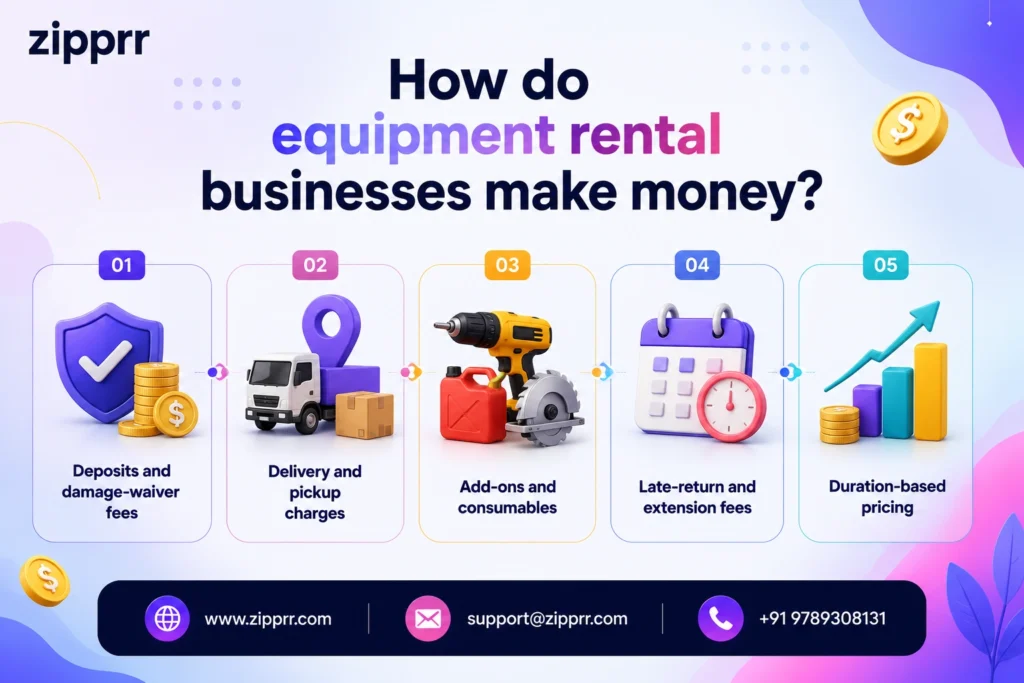
- Deposits and damage-waiver fees: optional protection buyers pay for.
- Delivery and pickup charges: a real revenue line for heavy or bulky equipment.
- Add-ons and consumables: accessories, fuel, blades, safety gear.
- Late-return and extension fees: with clear terms.
- Duration-based pricing: hourly, daily, weekly, and monthly tiers that lift utilization.
The screens look similar across models, but the profit drivers differ, so plan for the drivers, not the interface.
What features does an equipment rental script need?
At minimum you need a catalog with categories and specifications, real-time availability calendars (so nothing is double-booked), duration-based pricing, secure payments with deposits or pre-authorization holds, ID verification, a damage and condition-check workflow, delivery or on-site scheduling, and an admin dashboard with inventory and reporting. A marketplace model adds owner onboarding, listings, and payouts.
But a feature list is the wrong way to choose a platform. What actually separates winners is a few systems working well: accurate availability across multiple items and locations, fast deposits and clean damage handling, and analytics that show you utilization per item so you know what to buy more of and what to retire. Zipprr ships these essentials as configurable modules in one online equipment rental system, so you refine a working platform rather than assembling one from parts.
How do I handle deposits, damage, and insurance?
Carefully, because equipment gets used hard and sometimes comes back broken. A credible platform needs three risk systems: security deposits or pre-authorization holds sized to each item’s value, a condition-check workflow with pre- and post-rental photos so disputes are evidence-based, and clear damage-waiver or insurance options. For higher-value or hazardous equipment, you may also need renter verification and, in some categories, proof of operator certification.
The condition-check and deposit flow is the relationship-critical part. Fair, fast handling of a damage claim keeps good customers and owners coming back, while slow or unclear handling loses them. Build these as core systems, not afterthoughts. Skimping here is how rental businesses lose money one damaged item at a time.
How do I manage inventory and availability across locations?
With a real-time inventory system that tracks every unit: its status (available, booked, out for delivery, in maintenance), its location, and its rental history. When multiple units of the same item exist, the platform should allocate bookings automatically and prevent double-booking, and when you operate several branches, it should support location-specific availability and pricing.
The metric to watch is utilization: the share of time each item is actually earning. Idle equipment is your biggest silent cost, so a good equipment rental app surfaces which items are over-utilized (buy more), under-utilized (retire or discount), and frequently in maintenance (a margin leak). Managing this well is what separates a profitable equipment rental platform from one that quietly bleeds on idle assets and lost units.
What types of equipment can I rent out?
Almost any category with high purchase cost and occasional use works, which is why equipment rental spans so many niches:
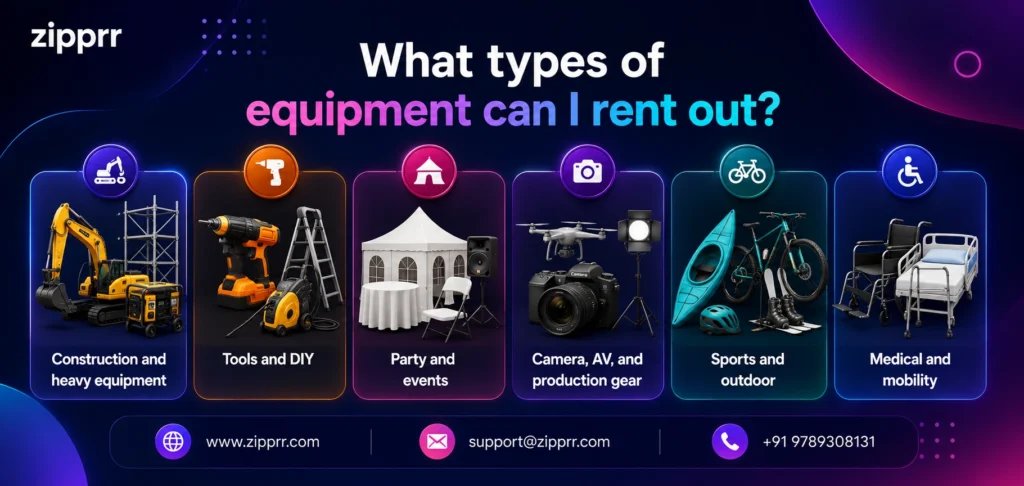
- Construction and heavy equipment: excavators, scaffolding, generators, compactors (largely B2B, contractor-driven).
- Tools and DIY: power tools, ladders, pressure washers (mix of trade and consumer).
- Party and events: tents, tables, chairs, sound systems, bounce houses (seasonal, consumer and business).
- Camera, AV, and production gear: lenses, lighting, drones (creator and production demand).
- Sports and outdoor: bikes, kayaks, ski gear, camping equipment (seasonal, tourism-linked).
- Medical and mobility: wheelchairs, hospital beds, mobility aids.
You don’t have to serve all of these. Picking one focused category with strong local demand, then building deep availability in it, beats spreading thin across everything. It is the same wedge-first logic that works in any rental marketplace.
Is an equipment rental business profitable?
It can be very profitable, because renting monetizes an expensive asset many times over, but only with disciplined utilization and cost control. The Construction Equipment Rental Market alone is forecast to reach USD 179.21 billion, growing at a 4.85% CAGR from 2026 to 2031. Source: Mordor Intelligence.
https://www.mordorintelligence.com/industry-reports/construction-equipment-rental-market
That scale (and it is just one segment of a much broader rental economy) shows steady, structural demand as businesses and consumers increasingly rent instead of buy. But profitability is local and operational, not automatic. For owned inventory it means high utilization per item, low downtime and maintenance leakage, and smart duration-based pricing. For a marketplace it means growing listings, high booking conversion, and low damage-dispute rates. Prove those in one category and area first, then expand.
Build your equipment rental platform with Zipprr
Ready to put your equipment rental business online without building software from scratch? Zipprr’s equipment rental script ships catalog and availability management, deposits, damage handling, delivery scheduling, and owner payouts built in for owned-inventory, peer-to-peer, or hybrid models.