

What Is an Uber Clone and Why Does the Name Undersell What It Actually Does?
A home is bought, sold, or rented somewhere on earth every few seconds — and yet, for most of the people involved, the act of finding that home feels a decade behind the rest of the web. A few countries enjoy instant, polished property search. Across most other markets, the process still leans on outdated listings, agents who never call back, and tips passed between neighbours. The distance between how property ought to be discovered and how it actually gets discovered — multiplied across thousands of cities — is exactly the territory a Zillow clone script is designed to claim.
This guide speaks to the founder, broker, or proptech team aiming to plant a flag in that territory. It covers what a Zillow clone script really is, how the marketplace beneath it operates, how its price stacks up against a build-it-yourself approach, and — the piece nearly every vendor leaves out — how to engineer the thing so it shows up first in Google and in the AI answer engines that increasingly stand between users and search results.
What Is a Zillow Clone Script?
A Zillow clone script is pre-assembled real estate marketplace software that recreates the parts of Zillow that matter: searchable, filterable listings; map-driven browsing; agent and seller profiles; mortgage tooling; lead routing; and a complete admin back end. Instead of paying a team to write each module from a blank page, you start from a proven base, dress it in your brand, aim it at a market, and go live — usually inside a week or two rather than most of a year.
A useful way to picture it: building from scratch is pouring a foundation and framing a house board by board; a clone script is buying that house already framed and weather-tight. The costly, time-consuming engineering — how search is structured, how maps render, how listings move through their workflow, how payments clear — is finished. What’s left is the work that genuinely decides who wins a market: accurate local data, real agent relationships, and distribution.
The Opportunity Behind the Software
The case for doing this lives in the category’s economics.
Worldwide, real estate is on track to grow from somewhere around $4.4 trillion in 2025 to roughly $4.7 trillion in 2026 — close to a 7% yearly pace — and to push past the $6 trillion mark before the decade closes. Perched on top of all that buying and selling is a slim but remarkably lucrative layer: the portals where discovery happens. Consider Zillow. It pulls in the neighbourhood of 214 million distinct visitors in a typical month and books revenue close to the $2 billion line, and even that, by the company’s own math, amounts to only about a hundredth of the market it could theoretically serve. Within the U.S., roughly six in ten real estate web visits flow to Zillow and the brands it owns; the nearest competitor, Realtor.com, accounted for somewhere near a third of portal visits in the opening months of 2026.
What unites those statistics is geography: they describe America almost exclusively. Cities like Lagos, Karachi, Manila, Bogotá, and Nairobi have nothing comparable — no mobile-first, AI-ready platform that owns the market. The transparent discovery layer that reorganised American real estate has simply never been built for the bulk of the world, and the places it’s missing happen to be the ones adding smartphone users fastest. A clone script is the shortest route from that empty seat to a product people can actually use.
How a Real Estate Marketplace Actually Works
For the Buyer or Renter
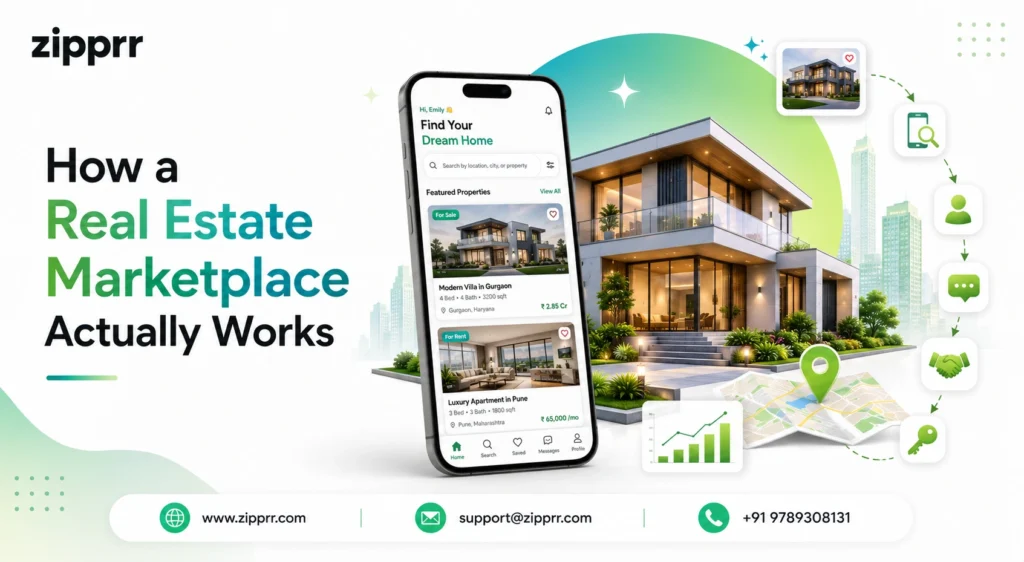
The platform behaves like a search engine for somewhere to live. They enter a city or district and then refine the results using filters — maximum price, type of property, bedroom and bathroom counts, floor area, furnishing, and amenities. Results appear two ways at once: a scrollable grid of cards and a set of pins on a map you can drag around. Tap any property and it expands into a full page — photo gallery, floor plan, virtual walkthrough, local context, and a single tap to reach the agent. The most engaged users save favourites and turn on alerts so fresh matches land the instant they’re posted.
For the Agent or Seller
It’s a publishing-and-leads tool. They open an account, post a property with images, copy, and a price, and publish. Paying accounts can lift their listings above the organic results in the searches that count. Underneath runs a dashboard that logs every enquiry, how quickly they answered, and how those conversations turned into deals — the loop that keeps the subscription worth paying.
For You, the Operator
It’s mission control. From the admin panel you greenlight or reject listings, verify agents, run the subscription tiers, watch each revenue stream, catch duplicate or fraudulent posts, and read off what’s being searched and where. This is the layer where the marketplace is genuinely managed.
Clone Script vs Custom Build: The Cost Reality
Economics is the headline reason founders pick a clone over full-scale custom real estate app development. Creating an equivalent portal from the ground up ties up a six-figure budget and the better part of a year.
| Build Component | Typical Custom Cost |
|---|---|
| UX / UI Design | $8,000 – $25,000 |
| Buyer & Renter Search Experience | $15,000 – $40,000 |
| Agent Listing Portal | $12,000 – $30,000 |
| Interactive Map Integration | $8,000 – $20,000 |
| Mortgage Calculator | $3,000 – $8,000 |
| Admin Dashboard | $10,000 – $25,000 |
| MLS / IDX Integration | $10,000 – $25,000 |
| iOS & Android Apps | $15,000 – $35,000 |
| QA & Testing | $8,000 – $20,000 |
| Total | $89,000 – $228,000+ |
Shipping a custom platform at this scope is, realistically, an 8-to-14-month undertaking.
A clone script shrinks both figures dramatically. Zipprr’s Zillow Clone ships the same core engine — search, listings, maps, agent profiles, lead capture, admin — for $490 on the basic plan or $890 on the pro plan, billed a single time. The source code is yours, no monthly software charge ever lands, and you can be live within days. Whatever you’d have sunk into engineering is freed up for the work that genuinely grows a portal: stocking it with listings, signing up agents, and earning search visibility.
The Features That Matter (and Why)
A marketplace succeeds or fails on whether each side gets what it showed up for. Here’s the shortlist for each.
Buyers and renters want a search bar fluent in cities, neighbourhoods, and postal codes, paired with deep filters and a grid-or-map switch with a draggable search area. They want listing pages that earn their attention — gallery, floor plan, virtual tour, amenities, schools, transit, walkability — alongside saved searches, real-time alerts, a repayment calculator, and a straight line to the agent.
Agents and sellers want to post a property in minutes with multiple photos, then edit, renew, feature, archive, or close it as sold; a single inbox for leads with reply-rate tracking; a clear read on how each listing performs; easy plan changes; a trustworthy profile carrying client reviews; and a verified badge earned after vetting.
The platform itself needs the controls that convert traffic into revenue and disorder into order: tiered agent plans, featured placements, pay-per-lead, developer project pages, banner space for finance partners, an approval queue, moderation with duplicate detection, SEO controls by category, and reporting on search demand, hot areas, and conversion.
Crucially, every one of these should arrive ready to switch on — configured, not coded.
How Real Estate Portals Make Money
A portal leaning on one income line is brittle. The ones that last stack several.
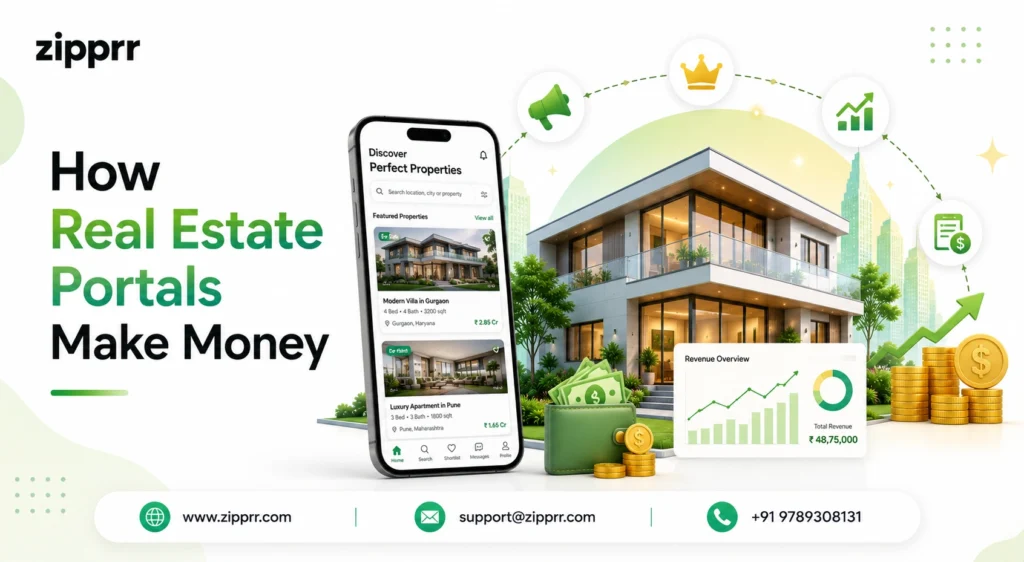
The base layer is agent subscriptions — recurring B2B revenue split across free, standard, and premium tiers that meter how many listings an agent can run, how visible they are, and how much data they see. Above that sit featured listings: pay to skip the queue, and since visibility translates straight into enquiries, it tends to be the platform’s best-converting product. Pay-per-lead turns intent into money — buyers who’ve searched and saved again and again are routed to agents one enquiry at a time, a performance model many agents now prefer over flat fees. New-development pages let builders buy a dedicated marketing slot for a whole project, where one campaign can reach five figures. And finance tie-ups — lenders, insurers, conveyancers — pay for co-branded spots and calculator integrations that genuinely help users while throwing off referral income.
The takeaway from Zillow’s own playbook: stack the streams, so a slow quarter in one is absorbed by the rest.
The Part Vendors Skip: Ranking in Google and AI Search
Here’s the awkward reality of 2026. You can launch a technically perfect portal and still pull in no visitors, because the entrance to search itself has moved. People don’t only type into Google’s familiar list of links anymore — they put the question to ChatGPT, Perplexity, Gemini, and Google’s AI Overviews. ChatGPT’s weekly audience has crossed the 800-million mark; Perplexity is fielding hundreds of millions of queries every month. Succeeding in 2026 means becoming the source these engines cite, not merely a page they happen to rank.
That calls for two overlapping disciplines: traditional SEO and the newer practice of Generative Engine Optimisation (GEO), also known as Answer Engine Optimisation (AEO). Four moves carry the most weight.
Spin Up Location Pages Automatically
The reason Zillow, Rightmove, and Realtor.com loom so large is millions of indexable pages pinned to specific places — “Apartments for Rent in [Area],” “3-Bedroom Homes in [Suburb].” Your clone ought to generate these on its own as listings arrive, never by hand. That one architectural choice is what snowballs, over time, into millions of organic impressions.
Open Every Page With a Direct, Fact-Dense Answer
The research on what AI engines quote is unambiguous: pages that start with a clean answer get cited noticeably more often — on the order of a quarter to a third more — and weaving in figures, sources, and structured pieces like tables and FAQs can lift AI visibility by close to half again. Mushy copy gets ignored; precise, number-backed copy gets quoted. “The typical two-bed here rents for $X a month” wins over “rents in the area are fair” every single time.
Stay Fresh and Structured
Recently updated material gets cited by AI Overviews several times more often than content left to age. A portal whose listings and neighbourhood pages refresh nonstop holds a built-in edge over a static brochure site. Reinforce it with schema markup on each listing — price, type, address, availability, agent — so engines can actually read your inventory and surface richer results.
Build Local Authority Early
Only a small slice of domains currently earn citations from both ChatGPT and Perplexity, so well-structured local content published now meets little competition for those mentions. The FAQ and blog pieces that answer genuine local questions — “How do I buy property in [country]?”, “What does [term] mean?” — are precisely what AI answers reach for at the city level, the exact place the global portals go quiet.
Most clone vendors hand you the listing engine and stop there. Visibility — across Google and the answer engines now sitting in front of it — is what separates a website that merely exists from a business that actually grows.
How Zipprr Compares to Other Zillow Clones
| Consideration | Typical Clone Vendor | Zipprr Zillow Clone |
|---|---|---|
| Pricing | Frequently quote-only or undisclosed; some bill monthly (e.g. ~$45/mo) | Published: $490 basic / $890 pro |
| Payment model | Recurring SaaS or hidden fees are common | Pay once |
| Source code | Often withheld or only partial | 100% source-code ownership |
| Mobile apps | Usually an extra | iOS & Android included |
| Support | Inconsistent | Post-launch support included |
| Built for AI/local search | Seldom addressed | Schema-ready, location-page architecture |
What a Launch Actually Looks Like
A clone compresses the build, but launching a marketplace is still a sequence of moves. A realistic start runs in three phases.
Week one is deploy-and-configure: brand it, set up your property categories (for sale, for rent, new builds, commercial), tune the filters to how people search locally, and fix your agent tiers and pricing. Week two tackles the cold-start problem head-on — recruit agents directly with an early-access deal: free listings for 90 days, featured placement, and personal onboarding, targeting 20 to 50 active agents and 200 to 500 listings before you open up, so no first visitor ever meets an empty site. From week three on, you open the doors and switch on demand: neighbourhood-level SEO, the location and FAQ content that feeds AI answers, social ads pointed at first-time buyers and renters, and Google Ads on high-intent local searches.
The agents who see real enquiries arrive in those opening weeks turn into your strongest salespeople — they bring in the next wave themselves. Before you commit, it’s worth taking a free product demo to walk through the workflow end to end.
Where the Best Regional Opportunities Are in 2026
A tightly focused regional portal can beat a national one simply by knowing its patch better. The most promising openings today: fast-growing emerging-market cities with no Zillow equivalent and surging smartphone use; university towns with dependable seasonal rental demand and thin local competition; resort and short-term rental markets where foreign buyers go hunting for holiday property; the luxury tier, where agents pay extra to reach serious buyers; and the still-nascent fractional-ownership space, where a dedicated platform barely exists yet.
Build the Portal Your Market Is Missing
Right now, in your target city, thousands of people are searching for a home through channels that waste their time. Whoever brings order to that search first — and keeps it fast, mobile, and quotable by the AI engines people now ask — locks in a position that’s very hard to dislodge. Zillow proved the model in a single country. Most of the world is still waiting for its own version.
Zipprr’s Zillow Clone hands you the full infrastructure to build it today, with the code in your hands and the price right there on the page.
Frequently Asked Questions
What is a Zillow clone script?
How much does it cost to build a website like Zillow?
What features does a real estate marketplace need?
What is IDX integration and why does it matter?
How do property portals make money?
Can I launch a portal for just one city or country?
Does a Zillow clone handle rentals as well as sales?
Yes — a Zillow clone runs for-sale and for-rent listings side by side, each with its own filters and flow, and can be paired with a dedicated property rental script for deeper rental management. Rentals often see heavier search volume and faster transaction cycles, which makes them a sensible first focus for a new platform.