

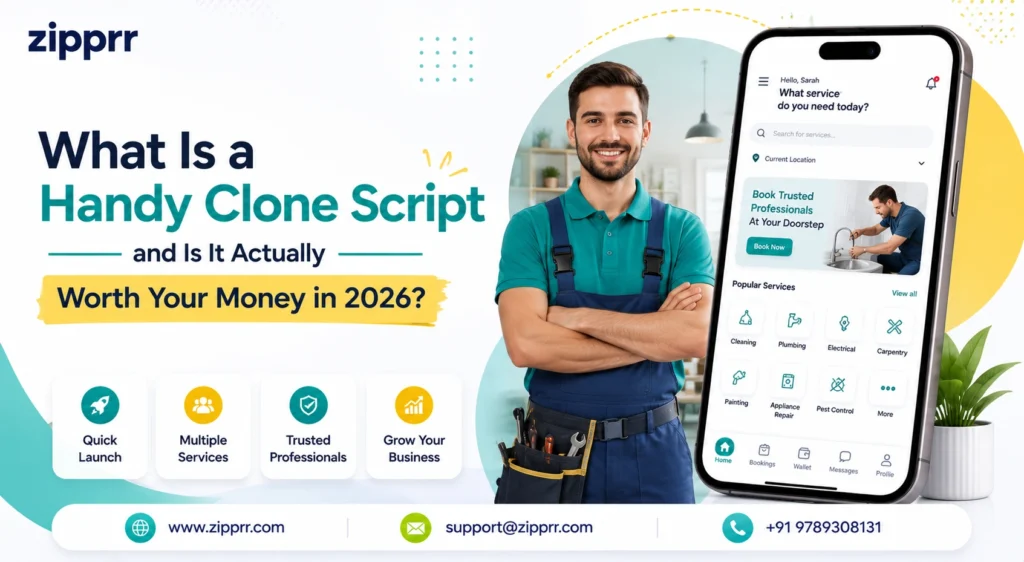
What Is a Handy Clone Script and Is It Actually Worth Your Money in 2026?
They wake up remembering they told their in-laws they were visiting this weekend, look at the state of the kitchen, and suddenly need someone, anyone, who can scrub a bathroom within three hours and won’t steal the cutlery.
That panic? That is your entire market.
Not the patient comparison-shopper. The one who needs it sorted before the guests show up. Millions of people land in exactly that moment every single day. In most cities globally, there is still no trustworthy app waiting to catch them when they do.
That is the business case for a Handy clone script. One paragraph. Done. Now, let us go deeper.
What Is a Handy Clone Script and Why Does the Name Sound Worse Than It Is?
A Handy clone script is ready-to-deploy software built to replicate the core mechanics of Handy.com. In this marketplace, property owners hire vetted professionals for domestic work through a mobile application. It ships as three connected pieces: an app for customers to place bookings, an app for tradespeople to manage incoming jobs, and a web dashboard for the operator to run the business. Purchase it once, receive the full underlying code, configure it under your own brand and service offering, and open for business without commissioning any original software development.
Here is the thing about the word “clone” that most articles will not say plainly.
It sounds like copying. It is not copying. It is the same logic behind buying an established restaurant franchise rather than reinventing the menu, the kitchen layout, the supplier relationships, and the training manual from nothing. The franchise model works not because the concept is stolen but because the operating system is proven. Your energy goes into running the business, not inventing the infrastructure.
Uber did not create satellite positioning. Airbnb did not invent the idea of renting a spare room. What both companies did was wrap existing capabilities inside a system elegant enough to make a complicated transaction feel routine. A Handy clone hands you that same type of system, the matching logic, the payment flow, the arrival tracking, the reputation engine, already assembled. You take it to a geography where it does not exist yet and make it yours.
That is not imitation. That is intelligent market entry.
How Does an On-Demand Home Services App Actually Function?
What the Customer Experiences, Boredom Is the Goal
Open the app. Pick a service. Choose a time. See the price. Confirm.
That five-step sentence is the entire customer journey if you build it well. The platforms that add a sixth step, a seventh, an eighth, lose a portion of their potential customers with each addition. Booking conversion data across consumer apps consistently shows a drop of around twenty per cent per unnecessary interaction point. The apps that win this category are not the most feature-rich. They are the most disciplined about what they removed.
Behind those five steps runs real engineering: live availability checks across all active providers within the service radius, dynamic time slot allocation, geographic job-to-provider matching, automated payment sequencing, and notification dispatch, all completing in under two seconds while the customer sees a clean, simple screen.
The customer never sees any of that. That invisibility is the product.
What the Provider Experiences, Dignity Drives Retention
A job notification arrives. Before the provider accepts anything, they already know four facts: what service is needed, which part of the city, which time slot, and precisely what they will earn after the platform takes its cut.
This sequencing, earnings disclosure before commitment, is a small design decision with disproportionate business consequences. Tradespeople who learn their take-home pay before accepting a job are measurably more likely to remain active on a platform month over month. They feel treated as professionals rather than processed as inventory. That distinction matters enormously when your supply base is the thing your entire customer promise depends on.
Once they accept, navigation opens with a single tap. When the work wraps, their income posts automatically. Job done, payment done. Their earnings update the moment they mark it complete. No invoice to send, no payment to chase, no awkward conversation about whether the cheque is in the post.
What the Operator Sees, Intelligence Not Just Data
Your administrative console is where the business actually lives. Approving incoming provider applications, watching live booking activity across your service zones, spotting categories that are generating unmatched requests, identifying providers whose on-time rate is quietly declining before customers start leaving reviews about it, these are not occasional tasks. They are daily operations.
Checking your admin panel once a month is like reading yesterday’s weather forecast. By the time the numbers reach you, the moment to act on them has passed. Book a job through your own app once a week. Experience what your customer experiences. That single habit will surface more actionable information than any dashboard ever built.
Why Does the Home Services Marketplace Opportunity Still Exist in 2026?
The Real Insight Behind the Market Statistics
The numbers are striking. The worldwide online home services sector reached $1,471 billion in value during 2025, and analysts project that figure crossing $1,862 billion by the end of 2026, a compounding annual expansion rate of 26.57 per cent. Seven in every ten consumers now prefer arranging a tradesperson digitally rather than dialling a number. Nearly seven in ten city-dwelling users book these services through their phones. And six in ten will abandon a booking entirely if they cannot see confirmed pricing and live provider tracking before they commit.
But the market size is not the real opportunity. Large markets with dominant incumbents are traps for new entrants, not invitations.
The real opportunity is fragmentation.
Handy has established itself across the United States, the United Kingdom, and Canada. Urban Company holds ground in selected Indian and Middle Eastern cities. TaskRabbit maintains a foothold in parts of North America and Europe. Stack those three together, and their combined geographic coverage sits somewhere around three hundred cities.
There are approximately ten thousand cities on this planet with a resident population above one hundred thousand people. The remaining nine thousand seven hundred are operating without a reliable equivalent platform. Many of them have smartphone penetration, disposable income concentration, and the tradesperson supply to support them right now.
That is not a niche. That is the majority of the addressable world.
Why Tradespeople Will Join Your Platform Before You Have a Single Customer
Something the Handy founding team understood instinctively: the supply problem in home services is easier to solve than the demand problem, because skilled tradespeople are suffering a more acute and daily version of the pain.
A capable plumber or professional cleaner does not have a skill shortage. They have a visibility shortage. Referral networks plateau. Paid advertising on search engines requires marketing expertise that most tradespeople actively dislike developing. Local listing directories generate a trickle of leads at unpredictable intervals.
A platform that promises consistent, pre-confirmed, prepaid work in their own service area, where they pay nothing unless they earn something, solves a frustration they wake up with on slow Tuesdays. Your earliest provider recruitment conversations should not feel like sales calls. They should feel like deliveries.
What Does It Actually Cost to Build Something Like Handy From the Ground Up?
Commissioning original development of a home services platform, covering the customer application, the provider application, a web-based operator dashboard, location-based job routing, payment infrastructure, and quality assurance testing, runs between $59,000 and $168,000 with a build window of five to nine months. Zipprr’s Handy Clone script provides the equivalent foundation at a substantially lower one-time cost, with complete code ownership, no subscription billing, and a setup window measured in days rather than quarters.
The Actual Cost of Building From Scratch, No Estimates Softened
Bring a development agency into the room and ask for a full home services marketplace. Here is roughly where your money is distributed:
Designing the interface across three separate applications, customer-facing, provider-facing, and administrative, costs somewhere between five thousand and twenty thousand dollars, depending on the studio and its market. Writing the customer application for both major mobile platforms runs from twelve thousand to thirty thousand. The provider application adds another ten to twenty-five thousand. The administrative console demands a further ten to thirty thousand. Backend architecture and the APIs connecting everything: twelve to twenty-eight thousand. Connecting payment processors and location services: five to twenty thousand. Testing, fixing, retesting, and submitting to app stores: five to fifteen thousand.
Total before scope creep: fifty-nine thousand to one hundred sixty-eight thousand dollars. Add roughly twenty per cent for the scope additions that arrive mid-project, because they always do.
Add five to nine months of calendar time before you process a single real transaction.
Now consider the alternative question: what becomes possible if that capital and those nine months go directly into building market position instead of building software?
What Zipprr's Handy Clone Script Actually Delivers
Purchasing Zipprr’s Handy Clone is an ownership transaction, not a licensing arrangement.
The complete underlying code is transferred to you. You host it on the infrastructure of your choosing. Any future modifications happen with any developer you select at any time. No monthly billing. No percentage of revenue flows back to a vendor. No exposure to a supplier’s pricing decisions five years from now.
The package covers the customer booking application for both major mobile operating systems, the provider job management application for the same platforms, a web-based administrative console, integrations with more than eight payment processors, location-based arrival tracking, in-application communication between customers and providers, a provider credentialing and approval workflow, a mutual ratings mechanism, configurable commission structures, and technical support through the launch process.
From purchase to live platform: one to two weeks.
The capital differential between this path and custom development is not a discount. It is a strategic reallocation, from building something that already exists toward acquiring the customers and providers who will determine whether your business succeeds or fails.
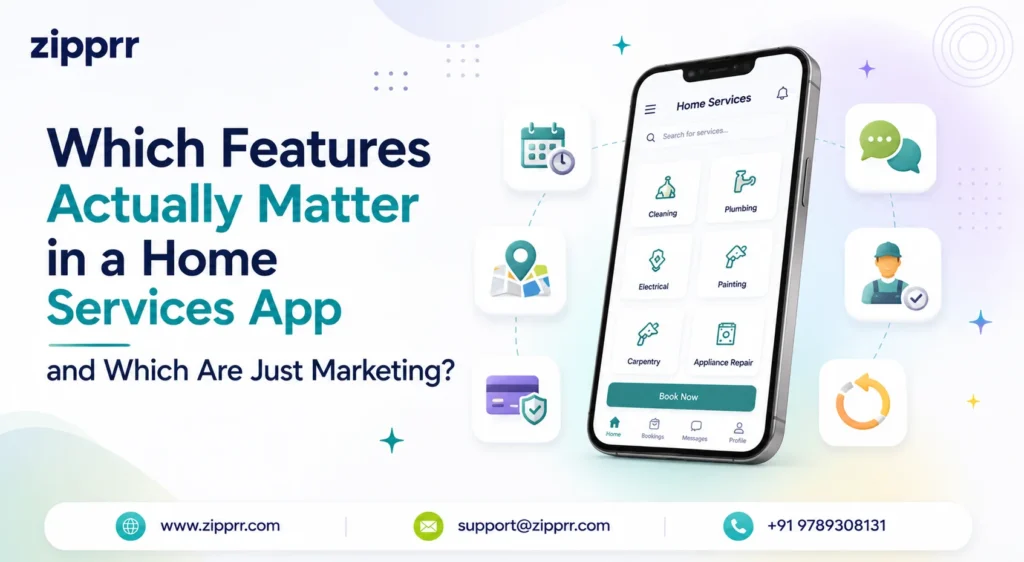
Which Features Actually Matter in a Home Services App and Which Are Just Marketing?
The Customer Features That Determine Your Retention Rate
Confirmed pricing before the booking completes. Not an approximate range. Not a “starting from” figure. The number. Customers who see their exact commitment before clicking confirm show higher completion rates and generate fewer post-service disputes. When the price shown and the price charged are always identical, trust builds automatically without you doing anything additional.
Four facts about the provider before acceptance. Their photograph, their name, their overall rating, and how many jobs they have completed in this category. That is enough. Customers in this category are not looking for an essay. They are looking for enough signal to feel comfortable. Those four data points provide it.
Arrival tracking during transit. Platforms that add this feature typically see their inbound customer service contacts about provider whereabouts drop by roughly half. Being eleven minutes away feels completely different from being an unknown quantity. It is the same journey either way. The tracking changes the emotional experience of waiting.
Previous provider rebooking in a single action. Most long-term revenue in this category comes from customers who repeat. Customers who had a satisfying experience with a specific person want to book that person again. If they can do it in one tap from their history, they will. If it takes navigating through a general search and hoping that the person appears available, a meaningful portion will not bother. This is where well-designed platforms quietly build loyalty and poorly-designed platforms quietly lose it.
The Provider Features That Determine Whether Your Supply Stays Active
Earnings visible before commitment. Worth stating a second time because the data behind it is compelling. Providers who see their net income before accepting a job show materially higher platform retention over twelve months than those kept in the dark until after acceptance. It is a design choice that costs nothing to implement and pays in compounding supply stability.
Genuine schedule autonomy. Tradespeople who can block their own unavailable times, set their active hours by day, and pause their availability without penalty remain on a platform three to four times longer than those who feel the platform controls their calendar. Their schedule exists as an asset they own. Design accordingly.
Payment that posts without action on their part. A job completion should trigger automatic earnings crediting. The provider marks the work done. Their balance updates. Nothing else is required from them. Any system that requires a separate claim, a scheduled batch, or an outbound request introduces friction that compounds into resentment over hundreds of transactions.
The Three Admin Metrics That Tell You Where the Business Actually Stands
Unmatched booking rate, broken down by geographic zone, tells you where your supply is thin. When a booking request goes out, and no provider picks it up, that is a lost customer and a map coordinate showing you exactly where to recruit next.
Per-provider metrics beyond the aggregate rating, specifically the proportion of jobs completed on time, the rate at which customers rebook the same provider, and the cancellation frequency, give you a performance picture that star scores alone will never reveal. A provider with a 4.2 rating who completes 96% of jobs on time and has a 40% rebook rate is a different asset from one with a 4.4 rating and a 20% rebook rate.
Category-level margin shows you which services are subsidising which. Volume and profitability are rarely distributed the same way. Cleaning might represent sixty per cent of your bookings but forty per cent of your margin. Electrical might represent twelve per cent of bookings and twenty-five per cent of margin. These numbers determine where you invest in growth.
Who Are the Customers Who Will Actually Make Your Unit Economics Work?
The High-Value Segments Nobody's Acquisition Campaign Targets
The individual homeowner who books once a month is a pleasant customer to have. They are not the customer who makes your business viable at scale.
The customers who underwrite the whole operation are the ones whose booking frequency is driven by something external to their mood. The dual-income household that outsources cleaning not because they feel like it, but because neither person has time for it, and the math works at their income level, they book every fortnight regardless of circumstance. One genuinely good provider experience,ce and they are gone for years without further acquisition cost.
The short-term rental host who runs three properties on Airbnb has a turnaround cleaning requirement attached to every checkout. Their booking frequency is not a lifestyle preference. It is a business necessity. One account. Predictable revenue locked to someone else’s calendar.
The property management professional overseeing a portfolio of fifteen apartments generates more monthly transactions than thirty individual homeowners. Harder to reach, but once they trust the platform, they are effectively a recurring revenue contract with legs.
Most home services platforms build customer acquisition campaigns targeting “homeowners aged 28 to 45” without distinguishing between these segments. That imprecision is expensive. The business that figures out how to specifically acquire the third and fourth type, before the competition does, compounds its way to profitability faster than any commission rate optimisation will achieve.
The Provider Reality That Separates Good Platforms From Great Ones
Your service professionals are not uniform inputs into a booking engine. The top twenty per cent of your provider base, the ones customers request specifically, the ones whose acceptance rate never drops below ninety per cent, the ones who generate five-star write-ups rather than silent three-star clicks, produce a wildly disproportionate share of your rebooking revenue and a majority of your reputation.
Every one of those providers deserves to know it. A reduced commission tier after fifty completed jobs costs you margin on your best operators while locking in the supply relationships that drive your highest-value customer behaviour. The arithmetic is overwhelmingly positive. Most platforms never run it.
The bottom twenty per cent, meanwhile, are not neutral. A provider who arrives late reliably, generates complaint tickets consistently, and produces low scores across dozens of jobs is damaging your reputation with every booking they complete. The instinct to retain any active supply is understandable. It is wrong. Removing a consistently poor performer protects more revenue than finding their replacement would cost.
How Does a Home Services Marketplace Make Money Beyond the Commission Everyone Mentions First?
Commission Is Where Revenue Starts, Not Where It Stops
Every completed booking earns you a percentage. For cleaning and similarly high-frequency categories, that typically sits somewhere between fifteen and twenty-two per cent. For specialist trades, such as plumbing and electrical work, where individual job values run higher, the sustainable rate tends to run between thirteen and eighteen per cent. This is your revenue baseline. It grows in direct proportion to transaction volume and shrinks with it equally.
A business entirely dependent on commission income has revenue as predictable as the weather. Healthy platforms layer in income streams that arrive whether or not any particular job gets booked today.
Provider Subscriptions, The Income Most Operators Stumble Into Rather Than Plan For
Once your provider base in a given category reaches forty or fifty active members, competition for available time slots begins. At that point, standing out in search results has a real monetary value to the tradespeople who depend on your platform for a significant portion of their income.
A monthly subscription, priced somewhere between twenty-nine and seventy-nine dollars depending on your market’s earning levels, that provides elevated placement above non-subscribing providers is a purchase many of them will make readily. They have the income context to evaluate the return. You have the platform position to deliver the placement.
This revenue posts monthly. It compounds as your provider base grows. It arrives irrespective of whether any individual booking happens that day. In the weeks where transaction volume dips, subscription income is what maintains operational stability.
Dynamic Pricing in High-Demand Windows
Public holidays. The fortnight before Christmas. The cleanup period following major weather events. Demand in these windows spikes sharply. Provider availability does not expand to match. Customers who need a service urgently will pay more for confirmation than they would during a quiet midweek afternoon.
A pricing multiplier applied transparently during these windows, shown to customers before they confirm, shared honestly with providers who take those high-demand jobs, generates more revenue per transaction without requiring any change to your standard commission structure. Platforms that leave this mechanism unbuilt are leaving their most profitable trading periods undermonetised. They are also running out of available providers during precisely the moments customers most need them.
Cancellation Policy as a Revenue and Trust Mechanism Simultaneously
When a customer cancels a confirmed booking ninety minutes before the scheduled arrival, the provider loses a time slot they could have filled. A modest fee for late cancellation, somewhere between ten and twenty dollars, is widely considered fair, compensates partially for that loss, discourages casual booking behaviour from customers who treat confirmation as tentative, and funds the customer service resource that handling cancellation disputes requires.
The key is transparency at the point of booking, not discovery in a terms page. Customers who understand the policy when they confirm it feel far less aggrieved when it applies than customers who encounter it as a surprise.
Is a Niche Home Services Platform Smarter Than a General One for a New Market?
Why Starting Narrow Is Not Thinking Small
A general home services launch requires a simultaneously viable supply base across six to ten service categories. Cleaners, handymen, plumbers, electricians, painters, pest controllers, you need enough of each to make any given zone feel populated to customers, and you need those customers before providers see enough work to stay active. The two requirements feed each other in reverse, and paralysis is the most common outcome.
A single-category launch collapses this to a solvable problem. Build your cleaner supply in one city. Acquire the customers who need cleaning. Demonstrate that the economics work. Then introduce a second category with the same method into a market that already trusts your name.
This is not a smaller ambition. It is a sequenced one.
Four Category Opportunities With Negligible Competition Right Now
Airbnb turnover cleaning. Hosts who list properties on short-term rental platforms live inside a recurring operational pressure: getting a property guest-ready between a checkout at eleven in the morning and a three o’clock check-in. A cleaning platform built around their specific timing constraints, their linen protocols, and their property access requirements is a fundamentally different offering from a generic booking app. Hosts will pay more for something that understands their actual operational reality.
Post-renovation deep cleaning. Construction and renovation projects leave properties in states that require specialist cleaning before they are habitable. The clients commissioning those renovations are already spending significant money and are not particularly price-sensitive about the cleanup bill. The job values are three to five times standard residential cleaning. The competitive landscape is essentially unorganised.
Appliance repair. A broken washing machine is an urgent problem. The people experiencing it are not browsing comparison sites. They want a competent technician today. The search volume for appliance repair terms is substantial. The organised digital supply side is almost nonexistent.
Senior home maintenance. Adults in their seventies and eighties own homes. They need regular assistance with physically demanding small maintenance work: clearing gutters, changing bulbs at height, adjusting sticking doors, and weatherproofing windows before winter. This customer is extraordinarily loyal once trust is established and extraordinarily unlikely to switch platforms for marginal pricing differences.
How Long Does It Realistically Take to Go From a Purchase Decision to a Live Paying Customer?
Configuring and deploying a Handy clone script to a production environment takes one to two weeks. Building a founding provider cohort through direct recruitment takes a further one to two weeks to run concurrently. A closed testing period with a small invited group of genuine customers adds approximately one week. Most operators reach their first paid public booking within four to six weeks of the purchase date. The equivalent custom-built platform takes five to nine months to reach the same milestone.
Days One to Seven, Make the Product Work Before Anyone Sees It
Establish your brand configuration: name, visual identity, and domain assignment. Define your opening service categories; three is a better number than ten at this stage. Set your pricing model, your commission rate, and the geographic boundaries of your launch zone. Connect your chosen payment processor. Then complete a full transaction cycle yourself: place a booking as a customer, accept it as a provider, mark it complete, verify the payment posted, and submit a rating. Do this several times across different scenarios.
Release nothing to the public until the product works without exception from end to end.
Days Eight to Fourteen, Build Supply Before You Touch Demand
A marketplace with thirty vetted providers and no customers is a business with potential. A marketplace with a hundred eager customers and five available providers is a reputation crisis.
Go where tradespeople are, not where they might see an ad. Local trade association gatherings. The waiting area at a wholesale trade supplier. Facebook communities for professionals in your target category. Open every conversation with the income reality, not the technology story: consistent, pre-confirmed, prepaid work in their local area, at no upfront cost, with a cut only taken when they earn.
Offer your founding providers three specific commitments: a reduced commission rate through their first ninety days, guaranteed elevated placement at the top of category results, and a minimum booking assurance for their opening month. If the jobs do not materialise at a minimum threshold, you cover the shortfall yourself. That last point removes the largest hesitation most skilled tradespeople feel when evaluating a new platform.
Week Three, Real Bookings With Real People Before the Public Launch
Invite sixty people from your personal network to make an actual booking. Pay for a real service. Not to explore the app. Not to leave feedback on the interface. To complete a genuine transaction and tell you honestly what felt wrong.
This controlled period will reveal things about your platform that no internal test session ever surfaces. Fix every one of those things before a stranger encounters them.
Week Four and Beyond, Acquire Publicly, Track Relentlessly
Local media outreach. Geographically targeted advertisements reaching homeowners within your service zones. Search advertisements on terms with clear, immediate intent. A referral mechanism rewarding customers who bring someone new with credit applied to their next booking.
Measure three operational indicators without exception every week. What share of your active providers completed at least one job this week? Thatt is your utilisation signal. What proportion of customers who completed one booking returned within sixty days? That is your retention signal. How many minutes passed between a booking request appearing and a provider accepting it? That is your supply density signal. These three data points tell you the state of your business more accurately than any revenue chart.
Which Handy Clone Script Is Worth Buying in 2026?
Three questions determine this. Does the vendor show you the price before you engage with their sales team? Do they let you use the platform before you purchase it? Do you own the software outright after the transaction completes?
Running those questions across the available options produces a clear picture.
Zipprr publishes its pricing openly. A working demonstration is available before purchase. The complete codebase transfers to the buyer permanently, with no ongoing subscription billing and no revenue participation from the vendor. Post-launch technical assistance is included.
Migrateshop charges between three thousand eight hundred and five thousand eight hundred dollars and offers no demonstration option. Oyelabs, Sangvish, Appscrip, and v3cube all withhold their pricing until you initiate contact, and none provide a working demo for evaluation.
A vendor who requires a sales conversation before disclosing pricing is structuring the interaction in their interest. A vendor who sells you software you cannot test before buying is asking for significant trust with limited accountability. For a purchase that forms the operational foundation of a business you intend to grow, those two omissions are not minor inconveniences.
Zipprr is currently the only provider in this category that satisfies all three evaluation criteria simultaneously.
One Last Honest Thing
Most home services businesses that fail do not fail because they bought the wrong software.
They fail because the founder miscalculated how much operational work two-sided marketplace supply development actually requires in a geography where neither side of the market knows the platform exists yet.
A Handy clone removes exactly one problem from that equation. The software problem. It removes it completely and immediately.
What remains is the real work: earning provider loyalty, earning customer trust, and expanding one city at a time with the discipline to not outgrow your operational capacity before your business model is proven.
That work is genuinely difficult. It is also the right kind of difficult, the kind where the outcome is a business with compounding network effects in a market that needed you to show up.
If that is what you are building toward, Zipprr’s Handy Clone is where the software chapter of the story ends, and the business chapter begins.
FAQ
What is a Handy clone script in plain terms?
What is the realistic cost of building a home services app from scratch in 2026?
Professional development of the complete package, customer application, provider application, administrative console, geographic matching, payment infrastructure, and quality testing runs from $59,000 to $168,000 with a build timeline of five to nine months. That range assumes a competent offshore development team working to a clear specification, scope additions excluded. Zipprr’s Handy Clone covers the same functional ground for a one-time payment well below that range, with complete code ownership and a configuration window of one to two weeks.
What features does a home services booking app genuinely need to compete?
Through what mechanisms does a home services platform generate income?
How does a Handy clone differ from a TaskRabbit clone in practice?
The operational philosophy behind each is distinct. Handy sets the price centrally and routes the job to the most suitable available provider automatically. The customer confirms, the system dispatches, and the transaction proceeds without further selection steps. TaskRabbit presents individual provider profiles with their own quoted rates and invites customers to browse and hire directly. Handy’s approach is faster and demands less decision-making at the moment of purchase. TaskRabbit’s approach provides customers with more agency but introduces comparison steps that extend the booking timeline. A configurable handyman clone script can be set up to follow either model; the appropriate choice is determined by how much friction your target customer finds acceptable in exchange for control.
How do you build a provider base before your platform has customers?
Can someone without technical experience operate a Handy clone script?
Yes. Zipprr’s Handy Clone is designed for business operators rather than software professionals. The technical deployment is handled by Zipprr’s team during setup. Everything that follows, category configuration, pricing adjustment, provider application review, active booking oversight, promotional campaign management, and reading your operational analytics, runs through an administrative interface designed for clarity rather than technical sophistication.