
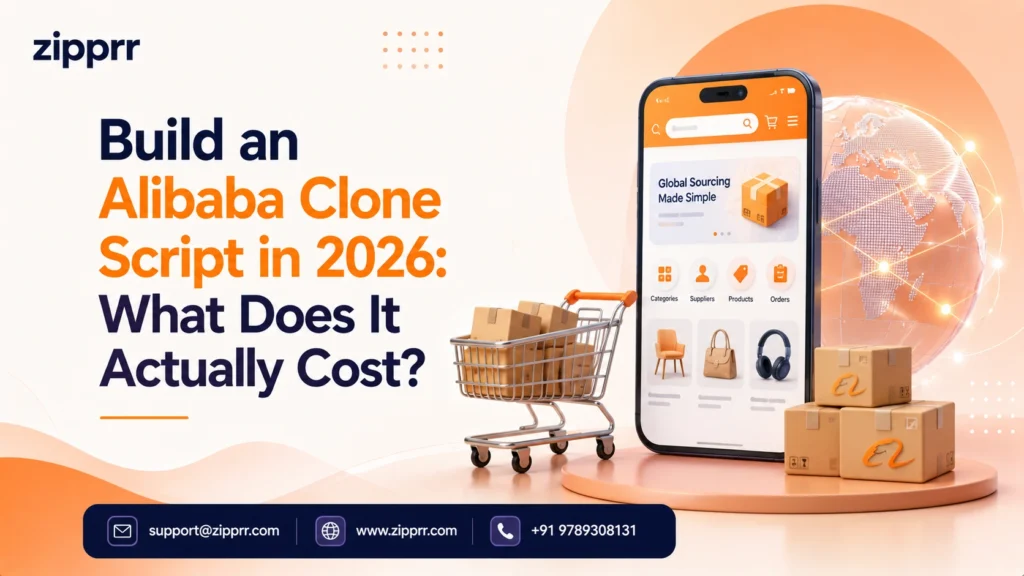
An Alibaba clone script costs between $490 and $890 as a one-time purchase, which is the current pricing of Zipprr’s Alibaba Clone Script, while building a comparable B2B wholesale marketplace from scratch typically runs $50,000 to $250,000 or more and takes six to twelve months. The script route gets you live in 3–7 business days with full source code included. This guide breaks down exactly what you pay for in each approach, the hidden costs founders forget to budget, and how quickly a B2B marketplace can start generating revenue.
What Exactly Are You Paying For in an Alibaba Clone Script?
A common worry with low sticker prices is that the software must be a stripped-down demo. In practice, the price covers a complete B2B ecommerce platform because the expensive engineering work (the wholesale-specific features that make Alibaba different from a retail store) has already been built once and is resold many times. That is the entire economic logic of the clone-script model.
The Alibaba Clone Script ships with the features that define B2B trade rather than B2C shopping:
- Request for Quotation (RFQ): buyers post requirements and suppliers bid, the core deal-making mechanism on any wholesale platform
- Minimum Order Quantity (MOQ) controls per product and per supplier
- Tiered bulk pricing that automatically drops the unit price as order volume rises
- Hidden or on-request pricing for negotiated wholesale deals
- Part-payment support for large orders, plus escrow-style payouts that hold funds until delivery terms are met
- Verified supplier profiles, custom invoicing, multi-vendor storefronts, and multi-currency and multi-language support for cross-border trade
If you are still weighing whether your business idea needs these wholesale mechanics at all, this overview of what B2B ecommerce software includes is a useful starting point: the short version is that RFQ, MOQ, and tiered pricing are precisely the features a standard retail cart lacks.
What Do the Two Pricing Plans Include?
The Basic plan ($490 one-time) covers the full web platform with separate buyer, supplier, and admin panels. The Pro plan ($890 one-time) adds native Android and iOS apps plus app store submission assistance. Both plans include 100% unencrypted source code, free server installation, 90 days of technical support, lifetime product updates, and a 7-day money-back guarantee. There are no recurring license fees, a meaningful difference from SaaS marketplace builders that charge monthly forever.
How Much Does Custom B2B Marketplace Development Cost by Comparison?
Custom development quotes vary enormously by region and agency, but the industry ranges are consistent enough to budget against. Here is how the two paths typically compare for a marketplace with Alibaba-style functionality:
| Cost Factor | Custom Development | Alibaba Clone Script |
|---|---|---|
| Upfront software cost | $50,000–$250,000+ | $490–$890 one-time |
| Time to launch | 6–12 months | 3–7 business days |
| Mobile apps | Often quoted separately ($20,000+) | Included in Pro plan |
| Source code ownership | Yes (negotiate in contract) | Yes, included |
| Server installation | Extra or DIY | Free, included |
| Ongoing license fees | None, but maintenance retainers common | None |
| Feature risk | Scope creep and rebuild cycles | Features pre-built and tested |
The honest caveat: custom development buys you unlimited architectural freedom. If your model depends on genuinely novel functionality no existing platform has, custom may be justified. For the large majority of founders launching a wholesale B2B marketplace with proven mechanics, paying 50–200x more to rebuild RFQ and MOQ systems that already exist is difficult to defend. The same build-once, sell-many economics apply across Zipprr’s wider marketplace script catalog, which is why the pricing gap is so consistent
Want to see the platform before spending anything?
Book a free one-on-one demo of the Alibaba Clone Script, or message the Zipprr team directly on WhatsApp, or email [email protected] with your requirements.
What Hidden Costs Should You Budget For Beyond the Script?
The script price is not the whole launch budget, and pretending otherwise helps nobody. A realistic first-year budget for a script-based launch should also include:
- Hosting: a capable VPS or cloud server, commonly $20–$100/month at launch scale. Installation itself is free with the script.
- Payment gateway fees: transaction-based charges from your chosen gateway (typically 2–3% plus a fixed fee per transaction, varying by country).
- Branding and customization: logo, color scheme, and copy changes are self-service; deeper custom features may need paid development time.
- Supplier acquisition: the real cost of any marketplace. Budget time or money for recruiting your first 50–100 verified suppliers, because an empty marketplace earns nothing.
- Marketing and SEO: ongoing content, listings, and ads to bring buyers to the platform.
- Support beyond 90 days: extended technical support after the included window, if you want it.
Even with all of these, a script-based launch usually stays under a five-figure first-year budget, a fraction of the custom-build software cost alone.
Build vs Buy: Which Makes Financial Sense for Your Situation?
The decision usually reduces to three questions. First, is your differentiation in the software or in the market? Most successful niche B2B marketplaces win on supplier relationships, category focus, and trust, not on proprietary code. Second, how fast do you need validation? A 7-day launch means you can test real supplier and buyer demand this month instead of next year. Third, what happens if you need to pivot? Losing a $890 experiment is survivable; abandoning a $150,000 build is not.
It is also worth matching the platform to your actual model before buying anything. If your vendors will sell single units to consumers rather than bulk orders to businesses, a multi-vendor retail platform like the Amazon Clone is the better fit. The Alibaba Clone is specifically the right choice when your buyers are businesses purchasing in bulk: wholesalers, distributors, manufacturers, and importers
How Quickly Can an Alibaba-Style Marketplace Start Earning Revenue?
Because the monetization modules are pre-built, revenue can begin as soon as transactions do. The platform supports five income streams out of the box:
- Transaction commissions: typically 2–10% per order, set from the admin panel
- Supplier subscription tiers: recurring fees for premium seller accounts
- Featured and promoted listings: suppliers pay for visibility
- RFQ and lead fees: charging suppliers for access to buyer requests
- Banner advertising: selling placements once traffic grows
A practical sequencing note from how established B2B platforms grew: start with free supplier onboarding and commissions only, then introduce subscriptions and featured listings once suppliers see consistent buyer activity. Charging for everything on day one is the most common self-inflicted wound in marketplace launches. This commission-first sequencing holds across marketplace models: cross-border consumer platforms built on the AliExpress Clone follow the same playbook, just with retail order values instead of wholesale ones.
Conclusion: Budget for the Marketplace, Not Just the Software
The direct answer to “how much does an Alibaba clone script cost” is $490–$890 one-time. The smarter framing is that the script converts your software budget from the largest launch cost into the smallest one. That frees real capital for the things that actually determine whether a B2B marketplace succeeds: recruiting credible suppliers, building buyer trust, and marketing consistently. With custom development, most founders run out of money before they ever get to test those things. With a script, the market test starts next week.
Ready to price out your own launch?
Explore the Alibaba Clone Script and schedule a free demo, chat on WhatsApp (+91 97893 08131), or email [email protected] for a walkthrough tailored to your niche.