

AI lawyer software is legal technology that uses artificial intelligence to draft documents, review contracts, track deadlines, and manage billing inside a law firm or legal business. Most buyers choose between three paths: subscribing to a hosted product, commissioning custom development, or licensing a ready-made platform such as AI Lawyer software that ships with its source code and runs on infrastructure you control.
This guide explains what the software actually does, how the technology works underneath the marketing, what it costs across its full life, not just the sticker price, and how to evaluate any vendor before you sign. Nothing here is legal advice.
Zipprr’s AI Lawyer software is used throughout as a worked example of the source-code-included model, because it publishes its pricing and feature list openly. All Zipprr-specific claims in this guide, including pricing, features, security certifications, integrations, and licence terms, are drawn directly from Zipprr’s official AI Lawyer product page and are labelled as vendor claims, not independently audited facts. Confirm current terms directly with the vendor before purchase, since pricing and features can change.
Build vs Buy vs Subscribe: Which Approach Is Right?
| Option | What It Means | Typical Buyer | Main Advantage | Main Limitation | Cost Considerations | Time-to-Market |
|---|---|---|---|---|---|---|
| Subscribe | Licence a hosted product; vendor owns and runs it | Firms wanting zero infrastructure responsibility | Fastest start, vendor-managed security and updates | No code access, per-seat cost compounds, roadmap not yours | Recurring per user, often annual commitments | Days to weeks |
| Build custom | Commission bespoke software | Firms with unusual workflows and real budget | Exact fit, full ownership | Highest cost and risk; you own every bug forever | Large upfront development plus permanent maintenance | Many months to years |
| Buy source-code-included | One-time licence for a ready-made platform you self-host | Firms and legal businesses wanting control without building | Source-code access, subject to licence terms; no per-seat fees; deep customisation potential | You carry hosting, security and maintenance; support window is finite | One-time licence plus ongoing infrastructure and AI usage | Days to weeks for base deploy; longer if customising |
Important: licensing is not a fourth buying model. For every option above, verify installation, modification, branding, transfer, resale, and sublicensing rights separately. Source code being included does not by itself grant unrestricted commercial rights.
There is no universally correct answer. A two-partner firm with standard workflows and no technical staff is usually better served by a subscription. A firm with a developer on retainer, distinctive processes, or a strong preference for holding its own client data often prefers the third path. Custom builds make sense when the workflow genuinely has no market equivalent, which is rarer than it feels during a demo.
What Is AI Lawyer Software?
AI lawyer software is a category of legal technology platform that applies artificial intelligence to the repeatable parts of legal work. The name is imprecise: these systems do not practise law and are not lawyers. They are tools that a licensed professional supervises.
There is no single established industry taxonomy for this market. For this guide, it is useful to think of the category in three overlapping groups:
Research and drafting assistants. Products aimed at the substantive work of a matter: finding authority, summarising a record, producing a first draft of a memo or motion.
Contract analysis tools. Systems built around agreements: extracting clauses, scoring risk, flagging missing provisions, comparing a counterparty’s paper against a house playbook.
AI-native practice management platforms. The broadest group. These combine matter management, client intake, calendaring, time tracking, trust accounting, and billing with AI features layered across all of it. This is where most small and mid-size firms end up, because a drafting tool that does not know about your matters, deadlines, or billing rates only solves a fraction of the problem.
Zipprr’s AI Lawyer software sits in that third group. It is marketed as an AI-native legal practice management platform covering drafting, contract review, intake, deadline tracking, and billing, sold as a one-time licence with the full source code included so the buyer hosts it themselves.
A related but distinct term is white-label legal software, a platform you can rebrand with your own name, domain, and visual identity. Rebranding rights and resale rights are not the same thing, and the difference matters commercially. We return to it below.
How Does AI Lawyer Software Work?
Most current legal AI shares a common architecture, regardless of vendor.
Large language models do the generation and summarisation. Some vendors build on general-purpose commercial models, some fine-tune their own, and many will not say. Model choice affects cost, latency, and where your data travels.
Document ingestion and retrieval is the unglamorous half. The system parses PDFs, Word files, and scanned images, splits them into passages, indexes them, and retrieves the relevant portions when a user asks a question. This retrieval step, often called retrieval-augmented generation, is why a well-built tool can answer questions about your 180-page agreement rather than about contracts in general.
Templates and structured logic handle anything that must be exactly right. Court caption formats, jurisdiction-specific headings, LEDES billing fields, and limitation-period calculations are typically driven by rules and templates, not by free-form generation, because a model that improvises a filing deadline is a liability.
A firm-specific knowledge base is what separates a generic chatbot from a useful assistant. Zipprr states on its product page that its platform can search across a firm’s own documents and precedent library, which is the pattern most vendors in this space describe.
One caution about vendor claims: phrases like “trained on statutes and case law” are common in legal AI marketing and frequently overstated. A system that retrieves from a licensed legal database is doing something quite different from a model trained on that corpus, and the two have different accuracy and licensing implications. Zipprr does not publicly disclose its model architecture, and neither do most vendors in this category. Ask directly, in writing, before you buy.
What Can AI Lawyer Software Do?
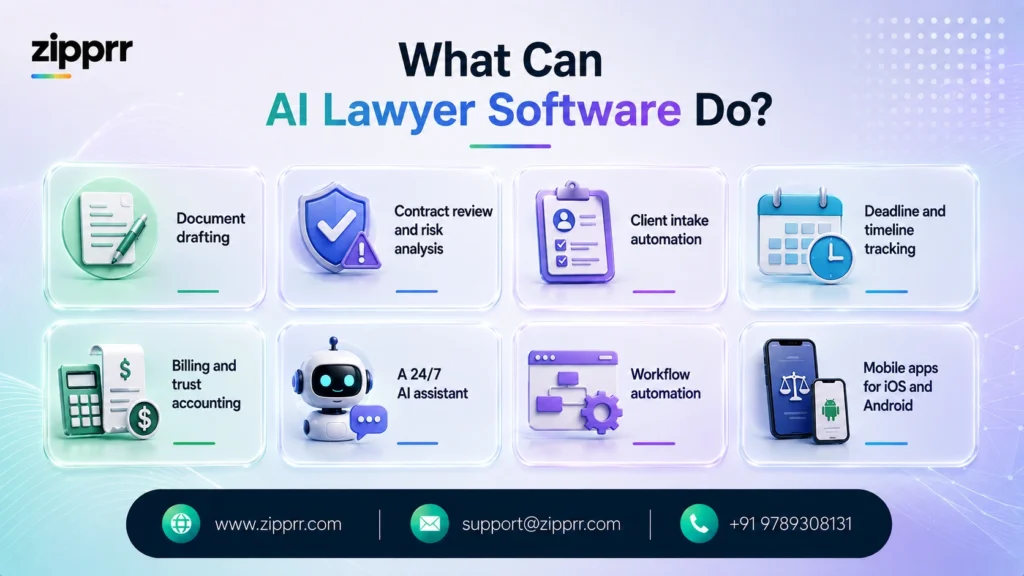
Concrete capabilities, not abstractions. Taking Zipprr’s AI legal-tech software as a worked example, all capability descriptions below are as stated on its product page and should be treated as vendor claims:
- Document drafting across a large template library, with jurisdiction-aware captions and citation formatting covering US states and federal circuits.
- Contract review and risk analysis, including clause-level risk scoring on a Critical / Review / Standard scale, obligation mapping, missing-clause detection, and a comparison or redline mode against a reference document.
- Client intake automation: adaptive intake forms, conflict checking, automatic case file creation, and client portal credential delivery.
- Deadline and timeline tracking tied to court rules, statutes of limitations, and immigration filing dates, with escalating alerts at 30, 14, 7, 3 and 1 days, syncing to Google Calendar and Outlook.
- Billing and trust accounting: LEDES 1998B and XML export, UTBMS task codes, IOLTA trust accounting with three-way reconciliation, time capture, invoicing, and Stripe payment links.
- A 24/7 AI assistant that searches the firm’s own documents and precedent library.
- Workflow automation via a set of pre-built templates and a no-code builder.
- Mobile apps for iOS and Android with offline access.
Zipprr also publishes performance and speed claims, including draft-generation and contract-review times such as a first draft in under five minutes and a 200-page contract reviewed in under ten. Treat these as vendor-reported claims and test them against your own documents, workflows, and accuracy requirements rather than taking them as independently verified benchmarks.
Key Features to Look For in AI Lawyer Software
| Feature Area | Why It Matters | What To Verify |
|---|---|---|
| Drafting template coverage | Determines how much real work the tool absorbs | Number and relevance of templates to your practice areas |
| Jurisdictional formatting | Wrong captions and citation formats create rework | Which courts and states are actually supported |
| Contract analysis depth | Clause extraction is easy; obligation mapping is not | Ask for a redline on your own agreement |
| Firm knowledge base | Generic answers have low value | How your documents are indexed and who can access them |
| Intake and conflicts | Ethical exposure sits here | Conflict-check logic and audit trail |
| Deadline engine | Errors can have serious consequences | Source of court rules and how updates are delivered |
| Billing and trust accounting | Where compliance failures get expensive | LEDES/UTBMS support, three-way reconciliation |
| Integrations | Determines migration pain | Calendar, e-signature, accounting, payments, DMS |
| Roles and permissions | Ethical walls, staff access | Granularity of role controls |
| Security posture | Client confidentiality | Encryption at rest and in transit, certifications, data residency |
| Deployment model | Controls cost and data custody | Vendor-hosted vs self-hosted |
| Source code access | Determines long-term flexibility | Is code included, and under what licence |
Zipprr’s product page states 50+ integrations including Google Calendar, Outlook, Stripe, PayPal, QuickBooks, Xero, DocuSign, Adobe Sign, Dropbox, Google Drive, Zoom, Microsoft Teams, Twilio SMS, LexisNexis, Westlaw and Zapier, plus an API and webhooks, along with one-click migration from Clio, MyCase and PracticePanther. On security, Zipprr states its platform holds SOC 2 Type II certification, uses AES-256 encryption with TLS 1.3, processes documents in isolated encrypted sessions that are said to be neither stored nor used for AI training, and offers GDPR and CCPA readiness with five-region data residency, and it markets this architecture as supporting attorney-client privilege. All of these are vendor representations from Zipprr’s own product page, not independently verified facts, and none should be read as a legal determination that privilege will apply in every jurisdiction or circumstance. Ask for the SOC 2 report itself rather than accepting the certification claim on the webpage, and have counsel review the applicable terms, data-processing arrangements, and technical documentation before relying on any vendor’s security description.
Benefits of AI Lawyer Software

The honest case for this software rests on four things.
Recovering unbilled time. Time that never makes it onto a timesheet is the quietest form of revenue loss in a small firm. Automatic time capture and structured billing codes reduce that leakage. How much is firm-specific; be sceptical of any vendor that quotes you a universal percentage.
Shortening the first-draft cycle. AI is genuinely good at producing a structured starting point from a set of facts. It is not good at being the final word. The gain is in the gap between blank page and reviewable draft.
Consistency. A playbook-driven contract review applies the same standards on a Friday afternoon as on a Monday morning. So does a deadline engine.
Client responsiveness. Portals, automated intake acknowledgements, and an assistant that answers routine status questions reduce the volume of low-value calls.
What it does not do: exercise judgment, take responsibility, or absolve a supervising attorney of the duty to check the output. Platforms like Zipprr’s AI legal-tech software are positioned to support that judgment, not substitute for it.
AI Lawyer Software Use Cases
The honest case for this software rests on four things.
Recovering unbilled time. Time that never makes it onto a timesheet is the quietest form of revenue loss in a small firm. Automatic time capture and structured billing codes reduce that leakage. How much is firm-specific; be sceptical of any vendor that quotes you a universal percentage.
Shortening the first-draft cycle. AI is genuinely good at producing a structured starting point from a set of facts. It is not good at being the final word. The gain is in the gap between blank page and reviewable draft.
Consistency. A playbook-driven contract review applies the same standards on a Friday afternoon as on a Monday morning. So does a deadline engine.
Client responsiveness. Portals, automated intake acknowledgements, and an assistant that answers routine status questions reduce the volume of low-value calls.
What it does not do: exercise judgment, take responsibility, or absolve a supervising attorney of the duty to check the output. Platforms like Zipprr’s AI legal-tech software are positioned to support that judgment, not substitute for it.
AI Lawyer Software Use Cases
| Practice Setting | Primary Use | What AI Actually Contributes |
|---|---|---|
| Solo and small firms | Everything, thinly staffed | Drafting speed, intake automation, billing hygiene |
| Mid-size litigation firms | Document-heavy matters | Summarisation, deadline tracking, discovery triage |
| Immigration practices | High-volume, form-driven filings | Template assembly, filing deadline monitoring |
| Corporate and transactional | Contract throughput | Clause risk scoring, redlines, obligation extraction |
| In-house legal teams | Contract intake from the business | Playbook enforcement, first-pass review |
| Legal service businesses | Standardised, scaled offerings | Workflow automation, client portals, self-service intake |
Who Can Use or Launch an AI Legal-Tech Platform?
Law firms and attorneys are the primary audience: the platform runs the practice. A second audience is entrepreneurs, agencies, and legal service businesses who want to deploy a ready-made platform under their own brand for their own operation, such as a document service, an immigration filing business, or a compliance consultancy.
Here the licence terms matter more than the features. According to Zipprr’s published FAQ, buyers may rebrand and white-label the software for their own business use, but explicitly may not resell, redistribute, or sublicense the source code or the software itself as a standalone product. In plain terms: you can run it as your own branded platform; you cannot turn around and sell copies or sell it as your own subscription product to other firms. Anyone planning a legal-tech SaaS business specifically to resell this software to third parties should not assume that is permitted. Get the licence terms confirmed in writing before building a business model on them.
This distinction is widely blurred in white-label marketing across the industry. Read the licence, not the landing page.
How Much Does AI Lawyer Software Cost?
Sticker price is the smallest part of this question.
Zipprr’s published pricing, per its product page: a Standard licence at $490 one-time, including 100% source code, a single licence, website installation, 90 days of support, and regular updates; and a Pro licence at $890 one-time, adding a multiple licence, Android and iOS apps, and app store submission. Native mobile apps are listed only under Pro. Zipprr states no monthly fee for the licence. These figures are current as published on Zipprr’s site at the time of writing; confirm the live price before purchase, since vendor pricing can change.
That last point needs qualification. A self-hosted product has no vendor subscription, but it is not free to run. Zipprr’s pricing page does not itemise the operating costs a buyer will incur.
Zipprr’s current product page also offers a free demo so prospective buyers can see the software before committing to a purchase. The free demo and the 7-day money-back guarantee are separate offers, and buyers should confirm the applicable terms before purchase.
Four things get bundled together in vendor marketing that are worth separating: updates (new features or fixes to the base product), technical support (help using or troubleshooting what you have), custom development (paid work to change the software for your needs), and security patches (fixes for vulnerabilities, which may or may not be included in “regular updates”). Zipprr’s page lists “regular updates” and 90 days of support as part of the licence; it does not spell out whether security patching continues indefinitely or whether custom development is billed separately. Ask each vendor to define these four terms individually rather than accepting one bundled promise.
Total cost of ownership
| Cost Component | Subscription SaaS | Self-Hosted Licence | Notes |
|---|---|---|---|
| Licence / subscription | Recurring, per user | One-time | The visible number |
| Hosting | Included | Your responsibility | Scales with usage and storage |
| Domain, SSL, email | Sometimes included | Your responsibility | Small but real |
| AI / LLM API usage | Usually bundled | Metered, your account | Often the largest variable cost |
| Setup and configuration | Onboarding fee or included | Your time or a contractor | Data migration |
| Ongoing maintenance | Often a paid service | Depends on tooling | Patching, upgrades, backups |
| Support | Vendor's problem | Yours after the support window | Contractual, ongoing; Zipprr states 90 days — ask what happens on day 91 |
| Customisation / custom development | Limited to vendor roadmap | Available through source-code modification, subject to licence terms and technical dependencies | Requires developer capacity or a paid contractor |
| Security patching | Vendor's obligation | Yours unless explicitly included in "regular updates" | Confirm in writing: this is distinct from feature updates |
| Monitoring and uptime | Vendor's obligation | Yours to build or buy | Server monitoring, alerting, incident response |
| Disaster recovery | Vendor's obligation | Yours to design | Backup frequency, restore testing, failover plan |
| Per-seat growth | Cost grows with headcount | Flat | The main long-run divergence |
The structural difference: subscription cost scales with your headcount and never ends; self-hosted cost is front-loaded and then dominated by infrastructure, AI usage, and whoever maintains it. A three-person firm and a thirty-person firm reach very different conclusions from the same arithmetic. Model both over three years before deciding.
AI Lawyer Software vs Other Legal AI Platforms
A brief, factual map of the landscape. Where vendors do not publish pricing, no figure is given here, and where a claim about Zipprr appears, it is attributed to Zipprr’s own product page rather than presented as independently confirmed.
Harvey AI targets large law firms and enterprise legal departments. It does not publish pricing; deals are sales-gated and negotiated, with reported seat minimums and long procurement cycles. Positioned around research, drafting, and firm-wide workflow.
Thomson Reuters CoCounsel is an AI assistant integrated with Westlaw, Practical Law and Microsoft 365, covering research, document review, deposition prep, and contract analysis. Thomson Reuters offers CoCounsel Legal through annual, two-year, and three-year plans; pricing and availability can depend on firm size, sector, jurisdiction, and plan. Some CoCounsel offerings publish list prices while others route through a sales quote.
Lexis+ with Protégé (LexisNexis) replaced the earlier Lexis+ AI branding in 2026. It combines an AI assistant with LexisNexis content, Shepard’s citation verification, secure collaboration workrooms, and agentic drafting workflows. Enterprise sales model.
Clio and MyCase are established practice management platforms that publish per-user monthly subscription pricing on their websites, with AI assistants offered as add-ons or in higher tiers. Clio and MyCase are useful functional comparators because they combine practice management with AI features, although their commercial and deployment models differ: both are vendor-hosted, per-seat, and closed-source, rather than self-hosted with source code included.
Spellbook, LegalOn, and Juro focus on contract drafting and review, primarily for in-house and transactional teams. Ironclad, LinkSquares, and Evisort are enterprise contract lifecycle management platforms with sales-gated pricing well above the small-firm range.
DoNotPay is a cautionary reference point rather than a comparator. In January 2025 the US Federal Trade Commission finalised an order requiring the company to pay $193,000 and prohibiting it from advertising that its service performs like a human lawyer without adequate substantiation. For publishers and vendors, the case illustrates the importance of substantiating performance claims before marketing an AI legal tool to consumers: the regulatory exposure attaches to the marketing, independent of how the underlying software performs.
Where Zipprr’s AI legal practice management platform differs structurally is the commercial model: a one-time licence with source code and self-hosting, rather than a per-seat subscription to vendor-hosted software. That is a difference in ownership and cost structure, not automatically a difference in capability, and it shifts real responsibilities onto the buyer.
How to Choose AI Lawyer Software
A vendor-neutral checklist. Use it on every product you evaluate, including Zipprr’s.
- Source code access: is it included, in full, and can you read the licence before purchase?
- Deployment model: vendor-hosted, self-hosted, or either? Where does the data physically sit?
- Branding and resale rights: can you rebrand? Can you resell or sublicense? Get both answered separately and in writing.
- AI architecture disclosure: which models, hosted where, and is your data used for training?
- Document processing: file formats, OCR quality, maximum document size, handling of scanned exhibits.
- Contract analysis depth: clause extraction only, or obligation mapping, playbook comparison, and redlining?
- Template coverage: count matters less than relevance to your practice areas and jurisdictions.
- Admin controls: audit logs, ethical walls, matter-level access restriction.
- User and role management: how granular, and does it scale to your staffing model?
- Billing integration: LEDES and UTBMS if you do insurance defence or corporate work; trust accounting with three-way reconciliation if you hold client funds.
- Third-party integrations: calendar, e-signature, accounting, payments, telephony, research databases.
- Security certifications: request the actual report, not the badge.
- Data handling and encryption: at rest, in transit, retention periods, deletion on termination.
- Scalability: behaviour at your projected document volume and user count, not the demo dataset.
- Maintenance responsibility: who patches, upgrades, and backs up? If self-hosting, that is you.
- Support window: length, channels, response times, and precisely what happens when it lapses.
- Update policy: are updates free, for how long, and how are they applied to a customised install?
- Licensing terms: single vs multiple installs, transferability, termination conditions.
- Jurisdiction and compliance: data residency, and whether the tool’s outputs suit the jurisdictions you practise in.
- Total cost of ownership: the three-year model described above, including AI usage.
Common Challenges and How to Handle Them
Hallucinated citations. The most publicised failure mode in legal AI, and courts have sanctioned lawyers for it. Verify every authority independently. Prefer tools with citation-checking, and never file AI output unreviewed.
Confidentiality of client data. Ask where documents are processed, whether they are retained, and whether they train any model. Vendor claims of isolated processing should be verified contractually.
Staff resistance. Adoption fails when a tool is imposed without a workflow. Start with one process, such as intake or first-draft engagement letters, and expand once it demonstrably works.
Migration mess. Data from a legacy system arrives incomplete. Budget time for cleanup and run parallel systems briefly before cutting over.
Self-hosting burden. Source-code access and modification rights are a real asset and a real obligation: security patches, backups, uptime, and upgrades become yours. If nobody at the firm will own that, a hosted product is the more honest choice.
Support expiry. A 90-day window is fine for launch and thin for year three. Decide in advance whether you will retain a developer.
How to Launch or Deploy AI Lawyer Software
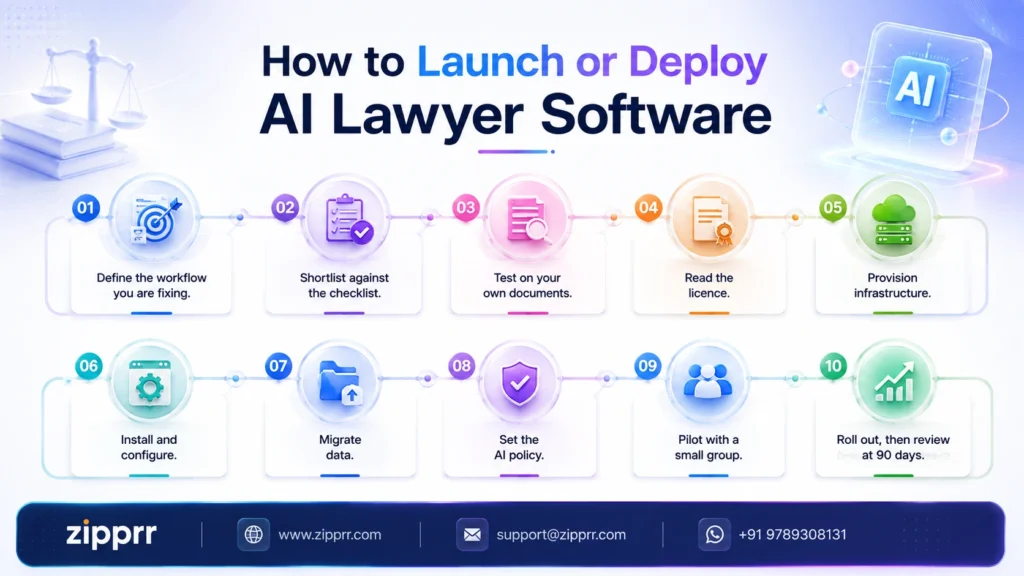
- Define the workflow you are fixing. Pick the one that costs the most hours today.
- Shortlist against the checklist, weighting the criteria that map to your practice.
- Test on your own documents. Demo data proves nothing. Run three real matters through drafting and contract review.
- Read the licence: rebranding, resale, install count, update policy, termination.
- Provision infrastructure if self-hosting: server, domain, SSL, backups, and an AI provider account with a spend cap.
- Install and configure: firm details, practice areas, jurisdictions, users, roles, billing rates, trust accounts. Zipprr describes a four-step setup (configure firm, migrate cases, activate AI tools, invite team) and claims a typical setup of under two hours; treat that as a vendor estimate and plan for longer if you are customising.
- Migrate data from your existing system, then reconcile balances and deadlines manually before you trust them.
- Set the AI policy before staff log in: what may be entered, what must be verified, who signs off.
- Pilot with a small group for two to four weeks.
- Roll out, then review at 90 days: measure drafting time, billing realisation, and missed deadlines against your pre-launch baseline.
Compliance and Responsible AI Considerations
This section is general information, not legal advice. Obligations vary by jurisdiction and by the rules of the bar you are admitted to, and you should take independent counsel.
Professional responsibility. The ABA issued Formal Opinion 512 in July 2024, its first substantive ethics guidance on generative AI, addressing competence, confidentiality, client communication, candour to tribunals, supervision, and reasonable fees. ABA Formal Opinion 512 makes clear that lawyers remain responsible for complying with their professional obligations when using generative AI. State bars have issued their own guidance, and it is not uniform. Read the one that binds you.
Unauthorized practice of law. UPL is regulated at state level in the US and differently again in other countries. Non-lawyer businesses deploying legal AI face materially different constraints from law firms, and the boundary between legal information and legal advice is contested. The FTC’s DoNotPay order illustrates the separate consumer-protection exposure that arises from how such a service is marketed.
Confidentiality and privilege. Sending client material to a third-party AI service raises questions about confidentiality obligations and, in some analyses, privilege. Whether disclosure to a vendor is permissible, and whether client consent is required, depends on the circumstances and the applicable rules.
Data protection. GDPR, CCPA, and equivalent regimes may apply depending on where your clients are. Data residency, retention, deletion rights, and processor agreements all warrant review.
Human oversight. Professional guidance generally places responsibility for final work product on the supervising lawyer. No tool changes that.
Future of AI Legal Technology
Some directions are visible in current product releases rather than speculative.
Vendors are moving from single-prompt assistants toward agentic workflows that chain multiple steps; LexisNexis and Thomson Reuters have both shipped features in this direction. Citation verification is being built directly into drafting rather than bolted on afterwards, a predictable response to court sanctions. Data control is becoming a competitive feature, with customer-held encryption keys and regional data residency appearing in enterprise offerings.
Two slower currents matter more for buyers. First, regulatory clarification: bar associations and courts continue to develop guidance on disclosure obligations and standards of care, so buyers should expect the compliance landscape to evolve. Second, pricing pressure: as underlying model costs fall, per-seat subscription pricing that was set when inference was expensive will face scrutiny, which is part of why one-time-licence and self-hosted models are getting attention.
What is unlikely: AI replacing the exercise of legal judgment, or professional responsibility shifting from the attorney to the vendor.
Ready to See AI Lawyer Software in Action?
Choosing between subscribing, building, or buying is easier once you have seen a real platform up close. Book a free demo of Zipprr’s AI Lawyer software to explore the drafting, contract review, billing, and intake tools firsthand. You can evaluate the source code, licensing terms, and total cost of ownership before making any commitment. Use the checklist in this guide during the demo so you leave with real answers, not just a features list.
What is AI lawyer software?
How does AI legal software actually work?
Does AI lawyer software replace lawyers?
How much does AI lawyer software cost?
What features should I look for?
What is white-label AI legal software?
Should I commission custom development or buy a ready-made platform?
Can a business deploy its own AI legal platform?
What compliance issues come with legal AI?
What should I check before buying?
Read the licence in full, request the security report rather than accepting a badge, test the software on your own files, confirm what happens when the included support period ends, and model three years of total cost including hosting and AI usage. Then compare that against a subscription alternative.
For firms comparing AI lawyer software, the right choice ultimately depends on workflow fit, licensing rights, data control, ongoing operating costs, and the level of technical responsibility the firm is prepared to take on.