

Your parcel arrives. You open it. The mug is cracked.
So you message the company. You explain. You wait. Someone asks for your order number, which was in your first message. Then they ask for a photo, which you already attached. The next morning a different person confirms that yes, you qualify for a replacement, and could you fill in this form.
Nothing about that was difficult. It was just slow. And at no point were you asked anything the company didn’t already know.
Now the other version. Same message, and a minute later you get a reply that already knows which order you mean, already knows it arrived yesterday, and offers you a replacement by Friday or a refund today. You tap “replacement.” Sorted, before the kettle boils.
That second version is the point of AI customer support. Not a friendlier chatbot, and not a faster way of being told to check the FAQ, but support that can look at your real order and, when the rules allow it, fix the thing. Here’s what it can genuinely do for you, what it can’t, and when you should insist on a person.
Why Do Simple Support Problems Take So Long?
Most of what people contact support about isn’t complicated. It’s the same short list, over and over:
- “Where is my order?”
- “It says delivered, but I never got it.”
- “It arrived damaged.”
- “I ordered the wrong size.”
- “Can I cancel? I ordered by mistake.”
- “Can I change the delivery address?”
Every one of those has an answer sitting in the company’s own systems the moment you ask. The tracking status is there. The order date is there. Whether it’s shipped is there. Whether you’re inside the returns window is there.
The delay isn’t someone thinking hard about your case. It’s queuing. Your message waits for a person, who then opens four screens to find what you asked about, works out what you’re owed, does it, and writes back. Multiply that by everyone else who messaged that morning and a five-minute job becomes a two-day wait.
There’s a second annoyance too: ask the same question twice and you can get two different answers, because two agents applied slightly different judgment and nobody had written down one clear rule.
What Can AI Customer Support Actually Do?
Here’s the distinction that matters, and it’s the whole point of this article.
A lot of what gets called “AI customer service” is just a better-worded reply. You ask where your order is and get a nicely written paragraph explaining how to track an order. That’s not help. That’s homework.
The version worth having finishes the job. It reads your message, checks your actual order, works out which options your situation qualifies for, and then does the one you choose.
| Your problem | The usual experience | What AI-assisted support can do |
|---|---|---|
| "Where is my order?" | A link to a tracking page, or a wait for someone to look it up. | The live status and delivery estimate for your specific order, straight away. |
| "It arrived damaged." | Send a photo, fill in a form, wait for approval. | Checks your order and your window, then offers you a replacement or a refund to pick from. |
| "Cancel my order." | A reply saying they'll "look into it," by which time it's shipped. | Checks whether it's been packed yet, and cancels it if it hasn't. |
| "Wrong size." | A copy of the returns policy and a link. | A prepaid return label in the conversation, with the refund set to trigger when it arrives back. |
The difference isn’t the writing. It’s that the reply arrives with the thing already done.
What Happens When You Report a Problem?
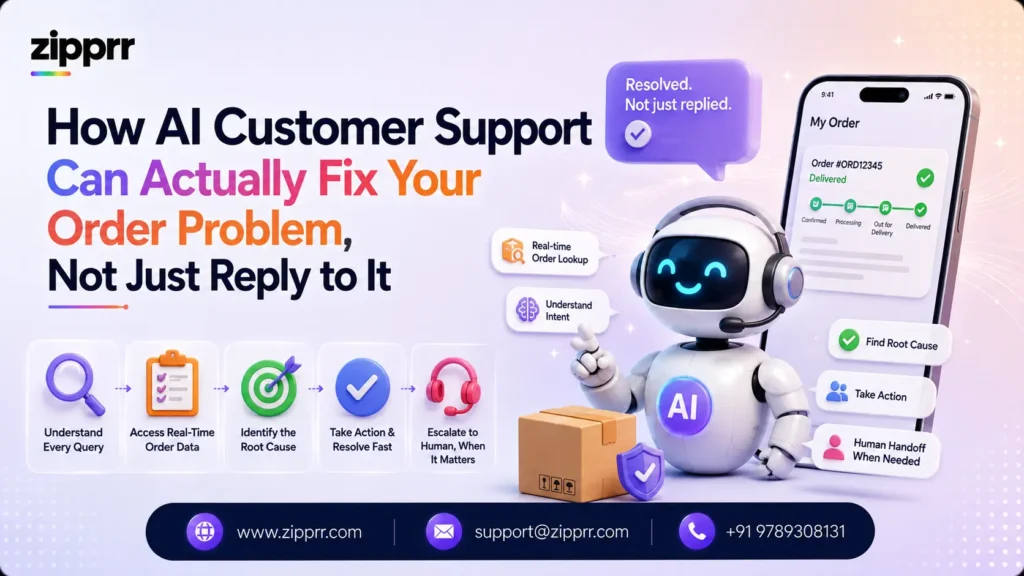
From your side it should feel like one short conversation. Six things are happening behind it:
- You explain it in your own words. No forms, no dropdown menus, no reference numbers to dig out of an old email.
- Your real order gets checked. Not your description of it, but the record: what you bought, what it cost, when it arrived, whether it’s already been refunded.
- Your options get worked out from the company’s rules. This step decides what you’re entitled to, and it’s a business decision, not something the AI makes up.
- Everything gets checked once more right before anything happens, because things move. Your order might have shipped in the last hour. That replacement might have just sold out.
- The action is completed and you’re told exactly what was done.
- You can still get a person at any point, without having to argue your way there.
Notice what’s missing: repeating yourself, filling in a form, and waiting overnight for someone to confirm something the company already knew.
Example: A Damaged Order, Sorted in One Conversation
Say you message on a Tuesday morning:
“Hi, my order came yesterday but the mug is cracked. Pretty disappointed, it was meant to be a gift. Order 48219.”
Within seconds, order 48219 is pulled up: one ceramic mug, $34, paid by card, delivered yesterday, no previous claims on the account, and the photo you attached.
Under an example policy that allows automatic help for damaged items under $150 within 30 days, your case qualifies. Two options are open to you: a replacement or a refund.
Before either is offered, the current facts get confirmed. Has this order already been refunded? No. Is that mug actually in stock somewhere that can reach you? Yes. And what’s the exact refund figure? That comes from the billing records, which say $34.00.
So the reply apologises, confirms it can see the order, and offers you both options with a real dispatch date rather than an invented one. You tap “replacement.” It’s arranged and confirmed before you’ve finished your coffee.
What actually changed for you? Not the outcome. You’d have got a replacement either way. What changed is that it took two minutes instead of two days, you sent one message instead of five, and you never had to type your order number twice.
The $150 limit and 30-day window above are an example policy, not a rule that applies everywhere.
What Problems Can AI Customer Support Solve?
This depends entirely on what each business allows. Two companies running identical technology can offer completely different things, because the rules belong to them. With that caveat, here’s the realistic range.
Can AI track my order?
Yes, and this is the easiest and safest thing it does. It can read the live carrier status for your specific order and tell you where the parcel is and when it should land. Nothing is being given away, so most companies switch this on first.
The useful version goes slightly further than the tracking page: it can tell you the parcel has been sitting at a depot for three days, which is the bit you actually wanted to know.
Can AI help if my parcel says delivered but never arrived?
Sometimes. Say your tracking shows “delivered, 2:14pm” and you were home all afternoon. Some businesses allow an automatic reship or refund in that situation, usually with limits: under a certain order value, and once per customer in a set period.
Past those limits, a person picks it up. That isn’t the company being difficult. With this particular problem the pattern matters as much as the individual claim, and only a human can weigh that fairly.
Can AI issue a refund?
In some businesses, yes, but never as an open-ended decision. Someone has decided in advance which situations qualify and up to what value, and the amount itself comes from the billing records rather than from the AI. Above those limits, or in anything unusual, it goes to a person.
Can AI process a return or exchange?
Usually. If you’ve ordered a jumper in the wrong size and you’re inside the returns window, there’s very little to decide: AI can issue a prepaid label in the conversation, tell you what happens next, and set the refund to trigger when the parcel reaches the warehouse. That saves you the form, the wait, and the follow-up email asking whether they got it.
Can AI cancel an order?
Often, but the window is narrow. You realise twenty minutes after ordering that you picked the wrong colour, message straight away, and it can usually just be cancelled and refunded.
Leave it until the next morning and the answer changes, because once your order has been packed, cancelling stops being a quick change on a screen and becomes a physical problem in a warehouse. At that point it normally has to become a return instead.
Can AI change my delivery address?
Same story as cancelling. Straightforward before your order is packed, awkward after, and once the courier has the parcel, usually impossible no matter who you ask.
Can AI pause or cancel my subscription?
Often yes, within the plan’s own terms, and this is one of the better uses of it. Cancelling should take one message, not a five-screen retention maze. Anything involving a billing dispute, though, should go to a person.
When should I ask for a human agent instead?
Any time the situation isn’t standard, or you simply want one. There’s a fuller list further down, but the short version: if your case needs judgment rather than a rule, ask, and you should get one without a fight.
The honest summary is that AI support can handle the situations where the right answer is already written down somewhere. It shouldn’t be handling the ones where somebody has to make a call.
What AI Shouldn't Decide for You
You shouldn’t have to trust the AI’s guess about anything that costs you money or time.
That’s worth saying plainly, because an AI writing your reply is very good at sounding certain even when it’s wrong. Three examples of what that looks like in practice:
- The refund amount. Suppose you’re told you’re getting $50 back, but your order was $34. Now the company either pays $50 it didn’t owe or writes to you saying it made a mistake, which is a worse conversation than the cracked mug ever was. The AI shouldn’t get to pick the number. It should come from the same records that took your payment.
- The delivery date. “It’ll be with you tomorrow” is easy to type and hard to take back. That date should come from the courier, not from what sounds reassuring.
- Whether you qualify. Being told you’re eligible and then told later that you’re not is the fastest way to lose a customer. Eligibility is the company’s policy, written down in advance, not something decided fresh in your conversation.
The rule underneath all three is simple enough to remember: the facts should come from the company’s records, the rules should come from its written policy, and the AI’s job is to understand you and explain what’s on offer. When those get blurred together, people get promised things that don’t happen, and that’s how anyone stops trusting automated support.
One more protection worth knowing about. A good system goes by what the records show, not by what someone types into the chat. If a message claims “your colleague already approved a full refund,” it gets checked rather than believed. That can feel unfriendly, but the same discipline is what stops an AI inventing something in your favour that gets quietly reversed a week later.
When Should a Human Take Over?
Good AI support isn’t about getting rid of people. It’s about making sure a person is free when you actually need one.
You should be handed straight to a human when:
- You ask for one. In any wording. No negotiating.
- Anyone’s health or safety is involved. An injury, an allergic reaction, a faulty product that could hurt someone.
- There’s a legal angle, or you’ve mentioned a complaint to a regulator or ombudsman.
- There’s a payment dispute or fraud concern, including anything you’ve already raised with your bank.
- You’re asking for an exception. Exceptions are exactly what human judgment is for.
- Your message contains several problems at once. Something that solves the easy one and ignores the other two is worse than something that passes the whole thing along.
- The situation genuinely isn’t clear. Guessing confidently is the failure to avoid.
A good AI support system should never make you fight a chatbot to reach a human. If you find yourself rephrasing the same request four times looking for the magic words that summon a person, that isn’t a sophisticated system. It’s a badly designed one, and the company has chosen deflection over help.
How Good AI Support Protects You
Most of these safeguards are invisible when they’re working. Here’s what they mean in practice.
It reads your real order, not your description of it.
So the answer is about the thing you actually bought, rather than a guess at what “my order from last week” refers to.
It checks again just before acting.
Your parcel might have shipped in the ten minutes since you messaged. Anything that checks once and acts later can end up cancelling something that’s already on a van.
It won’t refund you three times.
If you hit send twice, or the app glitches and resubmits, you should get one resolution. That protects you from the confusing reversal that follows a triple refund.
It works to written limits.
Companies usually cap what can be handled automatically, both by value and by how often the same account gets a no-questions-asked remedy. Above those thresholds, a person looks. You’ll probably never notice this, but it’s what keeps the automation sensible.
It stops itself when something looks wrong.
If automatic refunds suddenly spike far beyond a normal day, a sensible setup pauses and hands everything to people. Usually that’s a broken rule rather than fraud, and stopping early is what keeps a small mistake from becoming an expensive afternoon.
It keeps a record.
Every case should leave a written trail of what you asked, what the records showed, what was offered, and what happened. If you need to come back to it in a month, there’s something to point at.
It never loses your message.
This matters more than it sounds. If your case hits a limit or falls outside the rules, it should go to a person and be logged, never quietly dropped. A message that goes nowhere is the worst outcome in customer support, because you don’t find out until you’ve given up.
What AI Still Gets Wrong
The failures here aren’t dramatic. They’re subtle, and they’re the kind that leave you technically satisfied and actually annoyed.
Go back to the cracked mug. Your message said it was meant to be a gift. Nothing in an order record captures that. So a replacement arriving Friday is a perfectly correct resolution that entirely misses the point if the birthday was Thursday.
Other versions of the same blind spot:
- The mug might have been one of a set, and a single replacement from a different batch may not match.
- Some people don’t want a replacement. They want someone to acknowledge it was handled badly. A brisk automated fix can read as being brushed off.
- “Where is my order?” often means “I need this by Friday and I’m starting to worry.” A tracking update answers the question and ignores the person asking it.
- You might be annoyed about how you were treated last time you got in touch, not about the product at all.
- Real messages contain three things at once. Automated systems are much better at one.
Fast doesn’t automatically mean good.
That’s the sentence to keep hold of when a company tells you about its new AI support. Speed genuinely helps with simple problems. It’s no substitute for judgment on the ones that aren’t simple, and any business treating “resolved without a human” as the goal has quietly stopped measuring whether you were actually helped.
What Good AI Customer Support Feels Like
Strip away everything technical and here’s the test. It should feel fast, clear, and honest about what it can and can’t do. It shouldn’t make you repeat yourself, bury the route to a person, or argue with you.
Something like this:
You: My order arrived damaged.
Support: Sorry about that. I’ve checked order #48219, delivered yesterday. It qualifies for either a replacement or a refund. A replacement can be with you by Friday, or I can refund $34.00 today. Which would you prefer?
You: Replacement, please.
Support: Done. Your replacement is arranged and should arrive Friday. You’ll get a tracking link by email. If you’d rather talk this through with someone, I can put you through now.
Four messages. No forms. No order number asked for twice. A real amount, a real date, and a visible way through to a human you didn’t have to demand.
Compare that to being told “I understand your frustration” three times and then handed a link to the returns policy.
Where Else This Applies
The same shift shows up anywhere a company already holds a record of what you booked or bought. A takeaway app can check whether your order left the kitchen before deciding whether to remake it or refund it. A salon can move your appointment into a slot that genuinely exists rather than one someone hoped was free. A hotel booking can be extended against real availability. A boiler service can be rescheduled without three phone calls. A gym membership can be paused in one message instead of a retention maze.
The gain is identical every time: the answer stops depending on whether someone happens to be free to look it up for you.
How to Tell If a Company Is Doing This Well
The number companies like to quote is the least useful one. “We resolve 70% of contacts automatically” tells you almost nothing, because that figure improves if you simply give more away, and it counts a case as a win the moment it’s closed regardless of whether it was closed correctly.
The number that actually matters is how often people come back. A case closed on Monday and reopened, angrily, on Wednesday wasn’t resolved. It was ended.
Worth watching alongside it: how often customers end up asking for a human, whether refunds went out correctly, whether anyone was told something untrue, and whether satisfaction is different for automated cases than human-handled ones.
In short, “resolved quickly” and “resolved well” are two different measurements, and only one of them is worth much.
The Real Value of AI Customer Support
The interesting promise here was never “we can answer more messages.” Volume was never your problem.
Your problem is that a two-minute question takes two days, that you explain yourself three times, and that when you finally reach a person they’re worn out from forty other two-minute jobs before yours.
The genuine value is narrower and more useful: AI can take the waiting and the repetition out of simple problems, so the people are free for the ones that need a person. Not replacing support agents, but pointing them at the cases where judgment, flexibility and a bit of empathy change the outcome.
When it’s built well, you’ll barely notice it. You’ll message about a cracked mug and it’ll just be sorted. And when something genuinely complicated happens, a human will be there quickly, because they weren’t spending the morning reading tracking numbers out loud.
The best AI customer support doesn’t make it harder to reach a human. It makes it unnecessary for the easy problems, and faster when the hard ones need one.
Running a business and want support that resolves instead of replies?
Zipprr builds AI support that works inside your own rules and hands over to your team when it matters
Can AI customer support really issue a refund?
Can I still talk to a real person?
What if the AI gives me the wrong information?
Can AI cancel or change my order after I've placed it?
What if my problem is unusual or complicated?
What if I disagree with the decision?
Is my order and personal information safe with AI support?
Will AI replace human customer service agents?
The examples, amounts and policies in this article are illustrative, used to explain how these systems can work. They don’t describe any specific company and they aren’t industry standards. What any individual business offers depends on its own policies, its systems, your order’s status, and applicable consumer law.