

Walk through any commercial district on a Tuesday afternoon, and the pattern is hard to miss. A conference room sits empty two floors above a coffee shop packed with remote workers who have nowhere private to take a call. A photography studio stays locked between sessions while a content creator drives forty minutes to a less suitable location. An event venue charges full-day rates for a corporate team that only needs three hours.
The mismatch between available space and active demand is not a small inefficiency. It is the foundation of a multi-billion-dollar opportunity that platforms like Peerspace and Splacer have already begun capturing. The global flexible workspace market is forecast to surpass $50 billion by 2027, with on-demand and short-term space bookings recording the highest growth rate across all segments. (Grand View Research)
For entrepreneurs who see that gap clearly, a space rental script is the most direct route to launching a marketplace that captures it — without absorbing the time or capital cost of building the platform infrastructure from the ground up.
Why This Business Model Is Growing
Three forces are converging right now to make the space rental marketplace model one of the more compelling business opportunities available to independent founders.
Permanent changes in how people work have created a durable, repeating demand for on-demand professional space. A hybrid workforce that splits time between home and office does not need a twelve-month lease — it needs a reliable meeting room on Wednesday morning and a private workspace on the days a home setup falls short. That need repeats weekly and grows with every organization that makes flexible work a permanent arrangement rather than a temporary one.
An entire generation of creators, operators, and independent professionals needs physical infrastructure that the traditional rental market was never designed to serve. A photographer needs a studio by the hour, not by the year. A podcaster needs a soundproofed recording room for four hours on Saturday. A brand stylist needs a curated interior space for a product shoot. None of these use cases fit a standard commercial lease, and every one of them represents a booking waiting to happen on a platform designed around their actual needs.
Property owners have reached a tipping point in their willingness to monetize idle space. What was once considered operationally complex — managing bookings, vetting guests, handling access — is now manageable through a well-built platform. Owners who see their conference rooms, studios, and event spaces generating hourly revenue instead of sitting dormant are active participants in supply growth, not passive participants waiting to be recruited.
Key Features of a Competitive Space Rental Clone Script
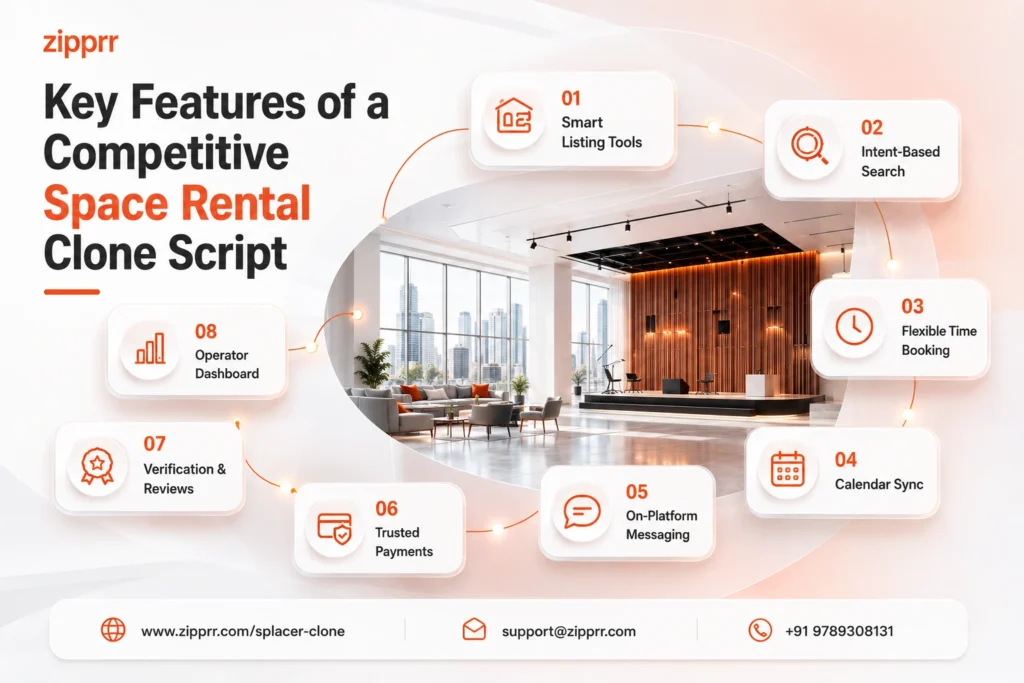
The features that drive real traction on a space rental platform are rarely the ones highlighted in a product brochure. They are the ones that reduce friction for hosts when listing and for guests when booking.
1. Listing Tools That Do Justice to the Space
A host listing a $600-per-day event venue or a $90-per-hour photography studio needs presentation tools that match the value of what they are offering. Multiple high-resolution image uploads, short video walkthroughs, floor plan attachments, a detailed amenity inventory, capacity tiers, and precise location and transit information all directly affect how often a listing converts. Platforms with shallow listing tools lose high-value inventory to competitors that give hosts the presentation architecture they need.
2. Search Designed Around Intent, Not Just Keywords
A founder searching for a meeting room for eight people at 2 pm on Thursday has entirely different needs from a filmmaker searching for a warehouse with high ceilings and natural light. Space type classification, capacity filtering, amenity-specific search, map-integrated browsing, and real-time availability filtering are not nice-to-have features. They are the mechanics that connect the right guest to the right space efficiently enough to complete a booking.
3. Booking Time Units That Match the Market
Space rental demand does not fit into a single booking window. Meeting rooms and coworking desks are booked by the hour. Event venues book by the half day or full day. Storage units and dedicated offices are booked by the week or month. A platform that forces all of these use cases into a single booking structure is poorly matched to the market it is trying to serve. Supporting all time units with accurate per-unit pricing is an operational requirement, not a technical enhancement.
4. Host Calendar Control with External Integration
A reliable availability calendar that hosts can manage in real time, block for personal use, and synchronize with existing scheduling tools like Google Calendar or iCal is a practical requirement for any host who manages their space as a professional revenue source. Platforms that offer this capability attract and retain the quality hosts who drive the most bookings. Platforms that do not will find their best hosts migrating to alternatives.
5. Communication That Stays On-Platform
Hosts and guests need a direct channel for access logistics, booking adjustments, and any mid-session coordination — and that channel needs to stay within the platform. Off-platform communication removes the operator’s ability to mediate disputes and breaks the audit trail that protects both parties when something goes wrong. An integrated messaging system with a complete conversation record is a dispute prevention tool as much as a communication feature.
6. Payment Architecture That Both Sides Trust
Guests need confidence that their payment is protected until the booking is completed. Hosts need confidence that their payout arrives on a predictable schedule without manual follow-up. A payment architecture that handles both — collecting at booking, holding in escrow, releasing after session completion, and managing security deposits automatically — is the financial layer that converts a skeptical first-time user into a repeat participant on both sides of the marketplace.
7. Identity Verification and Review Infrastructure
The trust gap on a new marketplace is closed primarily through two mechanisms: verified identities and accumulated reviews. A guest who has passed document verification and carries a visible review history from previous bookings is a fundamentally different proposition for a host than an anonymous account. Bidirectional reviews after each booking, combined with a clear verification requirement before booking eligibility, build the credibility infrastructure that a marketplace needs to function at scale.
8. Operator Dashboard with Market-Level Visibility
A complete administrative interface — covering listing approvals, user management, booking oversight, payout controls, dispute workflows, promotional tools, and performance analytics — gives the platform operator the decision-making visibility that a growing marketplace requires. Operators who cannot see what is happening across their platform cannot make the adjustments that determine whether it continues to grow.
Business Benefits of Using a Space Rental Clone Script
A custom-built space rental marketplace requires ten to sixteen months of development time and a budget that regularly runs between $120,000 and $300,000 before a single real booking occurs. That timeline means missing the early market window. That budget means less capital available for the host acquisition, marketing, and operational investment that actually drives marketplace growth.
A space rental script compresses the technical build phase to four to eight weeks and redirects the capital differential toward activities that create competitive advantage. The operator spends less time waiting to launch and more time building the host community and market presence that determines whether the platform succeeds after launch.
The infrastructure is not experimental. The reservation logic, payment processing, availability management, and user verification systems in a quality script have been built, tested, and refined through real marketplace usage. Operators are inheriting a proven technical foundation, not discovering production edge cases for the first time.
Every customer-facing element of the platform — the name, the visual identity, the app store listing, the domain — reflects the operator’s brand exclusively. The technology behind it is invisible to users.
The script framework adapts to the specific vertical the operator targets without requiring a rebuild. Configuring for photography studios versus configuring for event venues versus configuring for urban parking requires different listing fields and pricing structures — not different platforms.
How It Works: The Space Rental Platform Flow
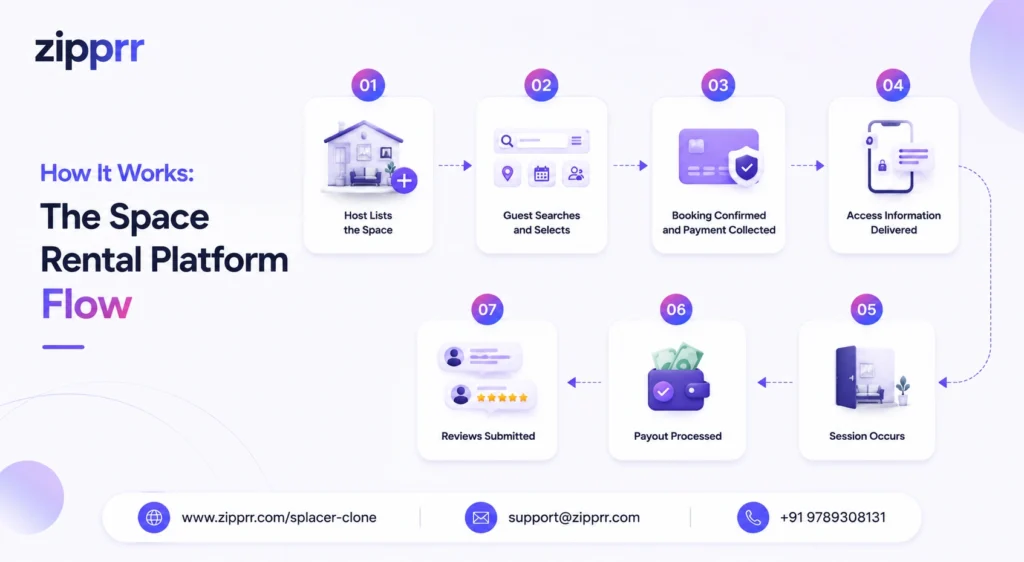
The transaction cycle on a space rental platform is direct, fully documented, and designed to protect every participant at each stage.
- Host Lists the Space — Completes identity verification, creates a listing with full media, detailed amenity information, pricing by time unit, and availability rules. The listing goes live after operator review.
- Guest Searches and Selects — Filters by space type, location, date and time, capacity, and specific amenity requirements. Selects an available listing and reviews booking terms.
- Booking Confirmed and Payment Collected — Guest completes in-app payment, including any security deposit. Both parties receive instant booking confirmation with all details.
- Access Information Delivered — Host shares entry instructions through the platform messaging system. Smart lock codes, key handoff details, or in-person access arrangements all remain on-platform.
- Session Occurs — Guest uses the space within the confirmed booking window. Any adjustments, extensions, or issues are handled through platform channels.
- Payout Processed — Platform releases the host payment after the session completes, minus the platform commission. Deposit is returned or retained according to documented space condition.
- Reviews Submitted — Both parties rate the experience. The review record feeds the platform's trust infrastructure and informs every future booking decision made by hosts and guests alike.
Revenue Opportunities
A space rental marketplace is not a single-revenue-line business. Operators who configure multiple concurrent income streams from launch build a financial model that holds through the volume fluctuations every early-stage marketplace experiences.
| Revenue Stream | Description |
|---|---|
| Host Commission | Collect 8 to 20% from space owners on every completed booking |
| Guest Service Fee | Charge renters a 5 to 12% service fee at checkout on each booking |
| Featured Listing Placements | Hosts pay for priority positioning in search results |
| Host Membership Subscriptions | Monthly plans for active hosts with commission reductions and placement benefits |
| Space Protection Add-Ons | Partner with insurers to offer per-booking damage and liability coverage |
| Corporate Account Access | Business accounts with monthly invoicing, volume rates, and team booking capabilities |
| Cancellation Fee Revenue | Platform retains a defined share of cancellation penalties under published policy terms |
Collecting fees from both the host and the guest on every completed booking doubles the effective revenue yield per transaction. That structure does not require additional inventory, additional users, or additional infrastructure. It requires only that the operator configure both fee lines at launch and present them transparently to each side of the marketplace.
Why Entrepreneurs Are Choosing This Model in 2026
Most marketplace businesses require the operator to create supply. A food delivery platform needs to recruit restaurants. A freelance platform needs to attract skilled workers. A space rental marketplace is different: the supply already exists in every city in the form of underutilized rooms, studios, venues, and storage units whose owners are already paying fixed costs to maintain them.
That means the barrier to building early inventory is substantially lower than in other marketplace categories, and the motivation for hosts to list is immediate and financially concrete. An operator who can clearly demonstrate to a space owner that their idle conference room will generate $400 per week in rental income has a compelling host acquisition pitch that requires no financial subsidy from the platform.
The most commercially attractive niches available to new entrants right now each carry a specific structural advantage.
Photography and film studio rentals combine high per-session rates with a professional user base that books repeatedly and refers actively within tight creative networks. A single well-placed listing in this category can generate significant platform revenue while building the review record that attracts the next ten bookings.
Coworking and meeting room access benefits from the most consistent demand curve in the space rental market. Hybrid workers who find a reliable, affordable space will return to it week after week. The rebooking rate on this use case is the strongest driver of host retention and guest lifetime value.
Pop-up retail and brand activation spaces attract commercially motivated renters whose event outcomes depend on the space they choose. These renters pay premium rates, book in advance, and share their venue selections publicly when the event is successful — providing organic visibility that no advertising budget can replicate.
Urban storage unit marketplaces address a structural shortage in high-density cities that is not solved by any existing platform at a meaningful scale outside the largest metro areas. Host supply in this category is abundant, listing complexity is low, and renter demand is driven by life events with low price sensitivity.
Future Trends Shaping Space Rental Platforms
Operators who build their platforms today with the next phase of the market in mind will hold structural advantages over competitors who optimize only for current conditions.
Contactless access infrastructure is moving from a premium differentiator to a market expectation. Smart locks, digital key delivery through the platform app, and IoT-enabled access systems are increasingly the standard that professional space renters expect. Platforms and hosts that support contactless entry will consistently outperform those that require in-person coordination on booking conversion and host retention metrics.
Intelligent pricing tools that incorporate demand signals, local event calendars, seasonal patterns, and competitive availability data will become the standard for operators managing multiple listings across multiple markets. Manual pricing decisions do not scale and leave meaningful yield on the table in high-demand periods.
360-degree virtual tours and short preview videos are rapidly becoming a conversion threshold for high-value bookings. A corporate team committing to a $1,500 full-day venue booking wants to walk the space virtually before confirming. Platforms that make this capability straightforward for hosts to publish will see measurably higher conversion rates on premium listings.
Corporate sustainability commitments are creating a new segment of space renters who are specifically choosing flexible space access over owned office infrastructure to reduce their environmental footprint. Platforms that can report and quantify that impact will attract and retain this growing segment of commercially valuable business users.
Start Building Today
The space rental market is at the point in its development where the operators who move now will determine which platforms become the category leaders in their regions and verticals. Supply is available. Demand is proven. The infrastructure to connect them is accessible today.
Zipprr’s space rental script gives you a fully configurable, white-label marketplace platform built for real operational use — listing management across multiple space types, flexible hourly and daily booking units, verified payments with automated host payouts, trust and safety tooling, and a complete admin dashboard. Configure it for the specific vertical and market you are entering and launch in weeks, not months.
Frequently Asked Questions
What does a space rental clone script actually give you as an operator?
When you launch with a space rental script, you receive a fully operational marketplace with every technical layer already built and tested — host onboarding and listing management, guest search and booking, in-app payments with escrow and payout management, identity verification, a real-time availability calendar, messaging, and a complete operator dashboard. None of that infrastructure needs to be engineered or validated. You configure it for your brand and market, then invest your time in host recruitment and demand generation rather than software development.
How much does it cost to build a space rental marketplace in 2026?
Engineering a space rental marketplace from scratch requires between $120,000 and $300,000 in development investment and a build timeline of ten to sixteen months. Neither figure accounts for the host acquisition, marketing, and operational costs of the first six months after launch. Launching with the Zipprr space rental script reduces both the financial commitment and the time to market to a fraction of those figures, with the technical infrastructure already proven in production environments.
What space categories can this platform support?
The platform handles any bookable space: meeting rooms, private offices, coworking desks, photography and film studios, event and entertainment venues, pop-up retail and brand activation spaces, outdoor event areas, private storage units, and parking spaces. Operators can choose a single-category launch focused on depth in one vertical, or configure a multi-category marketplace serving several use cases on the same platform from day one.
Can renters book spaces by the hour, or only by the day?
Hourly, half-day, full-day, weekly, and monthly booking units are all supported simultaneously. Meeting rooms and coworking desks typically book hourly. Event spaces and studios are booked by the day. Storage and office arrangements are booked by the week or month. Each listing can be configured with the specific time units and rates that match the space type, giving both hosts and guests accurate, flexible pricing options.
How should operators handle disputes between hosts and guests?
Prevention is more effective than resolution. Requiring both parties to complete a photo documentation checklist at check-in and check-out creates an objective record that resolves the majority of condition disputes without operator escalation. For cases that do require intervention, the platform’s admin dashboard includes a structured case management workflow with evidence review and outcome tools. Security deposit hold and release controls give the operator a practical mechanism for addressing damage claims without protracted back-and-forth.
Does the platform support external calendar synchronization for hosts?
Yes. Hosts can manage their availability directly within the platform and synchronize with external calendars, including Google Calendar and iCal. This is a practical necessity for hosts who use their space for personal purposes, run multiple listings across different platforms, or need their booking calendar integrated with broader scheduling tools. Without external sync capability, the double booking risk is high enough to damage both the host relationship and the platform’s reliability reputation.
What revenue model delivers the strongest platform economics at launch?
Configuring a commission from the host side and a service fee from the guest side on every completed booking creates the most durable launch economics because it generates two revenue events from each transaction without requiring any additional users or inventory. Featured listing placements and host membership subscriptions add recurring non-transactional revenue as the host base grows. Insurance add-ons at checkout belong in the launch configuration because a damage incident without any coverage framework in place creates trust damage on both sides that is disproportionately difficult to recover from.
Which niche should a new operator prioritize when launching their first space rental marketplace?
The strongest first market is one where the operator already has some existing relationships with potential hosts or renters, because personal recruitment is the most effective supply acquisition strategy in the first thirty days. Beyond that, photography studios and meeting rooms are the two categories that produce the fastest path to operational health: studios deliver high per-session revenue and professional repeat users, while meeting rooms generate consistent weekday booking frequency that stabilizes platform revenue early. Regardless of which niche is selected, launching with focused depth in a single city before expanding to adjacent markets or verticals is the approach that builds genuine marketplace liquidity rather than thin coverage across too many locations simultaneously.