

A lot of aspiring founders look at brands like Enterprise, Hertz, and Turo and assume the market is locked up. It is not. In fact, the global car rental industry crossed $120 billion in 2025 and is still growing. The US market alone is expected to hit $51 billion in 2026 and climb toward $67 billion by 2031.
Here is what those numbers actually mean for an entrepreneur reading this right now.
Thousands of cities still have no reliable digital rental option. Fleet owners with 10, 20, or 50 vehicles have no app to list them on. Travelers in second-tier markets are still calling someone on the phone to ask if a car is available. That gap is where new businesses are being built — quietly, quickly, and profitably.
If you have been sitting on the idea of launching a vehicle rental platform, this blog is going to cut through the noise and show you exactly how a car rental script gets you from idea to income without the cost and chaos of building from zero.
The Real Reason Entrepreneurs Miss This Opportunity
The car rental market is not hard to enter because of competition. It is hard to enter because of the technology gap. Building a rental marketplace from scratch requires a front-end app, a back-end booking engine, a payment layer, a fleet management system, a review module, GPS integration, and an admin dashboard all working together, all tested, all live.
That kind of build takes a specialized team anywhere from 12 to 18 months. The budget? Easily $80,000 to $200,000 before your first customer ever books a ride.
Most founders hit that reality and walk away from a perfectly viable idea.
A car rental script is built for exactly this problem. Every component mentioned above comes pre-built, pre-integrated, and ready to deploy under your brand. What used to be an 18-month project becomes a 6-week launch.
What a Car Rental Script Actually Gives You
When you launch with Zipprr’s car rental script, you get a complete two-sided marketplace. On one side, renters download your app or visit your site, browse vehicles, check real-time availability, and book within minutes. On the other side, fleet owners and individual vehicle operators list their inventory, set pricing, manage bookings, and track earnings through a dedicated dashboard.
You sit in the middle as the platform operator, collecting commission on every transaction, setting the rules, and watching the operation through an admin panel that gives you a live view of every booking, payment, and user on your platform.
That is a complete business model — not a prototype, not a concept. A working marketplace.
For founders specifically interested in peer-to-peer car sharing, Zipprr also offers a purpose-built Turo Clone and a Getaround Clone designed for hourly and daily self-serve rentals.
Features That Separate a Strong Platform from a Weak One
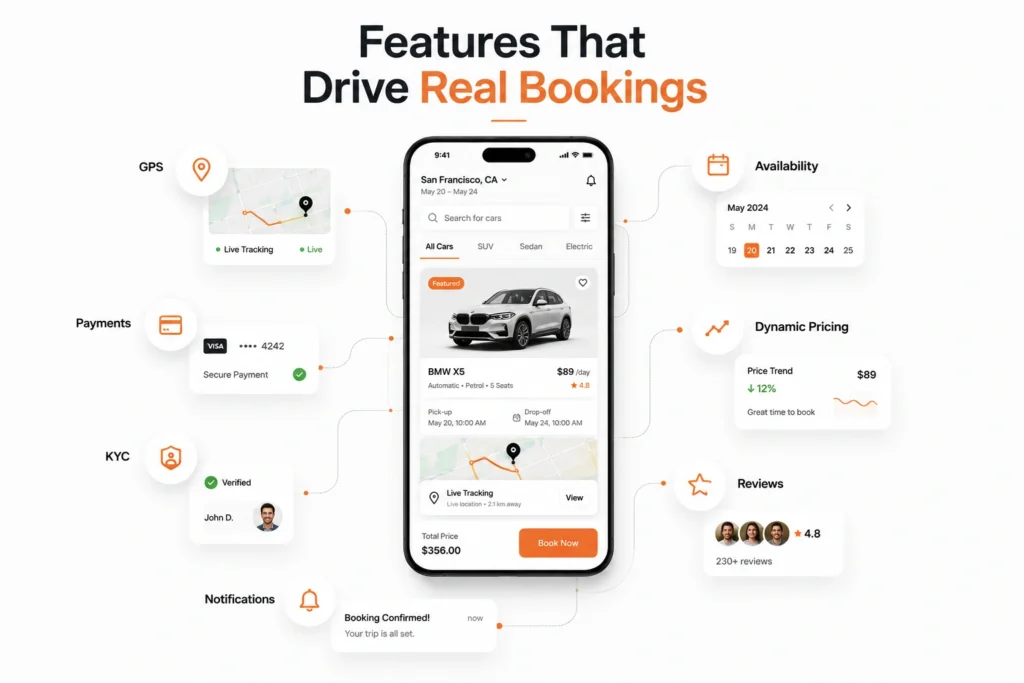
Choosing the right car rental script means knowing what features actually drive bookings and what features just look good on a sales page. Here is an honest breakdown.
Real-Time Search and Availability
Real-time availability paired with smart search is what turns casual visitors into confirmed bookings. A user who searches for a vehicle and gets stale availability data or a slow results page will close the tab and never come back. This is not a background feature. It is the engine your entire conversion rate runs on. Read more in our breakdown of car rental management software features.
Two-Way Booking Flexibility
Not every customer operates on the same schedule. Some need an immediate confirmation. Others are planning days or weeks in advance. A platform that handles on-demand and scheduled bookings within the same flow captures both audiences without compromise.
Role-Based Dashboards
Your platform has three distinct user types: renters, vehicle suppliers, and your admin team. Collapsing their experiences into a single interface creates friction and confusion. Separate portals built around each role’s actual workflow keep everyone efficient and reduce the support burden on your team.
Live GPS Tracking
GPS tracking is often listed as a safety feature. It is also a trust feature. When renters know a vehicle can be located and when fleet owners know their asset is being monitored, behavior on the platform improves across the board. It also gives you evidence in any dispute that goes to an admin review.
Frictionless Payment Processing
A checkout that supports multiple currencies and payment methods is not a luxury for international platforms; it is the baseline expectation. Zipprr’s car rental script integrates with major gateways, including Stripe and PayPal, giving your customers payment options they already trust.
Automated KYC and Document Verification
Driver license checks and identity verification done manually create a bottleneck that costs you registrations. Automated document screening approves qualified renters faster, filters out risk earlier, and removes the need for your team to manually review every new signup.
Condition Reports with Photo Evidence
One of the most overlooked features in car rental platforms. When both parties document the vehicle condition with timestamped photos before and after each rental, disputes become rare, and resolutions become fast. This single feature removes a massive category of customer service headaches.
Dynamic Pricing Engine
Static pricing is a missed revenue opportunity. The ability to adjust rates by vehicle type, booking duration, day of week, or seasonal demand helps you and your fleet owners price intelligently rather than leaving money on the table during peak periods.
Verified Review System
Renters read reviews before they book. Fleet owners want to know who is driving their vehicle. A two-sided verified review system creates accountability on both ends and gives new users the social proof they need to make their first booking with confidence.
Automated Communication at Every Step
Booking confirmations, pickup reminders, return alerts, and payment receipts at every touchpoint in the rental journey should fire automatically. Platforms that rely on manual outreach at any stage introduce delay, inconsistency, and unnecessary support volume.
How Every Booking Turns Into Revenue
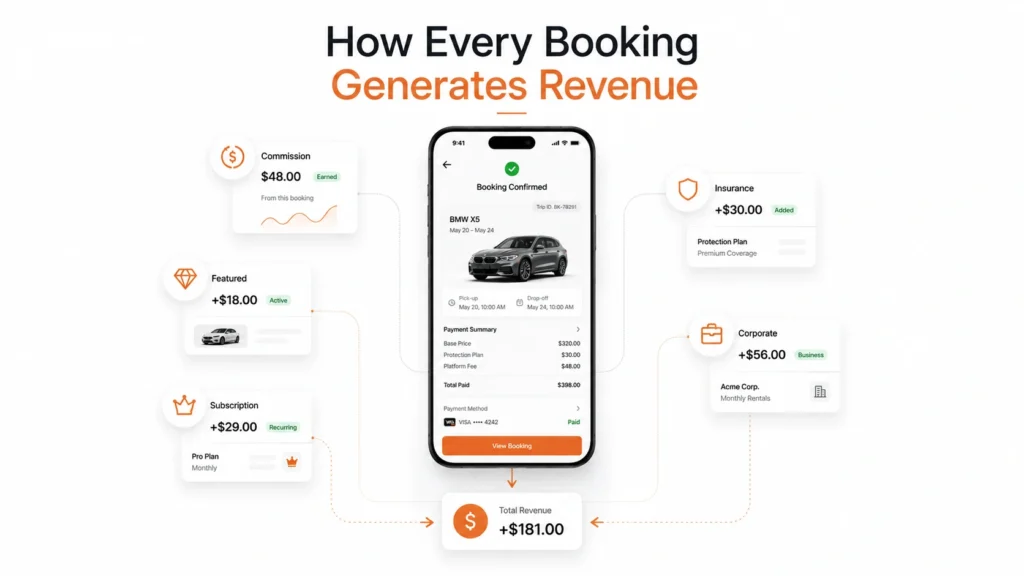
Every confirmed booking generates a commission for the platform. Set your rate between 10% and 25% depending on your market positioning and vehicle category, and every transaction that clears your platform puts money directly into your account. You do not own the vehicles. You do not carry the maintenance costs. You facilitate the exchange and earn from everyone.
Fleet owners who want better placement in your search results will pay a featured listing fee. This is pure margin — no extra operational cost for you, just revenue from suppliers who want more visibility.
A subscription tier for professional fleet operators is another compounding income stream. Owners who rely on your platform for a significant portion of their bookings are willing to pay monthly for advanced analytics, priority placement, and higher listing limits. Subscription income scales as your supply side grows.
Optional insurance packages at checkout are consistently the highest-margin line item on well-run rental platforms. Partner with a provider, integrate the option into your booking flow, and it generates revenue on autopilot without touching your operations.
Corporate accounts are worth pursuing early. Businesses that need regular vehicle access for employees, field teams, or client transport book in volume, pay reliably, and churn slowly. A dedicated corporate tier with invoicing and usage reporting opens a B2B channel that looks nothing like your consumer business and performs very differently.
What the Market Looks Like From Here
The US car rental market is on a clear upward trajectory — $51 billion in 2026 growing toward $67 billion by 2031, according to Mordor Intelligence. Globally, IMARC Group puts the market at over $129 billion in 2024 with strong compound growth expected through the end of the decade.
Within those headline numbers, specific segments are accelerating faster than the market average.
Electric vehicles are creating a new rental category. Travelers want the experience of driving an EV without committing to one. Fleet owners who add EVs to their lineup are seeing demand that justifies premium pricing. Platforms that surface EV availability clearly and include charging infrastructure context are winning bookings that traditional platforms are not even competing for.
Keyless vehicle access through smart lock integration is shifting from a differentiator to a user expectation. The friction of coordinating key handoffs is a pain point renters increasingly refuse to accept. Platforms that eliminate this step through in-app unlocking retain users more effectively.
AI-powered pricing models that read real-time signals — local events, weather patterns, competitor inventory — are giving analytically driven platforms a compounding revenue advantage over those still setting prices manually.
Subscription-based access models are attracting a segment of customers who want consistent vehicle availability without ownership. This is not the same customer as the occasional traveler. Retention on subscription models looks fundamentally different from booking-based retention.
The Launch Decision Most Founders Get Wrong
Here is what actually separates founders who build successful rental platforms from those who spend 18 months planning one.
The founders who win commit to a specific market before they commit to a feature list. Not car rentals in general — one city, one niche, one customer type. That focus makes every product, marketing, and pricing decision cleaner and faster.
They launch with what they have and optimize based on what they learn. A live platform generating its first 50 bookings will teach you more about your market than six more months of planning ever could. The insights that come from real user behavior reshape your product roadmap in ways no research document can predict.
They treat the car rental script as a foundation that grows with the business, not a ceiling that limits it. The technology gets you live. Your understanding of the market, your supplier relationships, and your brand reputation are what build a defensible business over time.
Build Your Rental Platform with Zipprr
Zipprr’s car rental script is built for entrepreneurs who are serious about launching and serious about scaling. It gives you the complete technological foundation of a professional rental marketplace — without the development timeline, without the budget risk, and without the trial-and-error of building from scratch.
Explore the full range of Zipprr rental solutions:
Your market is waiting. Start building today.
Frequently Asked Questions
1. What is a car rental script, and how is it different from building custom software?
A car rental script is a complete, pre-built software platform designed specifically to run a vehicle rental marketplace. The difference from custom development is straightforward: custom builds start from nothing, take 12 to 18 months, and cost $80,000 to $200,000 or more. A car rental script from Zipprr starts from a fully functional product and gets you live within weeks at a fraction of that investment.
2. How fast can I realistically launch?
Founders who use Zipprr’s car rental script typically go live within four to eight weeks. That window accounts for branding, configuration, payment gateway setup, and any market-specific customizations you want to apply before launch.
3. Will it look like my business, not Zipprr?
Completely. The app name, visual design, logo, domain, color scheme, and user-facing copy are all yours to define. Users on your platform will never see a reference to Zipprr. They see your brand.
4. What does the revenue model look like in practice?
Most operators start with a commission on each completed booking, typically between 10% and 25% of the transaction. As your platform grows, you can layer in fleet owner subscriptions, featured listing fees, and insurance add-ons. For more details on the feature set that supports these revenue streams, see our car rental management software features guide.
5. Can the platform support both fleet businesses and individual car owners listing their vehicles?
Yes. The platform handles both models within the same product. You can run a traditional fleet-based rental service, a peer-to-peer marketplace where private car owners list their own vehicles, or a hybrid of both. Zipprr’s Turo Clone and Getaround Clone are tailored specifically for the peer-to-peer use case.
6. Which markets make the most sense to target first?
Tourism-heavy destinations, cities with underdeveloped digital rental infrastructure, and business travel corridors consistently show the fastest early traction. Markets where EV adoption is growing, and no local platform has yet captured that supply, are particularly attractive right now.
7. How does the platform handle disputes?
The pre-rental and post-rental condition report system with timestamped photos submitted through the app creates a documented record that resolves most disputes before they escalate. GPS data, in-app message history, and transaction logs provide supporting context for any case that reaches admin review.
8. What growth path does this open up beyond car rentals?
Once your rental marketplace has operational momentum, expanding into adjacent categories is a natural next step. Zipprr’s Vacation Rental Script lets you bring property rentals onto the same platform, creating a broader inventory base and cross-selling opportunities within your existing user base.