
Fleet operators and first-time mobility entrepreneurs usually stall at the same point: the technology. Commissioning a ride-hailing platform from scratch swallows a year of development and a six-figure budget before the first booking ever happens. A ready-made Uber clone script collapses that barrier into days and a few hundred dollars.
Most comparison articles gloss over an uncomfortable truth: the software packages themselves have converged to near-sameness. Vendor purchase terms, however, remain wildly inconsistent. This guide lays out verified 2026 price data, a candid breakdown of provider categories, and the exact verifications worth completing before releasing any payment.
Quick Answer
The best Uber clone script in 2026 is whichever one hands you 100% unencrypted source code for a single one-time payment, backed by a contractually stated launch date and a clearly defined support period. Ready-made scripts range from $490 to $20,000, while building the equivalent platform from scratch costs $80,000 to $200,000. Zipprr’s Uber Clone starts at $490 one-time and carries a 7-business-day launch commitment.
What Exactly Are You Buying?
An Uber clone script is independently built, pre-assembled software that reproduces the working mechanics of a ride-hailing platform and ships as white-label source code you release under your own brand. None of it is Uber’s actual code, and no legal relationship with Uber exists. The word “clone” refers to the business model, never the codebase.
A complete package always contains three linked applications:
- Passenger app: riders request a trip, follow the driver on the map, pay, and leave a rating.
- Driver app: your fleet goes on duty, accepts trip requests, follows built-in navigation, and reviews payout totals.
- Admin panel: you control fares and commission, approve drivers, and track revenue.
Because nearly every credible vendor now bundles GPS tracking, surge pricing, and driver wallets, a feature checklist will not separate a sound purchase from a costly one. The commercial terms perform that job. Keep the distinction in view as the pricing data arrives.
How Much Does an Uber Clone Script Cost in 2026?
A ready-made Uber clone script sells for $490 to $20,000 in 2026, while commissioning the same platform as a custom build runs $80,000 to $200,000 across 9 to 12 months. Zipprr’s Uber Clone occupies the accessible end of that spectrum, with its complete pricing displayed publicly.
| Option | Typical price (2026) | Time to launch | You own the code? |
|---|---|---|---|
| Zipprr Uber Clone (Standard) | $490 one-time | 7 business days (contractual) | Yes, 100% unencrypted |
| Zipprr Uber Clone (Pro, done-for-you) | $890 one-time | 7 business days (contractual) | Yes, 100% unencrypted |
| Mid-market scripts (most vendors) | $1,500 to $8,000 | 2 to 6 weeks | Varies, confirm before paying |
| Premium cross-platform builds | $4,000 to $15,000 | 3 to 6 weeks | Usually yes |
| Custom build (agency) | $20,000 to $200,000+ | 4 to 12 months | Yes |
The license itself is only the opening line of your launch budget. Three further layers sit on top:
- Infrastructure: a 4-core / 8GB VPS at $40 to $80 monthly comfortably serves a single-city fleet, alongside a domain, SSL, and payment-processing charges near 3% per transaction.
- App stores: Google Play takes $25 once; Apple charges $99 annually.
- Driver and rider acquisition: the heavyweight. Set aside 5 to 10 times whatever the script costs for driver joining bonuses, neighborhood marketing, and promo credits.
The takeaway
each additional thousand dollars sunk into the license is a thousand unavailable for recruiting the drivers who give your platform a reason to exist. Keep the software spend lean and pour the savings into your fleet.
How Do the Uber Clone Providers Compare?
| Criteria | Zipprr | Premium providers | Quote-only providers |
|---|---|---|---|
| Public pricing | $490 / $890 on the page | Ranges published or reported | Sales contact required |
| Source code | 100% unencrypted, upfront | Usually complete, confirm terms | Rarely stated publicly |
| Recurring fees | None, single payment | Depends on package | Often revealed only at quote |
| Go-live timeline | 7 business days, contractual | 3 to 6 weeks, usually verbal | No public commitment |
| Support window | 90 days, in the agreement | Mixed, frequently paid tiers | Left undefined |
| Refund policy | 7-day 100% refund | Uncommon | Uncommon |
| Open demo | No sales call needed | Occasionally gated | Typically gated behind a call |
Premium cross-platform providers
Expect $4,000 to $15,000 for refined builds, occasionally carrying extras like AI voice translation between rider and driver. The craftsmanship is real. The real question is whether those extras earn back their cost during your first year on the road, given that core booking, dispatch, and payment functions have become standard across every serious script. At the upper end you spend 15 to 30 times an entry-level package, roughly the sum a new operator needs for driver recruitment.
Large agency houses
Big development firms sell taxi software inside sprawling on-demand catalogs spanning food, grocery, and parcel verticals. A sensible route when several service lines will sit with one vendor. The caution: quotes replace price lists, launch dates are rarely promised publicly, and support terms remain vague until you push them into the signed agreement.
Quote-only specialists
The remaining vendors each lead with a niche edge, perhaps AI dispatch or driver retention tooling. Plenty are competent. Yet as of July 2026, none of them publishes a contractual launch date, price lists are scarce, and code-ownership terms tend to surface only mid-negotiation.
Where Zipprr sits
Zipprr’s Uber Clone was deliberately positioned as the transparent choice: $490 Standard and $890 Pro, printed on the public page, each a single payment. Both tiers bundle unencrypted website, admin, and app source code, Android and iOS apps released through your own developer accounts, installation, store submission, lifetime updates, 90 days of contracted support, 15+ payment gateways, and a 7-day full-refund guarantee.
The honest trade-off: this is a productized launch rather than a months-long consulting engagement. For an operator who wants to own a functioning platform within the month, it is the strongest openly published offer available.
The 2026 buying rule
The 7-Point Checklist Before You Pay
Run these seven verifications, and insist each answer lands in the signed agreement:
- Unencrypted source code. Anything short of an unqualified yes means you are renting software, not purchasing it.
- Single payment, nothing recurring. No monthly platform charges, no yearly renewals, no per-trip royalty deductions.
- Launch date as a number. “A few days” is a sales phrase. Ask for the precise business-day count with milestones.
- Support scope and duration spelled out. Which issues are covered, and for exactly how many days after go-live.
- Demo without a gatekeeper. All three applications viewable before any sales conversation.
- Gateways matching your region. 15+ preintegrated payment gateways means launching without paid custom work.
- Multi-city built in. Opening city #2 should be an admin-panel task, never a second license.
How Will Your Platform Make Money?
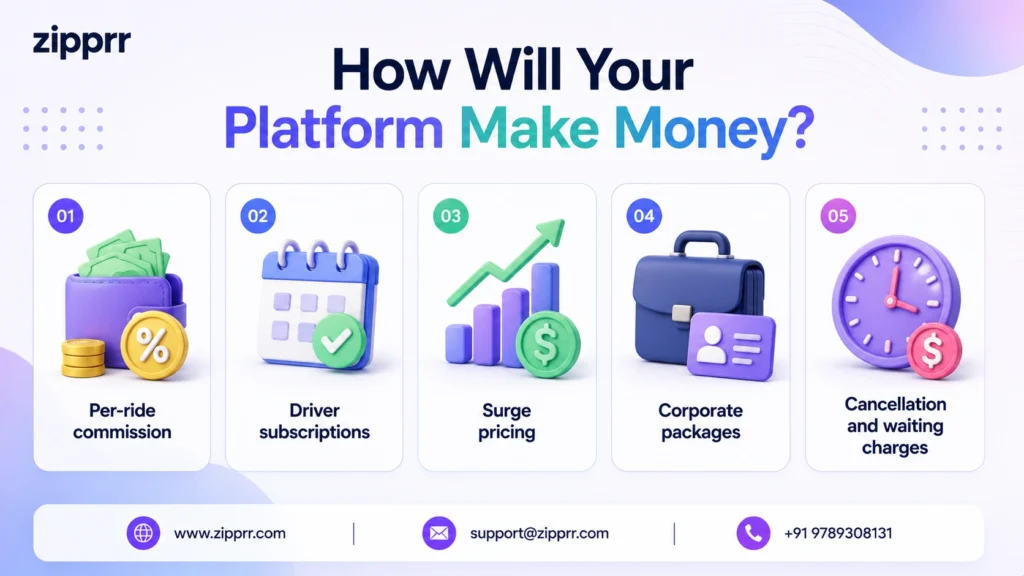
A ride-hailing platform running on a clone script generates income through five configurable streams, each one switchable per city inside the admin panel:
- Per-ride commission: usually 15 to 20% deducted from every completed fare.
- Driver subscriptions: drivers retain 100% of fares and pay a flat weekly or monthly access fee.
- Surge pricing: automatic fare increases during demand spikes, capped at your limits.
- Corporate packages: businesses pre-purchase ride blocks and settle by monthly invoice.
- Cancellation and waiting charges: policy fees that discourage no-shows and idle time.
Corporate accounts are the underrated performer here. Operators positioned near airports and business districts routinely attribute 30 to 40% of first-year revenue to B2B clients. Before purchasing, confirm all five streams already exist inside the admin panel; bolting one on after launch costs considerably more.
Schedule a Free Demo: See the Platform Before You Spend a Dollar
Nothing in this guide requires trust; all of it can be checked firsthand. The complete Uber Clone demo walks through the passenger app your riders will install, the driver app your fleet will operate, and the admin dashboard you will run the business from. Pricing sits openly on the page, an itemized quote reaches you within 24 hours, and a 7-day full-refund guarantee stands behind the purchase.
Carry the 7-point checklist into the demo and work through every item. A vendor with nothing to conceal will happily confirm all seven in the agreement.
Frequently Asked Questions
Which is the best Uber clone script to buy in 2026?
The best Uber clone script in 2026 pairs transparent one-time pricing and 100% unencrypted source code with a contractual launch date and a defined support period. Zipprr’s Uber Clone satisfies all four publicly, priced at $490 to $890 one-time with a 7-business-day launch agreement and 90 days of contracted support. Let the contract terms decide, not the feature list.
How much does an Uber clone script cost?
An Uber clone script costs $490 to $20,000 in 2026, depending on the vendor. Zipprr offers complete packages at $490 and $890 one-time, mid-market vendors ask $1,500 to $8,000, and premium builds command $4,000 to $15,000. A custom build of the same platform consumes $80,000 to $200,000 across 9 to 12 months.
Is it legal to buy and launch an Uber clone app?
Yes. Operating an Uber clone app is lawful when the script is independently developed code released under your own brand. No Uber software is being copied. Local transport rules still apply in your operating region: operator licensing, driver background screening, vehicle standards, and data-protection requirements.
How long does it take to launch a taxi app with a clone script?
A clone script reaches launch in 7 business days to 6 weeks, compared with 9 to 12 months for a custom build. Zipprr states 7 business days inside its signed project agreement, spanning server deployment, branding, payment gateway setup, QA, and store submission. Whatever vendor you pick, have the timeline added to the contract.
Do I own the source code when I buy an Uber clone script?
Only when the vendor supplies 100% unencrypted code under a perpetual, royalty-free license, and not every vendor does. Some ship obfuscated modules or chain the platform to a licensing server, so your app stops working if their company folds. Zipprr hands over fully unencrypted code for all three applications with no callback dependency.
Are there monthly fees or royalties after buying an Uber clone script?
There should be none, yet a sizable slice of the market collects them in one disguise or another. Look out for monthly “platform charges,” yearly license renewals, per-trip royalties, and compulsory paid hosting. Zipprr takes a single one-time payment covering lifetime updates, with zero recurring charges afterward.
Should I buy a readymade script or build a custom app like Uber?
Choose ready-made when launching a business; commission custom work only when the software itself is your competitive moat. A ready-made script puts you live within days on a market-proven codebase, preserving capital for driver recruitment. Successful operators usually start on a script and extend it later, which owning the code makes possible.
Is an Uber clone business profitable?
Yes. Well-run operators generally hit break-even within 6 to 12 months of a focused single-city launch, collecting 15 to 20% commission per completed ride. Consider the arithmetic: a $5 average fare at 18% commission across 300 daily rides produces roughly $8,100 in monthly gross platform revenue, against server bills under $100. Driver supply decides profitability, not the software.
What is the difference between a white label Uber clone and a regular clone script?
A white label Uber clone strips every vendor fingerprint from customer-facing surfaces, leaving only your name, icon, colors, notifications, and receipts. Check that no “powered by” credit is demanded and that the vendor keeps no access to your platform after handover. With Zipprr, apps go out through your own developer accounts, so Apple and Google display your company as publisher.
Can I customize the app after buying the script?
Yes. Owning the full source code lets any developer restyle the interface, add vehicle categories, connect APIs, or construct entirely new modules. Modular architecture keeps such changes from disturbing the core booking engine. Zipprr, like most vendors, also offers paid customization, though unencrypted code means you are never tied to them.