
Every business with a website or a messaging inbox eventually runs into the same wall: customers ask the same questions, at all hours, faster than any human team can answer them. A visitor wants pricing at 11 p.m. A lead wants a demo booked on a Sunday. A returning customer wants an order status update during a lunch break. None of these moments wait for business hours, and every one of them is a chance to win or lose a sale.
An AI Chat Assistant closes that gap. Rather than sending visitors to a static FAQ page or a bot that only fires on exact keyword matches, it carries on a genuine back and forth conversation, drawing its answers straight from a business’s own content and stepping aside for a human teammate only when the situation truly calls for one. Because it runs on large language models built to interpret intent rather than match phrases, the responses read like they came from someone who actually works there, not a script.
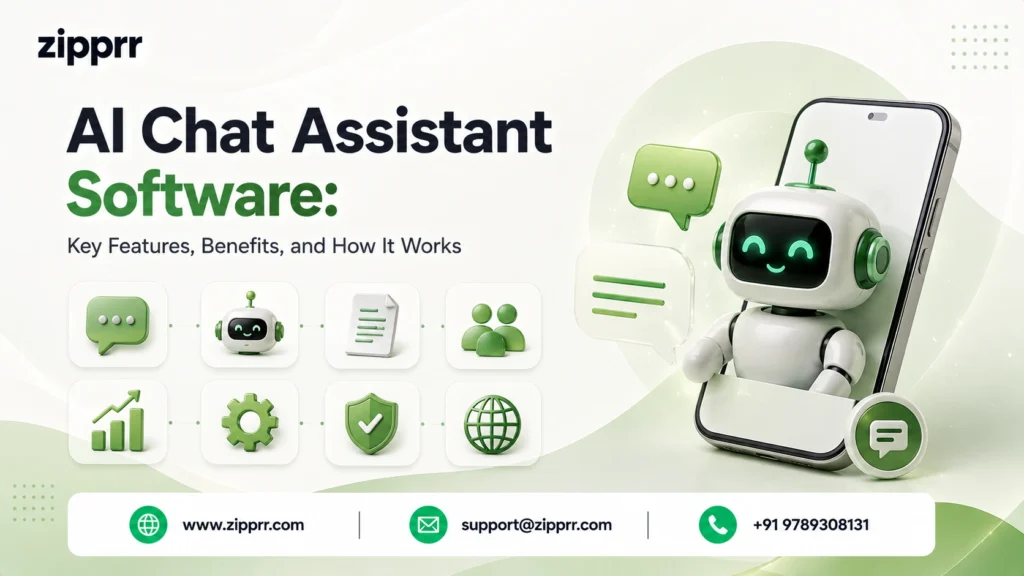
This guide takes a digital transformation and business automation perspective. Rather than treating an AI Chat Assistant as a novelty widget bolted onto a website, we look at it as infrastructure: a layer that sits across marketing, sales, and support, automating the repetitive parts of customer engagement so teams can focus on the conversations that actually need a human. You will learn what an AI Chat Assistant is, why it matters, the problems it solves, its core features, how to implement one, and what separates a serious platform from a toy chatbot builder.
What Is an AI Chat Assistant?
AI Chatbot vs. AI Chat Assistant vs. Live Chat
| Option | How it answers | Learns from your content | Best for |
|---|---|---|---|
| Traditional rule-based chatbot | Fixed decision trees, keyword matching | No | Simple, predictable FAQ flows |
| Live chat (human only) | A person types every reply | Not applicable | Low volume, high-touch sales |
| AI Chat Assistant | LLM-generated answers grounded in your data | Yes | 24/7 support, lead qualification, sales at scale |
Why Businesses Need an AI Chat Assistant
Customer expectations have shifted permanently toward instant, self-serve answers. A prospect comparing vendors will not wait two days for an email reply. They will simply move to the next tab. A support ticket that sits in a queue overnight becomes a churn risk by morning. This is not a seasonal spike businesses can staff around; it is the new baseline.
An AI Chat Assistant addresses this by turning a business’s existing knowledge into an always-available conversation partner. For companies pursuing digital transformation, it fits alongside CRM, helpdesk, and marketing automation tools as one more system that reduces manual, repetitive work and lets human effort go where it matters most: complex problems, high-value deals, and relationship building.
Common Business Challenges an AI Chat Assistant Addresses
- Slow response times: Leads and customers who message after hours or during peak periods wait too long for a reply, and many simply leave.
- Repetitive support volume: A large share of tickets are the same handful of questions, including pricing, hours, order status, and return policy, repeated endlessly.
- Lead leakage: Website visitors who have real buying intent leave without being captured because no one engages them in the moment.
- Inconsistent answers: Different support agents phrase policies differently, creating confusion and eroding trust.
- Rising support costs: Headcount does not scale linearly with growth, so support costs climb faster than revenue if every conversation needs a human.
- Limited multilingual coverage: Small teams often cannot offer support in every language their customers speak.
- Fragmented channels: Customers reach out through the website, WhatsApp, email, and social media, and keeping answers consistent across all of them is hard to manage manually.
How an AI Chat Assistant Solves Those Challenges
| Business Challenge | How an AI Chat Assistant Solves It |
|---|---|
| Slow response times | Answers instantly, 24/7, with no queue or wait time. |
| Repetitive support volume | Resolves common questions automatically, freeing agents for complex issues. |
| Lead leakage | Engages visitors in real time, captures contact details, and qualifies intent before handoff. |
| Inconsistent answers | Uses one source of truth, so every visitor gets the same accurate answer. |
| Rising support costs | Handles growing conversation volume without proportional headcount growth. |
| Limited multilingual coverage | Responds in multiple languages automatically, without hiring multilingual staff. |
| Fragmented channels | Centralizes conversations from the website widget and messaging channels into one dashboard. |
Core Features of an AI Chat Assistant
- Natural language understanding: Interprets questions phrased in everyday language rather than requiring exact keyword matches.
- Knowledge base grounding (RAG): Pulls answers from a business’s own website, documents, and help center rather than generic training data.
- Multi-model LLM support: Ability to connect to different large language models depending on cost, speed, or quality needs.
- Lead capture and qualification: Collects name, email, and intent, and scores leads before they reach a sales rep.
- Human handoff: Detects when a conversation needs a person and routes it to a live agent with full context.
- Omnichannel deployment: Runs as a website widget and extends to channels like WhatsApp, Messenger, and Instagram.
- Analytics dashboard: Tracks conversation volume, resolution rate, common questions, and lead conversion.
- Customizable branding: White-label appearance so the assistant matches a business’s or agency’s own brand.
- Multilingual responses: Detects and replies in the visitor’s language automatically.
- API and webhook support: Connects to a CRM, helpdesk, e-commerce platform, or payment gateway for two-way data flow.
- Conversation history and memory: Retains context within a session so follow-up questions do not need to be re-explained.
- Role-based admin access: Lets teams manage content, review conversations, and adjust settings with appropriate permissions.
Benefits of Using an AI Chat Assistant
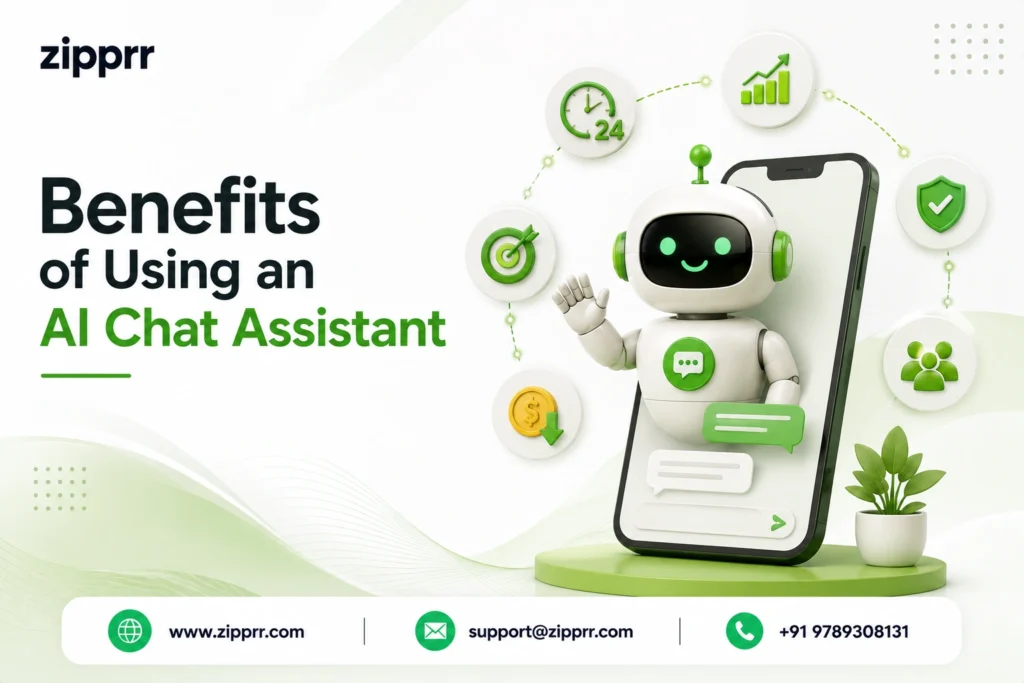
- 24/7 availability: Customers get answers at any hour, in any time zone, without staffing a night shift.
- Faster lead response: Prospects are engaged the moment they show interest, which measurably improves conversion.
- Lower cost per conversation: Automating repetitive questions reduces the marginal cost of scaling support.
- Consistent brand voice: Every answer reflects the same tone, policies, and accuracy.
- Higher agent productivity: Human agents spend time on complex, high-value conversations instead of repeating the same answers.
- Better data on customer intent: Conversation logs reveal what customers actually ask, informing product and content decisions.
- Scalability without linear cost: Conversation volume can grow significantly without a proportional increase in staff.
- Improved customer satisfaction: Instant, accurate answers reduce friction and frustration in the buying and support journey.
Industry Applications
- E-commerce: Product questions, order tracking, return policy, and cart abandonment recovery.
- SaaS and software: Onboarding help, feature questions, plan comparisons, and technical support triage.
- Real estate: Property inquiries, scheduling viewings, and initial buyer or renter qualification.
- Healthcare and clinics: Appointment scheduling, general information, and intake, with clear escalation for clinical questions.
- Education: Admissions questions, course information, and student support.
- Travel and hospitality: Booking assistance, availability questions, and policy information.
- Financial services: Account questions, product information, and lead qualification for advisors.
- Professional services and agencies: Initial client intake, service explanations, and consultation booking.
Real-World Use Cases
- A DTC retailer deploys an AI Chat Assistant to answer sizing, shipping, and return questions instantly, reducing support tickets and recovering abandoned carts through proactive prompts.
- A SaaS company uses it to answer plan and feature questions on the pricing page, qualifying self-serve leads and routing enterprise inquiries to sales with full conversation context.
- A real estate agency runs an assistant that answers property questions around the clock and books viewing appointments directly on the agent’s calendar.
- A local clinic uses an assistant to handle appointment scheduling and frequently asked questions, reducing the front-desk phone load.
- A digital agency white-labels an AI Chat Assistant platform and resells it under its own brand to multiple SME clients, creating a recurring revenue line without building the technology in-house.
Implementation Guide
- Define scope and goals: Decide whether the priority is support deflection, lead generation, or both, and set measurable targets.
- Gather the knowledge base: Collect the website content, FAQs, policies, and documents the assistant should be grounded on.
- Choose deployment channels: Start with the website widget, then extend to WhatsApp or other messaging channels as needed.
- Configure handoff rules: Decide which topics or sentiment signals should route a conversation to a human agent.
- Set branding and tone: Match the assistant’s appearance and voice to the business’s brand guidelines.
- Connect integrations: Link the CRM, helpdesk, and analytics tools so conversation data flows into existing systems.
- Test with real scenarios: Run through common customer questions and edge cases before launch to catch gaps in the knowledge base.
- Launch and monitor: Track resolution rate, handoff rate, and customer feedback in the first weeks.
- Refine continuously: Update the knowledge base and adjust responses based on the questions customers actually ask.
Best Practices
- Ground answers in verified content only, and avoid letting the assistant improvise on policies like pricing or refunds.
- Make human handoff easy to trigger, so frustrated or complex conversations reach a person quickly.
- Keep the knowledge base current; an assistant is only as accurate as the content behind it.
- Set clear expectations with visitors that they are speaking with an AI assistant.
- Review conversation logs regularly to spot gaps, confusing questions, or missed opportunities.
- Start narrow and expand: launch with support or lead capture first, then add more use cases once the first is working well.
- Measure outcomes, not just activity: track resolution rate and conversion, not just number of chats handled.
Comparison Table: AI Chat Assistant vs. Alternatives
| Approach | Availability | Cost at scale | Consistency |
|---|---|---|---|
| Human support team only | Business hours only (unless staffed 24/7) | Grows with volume | Varies by agent |
| Rule-based chatbot | 24/7 | Low, but limited capability | Rigid, breaks on unexpected phrasing |
| AI Chat Assistant | 24/7 | Scales with minimal added cost | Consistent, grounded in one knowledge base |
| Generic AI chatbot builder (no business grounding) | 24/7 | Low to moderate | Inconsistent, prone to inaccurate answers |
Ready to Put an AI Chat Assistant to Work?
Frequently Asked Questions
What is an AI chat assistant?
How does an AI chat assistant work?
Is an AI chat assistant the same as a chatbot?
Can an AI chat assistant replace human customer support?
How much does an AI chat assistant cost?
Is an AI chat assistant good for small businesses?
Can an AI chat assistant speak multiple languages?
How long does it take to set up an AI chat assistant?
Can an AI chat assistant capture and qualify leads?
Is customer data safe with an AI chat assistant?
Key Takeaways
- An AI Chat Assistant automates customer engagement using natural language understanding and a business’s own knowledge base.
- It solves real operational problems, including slow response times, repetitive support volume, lead leakage, and inconsistent answers.
- Core value comes from grounding responses in accurate, business-specific content rather than generic AI knowledge.
- Human handoff remains essential for complex or sensitive conversations.
- Implementation works best when scoped narrowly at first, then expanded once results are proven.
- White-label and self-hosted options let businesses and agencies own the technology rather than renting it indefinitely.
Conclusion
An AI Chat Assistant does not replace a support or sales team. It is the layer that makes that team more effective by absorbing the repetitive, time-sensitive work that used to fall through the cracks after hours or during peak volume. For businesses serious about digital transformation, it belongs in the same category as a CRM or helpdesk: infrastructure that compounds in value as conversation volume grows. The businesses that adopt it now are not just cutting costs. They are building a faster, more consistent customer experience that is difficult for slower-moving competitors to match.