

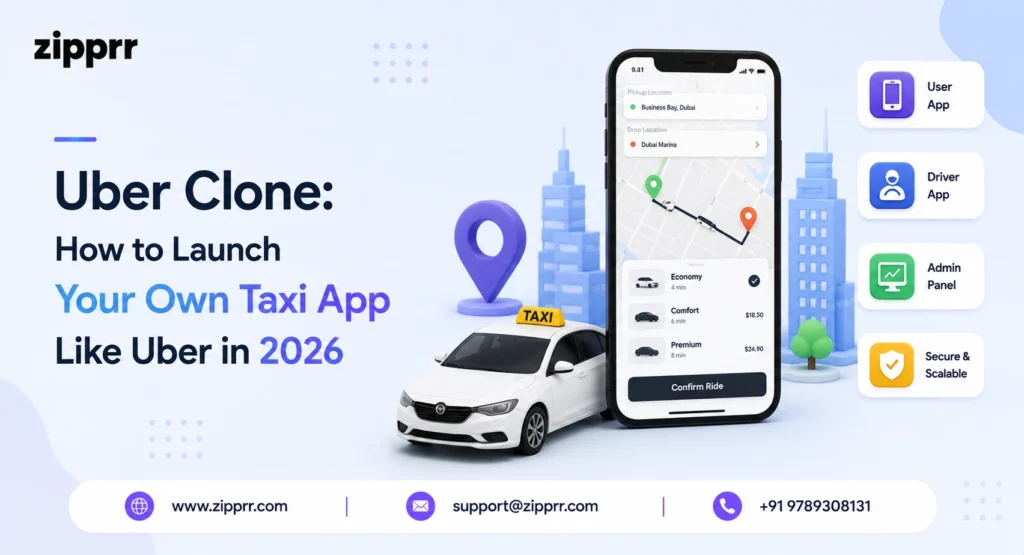
An Uber Clone is ready-made taxi booking software that copies the way Uber works: a rider app, a driver app, an admin dashboard, and the backend that ties them together. That means you can run your own ride-hailing brand without building everything line by line. Think of it as buying the engine instead of forging every bolt yourself. Below, I’ve answered the questions people actually type into Google before they spend a dollar: what it is, how it works, what it really costs, whether it’s legal, how the money comes in, and how to pick one that won’t fall apart at scale.
What is an Uber clone?
An Uber clone is pre-built ride-hailing software you rebrand and launch as your own taxi business. It is not a stolen copy of Uber’s app. It is independently written code that recreates the experience riders already expect: tap to book, track the car on a live map, pay in the app, and rate the driver at the end.
Every Uber clone bundles four working parts: a passenger app, a driver app, an admin web panel, and a backend server that keeps them in sync in real time. The expensive, time-consuming engineering is already built and tested, so your work shifts from writing code to going to market: branding the apps, recruiting drivers, and winning your first city.
Picture those four parts as a relay team. The rider app brings in demand. The driver app supplies the cars. The backend acts as the referee in the middle, matching riders to drivers and timing each handoff. The admin panel is the coach on the sideline, tracking the whole operation and adjusting the rules. With a good clone, all four players are already trained. You simply put them in your jersey and start the race
How does an Uber clone work?
An Uber clone works by matching a rider with the nearest free driver in real time, then handling the trip, the payment, and the ratings on its own. It’s the same loop millions of people run every day on the original app, only now it’s wearing your logo.
Here’s a single ride from tap to receipt:
- A rider sets pickup and drop-off, sees an upfront price and a few car options, and confirms.
- The system pings nearby drivers; the closest one accepts.
- The driver app navigates to the pickup while the rider watches the car move on the map.
- At drop-off, the fare is tallied (base, plus distance, plus time, plus surge if it’s busy) and charged to a card, wallet, or taken in cash.
- Your commission is skimmed automatically, the driver keeps the rest, and both sides leave a star rating.
Behind the curtain, it leans on mapping APIs for location and routing, a live socket connection for that moving-dot tracking, a payment gateway, and push notifications so nobody’s left guessing. None of that is something you build or babysit; it’s wired up once during setup, and then it simply runs every time a rider opens the app.
What features does an Uber clone include?
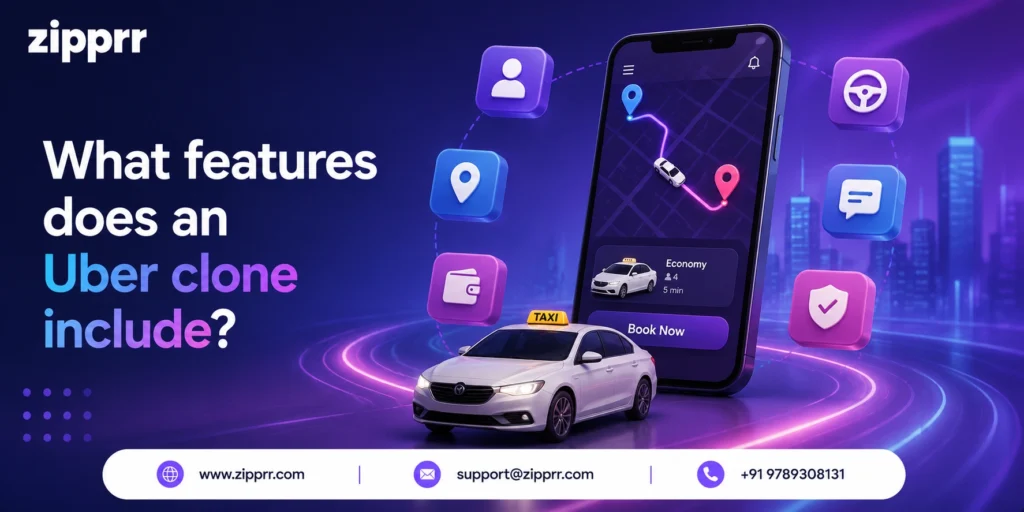
A solid Uber clone ships with everything you need to run day one, already built: the rider app, the driver app, the admin panel, and the plumbing between them. If you’re paying extra to add “book a ride” or “take a payment,” you’re buying the wrong product.
Rider app: fast sign-up, real-time GPS booking with fare estimates, multiple ride tiers, live tracking and ETA, card, wallet, and cash payments, plus the small stuff that keeps people loyal like scheduling, ride history, in-app chat, ratings, and referral perks.
Driver app: an online/offline switch, incoming ride alerts with accept or decline, built-in navigation, an earnings view, and document upload for onboarding.
Admin panel: live numbers on rides, revenue, active users, and cancellations; driver approval and document checks; controls for fares, commission, and surge; promo codes and dispatch tools; and reports you’ll actually use to make decisions.
The features that look small in a demo are often the ones that decide whether riders come back. In-app chat saves a cancelled ride when a driver can’t find the gate. Upfront fares kill the “why was I charged this” support ticket before it’s written. A clean earnings screen is half the reason a driver picks your platform over the one across town. When you compare scripts, look past the headline list and check that these everyday details feel finished.
How much does an Uber clone cost?
An Uber Clone script usually runs between $490 and $15,000 depending on the provider and package, while building the same thing from scratch lands somewhere between $40,000 and $300,000 or more. That gap is the whole reason this market exists.
Roughly how it splits:
- Ready-made scripts: entry tiers start near $490; professional and enterprise tiers commonly sit between $890 and $8,000+, mostly depending on which apps, source-code access, and support are included.
- From scratch: a bare-bones build is $40,000 to $60,000, and a polished multi-city platform can sail past $150,000 to $300,000.
What nudges your number up or down: how many platforms you need (iOS, Android, web), how much you customize, third-party API and payment fees, and ongoing support. Remember too that the sticker price is rarely the whole bill. Live maps, SMS one-time passwords, push notifications, and your app-store accounts all carry small recurring costs once you go live, so pad your first-year budget for them. For most founders testing a market, a ready-made base gets you ninety percent of the value for a sliver of the price. Zipprr, for instance, starts its package at $490 with full source-code access.
Is it legal to make an Uber clone app?
Yes. Building and launching an Uber clone is legal, as long as the code is written independently and you follow local ride-hailing rules. You’re not lifting Uber’s code or its name; you’re running an Uber-style platform under your own brand.
The part that actually needs your attention is operating. A real ride-hailing business needs the right local permits and transport licenses, proper insurance for drivers and riders, genuine driver screening, and compliance with privacy laws like GDPR or CCPA. The software is the easy, legal part; running it responsibly is on you. Good providers help by baking in driver verification, secure payments, and data controls from the start.
One practical tip: rules vary wildly by city, not just by country. A model that is routine in one market may need a special permit a few hundred miles away. Before you spend on marketing, spend an afternoon with a local transport authority or a lawyer who knows the space. It is the cheapest insurance you will ever buy.
How do you build an app like Uber?
An Uber clone makes most of its money by taking a commission on every ride, typically 15 to 25% of the fare, then stacks a few smaller streams on top. The commission is the heartbeat; everything else pads the margin.
- Ride commission: your cut of each completed fare.
- Surge pricing: fares climb 2x to 3x when demand spikes, and your slice climbs with them.
- Cancellation fees: charged when a rider bails after the grace window.
- Subscriptions: a monthly membership that trades small rider discounts for predictable income.
- In-app ads: promoted spots once you’ve got eyeballs.
- New verticals: reuse the same dispatch engine for food, courier, or parcel delivery.
The beauty is that the commission scales on autopilot: more rides, more revenue, without your costs rising at the same pace. Early on, though, resist the urge to crank commission too high. Drivers are your real supply, and in a young market, they have other apps to drive for. A slightly thinner cut that keeps cars on the road beats a fat percentage on rides that never happen.
How do you build an app like Uber?
You’ve got two honest paths to an app like Uber: buy a ready-made clone and customize it, or build from zero. Same four-part system at the end, but wildly different timelines and bills.
Path one, the clone (what most founders should do): pick a reputable script, drop in your branding, set your pricing and commission, plug in your payment gateway and maps key, and ship to the App Store and Google Play. You’re living for roughly one to three weeks.
Path two, from scratch: architect the rider app, driver app, admin pane,l and backend as separate services, build the mobile apps and server, wire up live tracking and maps, then test, deploy, and babysit it all yourself. Budget six to eighteen months.
If you’re validating a market or opening a single city, the clone route keeps your cash where it matters: signing drivers and winning riders, not paying engineers to reinvent a solved problem.
White-label Uber clone vs custom development: which is better?
A white-label Uber clone wins when you want to launch fast, keep costs tight, and prove a market early; custom development wins when you’re well-funded, and your service model genuinely won’t fit a standard ride-hailing mold. In practice, most successful operators start white-label and bolt on custom features later, once the revenue is real.
The short version you can lift at a glance:
- Cost: white-label around $490 to $15,000; custom $40,000 to $300,000+
- Time to launch: white-label 1 to 4 weeks; custom 6 to 18 months
- Source code: included with good providers; fully yours when custom
- Core features: pre-built vs built from scratch
- Best fit: fast launch and validation vs a unique long-term product
The move: validate with a clone, then reinvest in custom work once the model clearly pays. Think of the clone as your first lap, not your final car. It gets you onto the track while competitors are still in the garage, and it earns the revenue that funds whatever custom build comes next.
What can you use an Uber clone for?
An Uber clone isn’t just for plain taxi service. The same backbone powers a surprising range of on-demand models. Founders use it for city ride-hailing, airport and intercity transfers, corporate employee transport, women-only or premium niches, moto-taxi and auto-rickshaw services in fast-growing markets, and even courier or logistics runs off the same dispatch core. Because the booking, matching, and payment guts are identical, smart operators simply point one clone at whatever local niche has the thinnest competition.
The winners usually pick a lane the giants ignore. A campus shuttle, a regional airport run, a women-only service in a city that lacks one, a moto-taxi network where cars don’t fit the streets. The technology is the same; the opportunity is in choosing a niche where you can be the obvious first choice rather than the tenth option.
What is the Uber clone app development process, step by step?
The Uber clone app development process runs through six practical stages: planning, branding, configuration, integration, testing, and launch. With a ready-made script, most of the engineering is finished, so your real work is shaping the product around your market rather than writing core code.
Here is how a typical rollout looks once you’ve picked a script:
- Plan your model. Decide your city, your vehicle tiers, your commission rate, and whether you’re cash-first or card-first. This single decision shapes everything downstream, from fare rules to driver payouts.
- Brand it. Swap in your logo, colors, app name, splash screens, and store listings. This is where a generic script starts to feel like your company.
- Configure the rules. Set base fares, per-kilometer and per-minute rates, surge thresholds, cancellation windows, and service zones inside the admin panel. No code, just settings.
- Integrate third parties. Connect your payment gateway, your maps and routing key, SMS or email for one-time passwords, and push notifications. These are the moving parts that make the live experience feel instant.
- Test on real devices. Run a full ride end-to-end: book, match, navigate, pay, rate. Test edge cases too, like a driver canceling or a payment failing, before a real customer finds them.
- Launch and watch the numbers. Submit to the App Store and Google Play, onboard your first drivers, and keep the admin dashboard open. Your first week of live data tells you more than any plan ever could.
Start to finish, this is usually one to three weeks of focused work rather than the year-plus a custom build demands. The compressed timeline is exactly why so many founders validate with a clone first.
What technology stack powers an Uber clone?
A modern Uber clone is built on a mobile front end, a real-time backend, mapping and payment APIs, and a cloud host. You don’t need to write any of it yourself, but knowing the pieces helps you ask better questions before you buy.
The mobile apps for riders and drivers are commonly built with React Native or Flutter, so a single codebase serves both iOS and Android. The backend usually runs on Node.js with a framework like Express, paired with a database such as PostgreSQL or MongoDB for users, trips, and payments. Live driver tracking, the moving dot you watch on the map, runs over a socket connection (often Socket.io), so positions update second by second. Mapping, routing, and distance come from a provider like Google Maps, payments flow through a gateway such as Stripe or a local equivalent, and the whole thing typically sits on AWS, Google Cloud, or a similar host that can scale when your ride volume grows.
When you evaluate a script, ask which of these it uses and whether you get the full source code. A clean, documented stack you actually own is the difference between a platform you can grow for years and one you outgrow in months.
How do you choose the best Uber clone script?

To choose the best Uber clone script, weigh five things: source-code ownership, real customization, scalability, transparent pricing, and post-launch support. Anything that scores poorly on those is a cost you’ll pay later, usually at the worst possible time.
Run any provider through this quick filter:
- Do you get the full source code? Without it, you’re renting, not owning, and you can’t move or deeply customize.
- Can it actually be customized? Some “white-label” scripts only let you change a logo. Make sure you can add features and adjust flows.
- Will it scale? Ask how it behaves at hundreds of concurrent rides, not just a demo with three.
- Is pricing transparent? Watch for hidden fees on updates, support, or extra platforms. A clear $490 or $890 beats a vague “contact us” that balloons later.
- What does support look like after launch? Bugs and store rejections happen. Round-the-clock help is worth more than a slightly cheaper sticker price.
The cheapest option and the flashiest demo are both traps. The right script is the one that lets you launch fast today and still own and grow the platform two years from now.
What mistakes should you avoid when buying an Uber clone?
The most common Uber clone mistakes are buying on price alone, skipping source-code ownership, ignoring local regulations, and under-budgeting for driver and rider acquisition. Each one is avoidable, and each one quietly sinks launches that otherwise had a real shot.
Buying on price alone usually means you save a few hundred dollars upfront and lose months later to a script you can’t extend or scale. Skipping source code locks you to one vendor forever. Treating compliance as an afterthought, the permits, insurance, and driver screening can stop your business before it starts in regulated markets. And the quietest killer of all: spending your whole budget on software and nothing on getting drivers and riders onto the platform. A perfect app with no drivers is an empty parking lot. Plan your launch budget so the technology is the start of the story, not the entire plot.
Why choose zipprr for your Uber clone?
If you want to own your platform instead of renting it, zipprr is built for exactly that: a full white-label ride-hailing solution with complete source-code access, branded rider and driver apps, an analytics-rich admin panel, and packages that start at $490.
What you’re actually getting: full source-code ownership so there’s no vendor lock-in; the complete ecosystem of rider app, driver app, admin dashboard, and website; multiple vehicle tiers with secure rider-to-driver settlement; a dashboard that surfaces the numbers you’ll steer by; unlimited updates; and round-the-clock phone and chat support. Pricing stays honest and readable at $490 standard and $890 professional.
The bottom line
An Uber clone is the fastest, most affordable on-ramp into ride-hailing in 2026. You get Uber’s proven loop of instant booking, live matching, in-app payments, and commission revenue as a ready-to-brand package, and you skip the year and the six figures a from-scratch build demands. If you plan to launch in weeks, prove one city, and grow on commission, starting with a white-label clone is simply the smarter first move.
Ready to launch?
What is an Uber clone script?
An Uber clone script is ready-made source code that recreates Uber’s core ride-hailing features: rider app, driver app, admin panel, and backend. It lets you launch a branded taxi-booking business in weeks instead of building from scratch, saving most of the usual cost and time.
How much does an Uber clone cost?
Is it legal to make an app like Uber?
How do Uber clone apps make money?
They earn mainly through a 15 to 25% commission on each ride fare. Extra revenue comes from surge pricing, cancellation fees, subscriptions, in-app ads, and expanding the same platform into delivery services.
How long does it take to launch an Uber clone?
White-label Uber clone or custom development, which should I pick?
What features should an Uber clone include?
At minimum: a rider app (booking, live tracking, multiple payments, ratings), a driver app (availability toggle, ride alerts, navigation, earnings), and an admin panel (live KPIs, driver verification, fare and commission control, analytics). Real-time GPS, secure payments, and push notifications are non-negotiable.
Do I get the source code with an Uber clone?
What technology stack is an Uber clone built on?
A typical Uber clone uses React Native or Flutter for the rider and driver apps, a Node.js backend with PostgreSQL or MongoDB, a socket connection for live tracking, plus Google Maps for routing and a payment gateway like Stripe. It usually runs on a cloud host such as AWS or Google Cloud, so it can scale with ride volume.
How do I choose the best Uber clone script?
Judge a script on five things: full source-code ownership, genuine customization, scalability under real load, transparent pricing with no hidden fees, and strong post-launch support. The cheapest option and the flashiest demo are both risky; the best choice lets you launch fast and still own and grow the platform years later.