

Something Nobody Tells You About the Car Rental Industry
Parked in driveways, sitting idle in apartment garages, locked up in suburban carports — roughly 95 per cent of privately owned vehicles spend more than 22 hours per day doing absolutely nothing. That is not a transportation problem. That is a marketplace problem waiting to be solved.
Turo understood this years before most people caught on. Rather than owning a single vehicle, the company built the infrastructure for millions of car owners to monetise their idle assets. No fleet. No depreciation liability. Just a platform that connected supply with demand and collected a commission on every trip that followed.
You are not reading this to admire that story. You are reading it because you want to build something comparable — a platform positioned at the intersection of an underserved market, a proven model, and a technology stack that no longer requires tens of millions of dollars to assemble.
That is precisely what a Turo clone makes possible. Not a replica of Turo. A purpose-built marketplace that applies the same peer-to-peer vehicle rental logic to a geography, a niche, or a vehicle category that nobody has dominated yet.
This article walks through everything that matters: what the platform does, how each user type experiences it, where the revenue actually comes from, what it costs to launch, and the specific product decisions that determine whether your marketplace thrives or flatlines after 90 days.
QUICK ANSWER: What is a Turo Clone?
A Turo clone is a white-label peer-to-peer car rental platform — independently engineered software that mirrors Turo’s marketplace model. Vehicle owners set their own rates, mark their schedule, and publish their vehicle for renters to discover. Renters find, book, and pay for those cars through a mobile or web interface. The operator running the platform earns a commission on every completed transaction without owning a single vehicle. Delivered with a renter app, a host app, and a full admin dashboard, it can carry your brand and go live in under two weeks.
Why a Turo Clone Is Not Simply a Car Booking App
Plenty of developers will offer you a car booking system and call it a Turo clone. Spot the difference fast: a booking system assumes you own the cars. A marketplace platform assumes you do not own anything except the infrastructure connecting two parties.
Consider what that shift requires. When car ownership sits on one side of the transaction, and a renter sits on the other, with a stranger’s vehicle changing hands between them, several problems appear simultaneously. Trust has to be manufactured before the keys get passed. Liability needs a structural home. Both parties require independent verification. Payments must be held, not just processed. And if something goes wrong after the trip, there needs to be a documented resolution path that neither party can game.
Strip any of those elements out, and you do not have a marketplace — you have a directory with a payment form bolted on. Users will list cars once, rent once, and disappear the moment a single transaction goes badly without a system behind it.
Three Pillars the Platform Must Carry
Think of the architecture in three layers. First is the transaction layer: discovery, booking, payment, and scheduling. Second is the trust layer: identity verification, insurance, damage documentation, and dispute handling. Third is the intelligence layer: pricing signals, demand analytics, host performance data, and fraud pattern detection. Most car-sharing scripts deliver the first layer tolerably. Fewer build the second with any seriousness. Almost none invest meaningfully in the third. That gap is where well-built platforms widen the distance from their competition.
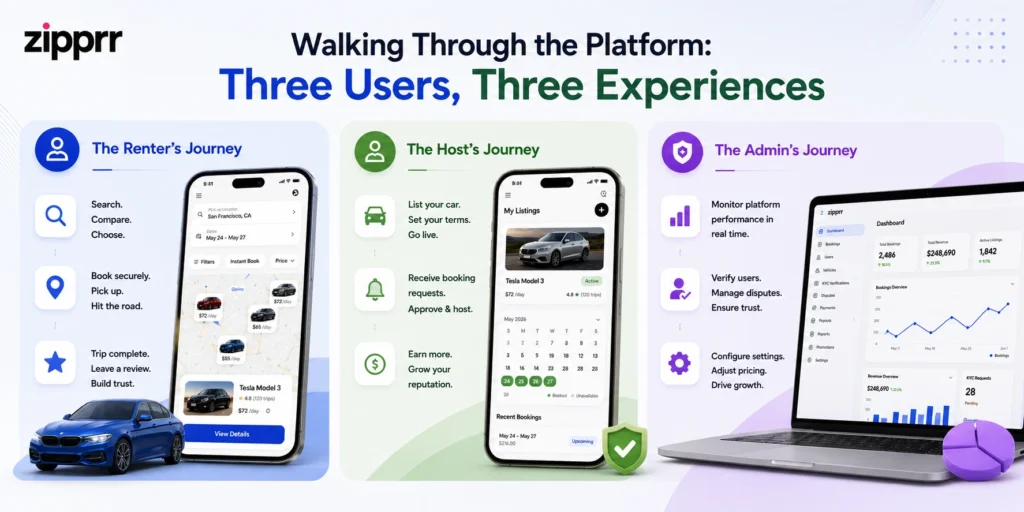
Walking Through the Platform: Three Users, Three Experiences
The Renter's Journey
Opening the app, a renter enters a pickup location and dates. What comes back is not just a list of available cars — it’s a map layered with filtered options, showing distance, price per day, host rating, and whether the car supports instant confirmation. Tap into any listing, and the experience deepens: a full photo gallery, vehicle specifications, host response rate, reviews from previous trips, and a breakdown of what is and is not covered by the booking protection. Payment clears in-app and goes into escrow. Directions route the renter to the agreed handover point. Both sides document the vehicle’s condition through timestamped photos before driving away. After the trip, the same process closes the booking, triggers the host’s payout, and prompts both parties to leave verified reviews.
The Host's Journey
Creating a listing takes fifteen minutes if the host follows the guided wizard: upload photos, enter the make and model and year, set a daily base rate, mark unavailable dates on the calendar, and choose whether to auto-approve renters or review each request manually. Once live, a notification arrives when a booking comes in. The host reviews the renter’s profile, licence scan, and rating before accepting. After the trip completes, earnings arrive in the linked payout account. Every additional completed booking improves the host’s ranking in search results, making the platform self-incentivising for consistent performance.
The Admin's Journey
The operator never touches a car. From a browser-based dashboard, they watch bookings flow in, KYC requests land in the verification queue, and revenue accumulates in real time. Commission rates are adjustable by vehicle category, host tier, or trip duration — no developer involvement needed. Flagged disputes surface in a claims interface with both parties’ evidence attached. A monthly report exports every financial and operational metric needed for business review. At any point, the admin can push a promotion, suspend a user, adjust a payout schedule, or launch a new vehicle category with a few configuration changes.
Features That Determine Whether Users Come Back
Feature lists are everywhere. What is harder to find is an honest account of which features actually drive retention versus which ones just fill a checklist. Here is the distinction as it applies to a car-sharing marketplace.
For Renters: What Keeps Them Booking
- Context-aware search: A search that adjusts results based on unstated signals — an airport-area query surfaces cars with airport pickup enabled; a late-night search prioritises hosts with instant confirmation. Renters do not articulate these preferences, but they notice when results feel relevant rather than random.
- AI-assisted damage documentation: Pre-trip and post-trip photo capture with machine-vision comparison is not just a legal tool. It is a psychological one. Renters who know the platform objectively documents vehicle condition book with far less anxiety — and anxiety is the friction that keeps first-time users from becoming regulars.
- Persistent in-app messaging: Every conversation attached to a booking lives inside the platform, timestamped and retrievable. No personal contact details change hands. If a dispute arises, the admin has the full communication record. This is accountability architecture, not just messaging convenience.
- Escrow payment protection: Funds collected at booking are not released to the host until trip completion is confirmed. Both sides gain certainty: the renter knows their money is protected if a host cancels at the last minute; the host knows the renter cannot dispute a completed transaction as unauthorised.
- Doorstep delivery option: Offering vehicle delivery to a renter's chosen address unlocks a substantial segment of users who would not otherwise access the platform. High-demand urban areas, airport corridors, and business travel routes are all served better by delivery-enabled listings.
For Hosts: What Keeps Them Listing
- Demand-driven pricing recommendations: An AI pricing engine that monitors local booking volume, competitor rate data, and upcoming demand events to suggest daily rates in real time. Hosts who follow these signals consistently earn measurably more than hosts who set a fixed price and leave it unchanged for weeks.
- Multi-vehicle management console: Fleet operators managing five to twenty vehicles need a completely different interface than someone renting out one car. Aggregate earnings, vehicle-level availability controls, and bulk calendar editing are features that transform the platform from a personal side-income tool into a viable business channel.
- Listing performance analytics: Search impressions, profile click-through rate, booking conversion, and average trip length presented as per-listing metrics. Hosts who can identify what is underperforming in their listing adjust and improve. Hosts who guess, churn.
- Booking mode flexibility: Auto-approve mode maximises occupancy for hosts who trust the platform's verification layer. Request-based mode gives others granular control over who drives their car. Platforms that force one approach lose the hosts who need the other.
Admin Capabilities That Scale With the Business
- Tiered commission architecture: Setting a single flat commission rate is a short-term shortcut. Mature platforms need rate differentiation by vehicle tier, booking duration, host subscription level, and promotional campaign. The admin panel must support this without engineering involvement.
- Integrated KYC workflow: Automated licence scanning, face-match verification, and manual review queuing for flagged accounts — all before a renter's first trip is confirmed. Damage and fraud incidents cluster heavily in the first three bookings. KYC is the cheapest form of incident prevention available.
- Structured dispute resolution: Both parties submit evidence. Admin reviews and issues a documented decision. Escrow releases or retains based on that outcome. Without this workflow, every dispute becomes an ad-hoc negotiation that erodes host confidence faster than any other platform failure.
- Real-time revenue intelligence: Gross marketplace volume, net commission, active user cohorts, booking velocity by city, and host retention rates visible in a single operational view. Running a marketplace without live financial visibility is operating blind.
What Separates 2026 Platforms From Earlier Car Sharing Scripts
Car-sharing software from five years ago was, at its core, a booking calendar with payments attached. The mechanic worked; the intelligence did not. Current platforms are inverting that ratio. Booking mechanics are table stakes. The competitive layer is now built from data signals, learned behaviour, and automated decision-making that operates faster and more accurately than any manual process.
- Demand-responsive dynamic pricing: Rather than reacting to demand after the fact, an AI pricing layer monitors booking velocity, cross-references upcoming local events, and adjusts host rate suggestions before demand peaks hit. Hosts who benefit from peak pricing stay active. Consistent host supply is what prevents demand spikes from becoming unmet demand.
- Behavioural fraud recognition: Machine learning models trained on historical booking behaviour identify statistical anomalies that signal fraudulent intent — account creation patterns, payment method mismatches, trip duration outliers — and flag them before a booking is confirmed. Legitimate users experience no friction. Bad actors get filtered upstream.
- Personalised vehicle recommendations: Each renter's search history, past trips, stated preferences, and in-session behaviour feed a recommendation model that surfaces vehicles they are statistically predisposed to book. This is the feature most directly correlated with second and third booking rates, which is where marketplace unit economics start working in your favour.
- Computer-vision damage assessment: Pre-trip and post-trip photos are processed through an image comparison model that identifies visual differences consistent with damage. Both parties see the same AI-generated report. Objectivity in damage assessment reduces dispute volume by removing the interpretive disagreement that most claims rest on.
- Predictive fleet maintenance alerts: For operators managing commercial vehicle supply, telematics integration enables maintenance prediction before a vehicle is taken offline mid-booking. A breakdown during a rental is the worst outcome measurable — for the renter's experience, the host's rating, and the operator's reputation simultaneously.
Walking Through the Platform: Three Users, Three Experiences
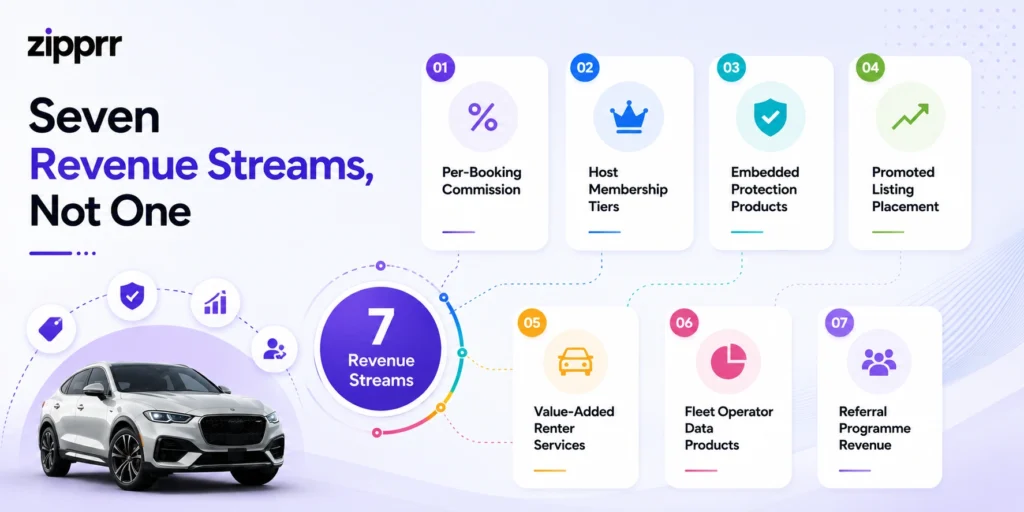
A marketplace that charges commission and nothing else is one bad market cycle away from a revenue problem. Platforms that survive across seasons and economic conditions build multiple interlocking income sources. Here is the complete picture for a Turo-model platform.
1. Per-Booking Commission
Every completed rental generates commission revenue split between a guest-facing service fee and a host-facing platform fee. Combine both sides, and your effective take rate sits between 18 and 28 per cent of each booking’s total value. At 1,000 monthly bookings averaging INR 4,500 each, a 22 per cent combined take rate produces INR 9.9 lakh in gross commission before operational costs.
2. Host Membership Tiers
Monthly subscriptions sold to car hosts create predictable recurring revenue that sits outside the volatility of transaction volume. A three-tier model works cleanly: free access at base commission rates, a mid-tier that reduces commission by five percentage points in exchange for a monthly fee, and a premium tier that adds listing priority, advanced analytics, and a direct support channel. Hosts who invest in a subscription also exhibit materially higher booking approval rates — a quality-of-supply benefit that reinforces itself.
3. Embedded Protection Products
Insurance anxiety is the friction point that loses you renters who almost booked. Solving it inside the checkout flow — with tiered protection plans underwritten by a partner insurer — converts that anxiety into a chargeable product. Referral commissions from each policy sold can account for 15 to 25 per cent of total platform revenue on a mature operation.
4. Promoted Listing Placement
Hosts pay to move their vehicles to the top of search results within their category and city. Beyond pure revenue, promoted listings self-select for quality: hosts willing to spend on placement tend to respond faster to booking requests and maintain better-reviewed profiles, which improves the search experience for renters even as it generates revenue for the platform.
5. Value-Added Renter Services
Doorstep delivery, child seat rental, unlimited mileage upgrade, GPS device add-on, and young driver access surcharges are each configurable line items within the checkout flow. None requires inventory. All generate revenue at close to 100 per cent margin once the platform infrastructure is running.
6. Fleet Operator Data Products
Small fleet businesses and car rental operators using your platform as a distribution channel have an appetite for market intelligence: average daily rates by vehicle class in their city, demand seasonality data, and competitor pricing benchmarks. An analytics subscription sold to professional hosts at a monthly fee adds an enterprise revenue layer that almost no consumer-facing clone has built — yet the data is already being generated by the platform’s transaction history.
7. Referral Programme Revenue
A host referral scheme where existing hosts earn credit for recruiting new vehicle listings costs the platform a fraction of its typical host acquisition spend. Renter referral credits applied to future bookings accelerate repeat booking rates. Both mechanisms generate ROI that outperforms equivalent paid advertising spend across most market conditions.
What It Actually Costs to Launch: An Honest Breakdown
Budget planning for a marketplace launch breaks into two distinct questions. First: what does the platform cost to acquire? Second: what does it cost to reach the first meaningful level of supply and demand? Most cost discussions answer only the first question. Both matter equally.
| Launch Approach | Platform Investment | Time to Live | Included | Right For |
|---|---|---|---|---|
| White-Label Clone | $500 to $5,000 | 7 to 14 days | Renter app, host app, admin panel, source code, white-label setup | First-to-market regional launches, niche verticals, low-risk validation |
| Customised Clone | $5,000 to $25,000 | 4 to 8 weeks | All of the above, plus niche feature development, UI overhaul, and integration work | Differentiated verticals: EV-only, luxury, commercial fleet |
| Full Custom Build | $60,000 to $200,000+ | 6 to 14 months | Fully bespoke architecture designed around a unique operational model | Venture-backed operators with genuinely novel mechanics |
Beyond platform cost, carry these monthly figures in your projections: cloud hosting runs between $80 and $500 depending on traffic volume; payment gateway fees typically land at 2.5 to 3 per cent per processed transaction; Apple developer account costs $99 per year; Google Play costs $25 as a one-time fee.
The strategic argument for the white-label Turo clone route is not just about saving money. Capital not spent on development is capital available for host acquisition — the variable that determines whether your marketplace has supply when the first renter arrives. A platform with no cars is not a marketplace; it is a waiting room. Fund the supply side early, and the product investment pays back faster.
Clone vs. Custom Build: What the Tradeoff Actually Looks Like
| Factor | White-Label Clone | Custom Development |
|---|---|---|
| Time from decision to first live booking | Two to four weeks | Eight to sixteen months |
| Day-one feature completeness | Renter app, host app, admin panel — all functional | Only what you have scoped, funded, and tested |
| Capital requirement | $500 to $25,000 | $60,000 to $200,000 or above |
| Who owns the source code | You, from the day of delivery | You, once development is paid for and delivered |
| Peer-to-peer marketplace mechanics | Pre-built and production-tested | Requires design, specification, and build from scratch |
| Ability to validate market demand | Within weeks of launch | After a year or more of development |
| Risk exposure if the strategy needs adjusting | Contained — adapt or redirect at low cost | Significant — months of sunk development effort |
Choosing a white-label clone is not a compromise on ambition. For a market-entry play in an underserved region or niche, it is the strategically superior path: lower capital at risk, faster feedback from real users, and a clear point at which custom feature investment is justified by demonstrated market demand rather than hypothetical projections.
Zipprr's Turo Clone: What We Built Differently
Rather than listing features, here is what makes Zipprr’s Turo clone different from most clone vendors — and why those differences matter when your platform is live and scaling.
Built for two distinct host types simultaneously
Solo car owners listing a personal vehicle and fleet operators managing twenty cars have fundamentally different workflow needs. Most clone products build for one and tolerate the other. Zipprr’s host app serves both — with simplified listing flow and reassurance features for individual owners, and bulk management tools, aggregate analytics, and vehicle-level performance views for commercial operators.
Admin panel designed for decisions, not just records
Most admin dashboards report on what has happened. Ours surfaces what to act on: which active listings are getting search impressions but no conversions (a pricing signal), which renters have completed five or more trips in 30 days (a loyalty target), which city is showing supply shortfall relative to renter search volume (an acquisition opportunity). Data without direction is just noise.
Damage workflow treated as a first-class product feature
Damage disputes are the single most trust-destructive event in a P2P car rental marketplace. We built photo documentation, AI image comparison, evidence submission, and structured resolution into core platform mechanics — not as an add-on feature, but as a prerequisite for every booking completion. How a platform handles its first five damage disputes writes the narrative hosts carry about whether it is worth listing their car with you long-term.
White-label delivery included at no extra charge
Your brand identity — logo, app name, colour palette, domain configuration — applied before delivery. No invoice line for rebranding. No waiting period after purchase.
Source code transferred outright at delivery
No per-booking royalty. No monthly SaaS licence. No vendor dependency after the contract closes. Your platform’s economics belong entirely to your operation from the moment delivery is complete.
See the Platform Before You Commit to Anything
Request a live walkthrough of the Zipprr Turo clone: renter app, host app, and admin panel in one session. No slides. No sales deck. Just the product.
Real Questions From Entrepreneurs Evaluating a Turo Clone
What does a Turo clone purchase actually include?
Delivery of the Turo clone covers the full iOS and Android renter app, iOS and Android host app, web-based admin panel, and the complete backend API with source code. White-label rebranding with your brand identity is completed before handover. Technical documentation and setup support accompany the delivery. You own everything from day one.
Which markets make the most sense for a Turo clone launch?
Markets where Turo does not operate — most of Asia, the Middle East, Africa, and large parts of Europe and Latin America — offer the clearest first-mover opportunity. Within established Turo markets, niche positioning works well: an EV-only platform, a luxury vehicle marketplace, or a commercial fleet sharing service addresses segments that Turo’s general-purpose product does not optimise for.
How does the platform handle the insurance question?
Two integration paths exist. The first connects to a local insurance API partner that underwrites each trip on a per-booking basis, with coverage confirmed automatically at checkout. The second allows you to configure branded protection plans sold as an optional or mandatory purchase at booking, underwritten by a partner insurer, with the platform earning a referral commission on each sale. Both paths are architecturally supported.
What happens if a renter causes damage to a host's vehicle?
Both parties complete a photo-documented check-in and check-out through the app, creating a timestamped, AI-compared record of vehicle condition at each handover point. If the host raises a damage claim, both parties submit evidence through a structured dispute interface. The admin reviews the record and issues a resolution decision that directly controls escrow release or retention. Every step is documented and auditable.
Can the platform serve both individual car owners and fleet businesses simultaneously?
Yes, and this dual-host model is architecturally deliberate. Individual owners get a simplified listing experience with personalised guidance and single-vehicle management. Fleet accounts access bulk availability controls, consolidated financial reporting, vehicle-level performance metrics, and priority support routing. Neither experience compromises the other.
How long before the first booking realistically happens after launch?
Platform delivery takes one to two weeks. First booking timing depends on the host acquisition speed in your target market. Most successful operators run a pre-launch host recruitment campaign in parallel with setup so that when the platform opens, enough vehicles are listed to give arriving renters a genuine choice. Platforms that launch with fewer than ten active listings in a city see slow early traction; those with thirty or more see meaningful first-week activity.
Which payment gateways are available out of the box?
Stripe, PayPal, and Razorpay are integrated at delivery. Regional gateway additions — for markets where these are not dominant — are scoped during the customisation phase. Multi-currency pricing and processing are included, allowing the platform to display and settle transactions in local currencies across different geographies.
What does GDPR compliance look like in this platform?
User consent management, personal data deletion request workflows, cookie preference controls, and encrypted data storage are included as platform features. These address core GDPR and CCPA requirements. For jurisdiction-specific compliance assurance, reviewing the platform’s data handling architecture with a local data privacy counsel before launch is strongly recommended.
Can I position this as a niche platform — for example, electric vehicles only?
Yes. Search filter configuration, listing field customisation, and category architecture are all adjustable. An EV-focused platform would add battery range as a search filter, integrate charging station proximity into the map view, and surface connector type and charging speed as standard listing fields. Niche positioning consistently produces faster host community formation and stronger early brand identity than a general-purpose launch.
Is the source code genuinely mine after purchase?
Yes, unconditionally. Full source code is transferred at delivery, deployed on infrastructure you control, with no ongoing licence obligation. Every commission, subscription fee, and add-on charge your platform generates flows entirely to your business. Zipprr earns nothing from your platform’s ongoing revenue.
What does daily admin platform management actually look like?
The web-based admin dashboard gives a live summary of active bookings, new registrations, and revenue. Sub-sections manage user accounts, vehicle listing approval, booking oversight, disputes, commission configuration, subscription plan settings, push notification campaigns, and analytics exports. No coding knowledge is required to operate it. For most early-stage platforms, one part-time operations resource is sufficient for daily management.
How and when do car hosts receive payment?
Hosts link a bank account or digital wallet during profile setup. After each trip completes, the platform releases its earnings — the total booking value minus the platform’s commission — to the linked payout account on a schedule configured in the admin panel. Daily, weekly, and on-demand payout cycles are all supported. Hosts view their full transaction history and payout status from the earnings section of the host app.
What support exists after the platform goes live?
Zipprr’s post-launch support covers critical bug resolution, app store submission handling and rejection management, white-label update requests, and product update releases. Tiered support packages provide different levels of ongoing development capacity based on how actively you plan to build new features. The base package covers platform stability and maintenance.
How is this different from a standard car rental booking system?
A conventional car rental booking system manages reservations from a business to its customers using its own fleet. It has no concept of a vehicle host, no peer-to-peer trust architecture, no host payout mechanics, and no dual-sided identity verification. A Turo clone is designed entirely around connecting two private parties who have no prior relationship. These are architecturally different problems with architecturally different solutions — the surface similarity is in the vehicle category, not the underlying platform logic.
Can the platform operate across multiple cities or countries from a single instance?
Yes. Geo-filtered search, multi-currency pricing, multi-language interface configuration, and region-specific payment gateway settings are included. City-by-city expansion is handled through admin configuration, not through redeployment. An operator can launch in one city and expand to five more without touching the underlying codebase
The Actual Opportunity Is Narrower Than It Sounds — Which Is Good News
Broad markets sound attractive until you try to capture them. The car-sharing opportunity worth pursuing in 2026 is not the global P2P rental market in aggregate. It is the specific city where Turo has no presence. The vehicle category that the general-purpose platforms serve poorly. The renter demographic — remote workers, long-term business travellers, young urban professionals — whose behaviour patterns create a monetisable niche that a focused operator can dominate.
Narrow focus is not a limitation. It is how platform businesses actually get traction. You acquire fifty hosts in one city before you worry about the second. You nail the EV renter experience before you add petrol vehicles. You make one segment trust your platform completely before you try to serve everyone.
The technology to do this exists and is accessible. The market gap in most regions is measurable. The revenue model, tested at scale by Turo across 56 countries, works. What changes between now and six months from now is whether someone in your target market moves first.
Also, from Zipprr: More Ready-to-Launch Clone Solutions
Explore other marketplace platforms from the same codebase quality and white-label delivery:
- Vinted Clone — Launch a peer-to-peer second-hand fashion and resale marketplace. Buyer protection, seller dashboards, and AI product tagging included.
- Peerspace Clone — Build an hourly venue rental marketplace for studios, event halls, meeting rooms, and creative spaces.
- Uber Clone — Full ride-hailing platform with driver and rider apps, real-time tracking, and surge pricing engine.