

Start with one car. Not a fleet, not an app, not a pitch deck. Just one ordinary sedan parked at the curb, earning its owner nothing for twenty-three hours of the day. If you can turn that single idle car into a few hundred dollars a month for the person who owns it, and quietly keep a slice of that for running the show, you have the seed of a real business. Now repeat it. One car becomes a hundred, a hundred becomes a thousand, and somewhere in that climb, you have rebuilt Turo under your own name. That, with the buzzwords scraped off, is all a Turo clone really is.
So the questions worth losing sleep over are not the soft ones. Forget “is car-sharing a hot market?” Your gut settled that one before you opened this page. The questions that actually decide your year are sharper. What will it cost me to get this thing built? And once it is live and ticking, what does it genuinely pay? I wrote this guide to answer both in plain ranges, the kind you can drop into a spreadsheet tonight, and then to walk you from that first single car all the way to a marketplace you own outright. No theory, no fluff. The money in, the money out, and the moves in between.
Why 2026 is a strangely good time to launch a Turo clone
Here is a shift you rarely get to watch unfold live. A big competitor just walked off the field. Getaround shut down its US operations in early 2025. Uber quietly retired its Carshare product. That leaves Turo standing nearly alone at the top of peer-to-peer car sharing in the United States. When the giants thin out, the gaps widen. Regional gaps. Niche gaps. Underserved-city gaps.
The demand side looks healthy, too. Owning a car keeps getting more expensive, so more travelers are renting access instead of buying a car. Turo said its US bookings for the summer 2026 travel window (June through August) were running about 21% ahead of the year before. That is not a flat market. That is a market pulling people in.
Zoom out and the picture holds. The peer-to-peer car-sharing space was worth roughly 2.9 billion dollars in 2024, and forecasts have it climbing past 13 billion by 2033, growing somewhere near 18% a year. You do not need to capture much of a number that size to build something real.
So why does the timing matter for a clone specifically? Because a marketplace lives or dies on liquidity, the chicken-and-egg balance of cars and renters. When a competitor exits, their orphaned hosts and renters go looking for a new home. That is your opening.
What a Turo clone actually is (and what it is not)
Let me clear up a misconception fast. A clone is not a pixel-for-pixel copy of someone’s app. You cannot copy Turo’s brand, its logo, its exact code, or its insurance contracts. You should not want to.
What you are cloning is the model. The mechanics. A two-sided marketplace where car owners (hosts) list vehicles, renters (guests) book them by the hour or day, the platform handles payments, verification, and trust, and you keep a slice of every transaction. The visible app is the easy part. The engine underneath, escrow, identity checks, pricing logic, and dispute handling, is where the real product lives.
Think of it like this. Airbnb did not invent spare bedrooms. It invented the trust layer that made strangers comfortable sleeping in them. A car-sharing marketplace is the same trick applied to driveways and parking spots.
Turo clone development cost: what does it take to build?
Short answer up front, because I know that is why you are here.
If you build a Turo clone fully custom with an agency, you are looking at roughly 50,000 to 200,000 dollars and beyond, depending on how many features and how much polish you want. A genuinely advanced version, the kind with AI pricing, multi-country support, and slick native apps, lands around 60,000 to 100,000 dollars on the lower-custom end and climbs from there. If you instead start from a ready-made clone script, the entry point drops hard, often into the 5,000 to 15,000 dollar range before customization.
Instead of the usual line-item table you see copied across every dev-shop blog, let me reframe it the way I actually think about a budget. Picture five buckets, not a spreadsheet.
The first bucket is the part people physically tap: the rider app and the host app. If you want both of them native and smooth on iOS and Android, this is where the biggest chunk goes, easily a third of the whole spend. The second bucket is the brain nobody sees: server logic, the APIs, the database, the booking engine that has to never double-book a car. The third is how it looks and feels, the screens and the brand, cheaper than the brain, but not a place to go ugly. The fourth is your own cockpit, the admin side, where you approve users, chase fraud, and pull the numbers. The fifth is the unglamorous shipping work, the testing and security passes that keep launch day from becoming a fire.
If you forced me to put rough money on those buckets, I would say the two apps plus the back-end swallow well over half the budget, the design and admin tooling split most of the rest, and testing rounds it out. On a lean custom build that lands in the tens of thousands, on a feature-stuffed one, it sails past a hundred grand. Then comes the part founders forget entirely: the bills that never stop. Hosting might be twenty dollars a month while you are tiny and a few hundred once you are busy, and somebody has to patch bugs and ship updates every month, not once a year when you remember.
Why such a giant spread between five figures and six? Three things. Scope (how many features), platform (web only versus web plus two native apps), and team rate (a senior agency in a high-cost market versus a lean shop). A solo founder testing one city does not need the same build as someone launching across three countries. Spend on the version you actually need this year.
This is exactly the calculation that pushes a lot of founders toward a pre-built Turo clone solution rather than a blank-canvas custom build. You trade some flexibility for speed and a much smaller bill. More on that trade-off later.
Turo clone revenue: how much can it really earn?
Now the fun part. Let me show you the math from the platform’s own published numbers, because those are the most honest mirror we have.
In 2024, Turo processed about 2.5 billion dollars in gross booking value, the total dollar amount of all rentals flowing through the platform. Of that, it paid out roughly 1.5 billion dollars to hosts. The company’s own revenue, the part it keeps, was about 958 million dollars for the year, up about 9% from the year before. The year prior, 2023, it booked 879 million in revenue and turned a small net profit of nearly 15 million. So this is not a money-losing fantasy. It is a real, profitable model at scale.
Translate that to your level. As the platform operator, your revenue is mostly commission, the cut you take from each booking. Turo’s effective take is meaningful: hosts keep around 70% of a trip’s price, which means the platform side captures a chunk of the rest through its marketplace fee and protection plans (that fee can range widely, roughly 10% to 35%, depending on the protection tier).
Run a tiny model. Say your marketplace does 100 active cars, each booking around 900 dollars a month in gross rentals (Turo’s per-car average runs near that, roughly 10,800 dollars a year per vehicle). That is 90,000 dollars of monthly GBV. Take a 20% to 25% blended cut, and you are looking at 18,000 to 22,500 dollars a month in platform revenue from a hundred cars. Scale that to a thousand cars, and the picture gets interesting fast.
For context on the host side, so you understand who you are recruiting: US hosts earn an average of about 545 dollars a month per car after the platform’s cut. The vehicle type swings it hard. An economy car might net 300 to 600 dollars a month, an SUV 700 to 1,200, and a luxury car or EV anywhere from 2,000 to 5,000 and up. Cars in Miami or Los Angeles outperform the same car in a small town by a wide margin. Location is destiny in this business.
Want help mapping these numbers to your own city and target fleet size? You can book a free walkthrough and sketch the model out with someone who has seen it built before.
How a Turo clone stacks up its income streams
“Commission” is only the headline. Underneath it sit several quieter ways the money flows to you, and the smart operators turn on all of them.
Start with the obvious one, the cut you take from each completed trip. Charge it to the host, the guest, or split it between them. That slice is your foundation, but lean on it alone, and you will look expensive next to anyone who spreads the load.
Then there is the small fee a guest sees at checkout, layered on top of the rental price. Sometimes it is a rounding error, sometimes it is a meaningful add-on, and either way, it is disclosed before they pay. Quiet money, but real.
Protection plans are the line everyone underrates. Sell coverage in tiers, more safety for a bigger share, and you are doing two jobs at once: easing the fear that stops people renting their car to a stranger, and widening your own margin every time someone picks the richer plan.
After that come the little extras that barely register one at a time but compound across thousands of bookings. A surcharge on young drivers. Unlimited miles. Airport drop-off. A tank of fuel is sorted in advance. A child seat. Pennies that turn into real revenue at volume.
And finally, the services you sell to hosts themselves: pricing help, claim handling, and a paid boost that floats their listing higher. Bundle some, charge for others.
The takeaway is simple. Never run a marketplace on one fee. Stack five or six gentle ones so nothing feels like gouging, yet the blended take stays comfortably healthy. Most of these can be switched on from day one inside a ready-made car rental marketplace platform rather than being welded on later.
Must-have features in a Turo clone
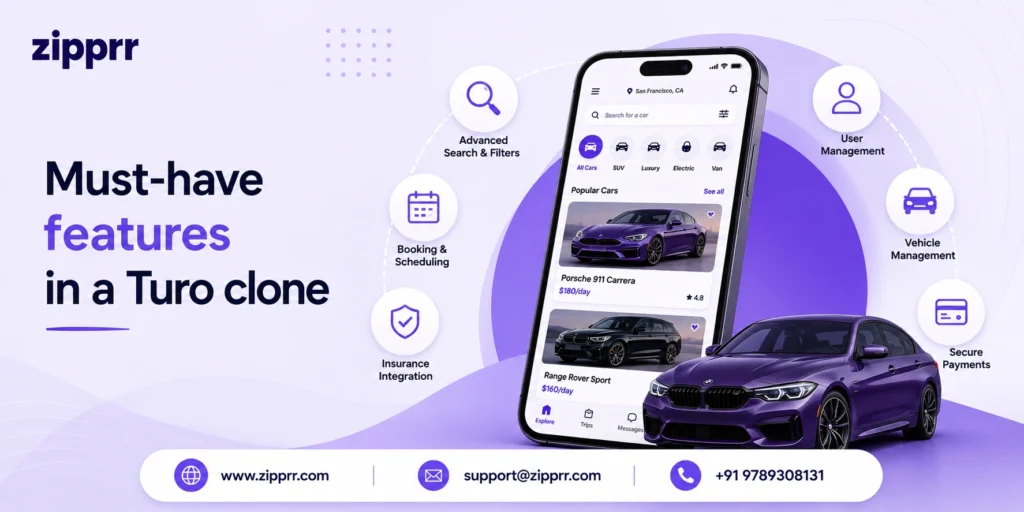
Anybody can ship a screen that lists cars. That is not a business. Here is what actually has to work, and I will skip the bullet-point checklist you have read a hundred times.
Think about the renter first. They land, they need to find a car near them, for the right dates, at a price they can stomach, and they need to trust it in about eight seconds of looking at photos, the rules, and a few reviews. Then they want to book without friction, message the owner if something is unclear, pay safely, and later tweak or cancel the trip without calling anyone. Get that loop smooth, and they come back.
Now flip to the owner. Their bar is different. They want listing a car to take minutes, not an afternoon: snap photos, set a price, mark the calendar, done. They want to glance at what they have earned, trust that the same car can never get booked twice on the same day, see payouts land, and wave a booking through (or turn it down) without a fight.
The hardest, most valuable work is the layer neither side really sees. This is where weak clones fall apart. You need to know the human renting a car is real, with a verified identity and a license that checks out. You need money to sit in escrow until a trip safely ends. You need pricing that can flex with demand, a calm way to handle damage claims and disputes, an insurance arrangement that actually holds up, and a command center where you can settle arguments, sniff out fraud, and read your own numbers.
Running underneath all of it is trust: reviews flowing both directions, verified badges, deposits handled cleanly, and a real human reachable when something goes sideways at 11 pm on a Saturday. Because it will.
If you remember one thing from this section: the hard, valuable engineering is invisible to the user. It is verification, payments, and dispute handling. Skimp there, and your marketplace becomes a fraud magnet.
The tech stack behind a Turo clone, in plain words
You do not need to be technical to make smart choices here, but you should know the shape of the thing.
A modern car-sharing build usually has a mobile app for each side (or one app with two modes), a web platform, a back-end that runs the business logic, a database, and a pile of third-party services stitched in. Payments get handled by a gateway with escrow capability. Maps and geolocation power search and delivery. A notification service fires off booking confirmations and reminders. Cloud hosting keeps it all running and lets you scale when a holiday weekend spikes demand.
When it comes to the actual apps, a team going fully native will write the iPhone version in one language and the Android version in another, while a leaner team often picks a single cross-platform toolkit so one codebase feeds both stores. The server can run on any of the usual suspects. Here is the part most “tech stack” sections bury: the specific language barely matters. What matters is whether the people building it have shipped a money-handling marketplace before. That scar tissue is worth more than any trendy framework on a slide.
The piece I would not cheap out on: payments and identity. Get those wrong and nothing else matters.
Turo clone: build from scratch or buy a script?
Here is the decision that swallows the most founder time, so let me be direct about how I would think it through.
Building a fully custom one gives you total control. Every workflow, exactly your way. It also costs the most, takes the longest (often six months to a year before a real launch), and carries the highest risk, because you are discovering and fixing the same problems Turo already solved years ago.
Buying a clone script flips that. You start from a working, tested marketplace and customize on top. Lower cost, sometimes by an order of magnitude. Faster launch, often weeks instead of quarters. And you inherit solutions to the boring-but-critical problems (payments, verification, admin tooling) instead of reinventing them.
The honest trade-off: a script may not bend to every exotic idea in your head, and quality varies wildly between vendors. A cheap, abandoned script will cost you more in the long run than a slightly pricier one that is actively maintained and genuinely customizable.
My rule of thumb? If you are validating an idea, entering a new city, or working with a real budget rather than venture millions, start from a maintained clone and customize. Prove the model first. You can always rebuild pieces custom once you have revenue and know exactly what your market wants. If you want to compare your wishlist against what a white-label Turo alternative already includes, that comparison alone usually settles the debate.
The best niche for your Turo clone (so you are not fighting Turo head-on)
Please do not launch “Turo, but again, for everyone, everywhere.” You will lose. Turo has the brand, the fleet, the budget. Going broad against an incumbent is how marketplaces die.
Go narrow instead. Some angles I have seen work or would bet on:
Pick a geography Turo underserves, a specific country, a tier-two city, or a region where it has thin coverage. Local trust and local support beat a faceless giant in those places. Or pick a vehicle niche: EV-only rentals, luxury and exotic cars, RVs and campervans, commercial vans for tradespeople and movers, motorcycles. Or pick a customer segment: rentals built for gig drivers who need a car to work, or for film and event production crews, or for long-stay digital nomads.
The narrower you go, the easier liquidity becomes, because you only need enough cars and renters to satisfy one specific need, not the whole world. A campervan marketplace for one country can hit critical mass with a few hundred listings. A general car app needs tens of thousands.
When Getaround exited, it did not just leave a hole for “another Turo.” It left holes shaped like specific cities and specific use cases. Aim at one of those.
Turo clone legal and trust essentials
You are running a marketplace where strangers hand car keys to other strangers. That means you need real terms of service, real liability protection, and real insurance arrangements. Insurance is the make-or-break. In many markets, you will need a commercial or peer-to-peer-specific insurance partner, because personal auto policies usually do not cover commercial rental use. Sort this before you take a single booking.
You also need solid KYC and driver verification, clear policies on deposits and damage, data protection compliance for the personal info you store, and tax handling for payouts. None of this is glamorous. All of it is what stands between you and a lawsuit.
Treat trust and safety as a feature you invest in, not a checkbox. It is, quietly, your product.
A simple Turo clone launch roadmap
First, pick the niche and one launch city. Just one. Second, decide build-versus-buy honestly based on budget and timeline. Third, lock down insurance and legal before anything else technical. Fourth, get the platform live with the core loop working: list a car, book a car, pay, complete trip, review. Fifth, recruit supply first, the cars, because renters follow availability, not the other way around. Seed it with hosts manually if you have to. Sixth, launch small, watch the data, fix the friction, then expand city by city.
Liquidity in one city beats a thin presence in ten. Win a place completely before you spread out.
Ready to see the engine before you commit to a city? You can grab a no-pressure product demo and poke at a working build instead of imagining one.
Ready to build your Turo clone?
If the numbers add up for your market, the next step is simple. Schedule a Free Demo to see a working Turo clone in action, or Chat with Us on WhatsApp to talk through your niche, budget, and timeline.