

Most cars sit parked for roughly 95% of their lives. That single fact is the reason peer-to-peer car rental has grown into a multi-billion-dollar category. Instead of buying a fleet, a modern car rental business simply connects people who own idle vehicles with people who need one for a weekend, a business trip, or a month-long stay.
Turo pioneered this idea at scale, and its success created a clear opening. Entrepreneurs everywhere want to run something similar in their own city, country, or niche. A Turo clone is how they do it without building the technology from scratch. If you want to see a ready-made option in action, the Zipprr Turo clone is a good reference point as you read.
This article is written for founders who think in terms of marketplaces, meaning liquidity, take rate, trust, and network effects, rather than lines of code. You will learn what a Turo clone really is, the problems it solves, the capabilities that matter, and a practical plan to launch and grow. The goal is to help you decide wisely, not to sell you a shortcut.
What Is a Turo Clone?
The word “clone” refers to the business model and feature set, not to copying Turo’s brand, code, or trademarks. A quality Turo clone is original software that implements the same proven marketplace pattern, much like thousands of independent stores run on the same e-commerce foundation without being copies of one another. A modern Turo clone script gives you that foundation out of the box.
At its heart, this is a two-sided marketplace. On one side are the car owners who want to earn from a vehicle that would otherwise gather dust. On the other are the renters, meaning travelers, locals, and businesses, who want more flexibility, variety, and often better prices than a traditional rental counter offers. You sit in the middle as the neutral operator who provides trust and discovery, and earns a commission on each completed trip.
Why Businesses Need a Turo Clone
Common Business Challenges in Car Rental Marketplaces
A marketplace is only as strong as its ability to remove friction for both sides. Before looking at capabilities, it helps to name the challenges a Turo clone is built to address.
- Cold-start liquidity. Renters will not come without cars, and owners will not list without renters. Breaking this chicken-and-egg loop is the hardest early problem.
- Trust and safety. Strangers are exchanging keys and money. Weak verification kills a platform quickly.
- Fragmented, manual operations. Bookings run by phone or spreadsheet do not scale and quietly leak revenue.
- Payment and payout complexity. Collecting from renters, holding deposits, and paying hosts on time takes reliable infrastructure.
- Insurance and liability ambiguity. Both sides need to understand who is covered when something goes wrong.
- Disputes and damage claims. Without clear evidence, disputes become costly and reputation-damaging.
- Discovery and matching. If renters cannot quickly find the right car nearby at the right price, they leave.
How a Turo Clone Solves These Challenges
| Business Challenge | How the Platform Solves It |
|---|---|
| Cold-start liquidity | Owner onboarding tools, referral programs, and promotional pricing to seed early supply and demand. |
| Trust and safety | Identity verification, driver's-license checks, and two-way ratings and reviews. |
| Manual operations | Automated booking flow, availability calendars, and instant confirmations that run without staff. |
| Payments and payouts | Integrated payment gateway, security-deposit holds, automatic commission split, and scheduled host payouts. |
| Insurance ambiguity | Configurable protection tiers surfaced at checkout, with documented terms. |
| Disputes and damage | Pre- and post-trip photo capture, mileage logs, and timestamps that create an evidence trail. |
| Discovery and matching | Geolocation search, filters, and map views that connect renters with nearby cars. |
What a Turo Clone Actually Does
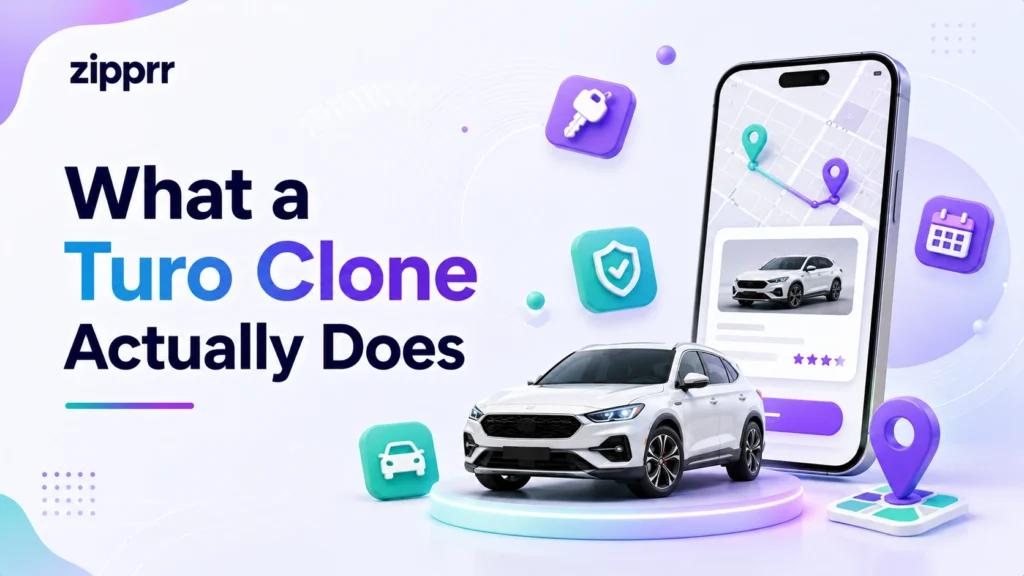
Rather than thinking in terms of screens, it helps to think in terms of the journey a car and a renter take through your marketplace.
For the car owner, it starts with listing. They add photos, specs, availability, and pricing, and can set seasonal or dynamic rates so a car earns more during peak demand. From there, the platform surfaces their vehicle to the right audience, manages incoming bookings, and pays them on a predictable schedule, turning an idle car into steady income with very little effort.
For the renter, everything centers on finding and booking the right car fast. Geolocation search, filters, and a map view help them spot a suitable vehicle nearby. A detail view shows reviews, pricing, and protection options, and a secure checkout handles the payment and deposit. Reliable payment handling, like the flow built into the Zipprr Turo clone, is what makes this feel effortless and trustworthy.
Underneath, the marketplace runs on cloud infrastructure connected by REST APIs and webhooks, so events like a confirmed booking automatically trigger notifications by push, email, or SMS. Identity verification, secure authentication, and two-way reviews keep the ecosystem safe, while analytics show you what is working, including occupancy, revenue, conversion, and retention. Increasingly, machine learning adds smart pricing suggestions, fraud detection, and better search ranking on top.
Key Benefits
- Lower upfront cost than custom development, freeing capital for marketing and liquidity.
- Faster launch means faster learning about your specific market.
- Scalable, cloud-native foundation that grows with demand.
- Full ownership and branding, so it is your marketplace, your data, your rules.
- Recurring commission revenue on every completed trip.
- Configurable for different countries, currencies, languages, and vehicle niches
Industry Applications
The same platform can power very different businesses depending on the niche you choose. Common directions include urban car sharing within a single metro area, airport and travel rentals aimed at tourists and business travelers, and premium luxury or exotic car rentals that support a higher take rate. Sustainability-minded founders often build an EV-first car sharing marketplace, while others focus on vans, RVs, and campervans for road trips and moving needs, or partner with small rental businesses that list inventory alongside individual owners. A flexible Turo clone can be configured for any of these directions.
Real-World Use Cases
Use Case 1: The Local Liquidity Play
A founder launches in one mid-sized city, personally recruits the first 50 car owners, and offers reduced commission for 90 days. Concentrating supply in one place means renters reliably find a nearby car, reviews accumulate, and word of mouth compounds before expanding to a second city.
Use Case 2: The Luxury Niche
An operator focuses only on premium and exotic vehicles. Higher daily rates support richer verification and white-glove handoffs, while a curated catalog builds a distinct brand that generic rentals cannot match.
Use Case 3: The EV-First Marketplace
A platform lists only electric vehicles and pairs rentals with charging guidance. It attracts renters who want to try an EV before buying, and owners who want to offset the cost of ownership.
Use Case 4: The Host Aggregator
Small independent rental businesses use the platform as an extra sales channel, listing idle inventory. The operator becomes the demand engine and earns commission without owning a single car.
Implementation Guide: Launching Step by Step
- Validate the niche and geography. Choose one city and one vehicle focus. Narrow beats broad at the start.
- Define your economics. Set your commission, deposit rules, cancellation policy, and protection tiers.
- Customize the platform. Configure branding, currency, language, payment gateway, and verification rules.
- Seed the supply side. Manually onboard your first car owners and incentivize early listings.
- Solve trust before scale. Turn on identity checks, reviews, and clear terms so early trips go smoothly.
- Launch to a focused audience. Drive your first renters with local marketing and referrals.
- Measure liquidity. Track search-to-book conversion, occupancy, and repeat rate, not vanity downloads.
- Iterate, then expand. Add new cities only once conversion is healthy in the first market.
Best Practices for a Sustainable Marketplace
- Start narrow. Density in one market builds reliability, while spreading thin kills liquidity.
- Obsess over the first trip. A smooth first rental for both sides is your best retention tool.
- Make trust visible. Verification, reviews, and clear coverage reduce hesitation at checkout.
- Automate payouts. Reliable, on-time payments keep car owners loyal.
- Instrument everything. Use analytics to find drop-off points in search, booking, and checkout.
- Communicate coverage clearly. Ambiguity around insurance is the fastest way to lose trust.
- Keep policies consistent. Predictable cancellation and deposit rules prevent disputes.
Turo Clone vs. Custom Build vs. Traditional Rental Software
| Factor | Turo Clone (P2P Marketplace) | Custom Development | Traditional Rental Software |
|---|---|---|---|
| Business model | Two-sided peer-to-peer marketplace | Any (you design it) | Single-fleet rental |
| Time to launch | Weeks | 9 to 18 months | Weeks, but not marketplace-ready |
| Upfront cost | Low to moderate | High | Low to moderate |
| Owns a fleet? | No, owners supply cars | Depends | Yes, typically |
| Revenue model | Commission per booking | Flexible | Rental margin |
| Customization | High | Full | Limited |
| Best for | Marketplace founders | Well-funded, unique models | Existing rental operators |
Future Trends in Peer-to-Peer Car Rental
Pricing Considerations
- AI-driven dynamic pricing that adjusts rates by demand, season, and events.
- Keyless digital handoff through connected-car and telematics integrations.
- EV-first fleets as electric adoption accelerates.
- Embedded insurance tailored per trip and per driver risk profile.
- Machine learning fraud prevention to keep bad actors off the platform.
- Deeper analytics giving owners pricing and utilization guidance.
Ready to Launch Your Own Car Rental Marketplace?
If you are ready to turn this strategy into a live business, you do not need to build the technology from scratch. Zipprr offers a fully customizable, launch-ready Turo clone with everything covered here: listings, bookings, secure payments, verification, and analytics, all under your own brand.
Explore the platform, request a demo, and see how quickly you can go live at turo-clone. Start small, focus on one market, and build the marketplace you have been planning.
Frequently Asked Questions
What is a Turo clone?
How does a Turo clone make money?
Is a Turo clone legal?
Do I need to own cars to launch a Turo clone?
How long does it take to launch a Turo clone?
How much does a Turo clone cost?
How does a Turo clone handle payments and deposits?
How does a Turo clone build trust between strangers?
What niches work best for a Turo clone?
Is a Turo clone scalable?
Key Takeaways
- A Turo clone is asset-light marketplace software for launching a peer-to-peer car rental business fast.
- Success is a liquidity problem first and a technology problem second, so start narrow and go deep.
- Trust and safety, including verification, reviews, and clear coverage, are non-negotiable.
- Revenue comes from commission on bookings, so retention of owners and renters drives the business.
- Customize for a niche such as luxury, EV, vans, or a single city to stand out.
- Budget realistically for insurance, compliance, and marketing, not just the platform itself.
Conclusion
A Turo clone lowers the barrier to entering one of the most durable sharing-economy categories. But the software is only the starting line. What separates thriving car rental marketplaces from stalled ones is disciplined strategy: pick a focused market, seed supply deliberately, earn trust on the first trip, and reinvest commission revenue into liquidity until network effects take over.
Approach it as a marketplace operator rather than a software buyer, and a Turo clone becomes a practical, capital-efficient way to build a real business around vehicles you never have to own.