


5/5 - (1 vote)
The global shift toward automation is no longer a futuristic experiment—it is a daily operational reality. In 2026, businesses across food delivery, healthcare, and retail are adopting autonomous delivery robots to combat rising labor costs and the inefficiencies of “last-mile” logistics.
However, the real goldmine isn’t necessarily in manufacturing these robots; it’s in the digital infrastructure that connects them to businesses. By building a delivery robot rental marketplace, entrepreneurs can tap into a recurring revenue model that offers high scalability with remarkably low operational risk.
What is a Delivery Robot Rental Website?
A delivery robot rental website is a multi-vendor marketplace that acts as the digital intermediary between robot owners (vendors) and businesses (renters). Much like a “Zillow for Automation,” it allows hospitals, restaurants, and warehouses to browse, book, and manage short-term or long-term robot leases. This model follows the Robotics-as-a-Service (RaaS) trend, allowing you to generate profit through commissions without ever having to own or maintain a physical fleet yourself.
1. The Market Opportunity: Why Now?
The “last mile” is the most expensive segment of the entire supply chain. As e-commerce and on-demand services dominate, automation has transitioned from a luxury to a necessity.
Labor Gap Bridging:
Restaurants and warehouses are using robots to handle repetitive internal transport, freeing up human staff for higher-value tasks.
Capital Preservation:
Purchasing a fleet of delivery robots requires massive upfront investment. Renting converts that “Capex” into a manageable, tax-deductible “Opex.”
Multi-Industry Demand:
From medicine transport in hospitals to document delivery on corporate campuses, the use cases are expanding daily, providing a massive, diversified customer base.
2. Choosing the Right Business Model
When entering the robotics market, you must decide between being an inventory-heavy owner or an asset-light marketplace.
The RaaS Advantage:
Traditional selling results in a one-time transaction. A rental marketplace, however, focuses on recurring revenue and high customer retention. By hosting multiple vendors, you scale your inventory without increasing your own capital requirements.
3. Core Features for a Profitable Platform
To build a platform that generates professional-grade revenue, your website must balance the needs of three distinct users through specialized dashboards.
The Admin Command Center:
This is your operational backbone. You need robust tools for Commission Configuration, where you can set different percentage takes, and Vendor Vetting to ensure only high-quality hardware enters your marketplace.
The Vendor Portal:
To attract fleet owners, your platform must offer Real-time Availability Calendars and Maintenance Tracking to ensure their assets are performing as promised.
The Renter Experience:
For a hospital or a retail chain, the booking process must be seamless. This includes Advanced Filtering—allowing them to search for robots by payload capacity or battery life—and Digital Contract Management.
4. Diversified Revenue: Moving Beyond the Transaction
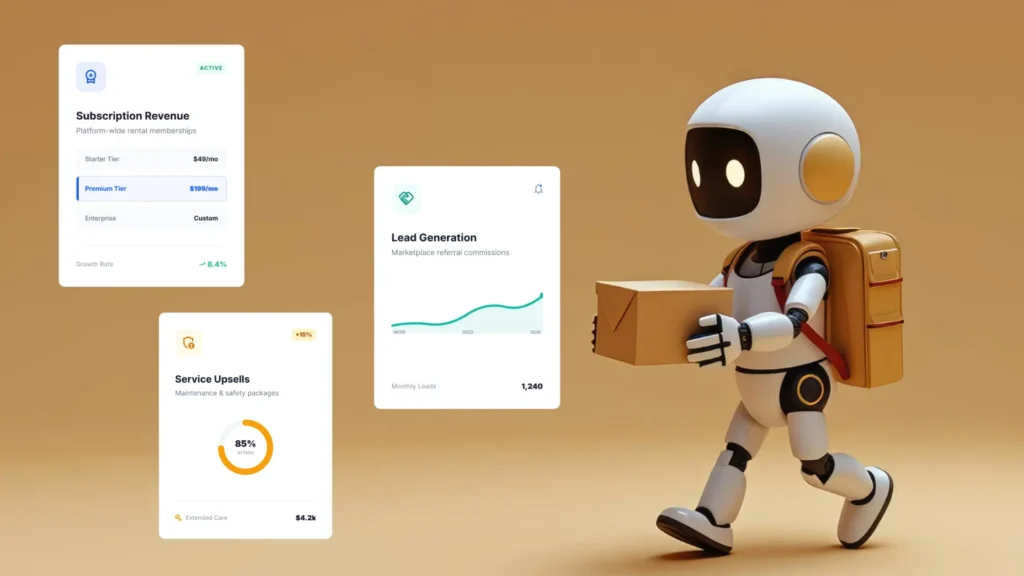
A truly profitable delivery robot website doesn’t just rely on a 10% booking fee. Sustainable growth comes from layered monetization:
Subscription Tiers:
Charging vendors a monthly fee for “Featured” placement.
Lead Generation:
Charging hardware manufacturers a fee for verified business inquiries.
Service Upsells:
Partnering with insurance providers or maintenance crews and taking a commission on every policy or service call booked through the platform.
5. Build vs. Buy: The Strategy of Speed
In the fast-moving world of automation, time-to-market is your most valuable currency. While custom development offers total control, it often results in a 12-month delay that allows competitors to lock in early partnerships.
The Case for Ready-Made White-Label Scripts:
1. Instant Infrastructure:
You bypass the technical debt of building payment gateways and booking logic from zero.
2. Reduced Financial Risk:
Lower upfront costs allow you to redirect your budget toward marketing and vendor acquisition.
3. Market Validation:
You can launch a “Lean” version of your site in weeks to test which niche (e.g., University campuses) is most profitable.
6. Strategic Positioning for Long-Term Growth
To ensure your platform doesn’t just launch but thrives, you must prioritize Vendor Quality and Transparent Pricing. Start by dominating a specific geographic region or a specific industry niche. Once you have validated the model in one market, use your scalable architecture to expand into new cities or sectors.
Conclusion
Building a delivery robot rental website is about positioning yourself at the intersection of two powerful trends: the growth of autonomous hardware and the shift toward “Access-over-Ownership.” Success in this sector belongs to the platforms that can lower the barrier to entry for businesses while providing a reliable revenue stream for robot owners.