


Why Scalability Determines the Success of a Fiverr-Like Platform
Most Fiverr-like platforms don’t fail because the idea is weak. They fail because scaling exposes problems that early traction hides. A system that feels stable with a few thousand users often struggles once real growth begins—pages slow down, searches break, messages lag, and payments fail.
Scaling creates a compounding effect. Growth doesn’t just add users; it multiplies gigs, searches, chats, transactions, notifications, and background processes simultaneously. Each layer increases pressure on infrastructure and operations, often in ways founders don’t anticipate.
This article is written for early-stage founders, funded startups, and technical evaluators who need to understand whether a Fiverr-like platform can truly grow. It explains what “scaling to millions” means in real usage terms and how technical, operational, and financial decisions affect long-term success.
Rather than diving into code, this guide focuses on practical realities—what breaks first, why platforms fail after initial traction, and how to design systems that turn growth into an advantage instead of a failure point.
Can a Fiverr-Like Platform Handle 100K+ Users Without Breaking?
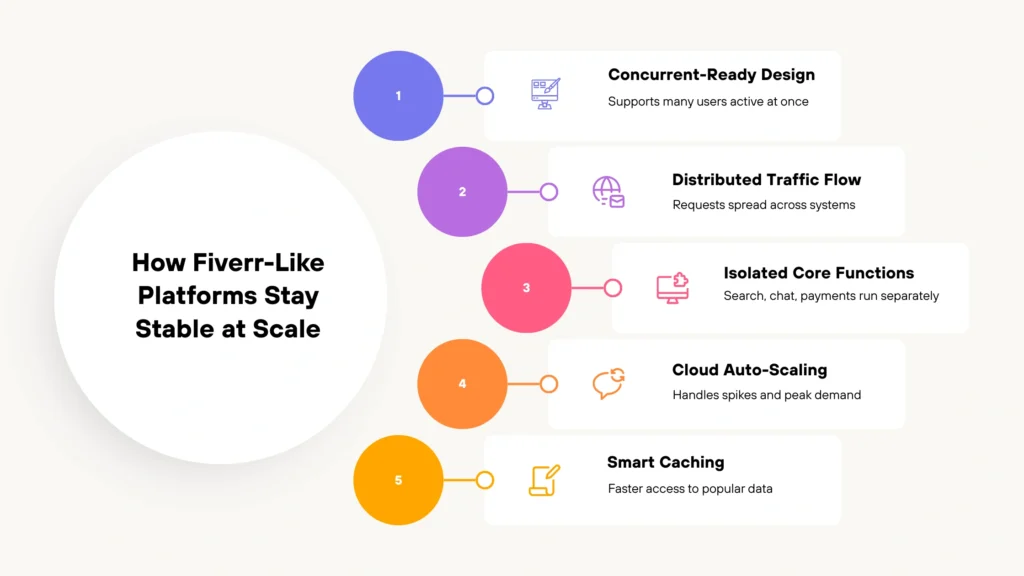
Yes—but only if the platform is designed for concurrent usage, not just total registrations.
Most founders focus on user count, but scalability depends on how many users are active at the same time. In gig marketplaces, traffic is uneven. A small percentage of users generate most of the load by browsing gigs, messaging sellers, and placing orders simultaneously.
Problems appear during success moments. Promotions, influencer mentions, or seasonal demand create sudden traffic spikes. Platforms built around single-server setups or tightly coupled systems often fail during these peaks, even if average traffic looks safe.
What separates scalable platforms is how they absorb pressure:
- Requests are distributed instead of hitting one system
- Heavy actions like search and notifications are isolated
- Frequently accessed data is cached to reduce repeat load
The practical implication is simple. A platform may work fine on normal days but still collapse during viral growth. Handling 100K+ users reliably requires planning for spikes, concurrency, and peak behavior, not averages.
What Is the Best Technology Stack for a Fiverr-Like Marketplace?
Choosing a technology stack is about balancing speed, cost, and future flexibility—not finding a perfect solution.
Most successful Fiverr-like platforms start with a relatively simple architecture. A well-structured monolithic backend is common in early stages because it reduces development time and operational complexity. When designed properly, it can handle substantial traffic before architectural changes are required.
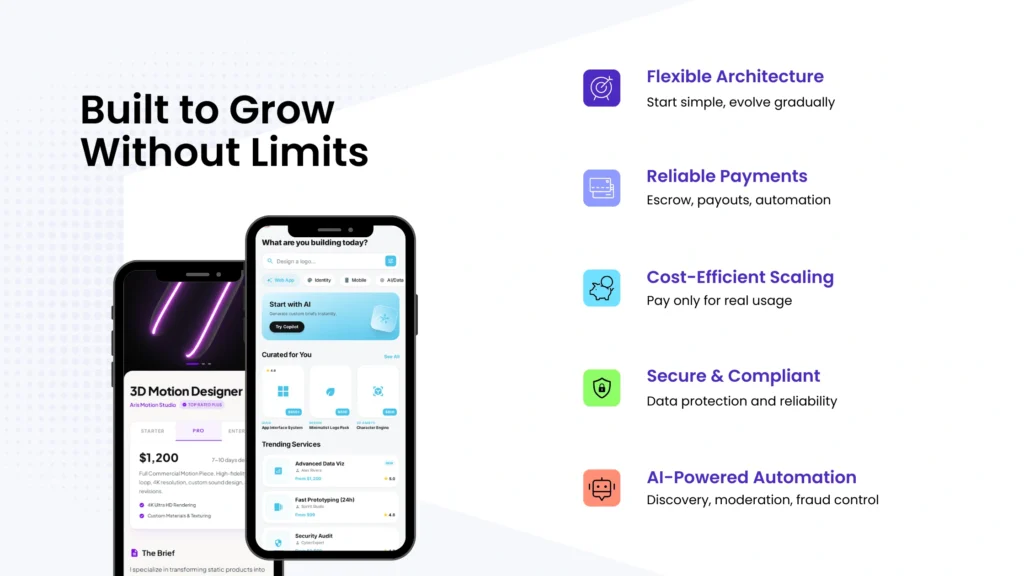
Some teams adopt a modular monolith approach, keeping the system unified while enforcing clear internal boundaries. This allows high-load components to be separated later without a risky rewrite. Problems arise when platforms over-engineer too early. Complex systems increase infrastructure costs, slow development, and add maintenance overhead without delivering immediate scalability benefits.
On the frontend, performance consistently matters more than visual complexity. Fast gig browsing—especially on mobile—directly affects conversion and retention. Lightweight rendering strategies scale more predictably than heavy client-side designs.
The most effective stack is one that supports rapid iteration early, remains stable under growth, and can evolve incrementally as real scaling pressure appears.
Should a Fiverr-Like Platform Use Microservices Architecture?
Microservices are not required at launch, and adopting them too early often creates unnecessary complexity. For early-stage platforms, a well-structured monolithic architecture is easier to deploy, debug, and scale. It keeps teams focused on product-market fit rather than infrastructure management.
Microservices become valuable only when specific parts of the platform grow faster than others. In Fiverr-like marketplaces, this typically happens with search, messaging, and payments. When these components begin affecting overall system performance, separating them improves reliability and scalability.
The safest approach is gradual extraction. High-load services are split off one at a time while the core platform remains stable. Microservices are not a goal in themselves; they are a response to real growth pressure and team maturity.
How Does Gig Search and Database Performance Scale?
Search is often the first system to struggle as a marketplace grows. Once gig listings exceed 100,000, users expect instant results with filters, categories, and sorting. Traditional databases are not designed for this type of discovery workload, and performance degrades as data volume increases.
The underlying issue is architectural misuse. Databases excel at transactional consistency, not large-scale filtering and ranking. As gig data grows, complex queries become expensive and unreliable, leading to slow or inconsistent search results.
Scalable platforms solve this by separating responsibilities. Search is handled by systems designed specifically for fast retrieval and filtering, while the core database focuses on transactions and data integrity. Category structures are optimized for efficient browsing, and popular searches are reused instead of recomputed repeatedly.
Read-heavy browsing traffic is isolated from write operations, preventing updates and transactions from being blocked. With this approach, platforms can support hundreds of thousands of gigs without noticeable slowdown. Without it, search performance becomes a direct limiter on growth.
Can Messaging and Real-Time Communication Scale Reliably?
Messaging is more than a feature—it is a trust mechanism. Buyers and sellers depend on fast, reliable communication to complete transactions. At scale, thousands of conversations may be active simultaneously, creating heavy concurrency during peak periods.
Reliable platforms separate real-time messaging from the rest of the application. Messages are delivered instantly, while notifications and secondary processes operate independently. This prevents chat traffic from slowing down browsing or payments.
Event-driven designs ensure messages are not lost during traffic spikes and notifications are not delayed when usage surges. From the user’s perspective, consistency matters more than technical sophistication. When messaging works reliably, transactions move faster and disputes decrease.
What Cloud Hosting Is Best for a Fiverr-Like Platform?
Cloud-native hosting is best suited for gig marketplaces because demand is unpredictable. Traditional hosting relies on fixed capacity planning, which often results in wasted resources or outages during sudden spikes.
Cloud infrastructure scales dynamically, increasing capacity during peak usage and reducing it during low demand. Load balancing prevents individual servers from becoming bottlenecks, while content delivery networks improve global performance.
Multi-region readiness further strengthens reliability. Platforms recover faster from outages and can expand geographically without rebuilding infrastructure. The result is stability under growth, not just raw computing power.
How Do Payments, Escrow, and Payouts Scale Operationally?
Payments are where platform trust is built or lost. As transaction volume increases, manual handling quickly becomes unsustainable. Scalable platforms rely on automated payment flows to manage escrow, releases, and payouts accurately and consistently.
Operational scalability depends on automation and reliability:
- Escrow handling scales without manual intervention
- Transaction volume increases without slowing processing
- Seller payouts remain predictable and timely
Monitoring and redundancy are critical. Issues must be detected early, temporary failures retried automatically, and payout delays avoided. At scale, users may never see these systems—but they immediately feel the impact when something goes wrong.
How Are Costs Controlled While Scaling?
Scaling does not require uncontrolled spending. Well-designed platforms use pay-as-you-grow infrastructure so costs increase in proportion to actual usage. Resources expand during high traffic and contract when demand drops.
Cost control typically evolves over time. Early stages prioritize flexibility, later stages focus on visibility, and mature platforms emphasize optimization. The greatest risk comes from systems that cannot scale down, quietly burning money during slow periods.
Predictability matters more than low initial cost. Platforms that align spending with real demand maintain financial stability as they grow.
How Does Security, Compliance, and Reliability Scale?
Security must scale alongside growth. High-availability architecture ensures the platform remains accessible even during failures, while redundancy and failover prevent single points of failure.
As data volume increases, protection becomes more complex. Encryption, strict access controls, and compliance-ready processes must be built in early. Automated defenses mitigate traffic-based attacks, and backup systems ensure rapid recovery from incidents.
These measures are not optional enhancements. They are foundational requirements for long-term reliability and trust.
How Do AI and Automation Enable Long-Term Scalability?
AI allows Fiverr-like platforms to scale operations without scaling teams at the same rate. Recommendation systems improve gig discovery and conversion, while automated moderation filters spam and low-quality listings before they affect the marketplace.
Automation also strengthens fraud detection, dispute resolution, and approval workflows. Routine cases are handled automatically, allowing human teams to focus on complex issues. Growth pressure is absorbed quietly by systems, while users experience a smoother platform.
Conclusion: What Truly Makes a Fiverr-Like Platform Scale
Scalability is not a single feature. It is the combined result of architecture, infrastructure, automation, and cost discipline working together.
Growth stress-tests everything at once—search, messaging, payments, and reliability. Platforms that scale successfully anticipate this pressure and design for it early.
The foundation you choose determines whether growth becomes a competitive advantage or a breaking point. When scalability is planned from the start, success strengthens the platform instead of exposing its limits.